
As the global wave of Hallyu continues to sweep across continents, more people than ever are turning their eyes toward Korea. While many fans have a deep understanding of the culture, several outdated stereotypes and myths still linger in the minds of those new to the peninsula. I know that you, as a reader of KCulture.com, are likely already well-informed, but these misconceptions still surface in global conversations. This article serves as a comprehensive guide to debunking these myths—from safety concerns to the reality of its linguistic and culinary landscape—helping you see the “real” Korea beyond the headlines.
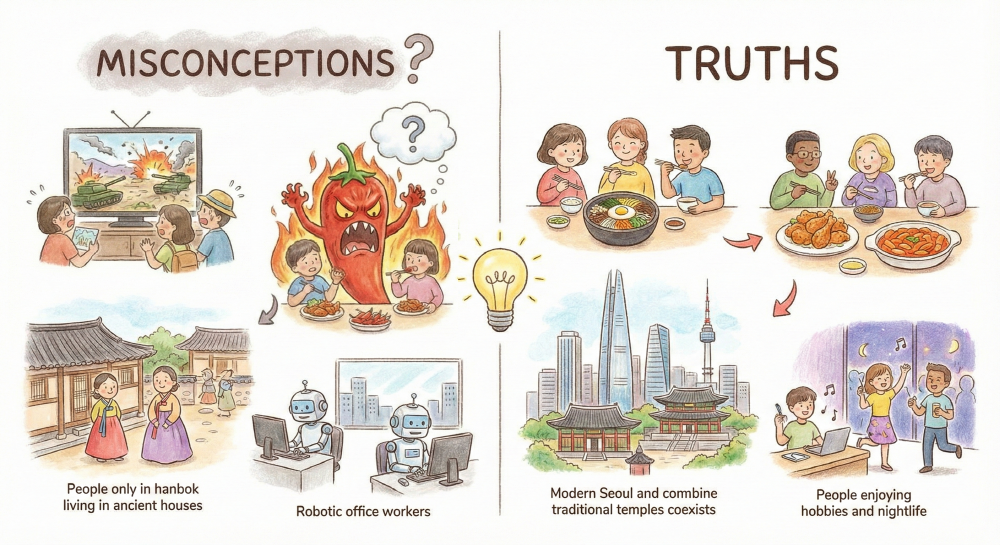
- Safety and the Myth of Constant War Risk
- The Truth About Dog Meat: A Vanishing Custom
- The Nuance of Plastic Surgery and Beauty Standards
- Beyond the Spice: A Diverse Culinary World
- Unique Identity: Korea is Not a Cultural Satellite
- Cyberpunk Reality? The Balance of Tech and Tradition
- Hangeul & Language: A Scientific Marvel, Not a Dialect
- Bonus: Fun Myths (Fan Death and Daily Hanbok)
Safety and the Myth of Constant War Risk
When you look at international news, the focus is often on the geopolitical tension between North and South Korea. This leads many travelers to wonder: “Is it actually safe to live there?” As someone living in Korea, I can tell you that the reality on the ground is the polar opposite of a “war zone.”
South Korea consistently ranks as one of the safest countries in the world. You will often see locals leaving their expensive laptops or bags on a cafe table to go to the restroom without a second thought. Walking alone at 2 AM in Seoul feels safer than walking at 2 PM in many other global metropolises. While we are technically in a state of ceasefire, the daily life here is defined by tranquility, efficient public service, and a deep-rooted sense of public order. For us, the biggest “threat” is usually deciding which 24-hour convenience store has the best snack deals.
📌 Local Note: If you lose your wallet in a Seoul subway, there is a surprisingly high chance it will be turned into the “Lost and Found” with all your cash still inside.
The Truth About Dog Meat: A Vanishing Custom
One of the most persistent misconceptions is that dog meat is a staple of the Korean diet. In reality, finding someone who eats dog meat in modern Korea is like searching for a needle in a haystack. It is an almost entirely vanished custom that is completely disconnected from the daily life of the modern Korean population.
Today, Korea is a pet-loving nation where over 15 million people—nearly one in four households—live with animal companions. Dogs are cherished as beloved family members, and seeing “dog strollers” in parks is a far more common sight than the practice of the past. To finalize this social shift and eliminate any unnecessary international controversy, the Korean government passed a “Special Act” in 2024 to officially ban the breeding, slaughter, and sale of dog meat. The practice will be fully illegal and punishable by law starting in 2027.
The Nuance of Plastic Surgery and Beauty Standards
The global media often labels Seoul as the “Plastic Surgery Capital of the World,” leading to the myth that every Korean has gone under the knife. While it’s true that medical tourism is huge and that Koreans value self-improvement, the idea that “everyone looks the same because of surgery” is a gross exaggeration.
In Korea, grooming and looking your best are seen as a form of “Self-Care” and respect for others. This includes advanced skincare and fashion. Many people opt for minor, non-invasive procedures rather than major reconstructive surgery. It’s less about “vanity” and more about a cultural emphasis on presentation and professional diligence. Most Koreans you meet on the street are simply the product of good skincare and a great eye for style.
Beyond the Spice: A Diverse Culinary World
Thanks to the viral “Fire Noodle Challenge” and the ubiquity of Kimchi, many believe that every Korean meal will set your mouth on fire. While we do love our spice, the Korean palate is actually incredibly balanced and nuanced.
There is a whole universe of non-spicy, savory, and mild Korean dishes that are healthy and comforting. Think of the deep, beefy broth of Seolleongtang (ox bone soup), the sweet and salty perfection of Bulgogi, or the delicate flavors of Japchae (glass noodles). Korean cuisine focuses heavily on fermented vegetables, steamed meats, and seasonal ingredients that prioritize health over heat.
| Spicy Classics | Mild & Savory Alternatives |
|---|---|
| Kimchi Jjigae | Galbitang (Short Rib Soup) |
| Tteokbokki | Gimbap (Seaweed Rice Rolls) |
| Bul-dak (Fire Chicken) | Bossam (Boiled Pork Belly) |
Unique Identity: Korea is Not a Cultural Satellite
A common historical misconception is that Korean culture is just a subset or a derivative of Chinese or Japanese culture. This couldn’t be further from the truth. Korea has maintained a distinct and fiercely independent cultural identity for over 5,000 years.
While East Asian neighbors have influenced one another, Korea developed its own unique aesthetics. Our traditional clothing, Hanbok, features vibrant colors and soft curves that differ significantly from the Kimono or Cheongsam. From our unique architecture (Hanok) to our distinct musical traditions, Korea’s history is one of resilience and original innovation.
Cyberpunk Reality? The Balance of Tech and Tradition
Because Korea rose to become a global tech giant in record time, many imagine a cold, neon-lit “Cyberpunk” society where technology has erased the past. Foreigners often ask if there are still “old things” left to see in Korea.
The magic of Korea lies in its Harmonious Contrast. In the heart of Seoul, you can stand inside Gyeongbokgung Palace—a 14th-century royal residence—and look up to see a 21st-century glass skyscraper reflecting the ancient wooden eaves. We aren’t just a nation of semiconductors; we are a nation that treasures 5,000 years of heritage, with temples and palaces coexisting alongside high-speed rail and smart cities.
Hangeul & Language: A Scientific Marvel, Not a Dialect
I must admit, I was genuinely taken aback when I first heard that some people still believe Korean is a dialect of Chinese or that we use Chinese characters for daily writing. Honestly, it’s a bit shocking to think this myth persists! Now, I’m quite sure you, as someone interested in our culture, wouldn’t fall for this, but the misunderstanding is surprisingly common.
First, let’s clarify the Language: The Korean language is fundamentally distinct from Chinese and Japanese. While it is true that many Korean words (Sino-Korean words) originated from Chinese characters due to historical influence, the grammar and phonetic structure are entirely unrelated. Using Chinese loanwords doesn’t make the languages similar anymore than French loanwords make English a dialect of French. For example, Chinese is a Subject-Verb-Object (SVO) language, while Korean is Subject-Object-Verb (SOV).
Second, the Script: Hangeul, our alphabet, was created by King Sejong the Great in 1443 specifically to be different from Chinese characters. He wanted a phonetic system that even the common people could learn in a single day. Unlike Chinese characters, which are symbols representing meanings, Hangeul is a scientific, phonetic alphabet where the shapes of the letters actually mimic the physical shape of the mouth when making the sound. It is an entirely original and independent creation that remains a source of immense pride for us. To learn more about Hangeul’s history, check out ‘Hangeul History: From Sejong’s Invention to Colonial Survival‘.
Bonus: Fun Myths (Fan Death and Daily Hanbok)
To wrap things up, let’s look at two of the more “entertaining” misconceptions that keep the conversation lively.
- The Infamous “Fan Death”: There is an old urban legend that sleeping in a closed room with an electric fan running can be fatal. While modern science has debunked this, it remains a “cute” cultural myth that many Koreans still jokingly (or seriously!) adhere to by cracking a window open.
- Daily Hanbok: Thanks to K-dramas, some expect to see people walking around in traditional robes daily. In reality, we wear Hanbok for special occasions like weddings or Chuseok. However, “Modern Hanbok” is becoming a very popular fashion trend among the youth, blending tradition with modern street style.
Korea is a land of surprises. It’s a place where you can find the world’s fastest internet and the world’s most peaceful mountain retreats in the same hour. By looking past these common myths, you open yourself up to the rich, warm, and incredibly vibrant reality of Korean life. We can’t wait to welcome you here to see it for yourself!
Korean Culture portal KCulture.com
Join the mailing service and add to your favorites.

Founder of Kculture.com and MA in Political Science. He shares deep academic and local insights to provide an authentic perspective on Korean history and society.