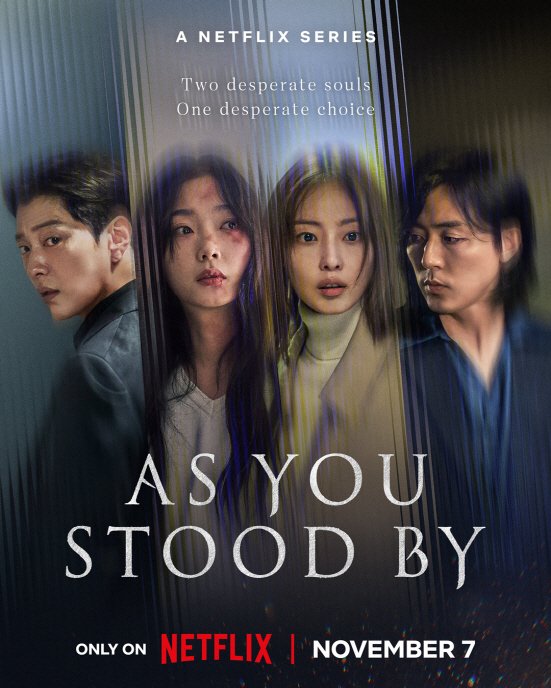
If you have just finished binge-watching the Netflix original series “As You Stood By,” you are probably left with a lingering sense of unease. Beyond the thrilling plot twists and the stunning cinematography, the series leaves global audiences with burning questions about Korean society. “Is the police corruption really that bad?” “Why didn’t she just get a restraining order?” “Do department store VIPs really act like that?”
As a local living in Korea, I watch these dramas with a mix of excitement and a heavy heart. While “As You Stood By” is a work of fiction, the friction points it highlights—domestic violence, the power of the elite, and the tears of emotional laborers—are rooted in real cultural dialogues we are having right now. To help you unpack what you just watched, I’m going to take you on a Deep Dive into the cultural context behind the show’s most shocking moments. Let’s separate the dramatic exaggeration from the uncomfortable truths.
- Why Kill Instead of Report? The Gap Between Law and Reality
- The “Unreachables”: Privilege and Public Authority
- The Tears Behind the Smile: Gapjil and Emotional Labor
- Local Insight: How to Read Between the Lines
Why Kill Instead of Report? The Gap Between Law and Reality
One of the most frustrating aspects for international viewers is often the protagonist’s decision. You might find yourself shouting at the screen: “Just call the police! Get a restraining order!” In “As You Stood By,” the choice to resort to extreme measures instead of seeking legal help paints a grim picture. So, is the Korean legal system truly that broken?
The Cultural Legacy of “Family Matters”
Historically, Korean society held a strong Confucian belief that “what happens inside the house, stays inside the house.” For a long time, police were hesitant to intervene in “family quarrels,” viewing them as private matters rather than criminal acts.
However, I need to be clear: this is rapidly changing. Today, domestic violence is treated as a serious crime, and the younger generation of police officers is trained to intervene actively. The laws are there, and the systems exist.
“The Law is Far, The Fist is Close”
Despite the legal improvements, the drama taps into a universal fear captured by the Korean proverb: “The law is far, but the fist is close.” In the show, the protagonist fears that a restraining order is merely a piece of paper that cannot physically stop a determined abuser in the moment.
This isn’t a uniquely Korean problem; it is a tragic reality in many societies where victims feel that the system acts too slowly to save them. The drama dramatizes this fear to the extreme, suggesting that for some, the only way to survive a monster is to become one. It asks us to empathize with the desperation of a victim who feels cornered, rather than critiquing the police manual itself.
The “Unreachables”: Privilege and Public Authority
Another recurring theme in “As You Stood By” is the collusion between the wealthy elite and public authority. The idea that prosecutors or police officers might look the other way for a Chaebol (conglomerate family) or a powerful politician is a staple trope in K-Dramas, much like we saw in The Glory or Stranger.
Echoes of Real-Life Scandals
Is this real? To an extent, yes. Korean society is currently grappling with high-profile allegations involving figures as powerful as the First Lady and other political elites. When news breaks suggesting that investigations into powerful figures are stalled or dropped, it fuels a profound sense of public cynicism.
In The Glory, we saw school violence covered up by wealthy parents and compliant teachers. “As You Stood By” expands this to adult society. The show reflects a sentiment held by many Koreans: that the legal playing field is not level.
💡 Local Insight: While corruption exists, it is not the standard operating procedure for every police station. Most Korean officers are dedicated public servants. However, K-Dramas focus on the “1% possibility” where the system fails, because that is where the dramatic tension—and the social critique—lies.
The Tears Behind the Smile: Gapjil and Emotional Labor
The scenes set in the department store luxury hall likely made your blood boil. The portrayal of a wealthy customer verbally abusing a kneeling employee is a depiction of Gapjil (갑질)—an authoritarian attitude where people in power (or paying customers) abuse those deemed “lower” in the hierarchy.
Understanding “Emotional Labor” (Gamjeong-nodong)
In Korea, service workers perform what is known as Emotional Labor. They are expected to suppress their true feelings and maintain a bright, kind demeanor regardless of how rude a customer is. The drama highlights how this forced kindness can turn into a tool for abuse when met with a customer who views money as a license to dehumanize others.
The Law is Fighting Back
The situation has become severe enough that the Korean National Assembly actually passed legislation often referred to as the “Emotional Labor Protection Act” (under the Occupational Safety and Health Act).
| Measure | Description |
|---|---|
| Prevention | Employers must take preemptive measures to protect workers from abusive customers. |
| Support | Mandatory provision of counseling and treatment for affected workers. |
| Right to Pause | Guaranteeing the right to stop work and rest if abuse occurs. |
The fact that this law exists proves two things: the problem was real enough to require legislation, and society is actively trying to fix it. The abuse you saw in “As You Stood By” is the ugly side of a culture that historically emphasized extreme hierarchy, but it is behavior that is increasingly shamed and punished in modern Korea.
Local Insight: How to Read Between the Lines
As you reflect on “As You Stood By,” it is crucial to maintain a balanced perspective. Does corruption exist? Yes. Do desperate victims sometimes feel the law is insufficient? Unfortunately, yes. But these are the shadows of a rapidly developing, safe, and dynamic society—not the entire picture.
K-Dramas are powerful because they do not shy away from airing our society’s dirty laundry. They act as a mirror, reflecting our fears about justice and power. By understanding these cultural contexts—the history of domestic privacy, the cynicism regarding elite power, and the pain of emotional labor—you can appreciate the series not just as a thriller, but as a poignant social commentary on the human condition.
The darkness depicted in the show isn’t unique to Korea; it’s a universal story of the weak fighting against the strong, told through the specific lens of Seoul’s high-pressure society.
Korean Culture portal KCulture.com
Join the mailing service and add to your favorites.

Founder of Kculture.com and MA in Political Science. He shares deep academic and local insights to provide an authentic perspective on Korean history and society.