The Playbook: Stepping Into a K-Drama Scene at Korea’s 5-Day Markets
You know those scenes in your favorite K-dramas? The main character walks through a chaotic, vibrant marketplace. Steam rises from dumplings, a grandmother shouts about how fresh her green onions are, and people are sitting on low stools eating spicy rice cakes. It feels alive, unscripted, and intensely local.
If you travel to Seoul, you will likely visit Gwangjang Market. And honestly, you should! But if you want to see the raw, unfiltered soul of Korea—the kind you see in Our Blues or Hometown Cha-Cha-Cha—you need to venture just a little bit further. You need to find an Oiljang (5-Day Market).
This isn’t just shopping; it’s a time-travel experience. Here is your playbook for distinguishing the tourist spots from the local lifelines and where to find the best ones near Seoul.
The “Oiljang” Difference: Farmers vs. Merchants
To be fair, to the untrained eye, a market is a market. You see food, you see crowds. But there is a massive difference between a permanent market (like Gwangjang or Namdaemun) and a traditional 5-Day Market (Oiljang).
1. The Permanent Market (Sangseol Sijang)
Think of places like Gwangjang Market in Seoul or Paldal Market in Suwon. These are open every day. The vendors here are professional merchants. They have fixed stores with signboards, electricity, and roofs. They are there Monday through Sunday, rain or shine. It is convenient, delicious, and accessible, but it is also very commercialized.
2. The 5-Day Market (Oiljang)
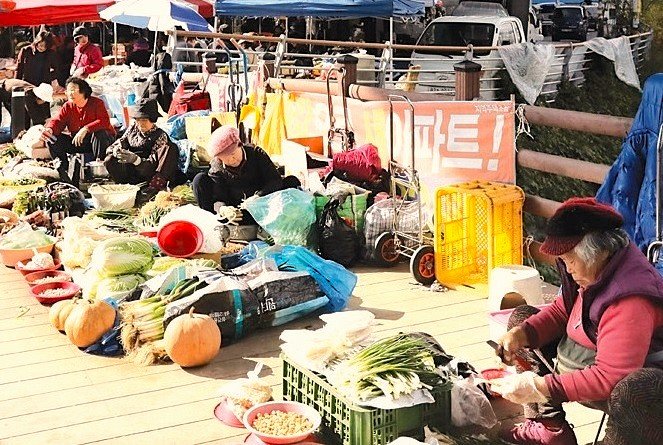
This is where the magic happens. These markets only explode into existence once every five days. The vendors here are a mix of itinerant merchants (who travel from town to town) and, more importantly, local farmers and grandmothers (Halmeonis).
In a 5-day market, you will see the “Jwapan” (street stall) culture. An elderly lady might spread a mat on the ground to sell a small pile of wild greens she picked from the mountain that morning, or a farmer might drive his truck up to sell the chili peppers he harvested yesterday. When the sun sets, they pack up, and the street returns to being a quiet road until the next market day.
💡 Key Takeaway: In a permanent market, you are buying from a store. In a 5-day market, you are often buying directly from the hands that grew the food.
Market Showdown: What to Expect
Before you choose your destination, here is a quick breakdown of what defines these two different worlds.
| Feature | Permanent Market (e.g., Gwangjang) | 5-Day Market (e.g., Moran, Yangpyeong) |
|---|---|---|
| Opening Days | Daily (Year-round) | Only on specific dates (e.g., 4th, 9th) |
| Vendors | Professional shop owners | Farmers, itinerant sellers, locals |
| Atmosphere | Structured, tourist-friendly, roofed | Chaotic, authentic, open-air |
| Best For | Fixed menus, clothes, souvenirs | Seasonal produce, plants, raw energy |

The Playbook: Where to Go (Near Seoul)
You don’t need to travel deep into the countryside to experience this. There are legendary 5-day markets accessible by subway or a short train ride from Seoul. Here are the top picks.
1. Seongnam Moran Market (The Big One)
When: Dates ending in 4 and 9 (4th, 9th, 14th, 19th, 24th, 29th)
Location: Moran Station (Subway Line 8 or Suin-Bundang Line)
This is arguably the most famous 5-day market in the metropolitan area. It is massive. You step out of the subway, and the smell of sesame oil hits you immediately (there is a famous oil alley here). You can find everything from puppies and poultry to antique herbal medicines and tools. It is loud, crowded, and absolutely electric. If you want the “deep dive” into Korean market culture without leaving the subway system, this is it.
2. Yangpyeong 5-Day Market (The Scenic Route)
When: Dates ending in 3 and 8 (3rd, 8th, 13th, 18th, 23rd, 28th)
Location: Yangpyeong Station (KTX or Gyeongui-Jungang Line)
If you want a day trip that feels like a getaway, head to Yangpyeong. The market is located near the beautiful Namhan River. It is famous for eco-friendly produce and wild vegetables. Because Yangpyeong is a water-source protection area, the vegetables here are renowned for their quality. After browsing the stalls, you can grab a bowl of Haejang-guk (hangover soup), which the region is famous for.
The Classics: Best Permanent Markets
If your schedule doesn’t align with the 5-day cycle, or you prefer a roof over your head, these permanent markets are the best in the business.
1. Gwangjang Market (Seoul)
Location: Jongno 5-ga Station
You probably know this one from Netflix. It is famous for Bindaetteok (mung bean pancakes) and Yukhoe (beef tartare). It is crowded with tourists, yes, but the energy in the food alley is undeniable. It is a great “starter pack” for market beginners.
2. Suwon Paldal / Nammun Market (Suwon)
Location: Near Suwon Hwaseong Fortress
Combine history with food. After walking the fortress walls, head to this massive market complex. It is famous for whole fried chicken and Sundae (blood sausage) town. It feels more “lived-in” by locals compared to Gwangjang.
Travel Essentials for Market Day
Ready to go? Keep these three things in mind to survive and thrive.
- Cash is King: While modern stores take cards, the grandma selling chives on a mat does not. Bring plenty of 1,000 and 5,000 won bills.
- Check the Calendar: 5-day markets are strict about dates. If you go to Moran on the 5th, you will see an empty parking lot. Remember the “ending number” rule.
- Come Hungry: Do not eat breakfast. Between the hotteok (sweet pancakes), corn dogs, and sample slices of fruit, you will be eating your way through the aisles.
The 5-day market is the pulse of the Korean people. It’s where the countryside meets the city, and where the past meets the present. So, check the date, grab some cash, and go get lost in the crowd.
Korean Culture portal KCulture.com
Join the mailing service and add to your favorites.

Founder of Kculture.com and MA in Political Science. He shares deep academic and local insights to provide an authentic perspective on Korean history and society.