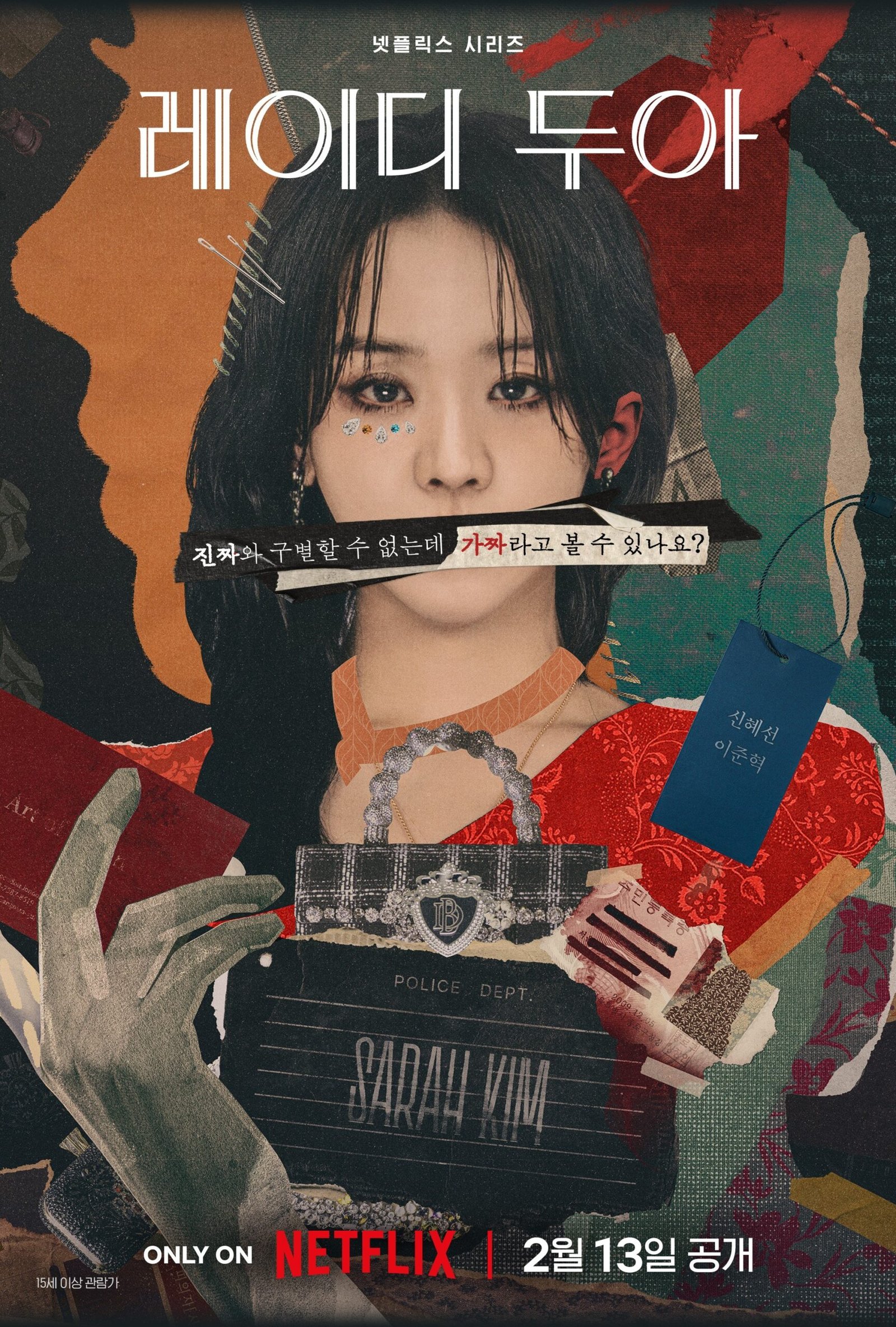
Netflix’s latest hit, Lady Dua, is not just a revenge drama; it is a chilling psychological autopsy of modern Korean society’s obsession with “Cham-gyo-yuk” (retributive justice). While global audiences might cheer for the underdog protagonist, the show subtly exposes a darker truth: the desire to destroy an oppressor often stems from a deep-seated envy to possess their power, a concept Nietzsche called Ressentiment. From a local perspective, this drama serves as a mirror reflecting the transition from the traditional sentiment of Han (sorrow) to a new era of aggressive, narcissistic justice.
Lady Dua peels back the glittering facade of Korea’s top 0.1% to reveal that the monsters are not just in the penthouses—they are created by the very system that claims to hate them.
- The Creative Force: Director & Cast
- Plot Overview: The Maid Who Hacked the Penthouse
- The Death of ‘Han’ and the Rise of ‘Cham-gyo-yuk’
- Ressentiment: When the Victim Desires the Whip
- The Narcissism of Vigilante Justice
- Conclusion: A Warning Wrapped in Catharsis
The Creative Force: Director & Cast
The intense psychological grip of Lady Dua is the result of a collaboration between a veteran genre master and a cast known for their intricate emotional portrayals.
The Director: Kim Jin-min
The series is helmed by Kim Jin-min, a director renowned for his high-density storytelling and raw, unfiltered depiction of human nature. Having previously directed Netflix hits like Extracurricular (Ingansueop) and My Name, Kim brings his signature style to Royal Hill—creating a suffocating atmosphere where the camera itself feels like an intruder exposing the characters’ darkest secrets.
The Cast: Shin Hye-sun & Lee Jun-hyuk
At the center is Shin Hye-sun, who plays the titular role of Sarah Kim. Known for her impeccable diction and vast emotional spectrum, Shin sheds her usual vibrant energy to embody a character of terrifying stoicism. She conveys complex emotions—contempt, envy, and calculation—through micro-expressions rather than dialogue, anchoring the show’s tension.
Opposite her is Lee Jun-hyuk as Park Mu-kyung. Lee, an actor celebrated for his ability to straddle the line between gentleman and villain (as seen in Stranger and The Roundup), brings a sophisticated mystery to the series. His portrayal of Mu-kyung is enigmatic; he is a figure whose true intentions remain obscured, adding a layer of unpredictable tension to Sarah’s plans. His chemistry with Shin Hye-sun leaves viewers constantly guessing whether he is a savior or the ultimate obstacle.
Plot Overview: The Maid Who Hacked the Penthouse
Set within the suffocatingly opulent walls of “Royal Hill,” a townhouse complex for South Korea’s elite, the drama follows the mysterious protagonist, Sarah Kim (Lady Dua). On the surface, she is a quiet, submissive housekeeper who fades into the background. In reality, she is a genius hacker and a master of psychological manipulation.
Unlike traditional heroines who stumble upon secrets, Sarah actively harvests them. Her goal is not merely to expose the corrupt residents but to dismantle their lives from the inside out using gaslighting techniques and digital warfare. The tension arises not from if she will succeed, but how far she is willing to go.
The Death of ‘Han’ and the Rise of ‘Cham-gyo-yuk’
For decades, Korean cinema was defined by Han (한)—a unique cultural sentiment of internalized sorrow, resentment, and passive endurance. However, Lady Dua signals the death of Han and the dominance of a new cultural keyword: Cham-gyo-yuk (참교육).
💡 Cultural Insight: What is Cham-gyo-yuk?
Literally translating to “True Education,” this internet slang refers to physically or psychologically “schooling” someone who has behaved rudely or immorally. It is retributive justice as entertainment.
In the drama, the protagonist does not endure injustice hoping for karma to intervene. She delivers immediate, disproportionate punishment. Sociologists often view this phenomenon as a pursuit of efficacy caused by a distrust in the judicial system. In Korea, where the law can feel slow and lenient toward the wealthy, the public craves the “cider” (referring to the refreshing feeling of a carbonated drink) moment where the protagonist destroys the villain without mercy.
However, Lady Dua complicates this. Sarah’s version of “True Education” often ignores the principle of proportionality. It raises the uncomfortable question: Is this justice, or is it merely the pornography of private sanctions?
Ressentiment: When the Victim Desires the Whip
The most profound psychological layer of Lady Dua can be explained through Friedrich Nietzsche’s concept of Ressentiment. This is not simple resentment; it is a moralizing revenge where the weak condemn the strong as “evil” while secretly craving their power.
Viewers might initially think Sarah wants equality. However as the series progresses, it becomes clear that she does not want to dismantle the hierarchy; she wants to climb it. She despises the “Gapjil” (arrogant abuse of power) of her employers, yet she mirrors their behavior perfectly when she gains the upper hand.
The “Gapjil” Mirror Effect
She manipulates the family dynamics of her employers with a coldness that rivals the villains themselves. This suggests that her motivation is not liberation, but the satisfaction of domination. She is an “underdog” who has internalized the oppressor’s logic: power exists to be wielded against those weaker than oneself.
The Narcissism of Vigilante Justice
Why do we cheer when she ruins a life over a perceived slight? Psychology experts link this to Covert Narcissism within a hyper-competitive society. In a culture of “Zero Tolerance,” anyone who inconveniences me or violates my standards is labeled a “villain” worthy of total destruction.
This is the “Narcissism of Justice.” It operates on the belief that “My discomfort is your sin.”
- The Hyper-Competition Factor: In Seoul’s high-pressure environment, people are constantly on edge. There is little room for forgiveness.
- The Villains: The residents of Royal Hill are portrayed as flawed, but the punishment often feels sadistic. If the audience feels pleasure watching this, it reveals our own latent desire to judge and punish others without context.
The show brilliantly traps the audience. We start by rooting for justice, but by the end, we are forced to confront our own complicity in this cycle of hatred. We realize that in a society driven by Cham-gyo-yuk, everyone is just waiting for their turn to be the bully.
Conclusion: A Warning Wrapped in Catharsis
Lady Dua is a masterclass in genre subversion. It lures you in with the promise of a satisfying revenge thriller and leaves you with a haunting sociological critique. It suggests that the true horror isn’t the abuse of power by the rich, but the realization that “anyone, given the opportunity, desires to abuse power.”
For international viewers, this drama offers a vital key to understanding modern Korea. We have moved past the weeping tragedy of Han. We are now in the era of Cham-gyo-yuk—a time of high dopamine, instant retribution, and the terrifying possibility that in our quest to destroy monsters, we have decided to become them.
Do you think the revenge was justified, or did she go too far?
Korean Culture portal KCulture.com

Founder of Kculture.com and MA in Political Science. He shares deep academic and local insights to provide an authentic perspective on Korean history and society.