The Ultimate Korea Travel Survival Guide 2025: Trash, Delivery, and Safety
So, you’ve decided to seek the ‘real’ Korea and booked an Airbnb instead of a hotel. That is a fantastic choice to experience local life, but it comes with a unique set of responsibilities. Living in Korea, I’ve seen many travelers face serious issues by disposing of trash exactly as they would in their home countries, or freezing up in emergencies without knowing the local protocols. Suddenly, a relaxing trip turns into a stressful ordeal.
This Korea Travel Survival Guide 2025 is your comprehensive manual for navigating the tricky parts of Korean life that guidebooks often skip. From mastering the complex recycling system depending on your housing type to ordering food without knowing Korean, and knowing exactly who to call in an emergency, here is everything you need to know to survive and thrive.
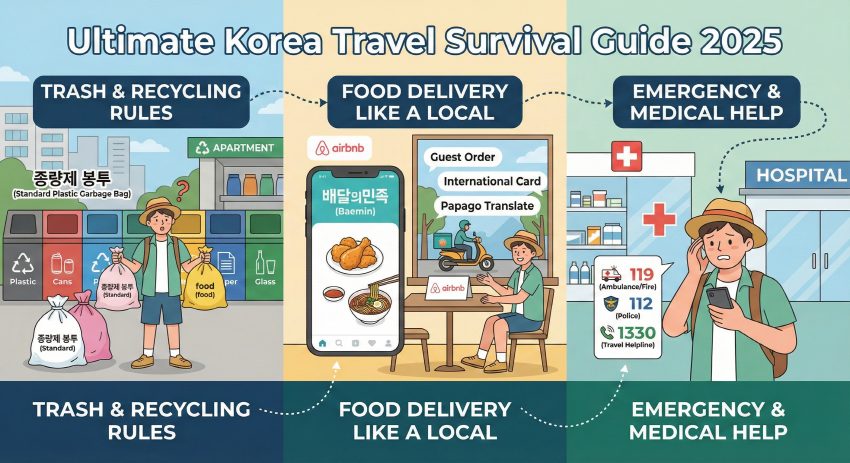
- Mastering Korean Trash & Recycling Rules
- How to Order Food Delivery Like a Local
- Emergency Numbers & Medical Help
Mastering Korean Trash & Recycling Rules
If you are staying in an Airbnb or a guest house, you cannot simply dump everything in one bin. South Korea—and Seoul in particular—has one of the strictest waste disposal systems in the world. As of 2025, regulations are tighter than ever, and improper disposal can lead to fines.
1. The “Pay-As-You-Throw” System (Jongnyangje)
You cannot use standard black plastic bags or grocery bags for trash. You must purchase specific government-issued bags called Jongnyangje Bongtu (종량제 봉투).
- Where to buy: Convenience stores (CU, GS25, 7-Eleven) or local supermarkets closest to your accommodation.
- Note: Bags are district-specific. A bag bought in Gangnam cannot be used in Mapo (Hongdae). Always buy them near your stay.
| Bag Type | Color (Seoul Standard) | Usage |
|---|---|---|
| General Waste | White (sometimes Pink/Blue depending on district) | Dirty tissues, wrappers, bones, shells, non-recyclable items. |
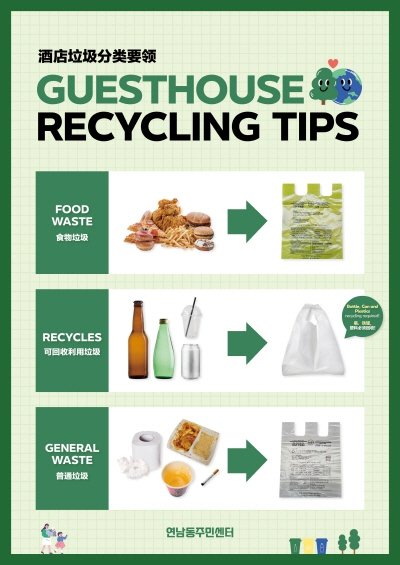
| Food Waste | Yellow (usually) | Leftover food only (Soft items). |
2. The Food Waste Dilemma
Korea processes food waste into compost or biofuel. Because of this processing method, it is crucial to separate what can be processed from what cannot.
💡 Pro Tip (Hard vs. Soft): Think about the texture. Hard items that cannot be easily broken down are NOT food waste.
Throw these in General Waste (White Bag):
- Animal bones (Chicken, Beef, Pork)
- Seafood shells (Clams, Oysters, Crabs)
- Eggshells
- Onion/Garlic skins
- Hard fruit seeds (Peach, Avocado pits)
3. Recycling: Apartments vs. Houses (Villas)
How you discharge recyclables depends entirely on your building type. Check with your host to confirm which category your accommodation falls into.
Type A: Apartments & Large Officetels (Communal Area)
Most large apartment complexes have a designated “Recycling Station” in the parking lot or basement. You can usually bring your recyclables here anytime (or on specific days depending on the complex rules) and sort them into the large bins provided (Glass, Plastic, Cans, Paper).
Type B: Villas, Houses, & Small Studios (Curbside Collection)
If you are in a standalone house or a low-rise “Villa,” there is no communal bin. You must place your recyclables in front of your building only on designated days and times (e.g., “Tuesday nights after 8 PM”).
⚠️ Critical Curbside Rules (for Type B):
- Paper & Cardboard: Do not just throw them loosely. You must flatten cardboard boxes completely and tie them together with string. Loose papers should also be bundled or placed in a paper bag.
- Vinyl & Wrappers: Clean snack wrappers and plastic films must be gathered and put inside a transparent/semi-transparent plastic bag. Tie the bag before placing it outside so the wind doesn’t blow it away.
- PET Bottles: Remove labels, crush them, and place them in a separate transparent bag.
How to Order Food Delivery Like a Local
You can’t talk about Korean culture without mentioning “Baedal” (delivery). However, the language barrier and payment verification systems can be hurdles.
1. Shuttle Delivery (The Tourist Friendly Choice)
If you don’t read Korean, Shuttle Delivery is your best friend. It is fully English-optimized and accepts international credit cards and PayPal.
- Pros: Full English menu, English customer support, easy payment.
- Cons: Slightly higher delivery fees, coverage is mostly limited to Seoul (Itaewon, Gangnam, Hongdae areas) and Pyeongtaek.
2. Baedal Minjok (Baemin) & Coupang Eats
These are the apps locals use. While the interfaces are in Korean, you can navigate them using image translation apps.
- The Payment Hurdle: Most Korean apps require “Identity Verification” via a Korean phone number to pay online.
- The Workaround: Look for the “Meet and Pay” (mannaseo gyeolje) option. This allows you to pay the driver directly with cash or a card when they arrive. Note that fewer riders accept this method in 2025, but it is still possible.
- Coupang Eats: Known for “Cheetah Delivery” (super fast). The UI is intuitive (lots of pictures), making it easier for foreigners to guess.
| ⚠️ Great news for travelers! you can now order delivery on Korea’s #1 app, Baedal Minjok (Baemin), without a local phone number or ID. Here is the quick guide: – Setup: Download the app and set your delivery address using the GPS icon for accuracy. – Order: Browse and add items to your cart. Tip: Since the app is in Korean, keep the Papago app handy to translate menus via image search. – Pay: At checkout, strictly select “International Card” (해외카드) to pay with Visa or Mastercard. As of late 2025, Alipay+ and WeChat Pay are also supported for easier payment. – Wait: Once the payment goes through, your order is confirmed instantly. Just wait for your food to arrive! |
Emergency Numbers & Medical Help
Korea is incredibly safe, but accidents happen. In 2025, the government has ramped up support for international visitors. Here is exactly what to do if you are in trouble.
1. Essential Phone Numbers
- 112 (Police): For crimes, theft, or serious disturbances.
- 119 (Fire & Ambulance): Medical emergencies or fires. Location tracking is automatic when you call.
- 1330 (Korea Travel Helpline):
This is the most important number for tourists. It operates 24/7 and provides real-time interpretation. If you need to call 112 or 119 but cannot speak Korean, call 1330 first, or conference them in. They can speak to the police/medics for you.
2. Going to the Pharmacy (Yak-guk)
Look for the sign “약” (Yak). Pharmacists in major areas (Hongdae, Myeongdong) often speak basic English.
- Convenience Stores: For mild issues (headache, indigestion, cuts), you don’t need a pharmacy. CU, GS25, and 7-Eleven sell basic safety kits including Tylenol (pain), Pancold (cold), and Bearse (digestion) 24/7.
3. Hospitals & International Clinics
If you need a doctor, university hospitals usually have an “International Healthcare Center.”
- Severance Hospital (Sinchon/Gangnam)
- Asan Medical Center
- Samsung Medical Center
These centers have English-speaking staff who will guide you through registration and treatment.
Navigating Korea requires a little bit of learning, but that is part of the charm. Once you master the trash sorting rules and successfully order your first delivery meal to your Airbnb, you will feel less like a tourist and more like a true Seoulite. Safe travels!
Korean Culture portal KCulture.com
Join the mailing service and add to your favorites.

Founder of Kculture.com and MA in Political Science. He shares deep academic and local insights to provide an authentic perspective on Korean history and society.