Honestly, standing on the streets of Seoul right now, the sight is bittersweet. Many of the brilliant yellow ginkgo leaves have already fallen, creating that distinct, golden carpet that crunches underfoot. The peak spectacle of Korea’s autumn is brief, but the story behind these ubiquitous trees is a year-round marvel. It’s a tale of survival, utility, and centuries of tradition that’s central to kculture.
I mean, you see them everywhere—lining streets, dominating palace grounds, and standing guard over ancient sites. It begs the question: Why are there so many ginkgo trees in Korea? It’s not an accident. There’s a fascinating story behind it, and knowing this history makes the view, even the fallen leaves, feel incredibly special. This is the enduring golden secret of korea travel.
The Paradox: A Common Sight, a Near-Extinct Species
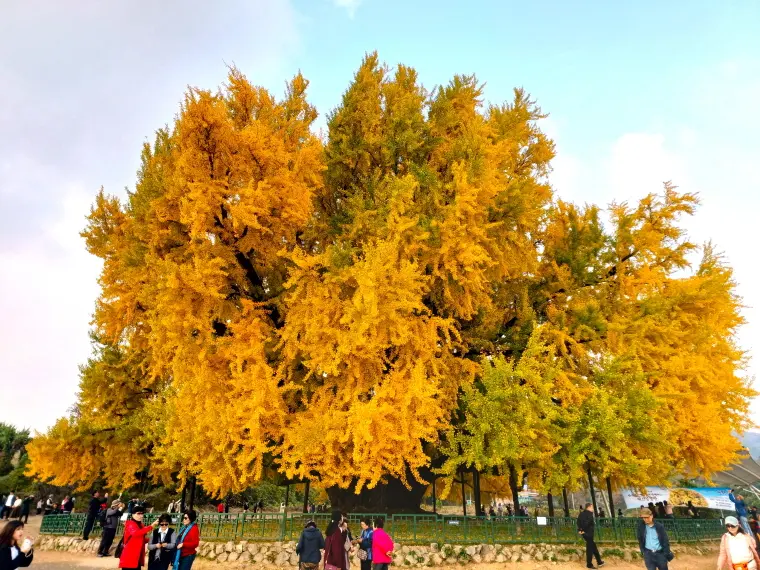
Let’s start with a mind-blowing fact. The ginkgo tree (*Ginkgo biloba*) is a “living fossil,” surviving for over 270 million years. Yet, this ancient species is functionally extinct in the wild. Its survival is completely dependent on human cultivation, particularly in East Asia.
💡 The Local Insight: By planting the ginkgo in temples, schools, and cities, Koreans have played a crucial role in preserving this prehistoric species. This wide distribution makes Korea a country practically covered in a globally endangered tree.
Why Korea is Covered in Ginkgo Trees
The sheer number and size of ginkgo trees in Korea are outstanding. The reasons for this extensive planting are twofold, combining historical philosophy with modern pragmatism:
- Confucian Symbolism: The tree became deeply linked to the scholar’s identity and the centers of learning.
- Urban Utility: They are highly resilient, disease-resistant, and low-maintenance, making them ideal street trees for crowded, polluted cities.
They are strong against pests and environmental pollution, offering a cost-effective, beautiful solution for urban green management. But the root of their success lies deeper, in the nation’s spiritual history.

A Legacy of Learning: Ginkgo and the Scholar’s Spirit
The ginkgo’s prevalence is deeply rooted in korean history and the philosophy of Confucianism, which governed the Joseon Dynasty for 500 years. The key concept is *Haengdan Yea-ak* (행단예악).
Ginkgo vs. Apricot: The ‘Haengdan’ Tradition
This term refers to the story of Confucius teaching his disciples. The character *Haeng* (행, 杏) can mean either apricot or ginkgo. While both trees were planted, especially near royal palaces and noble houses (*yangban*), the ginkgo tree solidified its place as the definitive symbol of scholarship in Korea.
- The Scholar’s Tree: Ginkgo trees symbolize longevity, strength, and unwavering virtue—qualities expected of a virtuous scholar (*seonbi*).
- Academic Hubs: The largest, most revered ginkgo trees were intentionally planted at major Confucian educational centers. For instance, the majestic ginkgo trees at Sungkyunkwan University in Seoul, the highest educational institute of the Joseon Dynasty, stand as powerful, centuries-old testament to this commitment to academic pursuit.
This tradition led to the widespread planting of ginkgo trees at all local Confucian schools (*hyanggyo*) and memorial shrines (*seowon*) across the peninsula, permanently linking the tree to the Korean educational and spiritual landscape.
Monuments of History: The Oldest and Tallest
To truly appreciate the ginkgo’s majesty, you must visit the following natural monuments. Their age and stature are humbling, connecting you directly to the past.
| Location | Designation & Age | Significance |
|---|---|---|
| Yongmunsa Temple (양평 용문사) | Natural Monument No. 30. Age: 1,018 years (current research). | The tallest ginkgo in Korea and one of the oldest in Asia. Standing over 40 meters tall, its sheer size is breathtaking. |
| Wonju Bangye-ri (원주 반계리 은행나무) | Natural Monument No. 167. Age: Over 1,300 years (current research). | One of the oldest trees in Korea, famous for its colossal, symmetrical canopy that forms a perfect, golden umbrella shape in the fall. |
| Sungkyunkwan University (서울 성균관) | Historic Ginkgo Cluster | The historical heart of Korean scholarship. The trees here are hundreds of years old and frame the campus’s traditional architecture perfectly. |
⚠️ Warning: The Infamous Ginkgo Smell! A quick word on reality: the female ginkgo trees produce fruit that emits a pungent odor when crushed. This is the main downside of the golden spectacle. Cities work hard to minimize the smell by harvesting the nuts, but you will almost certainly encounter it. It’s a small price to pay for such beauty, but you have been warned!
More Than Just a Pretty Picture
The golden spectacle of Korea’s autumn ginkgo trees is more than just a seasonal view for your camera. It is a connection to centuries of history, a testament to the preservation of a living fossil, and a deep-seated symbol of scholarly dedication.
If you find yourself in Korea, I urge you to look past the beautiful color and the unavoidable smell. When you stand beneath that golden canopy—or walk across the golden carpet of fallen leaves—reflect on the *seonbi* spirit of learning and virtue the tree represents. Doing so will transform a beautiful autumn sight into a truly profound and special kculture experience.
Korean Culture portal KCulture.com
Join the mailing service and add to your favorites.

Founder of Kculture.com and MA in Political Science. He shares deep academic and local insights to provide an authentic perspective on Korean history and society.