Uncovering Gyeongju: Why Bulguksa and Seokguram Are the Ultimate Local Picks
If you ask any Korean about their childhood memories, specifically their middle school or elementary school field trips, one destination comes up every single time: Gyeongju. It is practically a rite of passage for us. As a local people, I can tell you that Gyeongju Bulguksa Temple isn’t just a tourist trap; it is the spiritual and historical heart of the Silla Dynasty. Visiting Gyeongju without seeing Bulguksa and the nearby Seokguram Grotto is like going to Paris and ignoring the Eiffel Tower—it simply doesn’t count. Let me guide you through these UNESCO World Heritage sites not just as ancient ruins, but as living breathing parts of Korean culture.

- Bulguksa Temple: A Masterpiece of Silla Architecture
- The Twin Pagodas and The 10-Won Coin
- Hidden Gems: The Golden Pig and Ancient Texts
- Seokguram Grotto: The Stone Mystery
- Practical Guide: Transport and Temple Etiquette
Bulguksa Temple: A Masterpiece of Silla Architecture
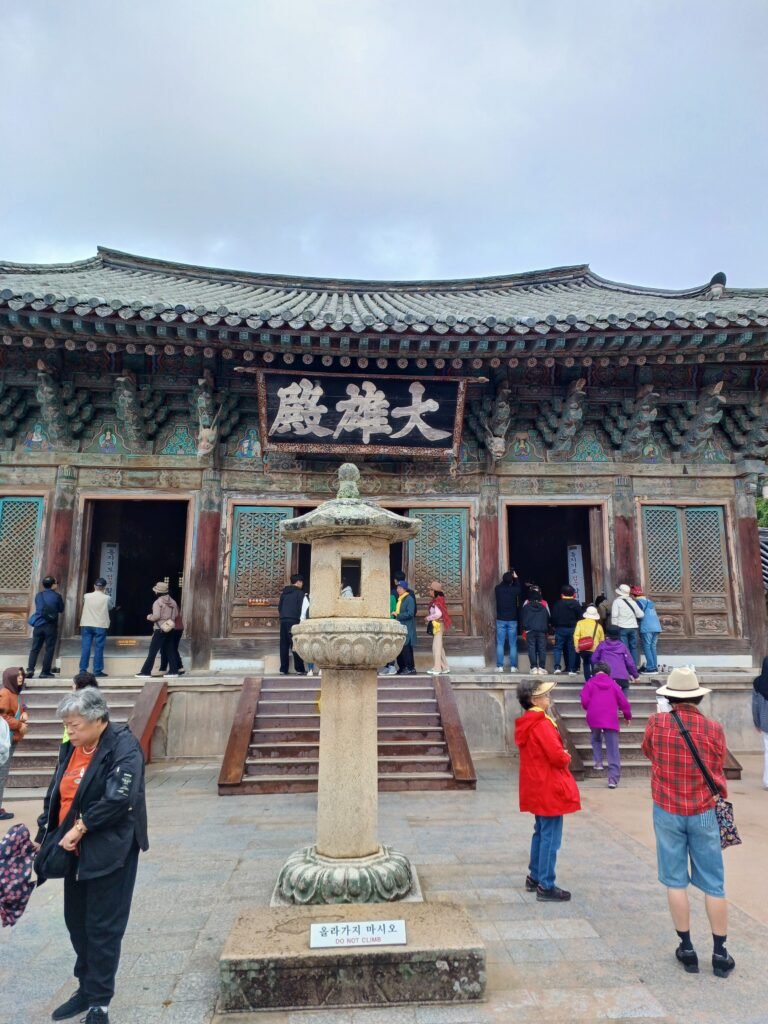
Located on the slopes of Mount Tohamsan, Bulguksa represents the Buddhist utopia on earth. Built in 751 AD during the Silla Kingdom by Prime Minister Kim Dae-seong, it was designed to honor his parents. What strikes me every time I visit is the harmony between the stone masonry and the wooden structures. It feels organic, as if the temple grew out of the mountain itself. (Address : 385 Bulguk-ro Gyeongju-si Gyeongsangbuk-do)
Cheongungyo and Baegungyo Bridges
Before you even enter the main courtyard, you will stand before a magnificent stone staircase. These are the Cheongungyo (Blue Cloud Bridge) and Baegungyo (White Cloud Bridge). In Buddhist philosophy, these bridges symbolically connect the secular world of humans to the spiritual realm of Buddha. While we cannot walk on them today to preserve the structure, standing in front of them gives you a sense of the grandeur that Silla royalty must have felt.

The Twin Pagodas and The 10-Won Coin
Once you enter the main courtyard, you will see two distinct pagodas standing before the main hall. To the untrained eye, they are just stone towers, but they represent the dual nature of Buddha.


Seokgatap: Simplicity and Sorrow
On the left (west), you have Seokgatap (Pagoda of Shakyamuni). It represents simplicity, austerity, and traditional Silla aesthetics. It is elegant in its lack of decoration.
Dabotap: Complexity and The Coin
On the right (east) stands Dabotap (Pagoda of Many Treasures). Unlike its partner, this pagoda is incredibly ornate and complex, showcasing the masterful stone carving skills of the era. Here is a fun fact that every local knows: take out a 10-won coin from your pocket. The image stamped on that coin is exactly this pagoda, Dabotap. It is iconic enough to be in everyone’s wallet!
Hidden Gems: The Golden Pig and Ancient Texts
While the pagodas get all the fame, there are secrets here that guidebooks often miss.
The Legend of the Golden Pig
Behind the signboard of the Geungnakjeon Hall, there is a small wooden sculpture of a pig hidden under the eaves. Legend says that if you find the “Golden Pig” and rub the bronze statue of the pig located in front of the hall (which was installed later for visitors), it brings you good fortune and wealth. You will often see locals lining up just to touch this statue.

Mugujeonggwangdaedaranigyeong
Inside Seokgatap, archaeologists discovered the Mugujeonggwangdaedaranigyeong (The Great Dharani Sutra). This is recognized as one of the world’s oldest surviving woodblock prints, dating back to the early 8th century. It proves that Korea’s printing technology was advanced far earlier than many realize.
Seokguram Grotto: The Stone Mystery
From Bulguksa, you must make the journey up to Seokguram Grotto. While Bulguksa is the temple of the land, Seokguram is the temple of the sky. (Address : 238 Seokgul-ro, Gyeongju-si, Gyeongsangbuk-do)
Why It Is Special
Seokguram is an artificial stone cave made of granite, housing a massive Buddha looking toward the East Sea. The architectural mathematics involved in building a domed ceiling with heavy stones in the 8th century is mind-blowing. It is designed so that the first rays of the rising sun strike the Buddha’s forehead.
⚠️ Important Warning: Photography inside the Seokguram Grotto is strictly prohibited. This is to preserve the stone from flash damage and to maintain the sanctity of the shrine. The guards are very strict about this, so please keep your camera away and capture the moment with your eyes instead.
Practical Guide: Transport and Temple Etiquette
To truly enjoy these sites, you need to know how to move and act like a local.
Getting from Bulguksa to Seokguram
You have two main options:
- The Bus: Take Bus No. 12 from the parking lot of Bulguksa. It runs roughly every hour and takes about 20 minutes up a winding mountain road.
- Hiking: If you are fit and visiting in autumn or spring, there is a hiking trail connecting the two. It takes about an hour, but the view is rewarding. After looking around Bulguksa Temple and exiting through the main gate, there is a path to the left of the main gate that connects to the hiking trail leading to Seokguram Grotto.


Temple Etiquette 101
When you are on the temple grounds, remember these simple rules to show respect:
- Quiet Voices: This is an active place of worship. Monks are living and praying here.
- Dress Modestly: Avoid overly revealing clothes.
- Entrances: When entering a temple hall, use the side doors, not the center door (which is reserved for the Buddha or senior monks), and step over the raised threshold, not on it.
Gyeongju is more than a city; it is a time capsule. Visiting Bulguksa and Seokguram connects you to the spirit of the Korean people. Whether you are looking for architectural wonder, spiritual peace, or just want to see where every Korean student has created memories, this is the place to be.
Korean Culture portal KCulture.com
| ☼ Check out this article about traveling to Gyeongju as well! ▪Gyeongju Night Tour: Donggung, Cheomseongdae, and Woljeonggyo ▪Gyeongju National Museum: Why This “Old” Museum is a Must-Visit ▪Gyeongju: A Timeless Walk Through Korea’s Golden Era |
Join the mailing service and add to your favorites.

Founder of Kculture.com and MA in Political Science. He shares deep academic and local insights to provide an authentic perspective on Korean history and society.