Honestly, deciding to move to Korea for the long term is one of the most life-changing choices you can make. But as someone living in Korea, I can tell you that the excitement of moving can quickly be replaced by confusion if you don’t have the right paperwork in order. As of December 2025, the immigration landscape has evolved significantly with new training visas and updated reciprocal agreements. Whether you are aiming for a career in K-pop, studying at a top university, or just exploring as a digital nomad, this Korea long term stay visa guide 2026 is designed to be your definitive roadmap. I have compiled every country, every fee, and every rule into one place so you can plan your move with absolute confidence.

- Complete K-ETA Visa-Free Country List & Stay Durations
- The K-Culture Training Visa (D-4-K): A Gateway for Fans
- Working Holiday (H-1): Youth Mobility & Participating Countries
- Can I Work? Part-Time Regulations for International Residents
- Mastering the Language: The 2026 TOPIK Guide
- Where to Live: Housing Types and Average Costs
- 2026 Budget: Estimated Monthly Living Expenses in Seoul
- Local Insider Tips: Finding a Home and Avoiding Scams
- Official Resources and Government Portals
Complete K-ETA Visa-Free Country List & Stay Durations
Most travelers begin their journey under a visa-free entry. However, you must apply for a K-ETA (Electronic Travel Authorization) before your flight. As of 2025, there are 113 countries and regions included in this program. While this is perfect for short-term exploration or setting up your long-term life, the duration of stay allowed varies significantly by your nationality.
| Stay Duration | Region | Participating Countries & Regions |
|---|---|---|
| 180 Days | Americas | Canada |
| 90 Days | Europe (39) | Albania, Andorra, Austria, Belgium, Bulgaria, Croatia, Cyprus, Czech Republic, Denmark, Estonia, Finland, France, Germany, Greece, Hungary, Iceland, Ireland, Italy, Latvia, Liechtenstein, Lithuania, Luxembourg, Malta, Monaco, Montenegro, Netherlands, Norway, Poland, Portugal, Romania, San Marino, Serbia, Slovakia, Slovenia, Spain, Sweden, Switzerland, UK, Vatican |
| Americas (28) | Antigua and Barbuda, Bahamas, Barbados, Brazil, Chile, Colombia, Costa Rica, Dominica, Dominican Republic, El Salvador, Grenada, Guatemala, Haiti, Honduras, Jamaica, Mexico, Nicaragua, Panama, Paraguay, Peru, Saint Kitts and Nevis, Saint Lucia, Saint Vincent and the Grenadines, Suriname, Trinidad and Tobago, Uruguay, USA, Venezuela | |
| Asia/Oceania (9) | Australia, Hong Kong, Japan, Macau, Malaysia, New Zealand, Singapore, Taiwan, Thailand | |
| Middle East/Africa (5) | Israel, Kuwait, Morocco, Tunisia, United Arab Emirates | |
| 60 Days | Misc | Russia (K-ETA Mandatory), Lesotho |
| 30 Days | Asia (7) | Bahrain, Brunei, Kazakhstan, Oman, Qatar, Saudi Arabia, China (Special Extension until Dec 31, 2026) |
| Oceania (13) | Fiji, Guam, Kiribati, Marshall Islands, Micronesia, Nauru, New Caledonia, Palau, Samoa, Solomon Islands, Tonga, Tuvalu, Vanuatu | |
| Africa/Others (6) | Botswana, Eswatini, Guyana, Mauritius, Seychelles, South Africa |
📌 Local Note on Russia and China: For my Russian friends, remember that although you have 60 days visa-free, K-ETA is strictly mandatory. For Chinese citizens, the temporary visa-free policy for tourism and business has been officially extended to December 31, 2026, allowing stays of up to 30 days.
The K-Culture Training Visa (D-4-K): A Gateway for Fans
The Korean government has officially fully operationalized the K-Culture Training Visa (D-4-K) to support the global Hallyu wave. This visa is perfect for foreigners who want to enroll in private academies for K-POP, choreography, modeling, or drama production. Unlike a standard student visa, this specifically caters to the arts and entertainment sector.
The initial duration is 1 year, but it can be extended depending on the training program’s length. This visa is often linked with the D-4-2K (International Trainee) program, which allows for internships within the entertainment industry, providing a real bridge between training and a professional career.
Working Holiday (H-1): Youth Mobility & Participating Countries
If you are between the ages of 18 and 30 (or up to 34/35 for some countries like the UK, Canada, and Ireland), the Working Holiday Visa (H-1) is an incredible way to live in Korea for a year. It allows you to travel while taking on part-time work to support your stay. Korea currently has reciprocal agreements with 27 countries:
- Asia/Oceania: Japan, Hong Kong, Taiwan, Australia, New Zealand
- Americas: Canada, Chile, Argentina, Brazil
- Europe: France, Germany, Ireland, Sweden, Denmark, Czech Republic, Austria, Hungary, Portugal, Netherlands, Poland, Spain, Belgium, Italy, UK (YMS), Andorra, Estonia, Latvia
- Middle East: Israel
Can I Work? Part-Time Regulations for International Residents
Working without permission is a serious offense that can lead to deportation. To stay safe, you must apply for “Permission for Part-time Work” at the immigration office. Here is how much you can work based on your specific visa status in 2026:
| Visa Type | Eligibility for Work | Allowed Hours & Restrictions |
|---|---|---|
| D-2 (University) | Immediately upon entry | 20–30 hours/week. Highly dependent on your TOPIK level and GPA. |
| D-4 (Language) | After 6 months of stay | 10–20 hours/week. Must maintain over 90% attendance to keep the permit. |
| H-1 (Work Holiday) | Immediately upon entry | Max 1,300 hours per year (~25 hrs/week). Cannot work as a doctor, lawyer, or language tutor. |
Mastering the Language: The 2026 TOPIK Guide
The Test of Proficiency in Korean (TOPIK) is your key to better jobs and residency points. In 2026, the test is expanding its digital reach significantly. The IBT (Internet-Based Test) is now available in over 15 countries, including the USA, Vietnam, Thailand, and India.
- TOPIK I (Levels 1-2): Beginner level focusing on Reading and Listening.
- TOPIK II (Levels 3-6): Intermediate to Advanced level adding a Writing section.
- Method: Paper-Based (PBT) 5-6 times/year or the growing IBT format.
Where to Live: Housing Types and Average Costs
Finding a home is the most important part of your settling-in process. Korea has unique housing types that you won’t find anywhere else. Here is a breakdown of what to expect in the 2026 market.
| Housing Type | Average Deposit (KRW) | Monthly Rent (KRW) | Key Features |
|---|---|---|---|
| Goshiwon / Goshitel | None to ₩100,000 | ₩300,000 – ₩600,000 | Tiny private room, shared kitchen. Often includes free rice/kimchi. |
| One-room (Studio) | ₩5M – ₩10M | ₩500,000 – ₩800,000 | Standard private studio. Most common for students and young workers. |
| Officetel | ₩10M – ₩20M | ₩800,000 – ₩1,500,000 | High security, modern building, usually built-in appliances. Premium choice. |
| Sharehouse / Coliving | ₩1M – ₩5M | ₩450,000 – ₩800,000 | Private or shared room with a social community. Great for making friends. |
| Apartment / Villa | ₩20M – ₩200M+ | ₩1.5M – ₩3.5M | Multiple bedrooms, high stability. Best for families or groups. |
2026 Budget: Estimated Monthly Living Expenses in Seoul
Living in the capital is fantastic but comes with a price tag. Based on the 2026 cost of living data, here is what a single person should budget per month to live comfortably in Seoul.
| Expense Category | Estimated Monthly Cost (KRW) | Insider Budgeting Tip |
|---|---|---|
| Rent | ₩600,000 – ₩1,200,000 | Living outside the main campus areas can save you 20%. |
| Utilities & Maintenance | ₩150,000 – ₩250,000 | Electricity and gas spike in summer and winter respectively. |
| Food & Groceries | ₩400,000 – ₩600,000 | University cafeterias (₩5,000-₩8,000) are hidden gems for cheap meals. |
| Transportation | ₩62,000 – ₩100,000 | Get the Climate Card for unlimited rides within Seoul. |
| Mobile & Internet | ₩40,000 – ₩80,000 | Use “Alteul-phone” (MVNO) plans to cut this bill in half. |
| TOTAL ESTIMATE | ₩1,300,000 – ₩2,300,000 | Equivalent to approx. $1,000 – $1,800 USD. |
Local Insider Tips: Finding a Home and Avoiding Scams
Finding a room in Korea can be intimidating, especially with unique rental systems like Jeonse and Wolse. Depending on your vibe, Hongdae and Sinchon are perfect for social life, while Seongsu and Yeonnam are the go-to for creatives. For sleek professional life, Gangnam is best, and for a global community, Itaewon and Hannam are unbeatable.
How to Find a Home: Top Foreigner-Friendly Apps
- Ziptoss: Offers English support and directly manages many of their listings, ensuring a higher level of trust for non-Koreans.
- Enkostay: Specializes in no-deposit or low-deposit options, which is a lifesaver for youth who don’t have thousands of dollars for upfront key money.
- Zigbang & Dabang: These are the “Big Two” for locals. While primarily in Korean, they have the largest inventory. Pro tip: Use them to see what’s available, then visit a local “Budongsan” (realtor) in the area you like.
- Live Anywhere: Excellent for hybrid stays—offering flexibility for those staying between 1 month and a year without the rigid terms of traditional year-long contracts.
The Most Important Document: Deunggi-bu Deung-bon
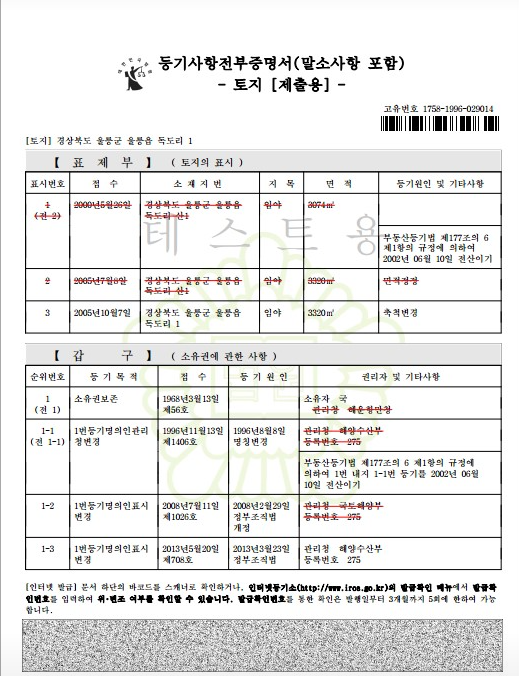
The Deunggi-bu Deung-bon (Certified Copy of Register) is the “ID card” of the property. You can get this online at the Supreme Court Internet Registry Office or at any local Jumin-center (Community Center). It is divided into key sections you must check. If you haven’t had a chance to check the Certified Copy of the Real Estate Register in advance, please request it from your real estate agent before signing the contract. (It is standard practice for agents to provide a printed copy even without a specific request. Be sure to verify the issuance date of the document.)
- Gab-gu (Section A): Lists the current legal owner. Always verify that the person signing your contract is the person listed here.
- Eul-gu (Section B): Lists debts and mortgages. If the property has high debt (close to or exceeding its market value), your deposit is at risk if the owner goes bankrupt.
Protecting Your Money: Hwakjeong-ilja (Fixed Date)
Once you sign your contract and move in, go immediately to your local Jumin-center to file your Jeonip-singo (Moving-in Report) and receive a Hwakjeong-ilja (Fixed Date) stamp on your contract.
The Fixed Date is a legal time-stamp that establishes your priority over other creditors. If the building ever goes to auction or foreclosure, this stamp ensures you have a “Preferential Repayment Right,” meaning you get your deposit back before later lenders. It is the single most important safety measure for any renter in Korea.
Official Resources and Government Portals
To ensure you have the most up-to-date information, always cross-reference with these official government websites. They are the final authority on all visa and stay matters.
- Immigration (Hi Korea): www.hikorea.go.kr
- K-ETA Official Application: www.k-eta.go.kr
- Official TOPIK Portal: www.topik.go.kr
- Study in Korea (NIIED): www.studyinkorea.go.kr
Korean Culture portal KCulture.com
Join the mailing service and add to your favorites.

Founder of Kculture.com and MA in Political Science. He shares deep academic and local insights to provide an authentic perspective on Korean history and society.