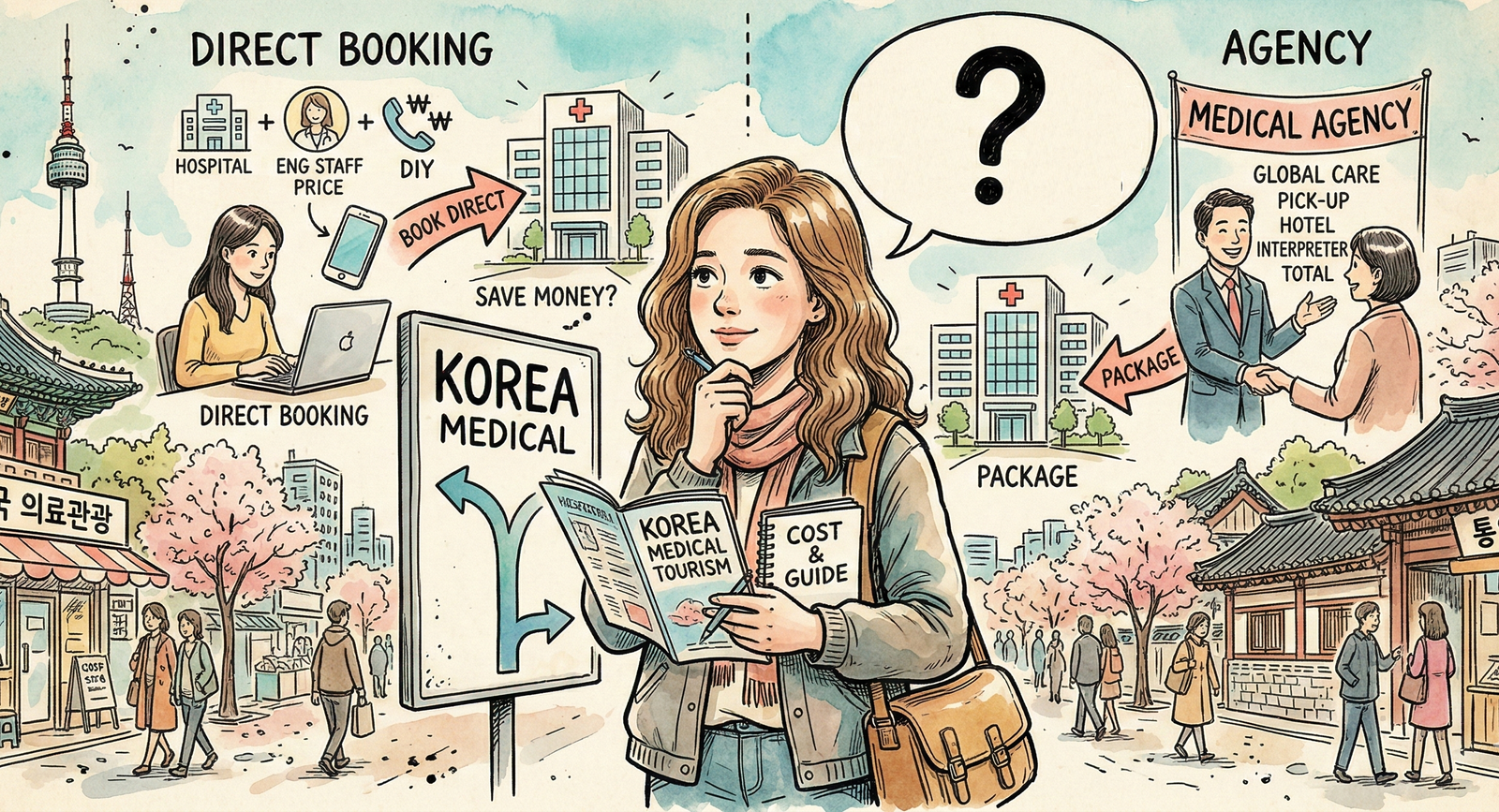
Planning a medical trip to South Korea? The most common dilemma is whether to book directly with a clinic or use a medical tourism agency. Here is the direct answer: booking directly requires more personal effort but ensures you only pay pure medical fees, while using a legally registered agency offers full-service convenience without extra medical costs, as their 10% to 30% commission is legally paid by the hospital from your standard fee. In this comprehensive guide to navigating Korea medical tourism direct vs agency, we will break down the true cost differences, explain the legal pricing structures for foreigners, and provide an essential contract checklist based on the latest 2026 regulations to ensure your medical journey is safe and transparent.
- Direct Booking vs. Medical Agency: What’s the Real Cost Difference?
- Do Foreigners Pay More? Understanding the Pricing Structure
- Hidden Costs & Payment Guide: Deposits, Translation, and Cards
- The Ultimate Checklist: Consultations and Contracts
- FAQ
Direct Booking vs. Medical Agency: What’s the Real Cost Difference?
When deciding how to arrange your procedure, the biggest factors are convenience and the fee structure. Many patients worry that using an agency will artificially inflate their medical bills. Let us clarify how the system actually works in 2026.
The Direct Booking Route
Booking directly means you handle your flights, accommodation, translation, and clinic appointments on your own. Since the hospital does not have to pay a 10% to 30% commission to a middleman, patients who book directly often have much more leverage to negotiate a discount. Clinics are sometimes willing to pass a portion of those saved commission fees directly back to you, either by lowering the final surgery price or by offering complimentary post-operative skin treatments and care packages. However, the hidden cost here is your time and the potential stress of navigating Gangnam-gu (강남구) clinics without local assistance.
Using a Registered Medical Tourism Agency
Legitimate, government-registered agencies operate on a commission basis. According to the latest guidelines set by the Ministry of Health and Welfare, these agencies typically receive a 10% to 30% commission on the total procedure cost. Crucially, this commission is paid by the hospital out of your medical fee as an operational expense, not added on top of your bill. While your baseline medical quote will be the same as a direct booking, you generally lose the ability to negotiate the discounts mentioned above because the clinic’s margin is already reduced by the agency fee. Furthermore, you will pay extra for the agency’s “package services,” such as airport pickups from Incheon International Airport (인천국제공항), hotel bookings, and dedicated concierge services, making your total trip expenses higher.
💡 Pro Tip: Beware of Illegal Brokers
While legal agencies are safe, unregistered brokers still exist. If an agent quotes a medical fee that seems drastically higher than average, or demands a commission fee directly from you (sometimes inflating costs by 50%), they are likely an illegal broker. Always verify their registration status.
Do Foreigners Pay More? Understanding the Pricing Structure
A frequent concern among medical tourists is whether they are being overcharged compared to local Koreans. While a price difference does exist, it is important to understand that this is not illegal discrimination.
Foreign medical tourists are not covered by the Korean National Health Insurance Service (NHIS), meaning all treatments fall under “non-covered” (uninsured) general rates. Under Korean medical law, hospitals are legally permitted to establish a separate “Foreigner Patient Rate.”
This rate is typically 1.5 to 3 times higher than the uninsured rate for local Koreans. This markup is completely legal and accounts for the high overhead costs of treating international patients, which include:
- Maintaining a dedicated international patient department.
- Hiring specialized coordinators and medical translators.
- Higher liability and medical dispute risk management costs.
Hidden Costs & Payment Guide: Deposits, Translation, and Cards
Beyond the primary surgery or treatment fees, budgeting for your trip requires understanding several logistical financial rules.
Deposits (Reservation Fees)
To prevent no-shows, almost all reputable clinics require a deposit to secure your surgery date. The standard deposit amount is generally 10% to 20% of the estimated total procedure cost. Always ensure you understand the refund policy for this deposit before transferring any funds.
Medical Translation Fees
Clear communication with your surgeon is critical. How you pay for translation depends on the facility:
- Large General Hospitals: Often have in-house interpreters, and the cost is usually bundled into the foreigner medical rate.
- Small to Medium Clinics: You may need to hire a freelance medical interpreter or use one provided by your agency. A professional freelance medical interpreter typically costs between 150,000 KRW to 300,000 KRW per day.
Credit Card Payment Regulations
When paying your final bill in Korea, be aware of your rights. It is strictly illegal for a Korean hospital to pass their credit card merchant processing fees onto the patient (e.g., adding a 3% surcharge just because you used a card). However, if you use a foreign credit card, your home bank may charge you international transaction fees or Dynamic Currency Conversion (DCC) fees. To minimize costs, always choose to be billed in the local currency (KRW) rather than your home currency.
The Ultimate Checklist: Consultations and Contracts
To protect yourself from fraud, miscommunication, or medical disputes, you must be proactive during your consultations. Never sign a contract or make a payment without verifying the following details.
What to Verify During the Consultation
- Legal Verification: Confirm that the agency is officially registered as a “Foreign Patient Facilitator” via the Medical Korea (메디컬코리아) website. You can also search for verified hospitals and clinics on our Find Clinics directory, using filters to view only registered foreign patient medical institutions.
- Surgeon Identity: To prevent “ghost doctor” incidents, explicitly confirm the name and credentials of the specialist who will actually be holding the scalpel, not just the consulting doctor.
What Must Be in Your Written Contract
| Checklist Item | What to Look For |
|---|---|
| Itemized Costs | The contract must clearly separate the pure surgical fee, anesthesia costs, post-operative care, and any agency service fees (like hotel or transport). |
| Refund Policy | Clear percentages for deposit refunds based on cancellation timing (e.g., 100% refund if canceled 7 days prior, 50% if 3 days prior). |
| Dispute Resolution | Agreed terms for compensation in case of side effects or dissatisfaction, and reference to the Korea Medical Dispute Mediation and Arbitration Agency. |
| Payment Details | Payments must only be sent to the official corporate bank account of the hospital. Never transfer money to an agency employee’s personal bank account. |
FAQ
Is it safer to book directly or through an agency?
Both are safe as long as you use verified institutions. Direct booking is more cost-effective if you are an experienced traveler. Using a legally registered agency is safer and less stressful for first-time visitors due to the language and logistical support.
Can I negotiate the surgery price?
While standard rates are generally fixed, some clinics may offer promotional discounts during off-peak seasons or if you agree to let them use your photos for marketing. As mentioned above, you also have much higher negotiating power if you book directly. However, prioritize safety and surgeon expertise over the lowest price.
For more detailed information on preparing for your trip, check out our guide: Korea Medical Visa Guide 2026: K-ETA Exemptions & Process.
Korean Culture portal KCulture.com

The KCulture Editorial Team is dedicated to providing deep insights and accurate information about the vibrant world of Korean culture.
🇰🇷 Essential Seoul Travel Kit
- ✈️ Flights: Find Cheap Flights to Seoul
- 🏨 Stay: Top Rated Hotels in Seoul
- 🎟️ Tours: Best Activities & K-Pop Tours