Beyond the Bow: Mastering the Subtle Art of Korean Etiquette and Manners
If you have spent more than a few days in Korea, you have probably experienced it: that moment when a new acquaintance asks, “So, what year were you born?” In many Western cultures, this might seem intrusive. But here in Korea, it is not just small talk—it is a navigational tool. They are trying to determine where you fit on the invisible map of social hierarchy so they can treat you with the proper respect.
As a local living here, I’ve learned that Korean etiquette and manners are less about rigid rules and more about Jeong (connection) and Nunchi (the art of sensing the atmosphere). While the younger generation is certainly more relaxed than their parents, understanding these underlying codes is the difference between being a “foreigner passing through” and a “respected member of the community.” Let’s unpack the social software that runs Korean society.
- The Invisible Ladder: Age, Titles, and Hierarchy
- The “Two-Hand” Rule: Physical Manners
- Table Manners: Who Eats First and How to Drink
- The “K-Event” Protocol: Weddings, Funerals, and Money
- Modern Korea: How Strict Is It Really?
The Invisible Ladder: Age, Titles, and Hierarchy
To understand why Korean etiquette functions the way it does, you have to look at the foundation. Korea is deeply influenced by Neo-Confucianism, which emphasizes order, harmony, and respect for seniority. In this system, society is not a collection of individuals, but a web of relationships.
For a deeper dive into the historical roots of this mindset, I highly recommend reading our guide on Confucianism in Korea: The Hidden Code of K-Dramas and K-Lifestyle. It explains why we act the way we do.
The “Unni” and “Hyung” Dynamic
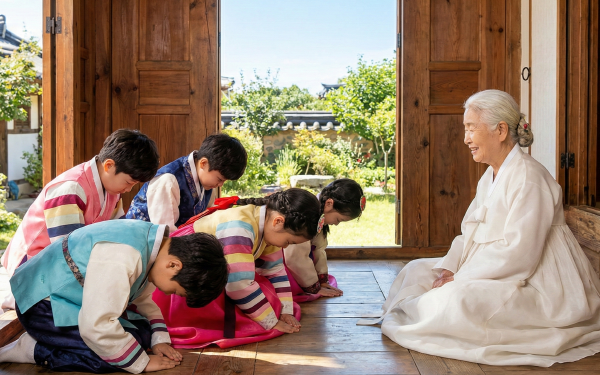
In Korea, age isn’t just a number; it dictates the language you use (Honorifics vs. Banmal) and your behavior. Even a one-year difference creates a “senior” (Sunbae) and “junior” (Hoobae) dynamic. This is why Koreans ask your age immediately—they need to know which “language file” to load.
Titles in the Workplace
If you are working in a Korean company, you will almost never call someone by their first name. You address them by their title. Calling a manager “Hey Min-su” instead of “Manager Kim” (Kim Gwajang-nim) is a serious breach of professional etiquette. The title acknowledges their hard work and status. Ignoring it feels like you are stripping them of their rank.
The “Two-Hand” Rule: Physical Manners
If you take away only one physical habit from this article, let it be this: Use two hands.
When giving something to or receiving something from someone senior to you (in age or rank), never use one hand. This applies to everything—a business card, a credit card to a cashier, a glass of water, or a gift.
- The Full Bow: Use both hands to hold the object while slightly bowing your head.
- The Support: If the item is small, extend your right arm to give the item, and place your left hand under your right elbow or wrist as a sign of support and respect.
💡 Local Insight: You might see older people using one hand with you. Do not be offended; this is their privilege as the senior party. You, however, should stick to the two-hand rule until you are very close friends.
Table Manners: Who Eats First and How to Drink
Dining is the main stage for Korean social life. While you don’t need to be perfect, a few key gestures go a long way.
The First Bite
No matter how hungry you are, do not pick up your spoon until the oldest person at the table has started eating. This is the golden rule. Once the senior starts, it’s a green light for everyone else.
Drinking Etiquette (Sool Culture)
Drinking soju with Koreans is a bonding ritual, but it comes with its own script:
- Never pour your own drink: It is considered bad luck (or just lonely). Wait for someone to fill your glass, and you return the favor.
- Receive with two hands: Hold your glass with both hands when a senior pours for you.
- Turn away: When you drink, turn your head slightly away from the senior person. Making direct eye contact while downing a shot is considered challenging or disrespectful in formal settings.
The “K-Event” Protocol: Weddings, Funerals, and Money
If you stay in Korea long-term—working, studying, or living here—you will eventually be invited to personal events like weddings, first birthdays (Doljanchi), or, sadly, funerals. This is where the “real” Korean etiquette kicks in.
In the West, attending a wedding might be optional. In Korea, if you are considered “close” (a team member, a good friend), attendance is an obligation of the relationship.
The Envelope Economy
You don’t bring gifts (like toasters) to these events; you bring cash. This is called Chugui-geum (congratulatory money) or Jo-geum (condolence money).
- The amount matters: It usually starts at 50,000 KRW for acquaintances and goes up to 100,000 KRW or more for close friends.
- The impact of missing out: If a close colleague gets married or suffers a loss in the family and you ignore it, it can permanently damage the relationship. They might think, “I thought we were close, but I guess I was wrong.” It causes significant disappointment. Even if you cannot attend, sending the envelope via a friend or bank transfer is considered the minimum courtesy.
Modern Korea: How Strict Is It Really?
Now, let’s be realistic. Is every night out a strict Confucian ceremony? Not anymore.
Recently, the rigid hierarchy has softened, especially among the younger generation (Gen Z and Millennials). In private settings, once you agree to drop the formalities (a process called Ya-ja time or just agreeing to be friends), the “turning away while drinking” rule often disappears. Friends interact freely regardless of a one or two-year age gap.
However, Context is King.
While a Friday night with friends is casual, a Tuesday lunch with your Department Head or a chaotic family gathering during Chuseok remains traditional. The hierarchy reappears instantly in professional settings or large family networks. As a foreigner, my advice is to start formal. It is much easier to loosen up later than to try and recover from being accidentally rude.
Korean etiquette is not about suppressing yourself; it’s about showing that you care enough to respect the other person’s position. Master these basics, and you will find Korea to be an incredibly warm and welcoming place.
Korean Culture portal KCulture.com
Join the mailing service and add to your favorites.

Founder of Kculture.com and MA in Political Science. He shares deep academic and local insights to provide an authentic perspective on Korean history and society.