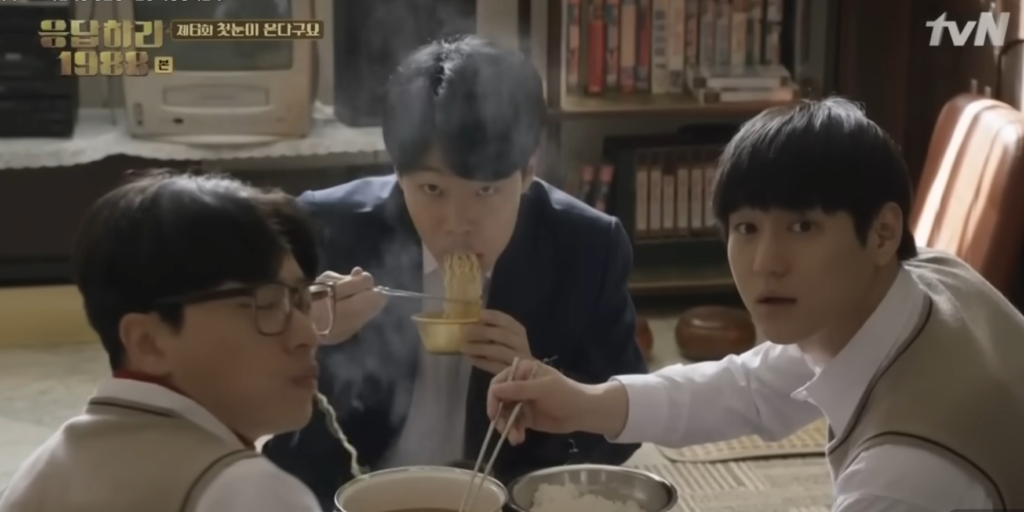
If you have watched any popular K-Drama, like Reply 1988 or even modern hits like Queen of Tears, you have likely witnessed a confusing scene. The characters live in a beautiful apartment with a large, plush leather sofa. Yet, where are they sitting? They are on the floor, leaning their backs against that expensive sofa. To a Western eye, this defeats the purpose of buying furniture. But to us living in Korea, it is the most natural thing in the world. Welcome to the unique world of Korean floor culture.
- The Mystery of the Sofa and K-Dramas
- The Root of It All: Ondol
- Why We Take Shoes Off
- The Ritual of Coming Home
- Yangban-dari and Modern Life
The Mystery of the Sofa and K-Dramas
In many Korean households, the floor is not just a surface to walk on; it is a primary living space. Foreign friends often ask me, “Why do you buy a sofa if you aren’t going to sit on it?” It is a valid question. In Korea, we joke that a sofa is essentially an expensive backrest. We sit on the floor, cushion our backs against the couch, and watch TV or eat fruit.
This behavior stems from centuries of habit known as Jwasik (sedentary culture). Even as Western-style apartments have replaced traditional houses, the instinct to be close to the ground remains deeply ingrained in our DNA. It feels more grounded, cozy, and, paradoxically, more relaxing to us than sitting high up on a chair.
The Root of It All: Ondol
To understand why we love the floor, you must understandthe architecture of the traditional Korean house, the Hanok, and specifically, the heating system called Ondol. Unlike Western radiators or fireplaces that heat the air, Ondol heats the floor itself.
Historically, smoke from a kitchen fire was channeled through flues under the floor stones, radiating heat upward. Today, we use hot water pipes embedded in the concrete, but the principle is identical. Because heat rises, the floor is the warmest part of the house during Korea’s freezing winters.
💡 Local Insight: In winter, there is no greater luxury than coming in from the cold and lying down on a toasty, heated floor. It literally melts the stress (and the cold) out of your bones. This is why we gravitate toward the floor—it is the source of warmth.
Why We Take Shoes Off
The “No Shoes” policy is strictly enforced in Korea, and it is directly linked to floor culture. If you are going to sit, sleep, and eat on the floor, it must be kept impeccably clean. It is not just about etiquette; it is a sanitary necessity.
- Hygiene: The floor is considered an extension of our bed. You wouldn’t walk on your bed with dirty sneakers, right?
- Protection: Traditional floor papers (Hanji) were delicate. Today’s floors are sturdier, but the mindset of protecting the living space from outside dust remains.
When you enter a Korean home, there is always a sunken entryway called a Hyeon-gwan. This is the physical boundary between the “polluted” outside world and the “sanctuary” of the inside. Crossing that threshold with shoes on is considered a major disrespect to the host and the home itself.
The Ritual of Coming Home
The floor culture extends to how we dress and behave immediately upon entering the house. You might notice in dramas that characters often change clothes right after getting home. This is accurate to real life.
Because our lifestyle involves rolling around or sitting on the floor, we cannot wear stiff jeans or suits. The typical Korean evening routine looks like this:
- Enter home and remove shoes at the Hyeon-gwan.
- Immediately wash hands and feet, or take a full shower. This washes away the “outside dust.”
- Change into “homewear”—usually comfortable tracksuits, pajama pants, or soft cotton t-shirts.
This ritual creates a psychological switch. By washing up and changing into soft clothes to sit on a clean, warm floor, we signal to our bodies that the workday is over and it is time to fully rest.
Yangban-dari and Modern Life
When sitting on the floor, we adopt a posture called Yangban-dari (the cross-legged position, similar to a lotus position). While it can be numbingly painful for foreigners not used to it, most Koreans find it comfortable. We also frequently use low, folding tables (Bapsang) for meals.
However, times are changing. Due to joint health concerns among the elderly and the convenience of Western lifestyles, many Koreans now use dining tables and beds. Yet, the old habits stick. Even families with large dining tables often find themselves pulling out a small folding table to eat ramyeon or fried chicken in front of the TV while sitting on the floor.
So, the next time you see a K-Drama character ignoring their luxury furniture to sit on the rug, know that they aren’t being weird. They are just enjoying the ancient, toasty comfort of the Korean floor.
Korean Culture portal KCulture.com
Join the mailing service and add to your favorites.

Founder of Kculture.com and MA in Political Science. He shares deep academic and local insights to provide an authentic perspective on Korean history and society.