Korean culture is a vibrant tapestry woven with deep philosophical threads, and nothing illustrates this better than Obangsaek Korean traditional colors. In this deep dive, we explore how these colors represent the cosmic order of the universe and how they protect the lives of everyone from the common people to the royalty. By the end of this article, you will understand that in Korea, color is not just decoration—it is a language of harmony and protection.
The Philosophy of Obangsaek: The DNA of Korean Aesthetics
If you walk through the historic streets of Seoul, you’ll notice a recurring palette: vibrant reds, deep blues, bright yellows, crisp whites, and stark blacks. This isn’t just a design choice. This is Obangsaek (오방색), a system of five colors based on the theory of Eumyang Ohaeng (Yin-Yang and the Five Elements). Honestly, it’s like the cosmic DNA of Korean culture.
Each color corresponds to a cardinal direction, a natural element, and even a season. Understanding this system is like finding a secret key to the Korean soul. According to traditional views, these colors were used to bring balance to the world and protect people from misfortune. We don’t just see these colors; we live through them.
Color
Direction
Element
Season
Symbolism
Blue (靑)
East
Wood
Spring
Creation, Life, Blessing
Red (赤)
South
Fire
Summer
Passion, Protection from Evil
Yellow (黃)
Center
Earth
–
Authority, Abundance, Center of the Universe
White (白)
West
Gold/Metal
Autumn
Purity, Peace, Innocence
Black (黑)
North
Water
Winter
Wisdom, Formality, Death
Saekdong: Attaching Colors of Protection and Blessing
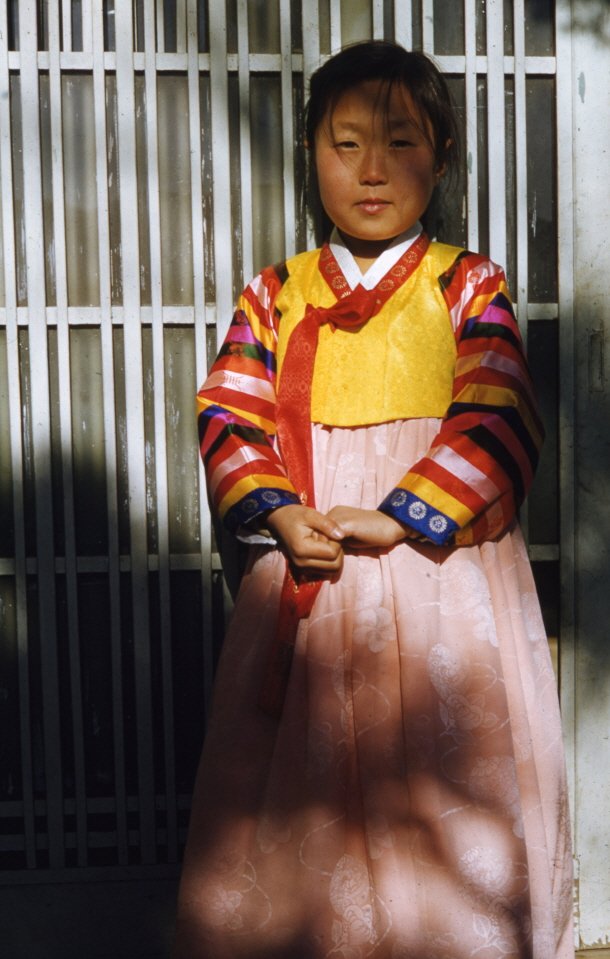
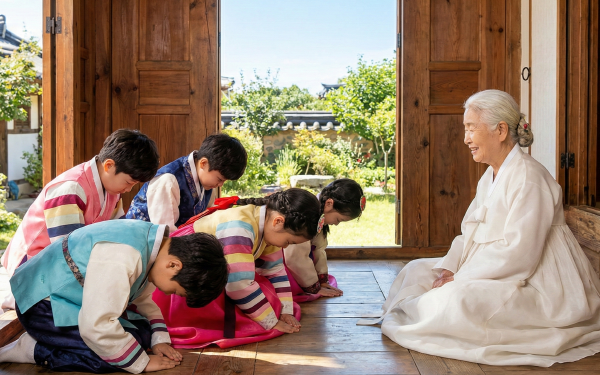
One of the most heartwarming applications of Obangsaek is found in Saekdong (색동), the colorful striped sleeves seen on traditional clothing. The term “Saekdong” actually comes from the phrase “attaching colors to the dong.” In Korean tailoring, a dong refers to the specific length or segment of a sleeve. By sewing different colored pieces together segment by segment, our ancestors created a literal rainbow of protection.
According to the Korea Cultural Heritage Foundation, Saekdong is more than just a decorative pattern. It is a manifestation of “Byeok-sa” (fending off evil) and “Gi-bok” (praying for blessings). By wearing these vibrant stripes, individuals—especially the most vulnerable—were believed to be shielded by the protective energy of the five cardinal directions.
📌 Local Note: During a child’s Doljanchi (first birthday), wearing a Saekdongjeogori is a crucial tradition. It signifies the parents’ wish for the child to live a long, healthy life, untouched by misfortune. Similarly, on New Year’s Day or at weddings, Saekdong represents a bright future and harmonious unity.
Experts often highlight that Saekdong represents the “Aesthetics of Harmony.” Even though the colors are bold and seemingly clashing, they come together to create a stunning visual balance. This philosophy is deeply rooted in the Korean mindset of “Eoullim”—the beauty of coexistence and harmony. Today, this tradition has evolved into a modern design element, seen in global branding and contemporary ceramic art, proving that these “attached colors” still hold the power of Korean identity.
A child wearing Saekdong clothes
Dancheong: The Guardian Colors of Architecture
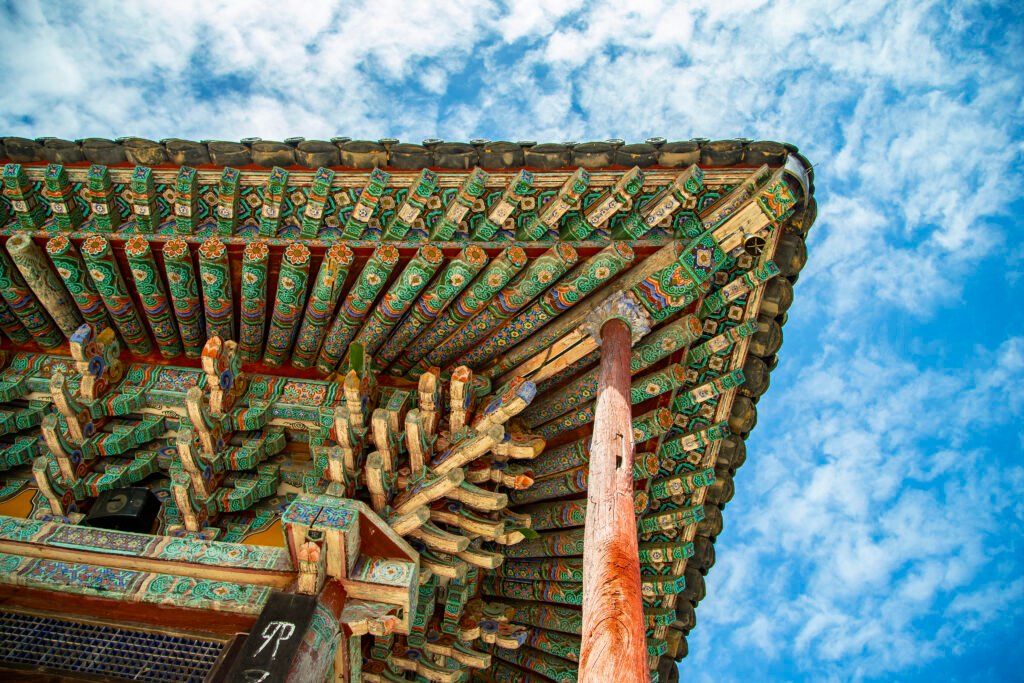
Have you ever looked up at the intricate patterns under the eaves of a Korean palace or temple? That’s Dancheong. While it served a practical purpose—protecting wood from rot and insects—its primary role was symbolic. The colorful patterns were believed to ward off evil spirits and signify the dignity of the building.
It’s a perfect example of how the five colors transform a simple structure into a sacred space. The application of these colors was strictly regulated, ensuring that the hierarchy and spiritual significance of the building were maintained through the precise use of Obangsaek. Every brushstroke in Dancheong is a prayer for the longevity of the structure and the safety of those within.
Dancheong of a Temple
Bibimbap: Consuming Cosmic Energy through Culinary Harmony
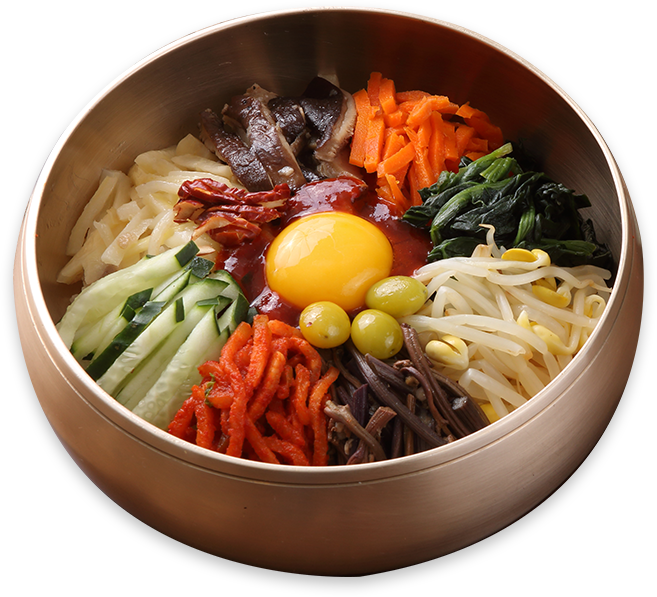
Even in Korean cuisine, balance is key. Think about Bibimbap. Have you noticed the specific ingredients? You have brown/black mushrooms (Water), white bean sprouts (Metal), green spinach (Wood), red chili paste (Fire), and a yellow egg yolk (Earth) in the center. By eating these five colors, you aren’t just getting vitamins; you are symbolically consuming the energy of the universe to maintain your health.
Korean food is often described as “eating with your eyes first,” and Bibimbap is the ultimate realization of this. It reflects the belief that when the five elements are in balance within the body, health and longevity are naturally achieved. This “culinary harmony” is a direct practical application of the Obangsaek philosophy on a daily basis.
Irworobongdo: The Painting That Followed a King
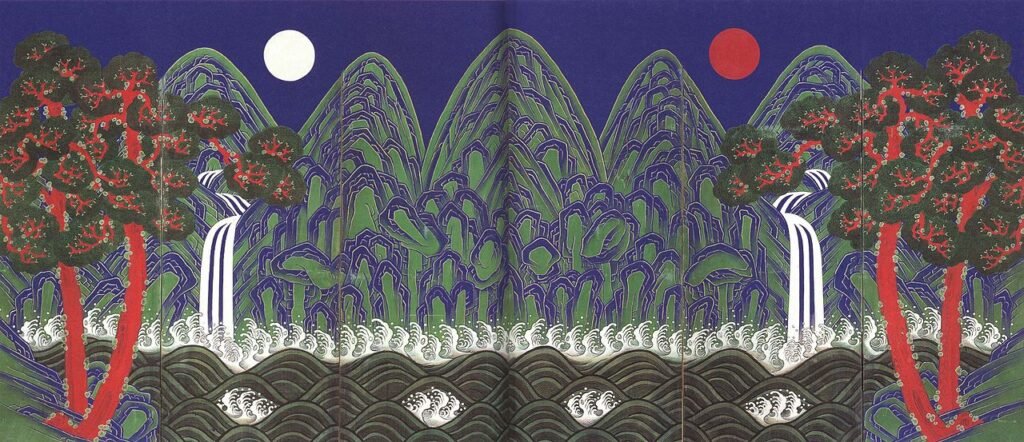
Among all the applications of Obangsaek, the most powerful is undoubtedly the Irworobongdo (일월오봉도)—the “Painting of the Sun, Moon, and Five Peaks.” This screen sat right behind the King’s throne (Eojwa) and was exclusive to the royalty of the Joseon Dynasty. Historically, wherever the King went, the Irworobongdo followed. Whether he was traveling outside the palace or resting in a different pavilion, it served as a portable throne room, signaling that the King was the center of the world wherever he stood.
The Cosmic Connection: Five Peaks and the Five Planets
Why five peaks? It’s not just about the landscape. Many scholars, including Kang Woo-bang (Director of the Ilhyang Korean Art History Institute), suggest that the Irworobongdo acts as a “Mandala”—a visual representation of the universe’s creation principles. The five peaks correspond to the five elements of Obangsaek and the five visible planets in traditional Eastern astronomy:
Jupiter (Wood/East): Associated with growth and the color blue.
Mars (Fire/South): Linked to the sun and vibrant red tones.
Saturn (Earth/Center): Representing the stability of the central peak.
Venus (Metal/West): Linked to the white moon and waterfall.
Mercury (Water/North): Represented by the swirling waves at the bottom.
Irworobongdo
Cheon-ji-in: The King as the Bridge Between Heaven and Earth
The National Palace Museum of Korea emphasizes that the Irworobongdo is “incomplete” without the King. This is based on the Cheon-ji-in (Heaven-Earth-Man) philosophy. In this triad, the Sun and Moon represent Heaven, the Five Peaks and Waves represent Earth, and the King represents Man. Historians like Professor Han Young-woo highlight the King’s role as the mediator, harmonizing the dualities of Yin (Moon) and Yang (Sun) to maintain cosmic balance.
The Symbolic Components:
The Sun & Moon: The balance of Yang and Yin (The King and Queen).
The Five Peaks: The five elements and the permanence of the nation.
The Red Pines: Eternal vitality and longevity of the dynasty.
The Waves: The people and the world governed by the King’s benevolence.
The Modern Legacy: Why These Colors Still Matter
You might think this is all ancient history, but Obangsaek is still the “color profile” of modern Korea. You see it in the Olympic logos, in the branding of K-food, and in the designs of high-end Hanbok. It’s a visual identity that connects 21st-century technology with 14th-century philosophy. Brands continue to use these colors to evoke a sense of tradition and premium quality.
Whenever I see these colors now, I don’t just see a pretty design. I see a culture that values balance, respects the natural order, and seeks to find harmony in everything. Whether it’s in a grand palace painting, the sleeves of a child’s jacket, or a simple bowl of rice, Obangsaek remains a testament to the Korean desire for a life filled with meaning and cosmic protection.
Founder of Kculture.com and MA in Political Science. He shares deep academic and local insights to provide an authentic perspective on Korean history and society.
To provide the best experiences, we use technologies like cookies to store and/or access device information. Consenting to these technologies will allow us to process data such as browsing behavior or unique IDs on this site. Not consenting or withdrawing consent, may adversely affect certain features and functions.
Functional
Always active
The technical storage or access is strictly necessary for the legitimate purpose of enabling the use of a specific service explicitly requested by the subscriber or user, or for the sole purpose of carrying out the transmission of a communication over an electronic communications network.
Preferences
The technical storage or access is necessary for the legitimate purpose of storing preferences that are not requested by the subscriber or user.
Statistics
The technical storage or access that is used exclusively for statistical purposes.The technical storage or access that is used exclusively for anonymous statistical purposes. Without a subpoena, voluntary compliance on the part of your Internet Service Provider, or additional records from a third party, information stored or retrieved for this purpose alone cannot usually be used to identify you.
Marketing
The technical storage or access is required to create user profiles to send advertising, or to track the user on a website or across several websites for similar marketing purposes.