I live in Korea, and let me tell you, there are few places that encapsulate the true spirit of modern Korean culture quite like the PC Bang (PC방, or PC Room). This is where the magic happens—the birthplace of legends like League of Legends’ unkillable demon king, Faker (Lee Sang-hyeok), and the crucible that forged the original StarCraft dynasty. Forget the dusty, dark image of an old internet cafe; the PC Bang is a high-tech, 24-hour sanctuary for gamers, students, and workers alike. It’s affordable, it’s fast, and most importantly, it offers a dining experience that is a legendary cultural phenomenon in its own right.
- Korea’s PC Bang History: From StarCraft to Esports Mecca
- The Ultimate PlayBook: A Culinary Deep Dive into PC Bang Food
- How to Order a Feast Like a Korean Pro Gamer
- The Esports Cradle: PC Bangs and Marketing Power
- Where to Find the Best PC Bangs: PlayBook
Korea’s PC Bang History: From StarCraft to Esports Mecca
To really understand the PC Bang, we need to talk about history. The concept of an electronic cafe (Jeonja Kape) first appeared in the late 1980s, but the modern PC Bang as we know it truly exploded onto the scene in the late 1990s. The catalyst? Blizzard’s StarCraft in 1998. This real-time strategy game was a cultural tidal wave, and suddenly, everyone needed a high-speed, networked place to play and compete.
The government’s push for advanced broadband infrastructure at the time perfectly aligned with this demand. Since not everyone could afford a powerful home PC or high-speed internet in the early days, the PC Bang filled a vital gap, democratizing access to high-end gaming. This accessibility, combined with the social aspect of playing shoulder-to-shoulder with friends, fostered an intensely competitive environment.
📌 Local Insight: The Birth of a Scene The intense, localized competition within PC Bangs quickly led to informal tournaments. This spontaneous development was the true seed of professional e-sports in Korea. PC Bangs were the original training grounds and scouting hubs, making them the indisputable foundation for the country’s global dominance in games like League of Legends and, before it, StarCraft. They are not just cafes; they are the heart of the Korean gaming industry.
The Ultimate PlayBook: A Culinary Deep Dive into PC Bang Food
Here’s the thing that surprises every foreigner I take to a PC Bang: the food. Honestly, playing games is only half the fun; the other half is the comprehensive, high-quality, and surprisingly delicious food service. What started as a small concession stand for instant noodles and soda has transformed into a full-service, in-seat delivery system with a massive menu.
The PC Bang food culture really took off when anti-smoking laws were implemented, and owners had to find a new revenue stream to compensate for a temporary dip in visitors. They leaned into food service, and it worked, becoming a core component of the experience. We’re talking gourmet-level meals prepared in a dedicated kitchen, delivered right to your desk, often at competitive prices.
What to Order: A Must-Try Menu for a Deep Dive Experience
As a local expert, I can tell you that the menu at a modern PC Bang rivals that of many casual restaurants. You’re not just getting pre-packaged snacks; you’re getting freshly prepared Korean comfort food.
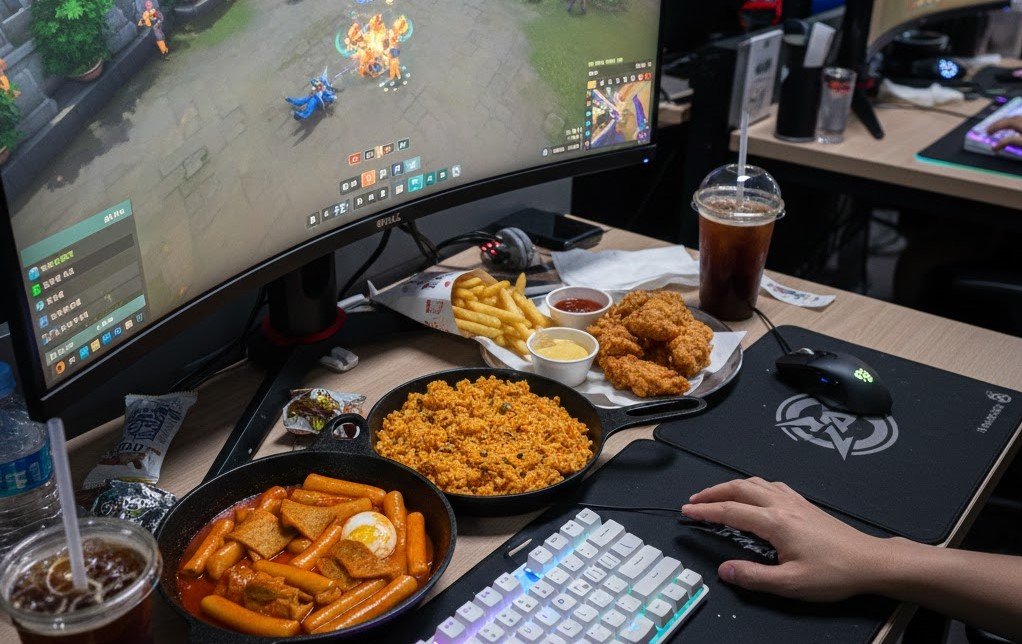
- Ramyeon (Ramen): Not just cup noodles! This is usually cooked perfectly on an induction cooker with add-ons like eggs, green onions, and even slices of cheese. It’s the undisputed champion of PC Bang cuisine.
- Tteokbokki (Spicy Rice Cakes): Chewy rice cakes smothered in a sweet and spicy sauce. Some places offer variations with cheese or ramen noodles (Rabokki).
- Rice Dishes: Look for classics like Kimchi Fried Rice (Kimchi Bokkeumbap) or a variety of rice bowls topped with a fried egg and marinated meat (Deopbap). These are substantial and perfect for a long session.
- Hot Dogs and Snacks: The legendary So-tteok So-tteok (a skewer alternating between sausage and rice cake, often brushed with a sweet chili sauce) is a must. Fried chicken tenders, French fries (often with honey-butter seasoning), and cheese sticks are also standard.
- Drinks: An Iced Americano (known as A-Ah) is the unofficial fuel of Korean gamers, but don’t miss out on sweet drinks like Sikhye (sweet rice drink) or fruit slushies, which are incredibly refreshing during intense gameplay.
How to Order a Feast Like a Korean Pro Gamer
The service method is a key part of the unique experience. You never have to leave your high-end gaming chair!
- Log In and Buy Time: Purchase your gaming time at the central kiosk or desk upon arrival (usually about 1,000 to 1,500 KRW per hour).
- Find the Menu: On your desktop screen, there will be a clearly visible ‘Order’ icon, often featuring a knife and fork. Click this to bring up the full menu interface.
- Place Your Order: Browse the menu categories. Select your items and any add-ons (like extra cheese for your ramyeon).
- Pay at Your Seat: You can pay directly through the computer system using your pre-purchased time credit or a linked credit/debit card.
- Delivery: A few minutes later, a staff member will silently deliver your piping hot meal right to your desk. No need to pause your game or even get up!
💡 Pro Tip: The highest profit margins for most PC Bangs come from food and beverages, not the hourly rate. This is why the service is so polished and the menu so extensive—it’s a core business strategy! Enjoying a perfect plate of kimchi fried rice while you’re dominating Summoner’s Rift is a quintessential Korean Culture experience.
The Esports Cradle: PC Bangs and Marketing Power
The impact of the PC Bang on the Korean gaming ecosystem is profound. They are the backbone of the entire industry.
First, for e-sports, they provide a standardized, high-performance environment accessible to anyone. Many professional players got their start grinding for hours in their local PC Bangs. Second, they are a powerful marketing tool for game developers. Game companies—from those behind League of Legends and StarCraft to new titles—often partner with PC Bangs to offer exclusive in-game benefits.
For customers, this means that by playing a specific game at a PC Bang, you often get better rewards, boosted XP, or access to locked characters/items that you wouldn’t get playing from home. This gives gamers a huge incentive to spend their time and money at these locations, further cementing the PC Bang as a central hub of Korean gaming.
Where to Find the Best PC Bangs: PlayBook
PC Bangs are literally everywhere in Korea—you’ll spot the glowing ‘PC방’ sign in basements or on upper floors of commercial buildings in every neighborhood. However, certain areas are known for having high-quality, high-spec, or uniquely themed PC Bangs.
- University Areas: Neighborhoods near major universities (e.g., Sinchon, Hongdae, Konkuk University) have incredibly competitive PC Bangs with top-tier equipment, as students are the core demographic.
- Gangnam and Major Transit Hubs: These areas often host large, modern, and aesthetically pleasing PC Bangs with premium seating and a huge food menu to cater to office workers and travelers.
- Themed PC Bangs: If you’re a League of Legends fan, the T1 Base Camp PC Bang in Seoul (147 Yanghwa-ro Mapo-gu Seoul) is a must-visit. Run by the team of the legendary Faker, it is a pilgrimage site for fans, featuring team branding and an e-sports competition zone.
In the end, whether you’re a hardcore gamer or just seeking the ‘real’ Korea, a visit to a PC Bang is a cultural Deep Dive. It’s a comfortable, affordable, and dynamic third space for Koreans—a cozy rest stop and the sacred ground where e-sports champions are born. It’s a must-do for any travel itinerary.
Korean Culture portal KCulture.com
Join the mailing service and add to your favorites.
Founder of Kculture.com and MA in Political Science. He shares deep academic and local insights to provide an authentic perspective on Korean history and society.
🇰🇷 Essential Seoul Travel Kit
- ✈️ Flights: Find Cheap Flights to Seoul
- 🏨 Stay: Top Rated Hotels in Seoul
- 🎟️ Tours: Best Activities & K-Pop Tours