Beyond the Rooftops: A Deeper Look at Korea’s Hanok
Hi there! As someone living here in Korea, I get asked a lot about what visitors should see. Of course, they always list the palaces, like Gyeongbokgung. And they should! They’re stunning. But those palaces are just one example of Hanok (한옥), our traditional Korean architecture. And honestly, as a local expert, I can tell you there’s so much more to a Hanok than just its beautiful, curving roof.
A Hanok is a home built in harmony with nature, using materials like wood, stone, and hanji (traditional paper). But its real secret, the thing that defines the Korean lifestyle, is hidden beneath the floor. We’re going to take a deep dive into the incredible science behind Hanok—from the underfloor heating system, Ondol (온돌), to the brilliant passive solar design—and explore how it reflects Korean history and class structure.

- The Ingenuity of Ondol: Traditional Underfloor Heating
- Korean Ondol’s Journey West: A Story of Kyongbokgung Palace
- The Built-in Science of a Hanok: Solar and Cooling
- Korean Architecture by Class: Dancheong and the 99-Kan Limit
- Local Picks: Visiting a Yangban (Noble) House
The Ingenuity of Ondol: Traditional Underfloor Heating
If you visit a Korean home today (even my modern apartment!), you’ll feel the floor is warm. That’s the legacy of Ondol, which literally means “warm stone.” It’s a unique underfloor heating system that’s been used in Korea for thousands of years. It represents a fundamental Korean culture insight into comfort and resourcefulness.
In a traditional Hanok, the system is ingenious: a fireplace (called an agungi) was located in the kitchen or outside the room. When a fire was lit, the hot smoke and air were channeled through stone passages (called gudeul) built under the room’s floor. The flat stones covering the passages would heat up and retain that heat for hours, radiating it into the room long after the fire was out.
The real genius of this Traditional Culture technology is twofold. First, all the smoke and exhaust goes out a chimney, so it heats the room *without* filling it with smoke. This was a huge advantage compared to, say, an open fire in the middle of a room. Second, those thick stones (the gudeul) hold the heat for *hours*. You could fire it up in the evening and the floor would stay warm all night. This incredible heat retention and clean indoor air gave it a special advantage over many other heating methods in the world.
📌 Local Note: Floor Culture This system is why our culture is a “floor culture.” We sit, eat, and sleep on the floor. And it all goes back to the warmest spot in the house: the Araetmok (아랫목), the part of the floor closest to the fireplace. My grandmother used to tell me that in the old days, this was the spot reserved for the eldest in the family. It was also where they’d place the brass bowls of rice, covered with a blanket, to keep the food warm for the next meal. It truly was the warm heart of the home.

Korean Ondol’s Journey West: A Story of Kyongbokgung Palace
This intense heat was a bit of a shock to Western visitors in the late 19th and early 20th centuries. I mean, to them, it must have been wild. They were used to fireplaces that warmed the air, not floors that cooked your feet. Isabella Bird, a famous British traveler, even wrote that Koreans seemed to “love this terrible temperature,” which could exceed $40^\circ\text{C}$ ($104^\circ\text{F}$) on the floor!
But the real breakthrough that brought this ancient Korean technology to global attention involves a sad piece of Korean history and a famous American architect. Following Japan’s annexation of Korea, the Japanese architect Okura Kihachiro dismantled the Jaseondang Hall (자선당) from Gyeongbokgung Palace in 1917 and moved it to his home in Japan to be used as an art gallery.
It was there that the legendary American architect Frank Lloyd Wright encountered the unique underfloor heating system of Jaseondang (which was, of course, Ondol). He was reportedly so deeply impressed by its efficiency and warmth that he was inspired to incorporate the concept into his own designs. Wright is widely credited with introducing radiant floor heating to the West, making this piece of Korean palace architecture, tragically moved, the catalyst for a global shift in heating technology.
The Built-in Science of a Hanok: Solar and Cooling
It’s not just the Ondol; the whole house is, honestly, sort of a brilliant machine of natural air conditioning and heating. Take those beautiful curved eaves I mentioned, called Cheoma (처마). Their length and angle are precisely designed to manage seasonal sun exposure. This is a crucial element of the Korean Culture Insight embedded in the architecture.
Seasonal Solar Management: The Cheoma’s Genius
The Cheoma’s design is an ancient form of passive solar design. In the hot summer, when the sun is high in the sky, the long eaves create deep shade over the windows, keeping the house cool. But in the cold winter, when the sun is low on the horizon, the same eaves let the sunlight stream deep into the house, helping to warm the rooms and the Ondol-heated floors. It’s a perfect, seasonal balance that requires no electricity.
The Natural Convection Cooling System
For summer cooling, traditional Hanoks utilize a technique based on natural convection. They feature a big, open, wooden-floored hall in the middle called the Daecheong (대청). This hall connects directly to the front yard, the Madang (마당).
The sun heats the Madang, but the Daecheong remains cool in the shade and is higher up. The temperature difference between the hot Madang and the cool Daecheong creates a pressure difference, causing air to flow—a natural, refreshing breeze—right through the house. It’s a centuries-old natural air conditioner that makes the humid Korean summer bearable, embodying the principle of building in harmony with nature.
Korean Architecture by Class: Dancheong and the 99-Kan Limit
Not all Hanoks are alike. During the Joseon Dynasty, architectural details were strictly regulated to reflect social hierarchy. The most striking difference is the use of color.
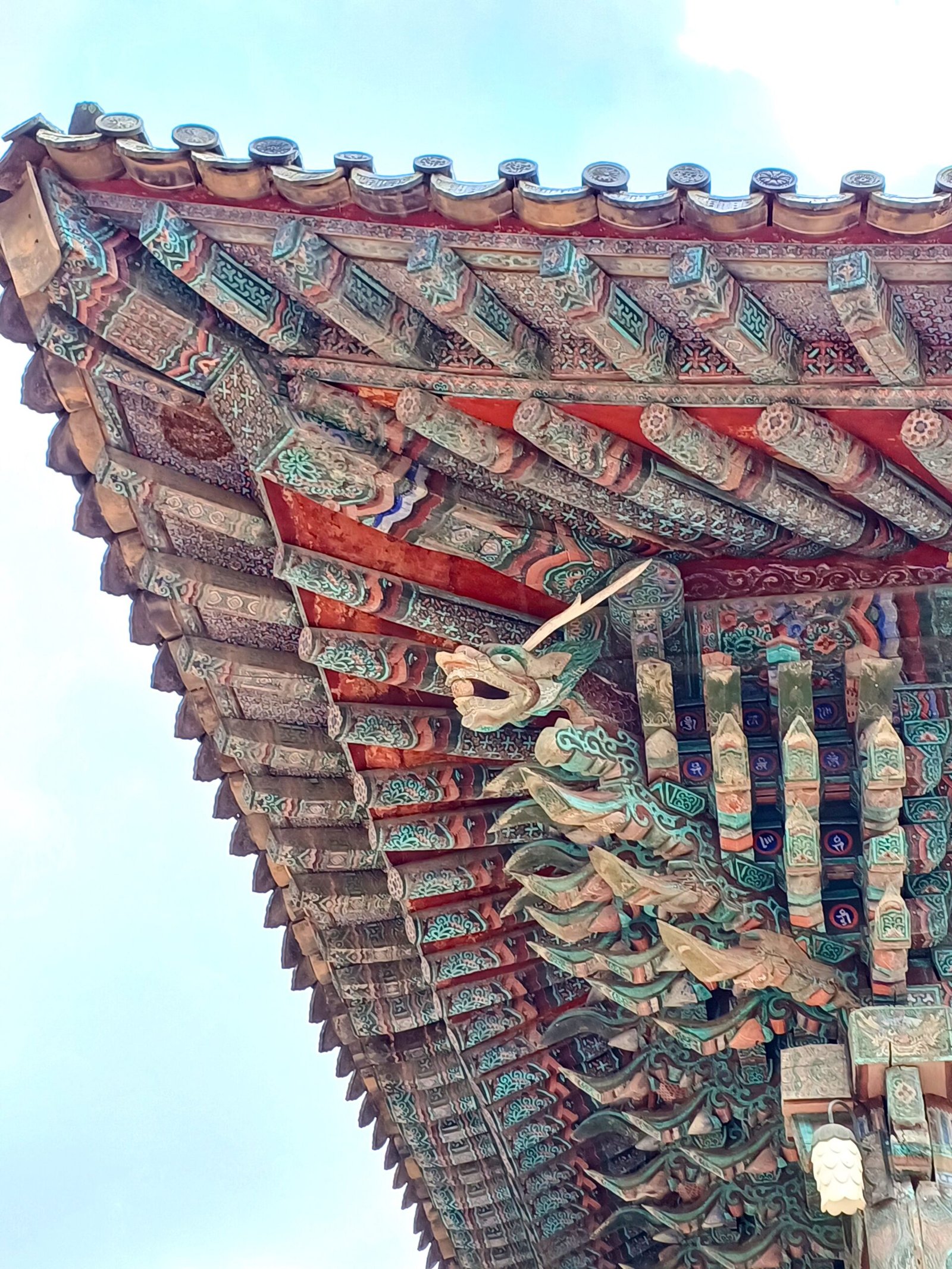
The Meaning and Absence of Dancheong
The vibrant, colorful painting on the wooden beams of structures like Royal Palaces and Buddhist Temples is called Dancheong (단청). This sophisticated ornamentation served two purposes: to show the importance of the building (Palaces, Temples) and, practically, to protect the wood from weathering and insects.
However, the wealthiest nobles (yangban) could not use Dancheong. Their homes, while grand, had to be more subdued, showing elegance through natural wood and tile. This restriction was mandated by Neo-Confucian values, which dictated that ordinary citizens (even the richest ones) must not imitate the King, reinforcing the strict social structure inherent in Korean Culture.
The 99-Kan Limit for Noble Houses
Even for the wealthiest nobles, there was a strict size limit: a noble’s house couldn’t be larger than 99 Kan (칸). The kan is not a simple unit of area; it’s a structural unit, defined as the rectangular space between two of the main wooden pillars. Ninety-nine kan was still a massive mansion, but it was a crucial limit set by law to prevent the nobility from building homes the size of the King’s palace. This law is a fascinating glimpse into Korean history and its societal structure.
Local Picks: Visiting a Yangban (Noble) House
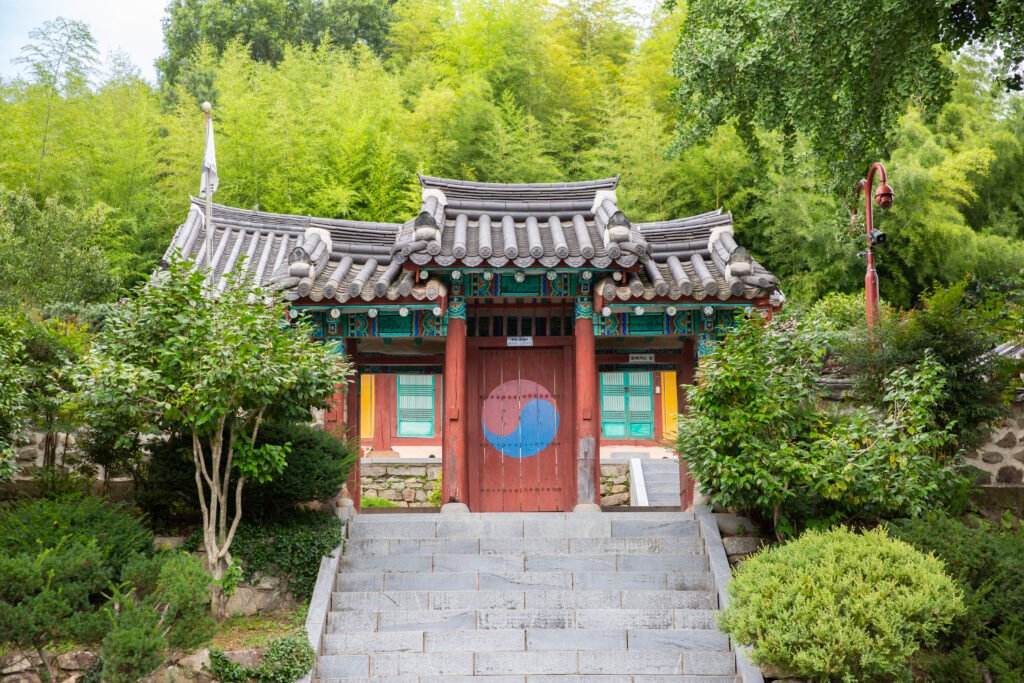
Most visitors to Korea visit Gyeongbokgung or Changdeokgung Palace, and a trip to an ancient traditional temple is likely included in many itineraries. However, it is rare to have the opportunity to tour and observe a traditional Yangban (noble) house in person. So, I want to give you some Local Picks for experiencing the elegance of a yangban (noble) Hanok, where you can see the beauty of the natural wood and tile structure without the colorful Dancheong. These are the best places to truly appreciate the sophisticated design of a high-class traditional dwelling.
- Hahoe Folk Village (Andong): This entire village is a UNESCO World Heritage site and is perhaps the most authentic example of a traditional yangban community and its architecture. It’s an entire Traditional Culture experience.
- Yangdong Folk Village (Gyeongju): Another UNESCO site, it displays a huge variety of yangban and commoner houses, showing the different scales and architectural styles dictated by class.
- Namsangol Hanok Village (Seoul): This is a collection of five reconstructed Hanoks from different social classes of the Joseon Dynasty, including a *yangban* house. It’s the easiest way to see the differences within Seoul.
- Owolseok Hanok (Jeonju Hanok Village): While Jeonju is famous, look for specific, well-preserved houses like Owolseok. Many offer authentic Hanok stay experiences.
So, when you plan your trip, don’t just take a photo of a Hanok. Book a night. Feel the Ondol. Trust me, you’ll understand Korea in a whole new way.
Korean Culture portal KCulture.com
Join the mailing service and add to your favorites.

Founder of Kculture.com and MA in Political Science. He shares deep academic and local insights to provide an authentic perspective on Korean history and society.