The Silent Soul of Korea: How Buddhism Shaped the Nation’s Psyche
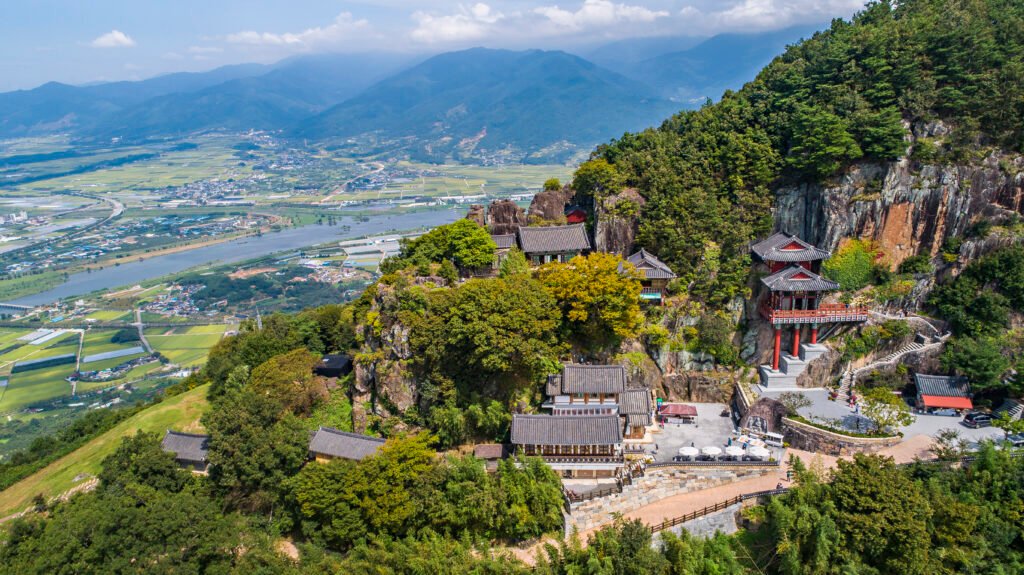
If you walk through the bustling streets of Gangnam, you see the hyper-modern face of Korea. But if you hike just an hour into the surrounding mountains, you find the country’s ancient heart: a Buddhist temple. For over 1,600 years, Buddhism has been more than just a religion in Korea; it is the subconscious of the nation.
While the skyscrapers represent Korea’s rapid future, the temples represent its enduring spirit. Even in a modern society where Christianity is prominent and atheism is growing, the cultural “DNA” of Korea remains deeply Buddhist. In this deep dive, we explore how this ancient philosophy coexists with Confucian traditions to form the unique Korean identity, supported by historical evidence, sociological insights, and daily habits.
- The Golden Age: Unifying a Nation (Silla & Goryeo)
- The Miracle of Woodblocks: A Prayer Against War
- The Joseon Era: Suppression and the Patriot Monks
- The Dual Psyche: Confucian Head, Buddhist Heart
- Living Buddhism: Inyeon, Aesthetics, and Food
- Modern Retreat: The Temple Stay Phenomenon
The Golden Age: Unifying a Nation (Silla & Goryeo)
To understand the depth of Korean Buddhism, we must look back to when it was the state ideology, powering the nation’s culture and politics.
Unified Silla (668–935 AD): The Buddha Land
When the Silla Kingdom unified the Korean peninsula, Buddhism was used as the primary spiritual force to bind the fractured people together. The rulers viewed their land as a “Buddha Land,” creating architectural masterpieces that still stand today.
- Bulguksa Temple & Seokguram Grotto: Located in Gyeongju, these UNESCO World Heritage sites represent the pinnacle of Buddhist art. They were not just places of worship but physical manifestations of the Buddhist paradise on earth, designed with precise mathematical geometry to reflect spiritual order. For a detailed guide on these masterpieces, check out: Gyeongju Bulguksa Temple & Seokguram Grotto: A Journey to Silla.
Goryeo Dynasty (918–1392 AD): State Protection
In the Goryeo era, Buddhism became the official state religion. It was believed that the power of the Buddha could protect the nation from foreign invasions. Royal family members often became monks, and festivals like the Yeondeunghoe (Lotus Lantern Festival) were national celebrations.
The Miracle of Woodblocks: A Prayer Against War
The most dramatic story of Korean Buddhism during the Goryeo Dynasty is undoubtedly the creation of the Tripitaka Koreana (Palmandaejanggyeong). It is a tale of loss, resilience, and technological mastery.
The Tragedy: Loss of the First Tripitaka (Chojo Daejanggyeong)
Originally, Goryeo carved the “First Tripitaka” in the 11th century as a prayer to repel Khitan invaders. This massive collection was stored at Buin Temple in Daegu. However, during the brutal Mongol invasions in 1232, the entire collection was burned to ashes by Mongol forces. It was a devastating psychological blow to the nation, akin to losing the country’s soul.
The Resurrection: The 81,258 Woodblocks
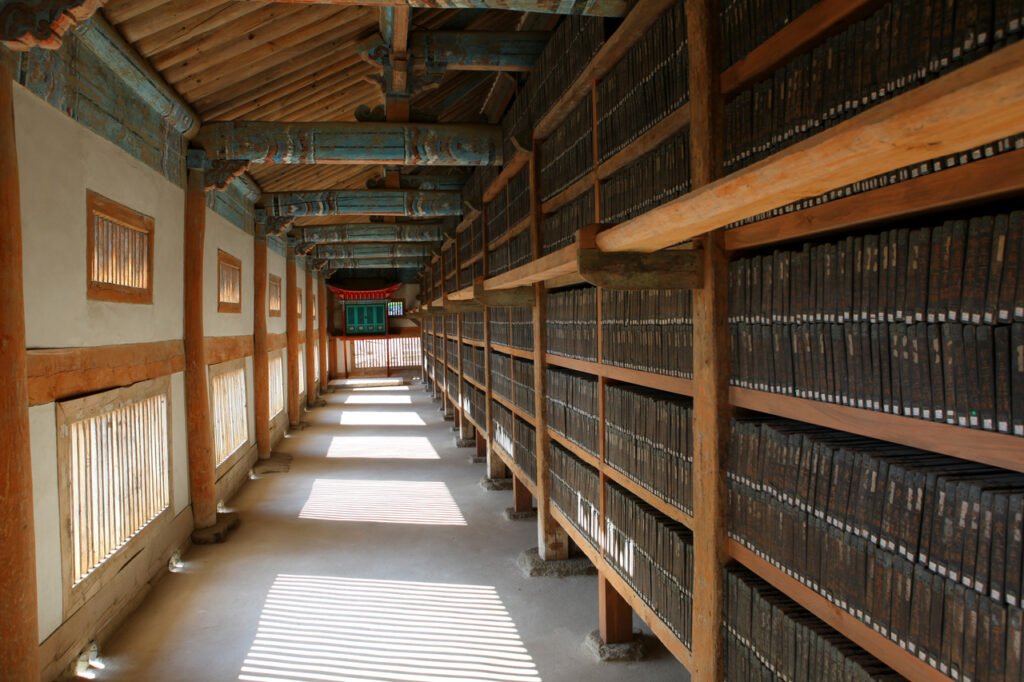
Refusing to surrender, King Gojong ordered the creation of a new set in 1237 to gather the people’s spirit and repel the Mongols through faith. It took 16 years to complete. This is the famous Tripitaka Koreana currently housed in Haeinsa Temple.
- Technological Marvel: To prevent the wood from rotting or warping (which destroyed the first set), the craftsmen used silver magnolia and birch wood. They soaked the wood in sea water for three years, boiled it in salt water, and dried it in the shade for three more years to make it insect-proof and durable.
- Perfection: There are over 52 million characters carved into 81,258 blocks. Astonishingly, there are almost no errors or corrections, earning it the reputation of being carved by “superhuman” devotion. It remains the world’s most comprehensive and accurate collection of Buddhist scriptures.
The Joseon Era: Suppression and the Patriot Monks
The transition to the Joseon Dynasty (1392–1910) marked a dramatic shift. The new rulers adopted Neo-Confucianism as the state ideology and actively suppressed Buddhism to eradicate the corruption of the late Goryeo era.
1. Exile to the Mountains
Monks were demoted to the lowest social class (Cheonmin), and temples were banned from major cities like Seoul (Hanyang). However, while the elite men studied Confucian texts, Buddhism remained the spiritual refuge for the common people and women of the royal court. When faced with illness or despair, people still climbed the mountains to pray to Buddha for comfort.
2. The Imjin War (1592): Monks to the Rescue
The true value of Buddhism shone during the Japanese Invasions of Korea (Imjin War). When the government forces collapsed and the King fled, it was the despised monks who stood up.
- The Righteous Monk Army (Seungbyeong): Led by great masters like Seosan Daesa and Samyeong Daesa, thousands of monks took up arms.
- The Dilemma & Sacrifice: Buddhism strictly forbids killing. However, the monks believed that “killing to save the many” (Compassionate Violence) was a higher form of mercy in the face of slaughter. They fought alongside the common people, protecting local villages and cutting off enemy supply lines.
📌 Historical Significance: This period solidified the concept of “Ho-guk Buddhism” (State-protecting Buddhism). The monks proved that despite persecution, they were the true guardians of the nation and its people. This sacrifice elevated their status in the eyes of the public forever.
The Dual Psyche: Confucian Head, Buddhist Heart
How does Buddhism influence modern Koreans who live in a society heavily structured by Confucianism? Sociologists argue that the Korean mind is a “layered” entity.
Sociological View: The Division of Labor
Prof. Koh Young-bok, a prominent Korean sociologist, argued that while Confucianism dictates the social structure (hierarchy, ethics), Buddhism dominates the inner psychological world (views on life, death, and fate). For a deeper understanding of how Confucianism shapes modern hierarchies and K-Lifestye, please read: Confucianism in Korea: The Hidden Code of K-Lifestyle.
Prof. Choi Joon-sik of Ewha Womans University adds that Buddhism remains the “emotional root” of Koreans. While the head follows the rigid rules of society, the heart seeks the mercy and flexibility of Buddhism.
| Aspect | Confucian Influence (Public) | Buddhist Influence (Private) |
|---|---|---|
| Focus | Social Order, Hierarchy, Duty | Inner Peace, Existence, Afterlife |
| Key Value | Hyo (Filial Piety) & Loyalty | Jabi (Compassion) & Emptiness |
| Rituals | Ancestral Rites (Jesa), Weddings | Funerals, Prayers for Fortune (Gibok) |
It is often said that Koreans have a “Confucian Head” (logic, structure) but a “Buddhist Heart” (emotion, impermanence).
Living Buddhism: Inyeon, Aesthetics, and Food
Beyond history, Buddhist philosophy has permeated daily Korean life.
1. The Concept of “Inyeon” (Karma/Connection)
If you meet a Korean, you might hear the word Inyeon (인연). Derived from the Buddhist concept of Hetu-pratyaya, it implies that even brushing sleeves with a stranger is the result of 500 lifetimes of connection. This makes Koreans value relationships deeply, treating every encounter as significant.
2. The Aesthetics of Emptiness (Yeobaek)
Korean traditional architecture (Hanok) favors “The Beauty of Emptiness” (Yeobaek). Unlike ornate Western styles, Korean aesthetics value empty space, allowing nature to fill the void. This is a direct influence of Buddhist teaching that emptiness is a space of infinite potential.
3. Dietary Culture: Temple Food
Temple Food (Sachal Eumsik) uses deep fermentation (Doenjang, Soy Sauce) and avoids pungent spices to aid meditation. Today, it is championed globally as the ultimate sustainable diet.
Modern Retreat: The Temple Stay Phenomenon
Today, this ancient heritage has evolved into a modern wellness movement. In a society known for its intense speed, the temple has returned to its original purpose: a sanctuary for the mind.
The Temple Stay program allows visitors to live like a monk—waking up at 4 AM, practicing 108 bows, and finding silence. If you are interested in experiencing this profound peace, find detailed information here: Find Your Inner Peace: A Korea Templestay Guide.
Korean Culture portal KCulture.com
Join the mailing service and add to your favorites.

Founder of Kculture.com and MA in Political Science. He shares deep academic and local insights to provide an authentic perspective on Korean history and society.