
If you have ever felt a chill while watching a K-drama or film set in the 1970s or 80s—wondering why the characters are so desperate for change or why the atmosphere feels so heavy with surveillance—this article is for you. South Korea’s democracy is not a gift of time, but a hard-won victory forged through decades of resistance and sacrifice. We will explore the dramatic journey from the dark ages of military dictatorship to a vibrant democracy, examining how historical scars like the 1980 Gwangju Uprising continue to empower Korean citizens to face modern threats, including the harrowing martial law attempt of late 2024.
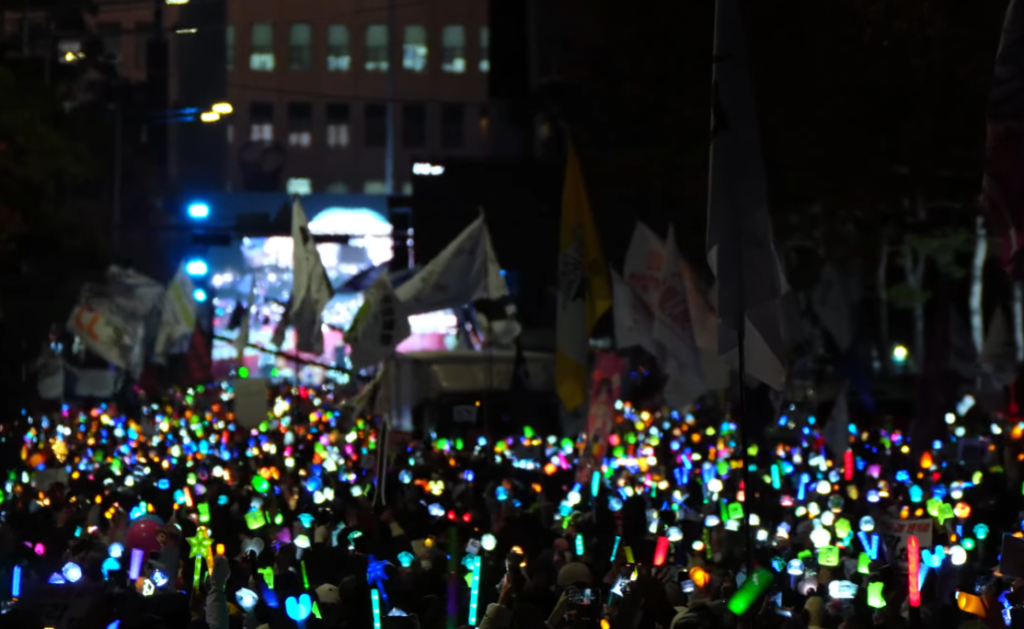
- Democracy’s Price: Not Inevitable, but Earned
- The 1980 Gwangju Uprising: The Conscience of a Nation
- Fictional Realities: Sandglass, Made in Korea, and the YH Trade Incident
- The 1987 June Struggle: Breaking the “Gym Elections”
- The Martyr Calendars and the Weight of the Past
- Modern Echoes: The 2024 Martial Law and the Light of Revolution
Democracy’s Price: Not Inevitable, but Earned
When you walk through the neon-lit streets of Seoul today, it is easy to assume that freedom was always the default state of this nation. But as someone living in Korea, I am constantly reminded that our democracy did not simply “happen” as time passed. It was snatched from the jaws of authoritarianism. Many of us grew up watching dramas that depicted the 70s and 80s—the eras of Park Chung-hee and Chun Doo-hwan—not as distant historical curiosities, but as visceral reminders of what we might still be facing if the people hadn’t stood their ground.
Dictatorship doesn’t just fade away; it is a monster that must be actively dismantled. Through this process, a nation builds its unique narrative and develops a shared sense of community and democracy. We see this narrative play out in the recent Disney+ series Made in Korea(View Drama Review), which captures the suffocating atmosphere of the military regime. Without the courage of those who came before us, the life depicted by Hyun Bin in that series—a life of fear, surveillance, and suppression—could very well have been our current reality.
The 1980 Gwangju Uprising: The Conscience of a Nation
If there is a singular event that serves as the bedrock of modern Korean democracy, it is the May 18 Gwangju Democratization Movement. In 1980, the military junta led by Chun Doo-hwan unleashed paratroopers on the citizens of Gwangju who were calling for the end of martial law. The result was a horrific massacre, a bloody stain on our history that the regime tried to bury under layers of propaganda and isolation.
The military sought to justify this violence by labeling the citizens as “rioters” or “communist rebels.” They even used this tragedy to target political rivals; most notably, Kim Dae-jung was falsely accused of inciting the uprising and was subsequently sentenced to death by the military junta. His life was only spared after intense international pressure, and he would eventually go on to become a President and a Nobel Peace Prize laureate, symbolizing the triumph of resilience.
💡 Local Note: For years, the truth about Gwangju was suppressed. Even current President Lee Jae-myung has shared how he, as a youth, initially believed the military’s propaganda that the Gwangju citizens were a violent mob. It was only after learning the horrific truth later that he felt a deep sense of remorse, a turning point that drove his commitment to social justice.
The Gwangju Uprising failed in the short term, crushed by overwhelming military force. However, it succeeded in awakening the nation’s conscience. Thousands of students, workers, and citizens pledged never again to turn a blind eye to such state-sponsored violence. It was the spark that ignited a fire that eventually consumed the dictatorship.
Fictional Realities: Sandglass, Made in Korea, and the YH Trade Incident
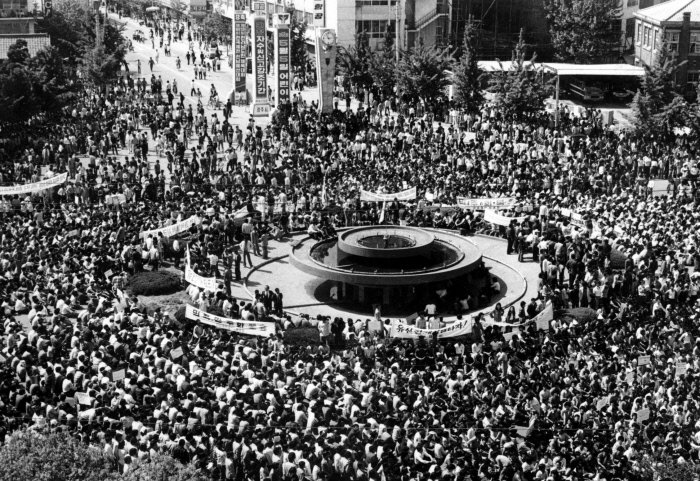
The legendary 1995 drama Sandglass (Moraisigye) was one of the first to realistically portray the Gwangju massacre, stopping the nation in its tracks. One of its most poignant arcs reflects the real-life 1979 YH Trade Incident, a pivotal moment in the downfall of the Park Chung-hee regime.
In 1979, female workers at YH Trade were protesting unfair layoffs. They sought refuge in the headquarters of the opposition party. The police launched a brutal raid, resulting in the death of a young worker, Kim Gyeong-suk. This incident exposed the absolute depravity of the dictatorship—showing how the state would use lethal force against its own vulnerable citizens just to protect corporate and political interests. This scene in Sandglass reminds us that the “good old days” often touted by nostalgics were actually built on the broken lives of the working class.
The 1987 June Struggle: Breaking the “Gym Elections”
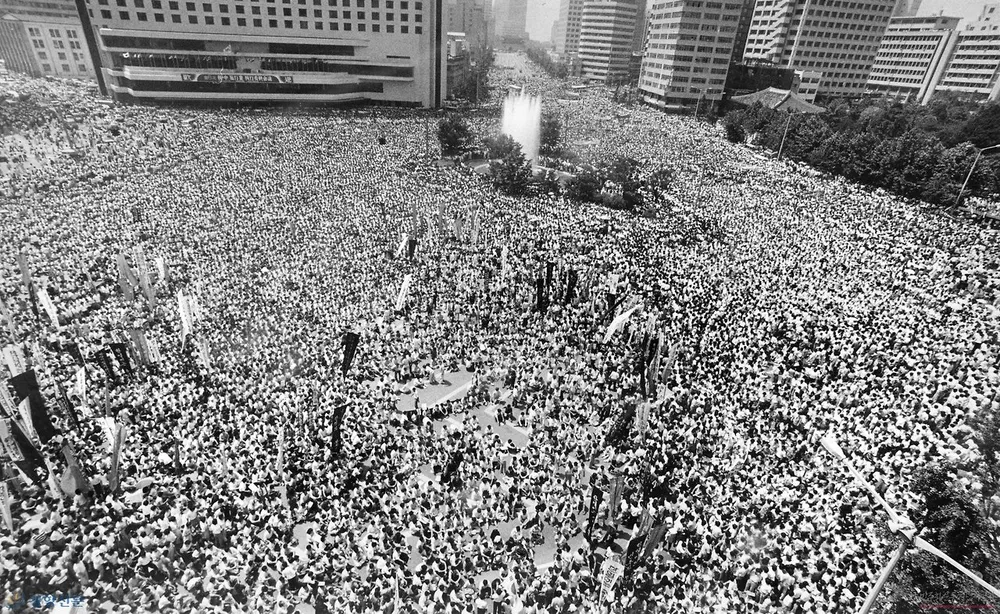
By 1987, the pressure cooker of Korean society was ready to explode. The Chun Doo-hwan regime maintained a sham democracy through “gym elections,” where a puppet electoral college (the National Conference for Unification) would “elect” the president in a sports arena, far from the reach of the people. The demand for a direct presidential election became the rallying cry of the June Struggle.
This wasn’t a quick revolution; it was a grueling, month-long battle in the streets. From the death of student activist Bak Jong-cheol under police torture to the fatal injury of Lee Han-yeol by a tear gas canister, the cost was immense. But the collective will was unbreakable. Eventually, the regime bowed, leading to the June 29 Declaration and the first direct presidential election in decades. The military elite eventually had no choice but to yield to the public’s demand for democracy, and the institutional foundations of democracy were gradually established.
The Martyr Calendars and the Weight of the Past
Growing up in the aftermath of these struggles, I remember the “Martyr Calendars” (Yeolsa Dalryeok). These were not your typical calendars; they were filled with the names and death anniversaries of those who died during the democratization and labor movements. Every month was a dense list of sacrifices. These names—students, factory workers, ordinary fathers and mothers—served as a constant reminder that our current peace is an expensive luxury paid for by others.
While some are frustrated that the transition was gradual and that dictators like Chun Doo-hwan lived long lives without full legal retribution, the steady progress solidified our democratic institutions. We moved from the 1960 April 19 Revolution against Rhee Syngman to the 1980 Gwangju Uprising and the 1987 June Struggle. Each step was a brick in the wall that now protects us from the return of tyranny.
Modern Echoes: The 2024 Martial Law and the Light of Revolution
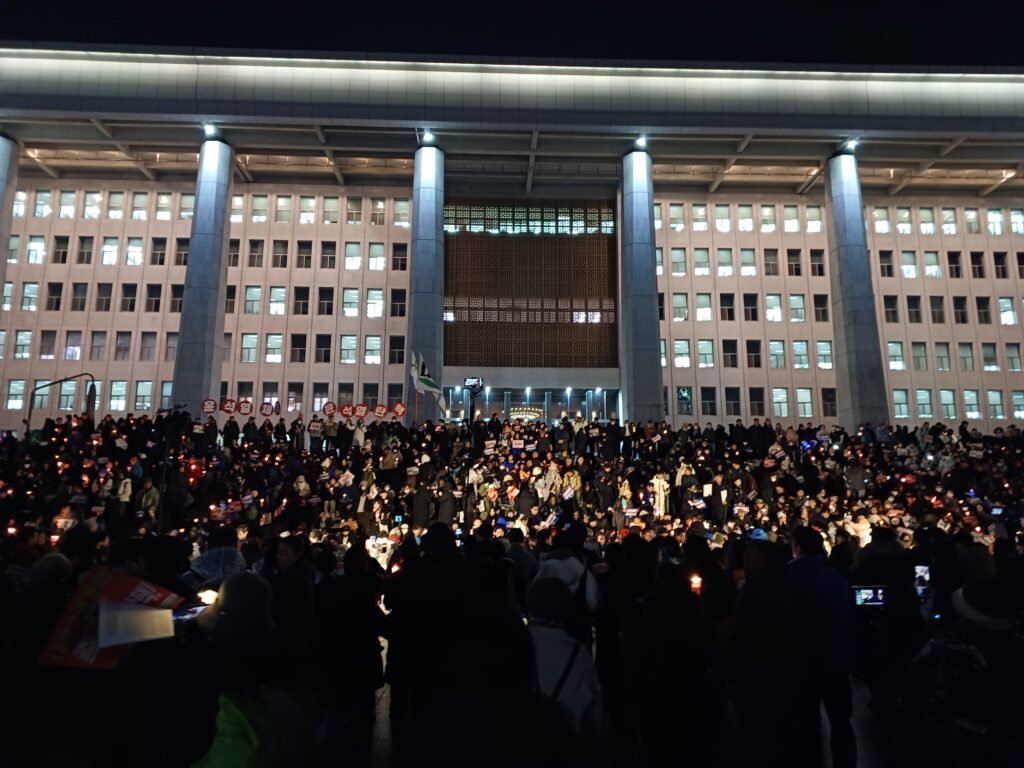
The strength of this historical narrative was put to the ultimate test in late 2024. When a reckless and illegal declaration of martial law was made, threatening to drag Korea back into the dark ages of the 70s, the response was instantaneous. The citizens did not wait for instructions. They remembered the lessons of 1980 and 1987.
Ordinary people stood in front of armored vehicles and faced down soldiers, refusing to let the military enter the National Assembly. This “Revolution of Light” (Bicheui Hyeongmyeong) was the spiritual successor to the 2016 Candlelight Revolution that led to the impeachment of Park Geun-hye. It proved that the spirit of the 1919 Provisional Government, which first proposed the name “Republic of Korea” and a democratic republic system over a century ago, is finally fully realized in the hearts of the people.
Korean Culture portal KCulture.com
Join the mailing service and add to your favorites.

Founder of Kculture.com and MA in Political Science. He shares deep academic and local insights to provide an authentic perspective on Korean history and society.