I often tell my friends that if you’re looking for the true pulse of modern Korean society, don’t look at the palaces or the high-tech skyscrapers—look at the cafes. In Seoul, you can’t throw a stone without hitting a coffee shop. From minimalist concrete cubes to five-story themed palaces, the sheer density of these spaces often leaves visitors asking: “How much coffee can one nation drink?” But here’s the secret: for us, it was never just about the caffeine. In this understanding South Korean cafe culture guide, we’ll explore how the cafe became the nation’s shared living room, a high-tech study hub, and a sanctuary of social trust.
- The Shared Living Room: The Sociology of Space
- The “Eol-Juk-A” Phenomenon: Why Iced Coffee Rules the Winter
- High-Tech Hospitality: Pagers, Kiosks, and Infrastructure
- The Miracle of Trust: The Great Laptop Mystery
- Visual and Taste Sensations: From Croffles to Mugwort
- Essential Etiquette: The Unwritten Rules of the K-Cafe
The Shared Living Room: The Sociology of Space
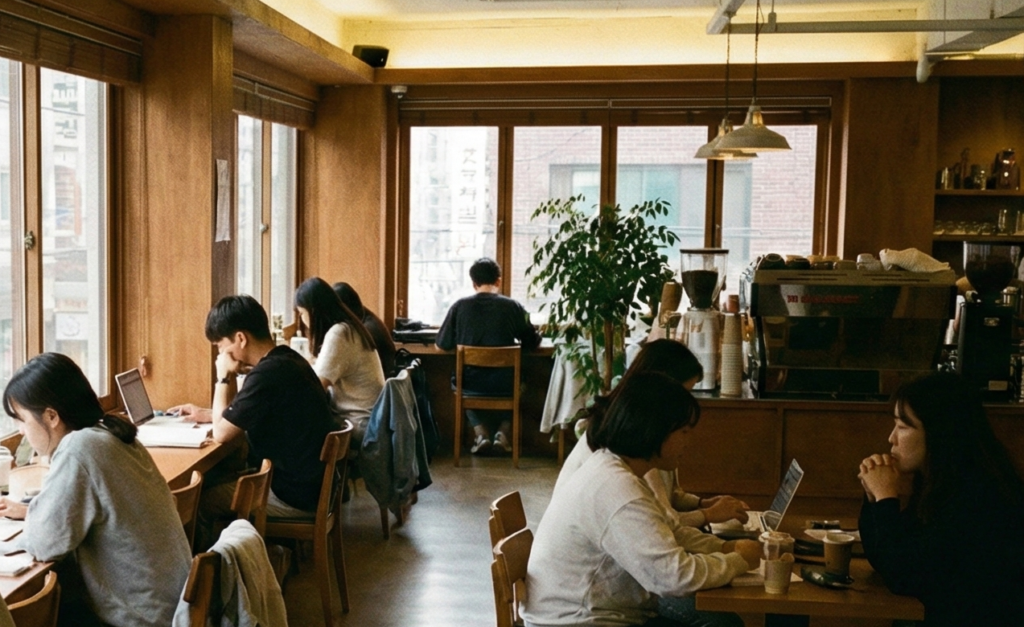
The first thing foreigners notice is that Koreans don’t just “grab a coffee”; they “occupy” the cafe. To understand why, you have to look at Korean housing. Many young Koreans live in officetels or small apartments where inviting friends over isn’t always practical. Consequently, the cafe has evolved into a “Shared Living Room.” It’s where we host birthday chats, hold first dates, and conduct business meetings. It is the quintessential “Third Space”—the sanctuary between home and work.
This has given rise to the Ka-gong-jok (Cafe-Study Tribe). If you walk into a cafe near a university like Yonsei or SNU, you’ll see rows of students with dual monitors, tablets, and noise-canceling headphones. Many travelers ask on Reddit, “Is it okay to stay for four hours with one latte?” In Korea, the answer is generally yes, provided the cafe isn’t packed. The “rental fee” for the space is included in the price of your 6,000 KRW Americano. It’s a culture that respects the need for a quiet, productive environment away from the cramped quarters of a dormitory or a busy home.
Local Insight: This culture is so prevalent that many cafes now feature “Study Zones” with individual cubicles and power outlets built directly into every single table. In Korea, “Cafe hopping” isn’t just a hobby; it’s a lifestyle necessity.
The “Eol-Juk-A” Phenomenon: Why Iced Coffee Rules the Winter
Even when the Siberian winds blow through the streets of Seoul and the temperature drops to -15°C, you will see Koreans clutching plastic cups filled with ice. We have a specific term for this: Eol-Juk-A. It’s an abbreviation for “Eol-eo Juk-eo-do Ice Americano,” which literally translates to “Even if I freeze to death, I’m drinking an Iced Americano.”
Why the obsession? It’s partly about efficiency. Koreans value Pali-Pali (hurry-hurry) culture. A hot coffee requires sipping and waiting; an iced Americano can be chugged in seconds, providing an immediate caffeine hit to power through a long workday. Furthermore, the modern Korean diet—often featuring spicy, hot stews like Kimchi-jjigae—makes a freezing, bitter coffee the perfect palate cleanser. It’s the ultimate refreshing finish to a “K-Dessert Course” that follows every meal.
High-Tech Hospitality: Pagers, Kiosks, and Infrastructure
The service in a Korean cafe is a masterclass in efficiency and technology. For many visitors, the first encounter with a Vibrating Pager (Jin-dong-bell) is a revelation. Instead of a barista shouting your name, you get a sleek disc that buzzes when your order is ready. It allows you to find a seat on the third floor without worrying about missing your drink. (Notably, Starbucks in Korea is an exception to this; they stick to their global policy of calling out order numbers or nicknames instead of using pagers.)
In 2025, non-face-to-face ordering via Kiosks has become the standard. While this can be daunting for tourists, most modern kiosks now offer English, Chinese, and Japanese language support. Beyond the ordering, the infrastructure is what truly wins people over. In Korea, “Free Wi-Fi” isn’t just a perk; it’s a human right. You can expect blazing-fast speeds and, more importantly, a sea of electric outlets. Finding a “No Outlet” cafe in Seoul is harder than finding a needle in a haystack.
| Feature | Korean Cafe Experience | Visitor Impression |
|---|---|---|
| Internet | Ultra-high speed, password usually on the receipt. | “Faster than my home Wi-Fi!” |
| Power Outlets | Available at almost every seat. | “Perfect for digital nomads.” |
| Ordering | Kiosk or mobile app (Pass-order). | “Efficient but requires a card.” |
| Pick-up | Vibrating pager system (Except Starbucks). | “No more shouting names!” |
The Miracle of Trust: The Great Laptop Mystery
Perhaps the most shocking thing for any expat or traveler is the “Laptop Test.” If you walk into a Starbucks in Gangnam, you will see tables laden with MacBook Pros, iPhones, and designer handbags—completely unattended. The owner is likely in the restroom or ordering another drink downstairs. This isn’t a glitch in the matrix; it’s a reflection of the profound social trust and the density of CCTV cameras in Korea.
Local Note: While losing belongings is extremely rare in Korea, it’s not completely non-existent. There are very minor exceptions to this high standard of trust that occur occasionally. For instance, on a rainy day, someone might accidentally(?) walk off with the wrong cheap umbrella from a communal stand, or there might be an infrequent report of a missing bicycle.
Visual and Taste Sensations: From Croffles to Mugwort
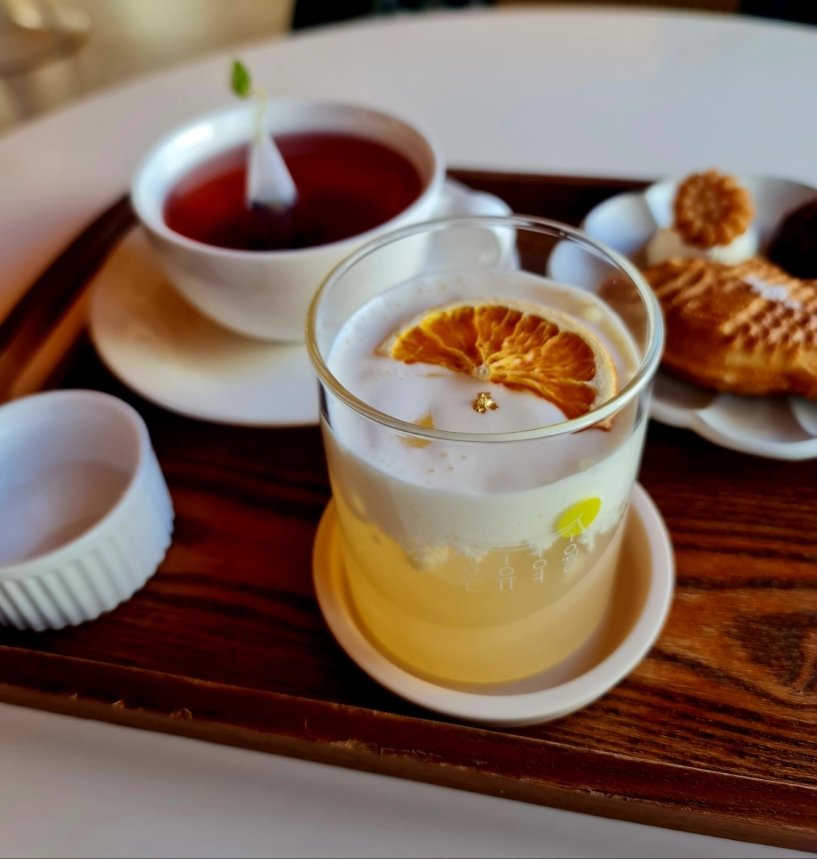
Korea is the world capital of “Instagrammable” food. We don’t just eat; we document. This has led to the rise of incredible fusion desserts. The Croffle (a croissant pressed in a waffle iron) reached its peak perfection here. Then came the “Salt Bread” (Sogeum-ppang) craze, and most recently, a revival of traditional aesthetics.
Modern cafes are now leaning into “Grandma-core” flavors—ingredients known as Hal-mae-ni-al (Grandma + Millennial). You’ll find:
- Mugwort (Ssuk) Lattes: Earthy, green, and surprisingly creamy.
- Black Sesame (Heuk-im-ja): Rich, nutty, and visually striking.
- Injeolmi: Toasted soybean powder that adds a nostalgic sweetness to shaved ice (Bingsu).
- Gaeseong Juak: Traditional honey-glazed donuts that look like glossy jewels.
These aren’t just snacks; they are edible art pieces designed to be photographed against the backdrop of the cafe’s unique interior design.
Essential Etiquette: The Unwritten Rules of the K-Cafe
To enjoy the Korean cafe scene like a local, there are a few unwritten rules you should follow to avoid the side-eye from staff or other patrons.
1. The “One Drink Per Person” Rule
Most cafes in Korea strictly enforce a “One Person, One Order” policy. Even if you aren’t very thirsty, if you are taking up a seat, you must order at least one beverage. Ordering one giant cake for three people and no drinks is generally considered a breach of etiquette, as you are paying for the “rent” of the space.
2. The Self-Return System
Unlike some European cafes where you leave your cups on the table, Korea is a “Self-Return” culture. Look for a station labeled “Return”. You are expected to bring your tray there and, most importantly, separate your trash. There will be specific bins for liquids, ice, plastic cups, and paper sleeves. It’s part of the collective effort to keep these shared spaces clean.
3. No-Kids and No-Laptop Zones
While most cafes are welcoming, some popular “Hot-place” cafes in areas like Seongsu or Ikseon-dong have designated No-Kids Zones for safety and atmosphere. Recently, some smaller aesthetic cafes have also introduced No-Laptop Zones during weekends to ensure that the “Shared Living Room” remains a place for conversation rather than a silent office.
Understanding South Korean cafe culture is about realizing that these spaces are the heart of our social fabric. They are where we work, play, love, and—occasionally—drink some really excellent coffee. So, the next time you’re in Seoul, grab an iced Americano (even if it’s snowing!), find a cozy corner, and leave your laptop on the table. You’re finally living like a local.
Korean Culture portal KCulture.com
Join the mailing service and add to your favorites.

Founder of Kculture.com and MA in Political Science. He shares deep academic and local insights to provide an authentic perspective on Korean history and society.