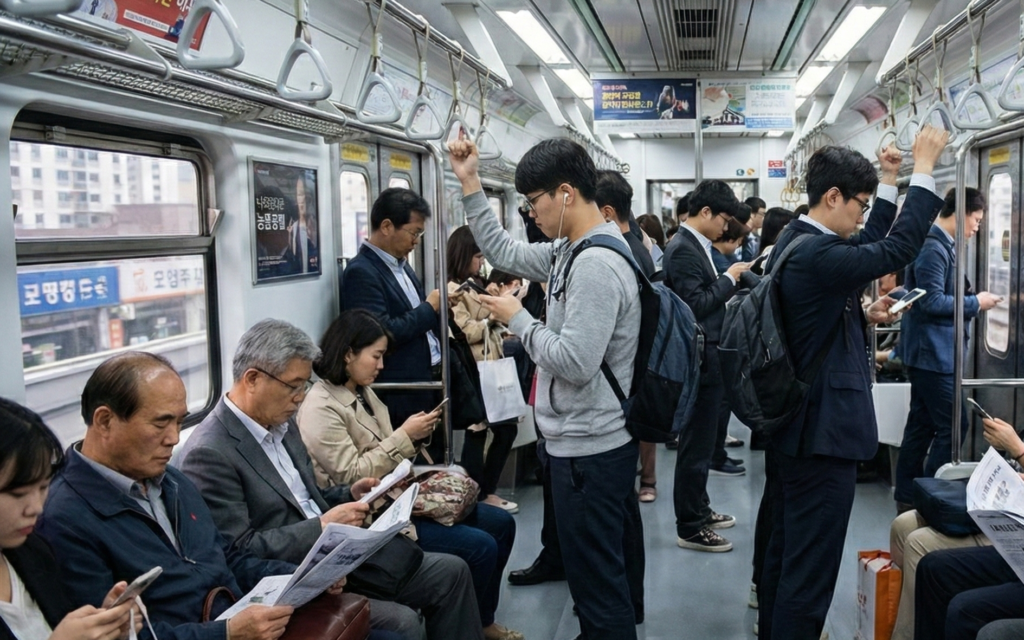
If you have ever taken a ride on the Seoul Metro during rush hour, you might have noticed something peculiar. Despite being packed shoulder-to-shoulder with hundreds of people, the carriage is often enveloped in a profound silence. No “How are yous,” no comments on the weather, just the hum of the train and the collective gaze fixed on smartphones. For travelers coming from cultures where chatting with strangers is the norm, small talk in Korea—or the lack thereof—can be quite a culture shock.
I often hear visitors confess that they feel a bit isolated here, mistaking this silence for coldness or indifference. But as someone living in Korea, I want to unpack this phenomenon for you. It isn’t about being rude; it is actually a complex, unspoken social agreement. Let’s dive into why Koreans tend to avoid small talk and why this silence is actually a form of loud respect.
- The Misunderstood Silence: Is It Coldness?
- The Architecture of Coexistence
- Action Over Words: The Caring Reality
- The Rural Exception: When Silence Breaks
- Where to Find the Conversation You Seek
The Misunderstood Silence: Is It Coldness?
First, let’s address the elephant in the room. In many Western cultures, acknowledging a stranger’s presence with a nod or a quick comment is a sign of politeness. It validates the other person’s existence. Consequently, when you smile at a Korean stranger on the street and receive a blank stare in return, or when you try to start a conversation in a cafe line and get a one-word answer, it is easy to feel rejected.
However, you must understand that the baseline setting for public interaction in Korea is different. In Korean society, “politeness” toward strangers is often defined by non-intrusion. Engaging a stranger in conversation without a specific purpose can be seen as burdensome—you are demanding their time and attention, which are considered precious resources in a fast-paced society.
💡 Local Insight: The silence you experience isn’t a barrier built to keep you out; it is a bubble specifically designed to protect everyone’s peace inside.
The Architecture of Coexistence
To truly understand why small talk in Korea is rare, we need to look at the environment. South Korea, particularly Seoul, went through incredibly rapid industrialization. We have millions of people living in high-rise apartments and commuting in some of the densest urban environments on Earth.
Imagine your daily life involves being physically pressed against strangers on a crowded bus for an hour every morning. In such a high-density environment, physical distance is impossible. Therefore, Koreans create psychological distance to survive.
The Unwritten Rule of the Commute
Maintaining a stoic silence is a technique for coexistence. It is a way of saying, “I acknowledge we are stuck in this tight space together, so I will grant you the only privacy I can offer—by pretending you aren’t there and not invading your mental space.”
If everyone started chatting on the subway, the sensory overload would be unbearable. By keeping to ourselves, we are actually being considerate neighbors in a crowded city. It’s not ignoring you; it’s respecting your right to a quiet journey.
Action Over Words: The Caring Reality
If you think this lack of verbal interaction means Koreans don’t care about each other, look closer. The concept of Jeong (deep affection and attachment) is fundamental to Korean culture, but it often manifests in actions rather than casual words.
The best proof of this contradicts the “cold” theory entirely. Observe the seating priority seats on any subway car or bus.
- The Silent Exchange: You will often see a tired young person instantly spring up to offer their seat to an elderly person, a pregnant woman, or someone carrying heavy luggage.
- No Words Needed: This exchange usually happens with zero small talk. The giver stands up, the receiver sits down, perhaps with a slight bow of the head. No “Here you go,” no “Thank you so much, how kind.” Just action.
If Koreans were truly indifferent or cold, these acts of concession wouldn’t happen. But they happen thousands of times a day. We care deeply about the collective well-being; we just don’t feel the need to narrate it with pleasantries.
The Rural Exception: When Silence Breaks
Now, here is a twist that even catches local Koreans off guard. If you leave the frantic energy of Seoul and travel to the countryside—places like rural Jeolla-do or Gyeongsang-do—the rules of small talk in Korea completely flip.
In small villages, where communities have lived together for decades, anonymity doesn’t exist. Here, local elders (grandmas and grandpas) are the masters of small talk.
I have traveled to rural areas and been grilled by a grandmother at a bus stop: “Where are you from?” “Are you married?” “Why is your bag so heavy?” It can be startling! Even for us city-dwelling Koreans, this sudden intimacy can be overwhelming/ But it highlights a key point: the silence is a product of urban necessity, not an inherent Korean trait. In the countryside, connection is the currency.
Where to Find the Conversation You Seek
So, does this mean you can’t make friends or have great conversations in Korea? Absolutely not. You just need to know where to look. Trying to chat up a busy salaryman on the street will fail, but Korea has specific “zones” where social barriers are lowered, and engagement is expected.
If you are seeking connection, skip the subway chat and try these spots instead:
| Location Type | Vibe & Expectation |
|---|---|
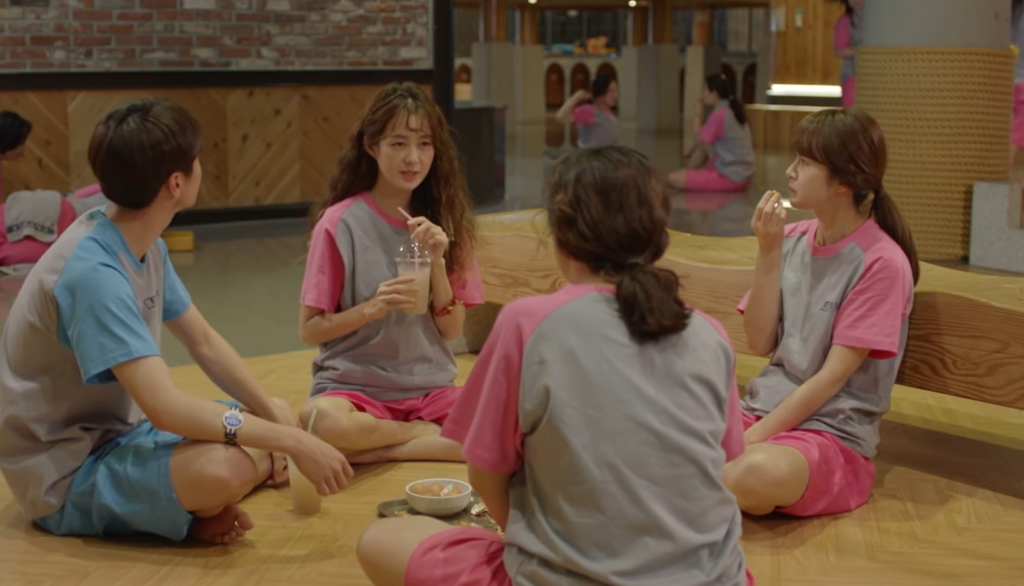
| Guesthouses & Hostels | Specifically designed for interaction. Common rooms in areas like Hongdae or Itaewon are buzzing with travelers and locals looking to chat. |
| Pojangmacha (Tent Bars) | Late at night, over a bottle of Soju, the social walls come down. It is much more acceptable to strike up a conversation with neighboring tables here than in a fancy restaurant. |
| Hiking Trails | Koreans love hiking. On a mountain trail, sharing food or a quick greeting (“Annyeonghaseyo”) with passing hikers is very common and welcomed. |
Understanding the nuance of small talk in Korea is key to enjoying your trip. Do not take the silence personally. Instead, appreciate it for what it is: a respectful gesture of giving you space in a crowded world. And when you are ready to talk, head to the places where the noise is welcomed—you’ll find Koreans are some of the warmest people once the correct context is set.
Korean Culture portal KCulture.com
Join the mailing service and add to your favorites.

Founder of Kculture.com and MA in Political Science. He shares deep academic and local insights to provide an authentic perspective on Korean history and society.