Living in Korea, a nation that absorbs new technologies faster than almost any other, I witness firsthand a monumental shift in how we consume information. Traditional TV viewership has plummeted, and an overwhelming amount of video content is now consumed on platforms like YouTube, which has effectively become the primary source for daily news. Furthermore, Korea boasts one of the highest paid subscription rates for generative AI services globally, illustrating how rapidly and deeply we are adapting to this new digital environment. However, this hyper-exposure comes with significant side effects. Much like in other parts of the world, we are observing a concerning trend of young people leaning heavily into extreme right-wing ideologies, sparking intense debates about the underlying causes. As the generation that spent their formative years isolated by the pandemic becomes the driving force of our society in 2026, their primary lens for understanding the world is no longer the physical community, but hyper-personalized AI. This article explores how this radical shift from traditional socialization to algorithmic echo chambers threatens our free will, and why we must urgently address it.
- The Shift in Political Socialization: From Community to Algorithms
- The Dopamine Trap and the Deepening Abyss of Confirmation Bias
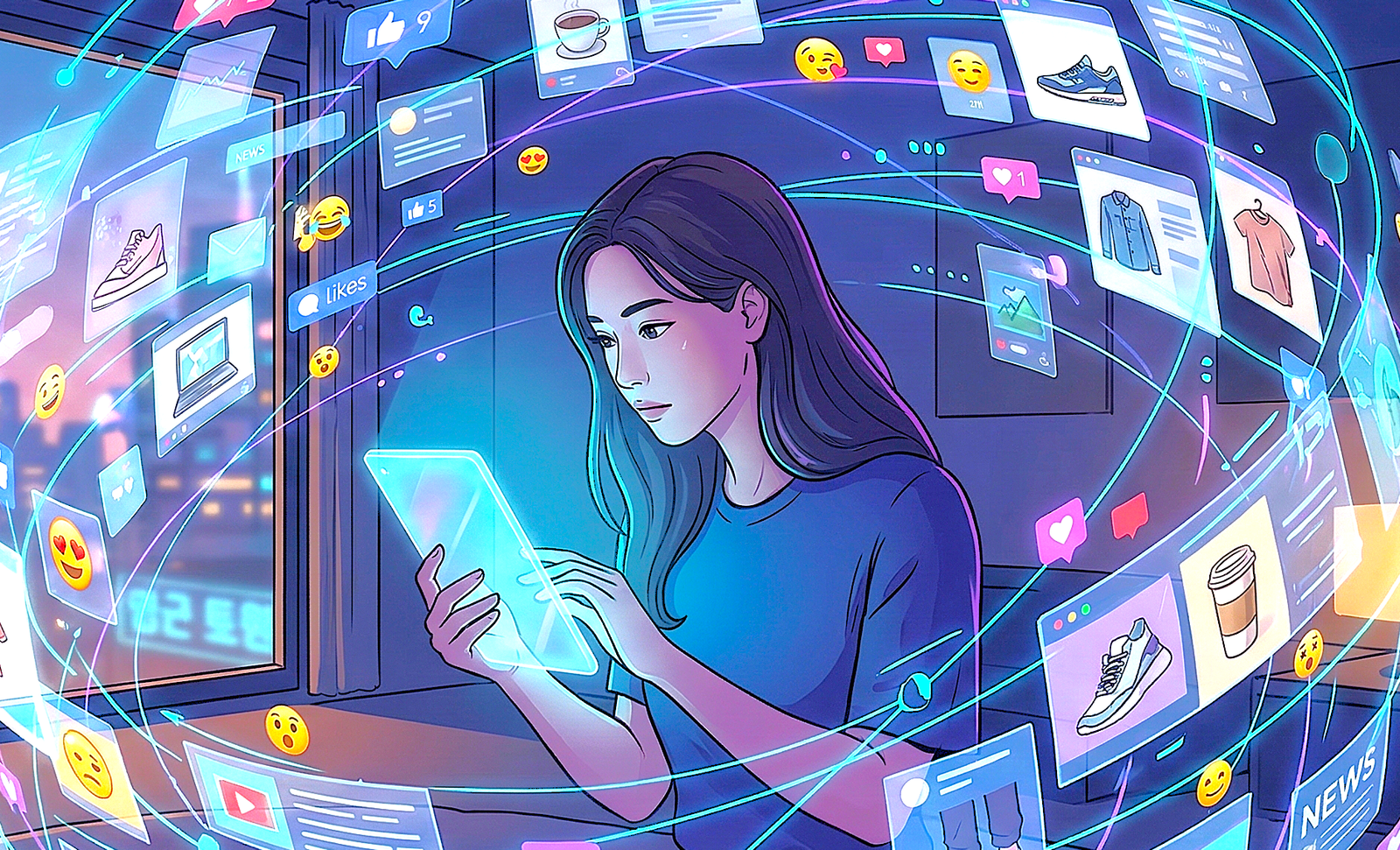
- The Fully Surrounded Human: Hyper-Personalized AI and Echo Chambers
- The Illusion of Choice: When Freedom is No Longer Free
- Reclaiming Our Autonomy in the Age of National AI
The Shift in Political Socialization: From Community to Algorithms
When I was studying political science, the established academic consensus on political socialization was clear: our worldviews and attitudes are heavily shaped by our “primary groups,” such as parents, teachers, and local neighborhood dynamics. Walter Lippmann’s concept of “stereotypes” and the cognitive psychological framework of “schemas” demonstrated that human values are rarely based on pure objective facts. Instead, they are internalized through personal experiences and the emotional bonds of our immediate physical surroundings.
However, living in Seoul today, I see that the agents of this socialization have entirely shifted. For the youth whose physical interactions were severely curtailed during the pandemic, the recommendation algorithms of YouTube and social media have completely replaced the schemas once built by family and local communities. These video platforms, initially adopted to fill the void of severed face-to-face communication, have become the most powerful, and often the only, window through which the new generation interprets reality.
| Aspect of Socialization | Traditional Era (Pre-Pandemic) | Algorithmic Era (2026 Present) |
|---|---|---|
| Primary Influencers | Family, peers, local community leaders | YouTube algorithms, AI recommendations, Influencers |
| Information Flow | Dialogue-based, often requiring conflict mediation | Unidirectional, highly curated, emotionally stimulating |
| Worldview Formation (Schema) | Built through shared physical experiences | Built through digital consumption history and data tracking |
The Dopamine Trap and the Deepening Abyss of Confirmation Bias
Our brains, exposed to highly stimulating and aggressively edited short-form videos from a young age, constantly demand dopamine. The ultimate goal of platform algorithms is viewer retention. To keep audiences hooked, they meticulously analyze viewing histories to serve content that is not only palatable but increasingly extreme. In this dopamine-driven environment, logical reasoning and rigorous fact-checking are marginalized.
This detrimental impact on individual cognition and democratic processes is not just theoretical; it has been extensively documented and rigorously fact-checked by Korean scholars.
- Algorithmic Amplification of Bias: Communication scholar Kang Myung-hyun has demonstrated that YouTube’s algorithms actively provoke users into confirmation-biased behaviors. Rather than fostering logical, fact-based judgment, the platform is designed to blindly reinforce pre-existing beliefs to maximize watch time.
- The Filter Bubble Effect: Content analysis experts Shin Yoo-jin and Lee Sang-woo have shown how these recommendation systems create impenetrable “filter bubbles” using text mining techniques. By trapping users in a loop of homogeneous information, the algorithm effectively blocks their access to objective truths and opposing viewpoints.
- Polarization and Group Conflict: Empirical research conducted by Choi Eui-rak at Sogang University (서강대학교) further underscores this crisis. The study points out that unchecked reliance on YouTube algorithms maximizes confirmation bias, which directly translates into extreme group conflicts within our society.
The Fully Surrounded Human: Hyper-Personalized AI and Echo Chambers
The technology we interact with daily goes far beyond simple video recommendations. A word casually dropped during a conversation at a cafe in Gangnam-gu (강남구), or a single product searched online, is instantly converted into behavioral data, flooding our screens with hyper-personalized advertisements. AI now identifies our personal tastes, political leanings, and emotional vulnerabilities in real-time to construct a bespoke, inescapable worldview.
Consequently, we are entirely surrounded by a virtual reality built from our own past data. Stripped of the cognitive breathing room needed to weigh facts and causal relationships, we lose our grip on shared reality. The physical human interactions that once forced us to navigate differences, tolerate opposing views, and mediate conflicts have vanished. Instead, we voluntarily lock ourselves inside an echo chamber where only the things we want to see and the words we want to hear echo back to us.
The Illusion of Choice: When Freedom is No Longer Free
“If our personal tastes and political outrage are meticulously engineered by the algorithms of tech giants, the freedom we believe we enjoy is a mere illusion.”
In classical liberal philosophy, true human freedom is defined as the state of being able to make choices based on one’s own free will. At the foundation of these choices lies a preference based on a mix of emotion and reason. But what happens when the very process of forming those emotions and preferences is hijacked?
If our desires are reflexively generated by biased stimuli injected by an algorithm, devoid of any effort to objectively perceive the subject or think logically about cause and effect, can we genuinely call this “pure free will”? When our likes, dislikes, and even our political anger are cultivated by AI designed for corporate profit, our autonomy is deeply compromised. The fragmented individual, isolated from the physical community and absorbed into the smartphone, is paradoxically at the greatest risk of surrendering their freedom to the invisible dictators of AI and algorithms.
Reclaiming Our Autonomy in the Age of National AI
To protect our human agency from this massive cycle of algorithm-controlled bias, we must urgently consider solutions on a societal level. Recently, the current Lee Jae-myung administration has placed a massive focus on AI research and development, successfully passing the long-awaited AI Basic Law. The administration’s vision is to make AI a public good that benefits all citizens evenly, rather than a tool monopolized by a privileged few.
While fostering technological advancement is crucial, we must pay close attention to the ethical frameworks and algorithmic transparency within this process. It is imperative that the government ensures these newly developed AI systems do not inadvertently reinforce existing prejudices or serve narrow political and corporate interests under the guise of public utility. True technological progress cannot come at the cost of human agency. We must no longer leave individuals defenseless, abandoned to be dominated and manipulated by opaque algorithms. It is time to establish robust social and legal safeguards that protect our cognitive independence, ensuring that the technology meant for all citizens does not become the very tool that strips away our fundamental freedom.
Korean Culture portal KCulture.com

Founder of Kculture.com and MA in Political Science. He shares deep academic and local insights to provide an authentic perspective on Korean history and society.