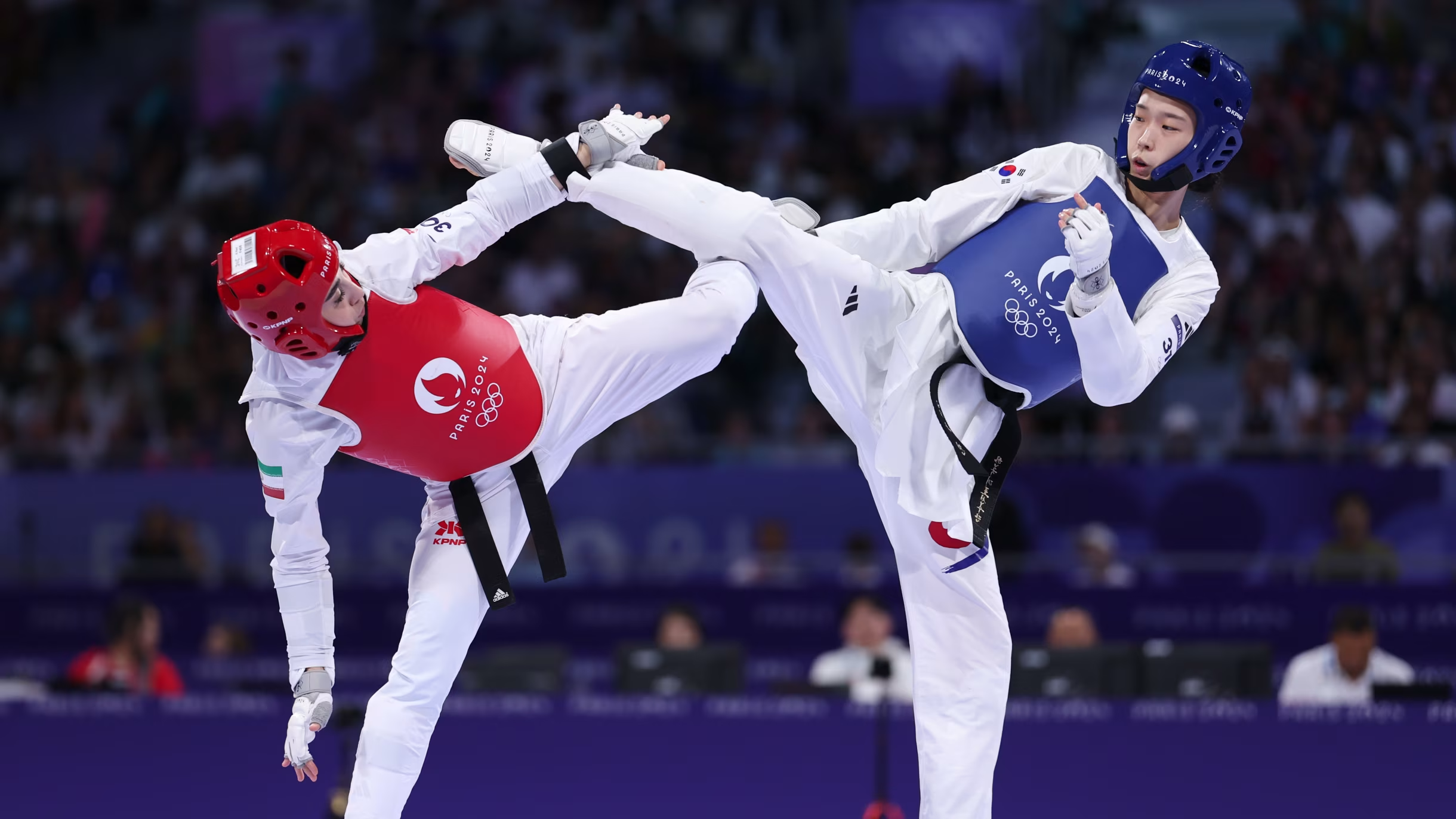
There is hardly anyone in the world who doesn’t know about Taekwondo (태권도). As a famous sport originating from Korea, Taekwondo dojangs are actively thriving globally, and it is a well-known fact that many countries often secure their very first Olympic medals through this dynamic sport. If you are exploring the roots of Korean combat disciplines, understanding the deep historical connection between Taekkyeon (택견) and Taekwondo is absolutely essential. Taekkyeon is Korea’s indigenous, fluid martial art focused on harmony and co-existence, whereas Taekwondo represents its modern, dynamic reinterpretation. Living in Korea, I vividly remember practicing Taekwondo during my mandatory military service, a shared experience since all Korean men serve in the military and are given the opportunity to earn their 1st-degree black belt. Furthermore, Taekwondo occupies a massive part of our modern daily life and national sports culture. Walk through any neighborhood, and you will find numerous children’s Taekwondo academies, making it a quintessential childhood experience for most Koreans. This modern transformation from traditional roots was largely driven by early modern martial artists who, after studying foreign disciplines, were deeply stimulated to unearth and modernize Korea’s traditional martial heritage to reclaim their cultural identity.
- Taekkyeon: The Indigenous Root of Korean Martial Arts
- The Birth of Taekwondo: Reclaiming Identity Through Modernization
- Taekkyeon vs. Taekwondo: A Cultural and Physical Comparison
- Experiencing Traditional Martial Arts in Korea
Taekkyeon: The Indigenous Root of Korean Martial Arts
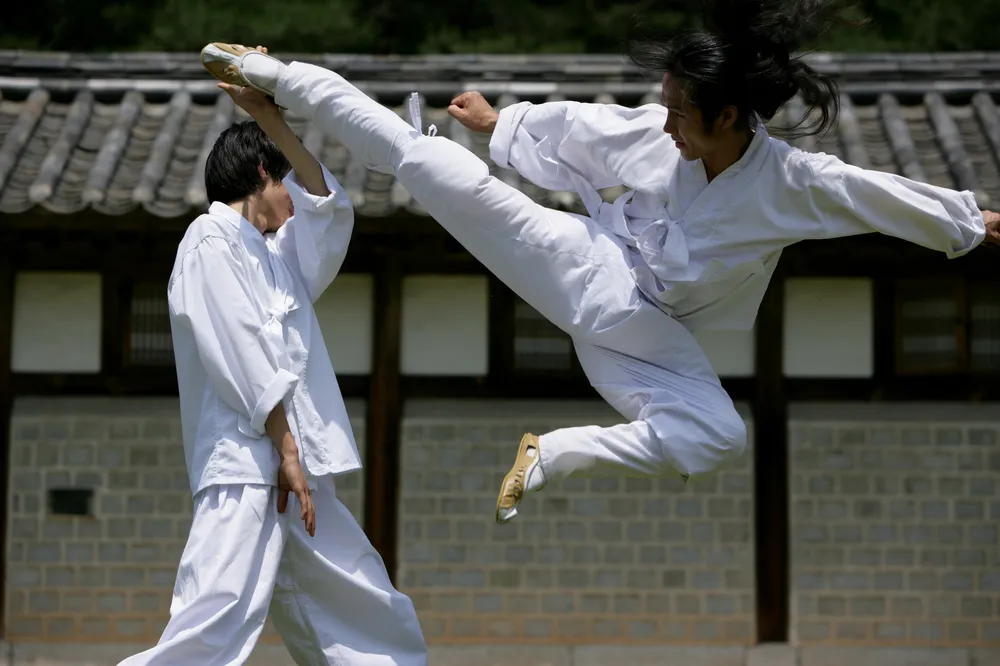
To truly grasp the spirit of Korean martial arts, we must first look at Taekkyeon. Recognized in 2011 as the first martial art ever to be inscribed on the UNESCO Intangible Cultural Heritage list, it is a beautifully deceptive discipline. On the surface, it looks like a rhythmic dance, but hidden within its fluid motions is a formidable system of strikes and sweeps.
History and Preservation
The origins of this art trace back to the Three Kingdoms period, but it truly flourished during the Joseon Dynasty as both a popular folk game and a serious combat technique. Academic research by cultural historian Sim Seung-gu notes that classic Joseon-era texts, such as the Jaemulbo (재물보) from 1798 and the Haedong Jukji (해동죽지) from 1925, provide concrete descriptions of its techniques and its immense popularity among the common people.
Tragically, during the Japanese colonial period, policies aimed at erasing Korean culture pushed Taekkyeon to the brink of extinction. It was miraculously preserved by Master Song Deok-gi (송덕기), often referred to as the last Taekkyeon practitioner of the Joseon era. Through his dedication, the art survived to be designated as South Korea’s National Intangible Cultural Heritage No. 76 in 1983, solidifying its identity not merely as a sport, but as a vital cultural asset.
The Philosophy of Co-existence
According to extensive studies by martial arts historian Lee Yong-bok, the core philosophy of Taekkyeon lies in “Sangsaeng” (상생), meaning mutual co-existence. The goal is never to brutally destroy the opponent. Instead, practitioners utilize the opponent’s momentum against them, aiming to offset their balance or lightly touch their face. This profound respect for life is a cornerstone of Korea’s traditional martial spirit.
The Birth of Taekwondo: Reclaiming Identity Through Modernization
While Taekkyeon is the ancient root, Taekwondo is the magnificent modern tree that grew from the desire to reclaim Korean identity in the 20th century. Following Korea’s liberation in 1945, martial arts in the country were heavily influenced by Japanese disciplines like Karate (Gongsudo). However, the masters of the era felt a profound calling to break away from colonial shadows.
Stimulus for Modernization
Prominent modern history researchers, such as Kang Won-sik and Lee Kyong-myong, explain that the early post-liberation martial arts schools, or “Kwans,” were initially founded by men who had trained in Karate and other modern sports during the occupation. However, these practitioners were deeply stimulated by the existence of indigenous arts like Taekkyeon. The survival of Taekkyeon challenged them to unearth their own traditional martial roots. They realized that to create a truly Korean discipline, they needed to look past imported techniques and draw inspiration from the rhythmic, high-kicking traditions of their ancestors.
The Reinterpretation and Systematization
In 1955, a naming committee led by General Choi Hong-hi coined the term “Taekwondo.” The name was deliberately chosen for its phonetic similarity to Taekkyeon, symbolically bridging the gap between the past and the present. From there, Taekwondo rapidly evolved. While it retained some structural elements from modern martial sports, it aggressively absorbed the defining physical traits of Taekkyeon—specifically its spectacular flying kicks, spinning techniques, and dynamic footwork.
Academic analyses by scholars like Yang Jin-bang highlight that this period also saw the integration of profound Korean philosophies, such as the Taeguk principles, into the “Poomsae” (forms). By combining the safety and competitive structure of modern sports with the acrobatic flair and philosophical depth of traditional Taekkyeon, Taekwondo was formalized into a highly scientific, modern sport, eventually earning its place in the 2000 Sydney Olympics.
Taekkyeon vs. Taekwondo: A Cultural and Physical Comparison
For international enthusiasts trying to distinguish between the two, looking at their movement lines and underlying philosophies offers the clearest perspective.
| Feature | Taekkyeon (The Traditional Root) | Taekwondo (The Modern Evolution) |
|---|---|---|
| Line of Movement | Circular, fluid, and dance-like. Uses rhythmic knee-bouncing steps called pumbalgi. | Straight, dynamic, and powerful. Characterized by explosive speed and flying kicks. |
| Core Philosophy | Sangsaeng (Co-existence). Focuses on unbalancing or safely subduing the opponent. | Geukgi (Self-control). Focuses on overcoming oneself through physical conditioning and precise striking. |
| Modern Status | UNESCO Intangible Cultural Heritage; a cultural art form with safe sporting rules. | A fully globalized Olympic sport with a highly systematized scoring structure. |
Experiencing Traditional Martial Arts in Korea
If you are planning a trip to Korea and want to experience this martial history firsthand, there are a few essential spots you must visit.
💡 Local Pro Tip:
To see the ancient art of Taekkyeon, visit the Namsangol Hanok Village (남산골한옥마을) in Seoul during the cultural festival seasons, where live demonstrations are often held in the courtyards. For Taekwondo, a pilgrimage to the Kukkiwon (국기원) in the Gangnam district is a must. They host incredible demonstration performances that showcase the absolute pinnacle of modern martial arts acrobatics.
Ultimately, Taekwondo did not simply emerge from nowhere, nor is it a mere copy of foreign styles. It is the result of modern visionaries who, inspired by the graceful resilience of Taekkyeon, reinterpreted Korea’s traditional martial spirit for the contemporary world. Together, these two disciplines tell a complete story of Korea’s past, its perseverance, and its triumphant leap onto the global stage.
Korean Culture portal KCulture.com

Founder of Kculture.com and MA in Political Science. He shares deep academic and local insights to provide an authentic perspective on Korean history and society.