The Eulmi Incident of 1895 was a tragic, state-sponsored assassination of Korea’s Empress Myeongseong by Japanese agents inside the royal palace, orchestrated to violently crush Joseon’s pro-Russian, anti-Japanese diplomatic policies. Living in Korea, I often watch visitors marvel at the breathtaking beauty of the royal palaces, unaware of the heavy, heartbreaking history concealed within their quietest courtyards. In this guide, we will step back in time to explore the geopolitical background of this tragedy, walk through the actual site of the assassination, understand the rise of the Righteous Army, and discover how modern media remembers this pivotal moment in Korean history.
- The Historical Background of the Eulmi Incident
- Geoncheonggung: A Tragic Stage Inside the Palace
- The Night of the Assassination: October 8, 1895
- The Aftermath and the Rise of the Righteous Army
- Historical Significance: State-Sponsored Terrorism
- Movies and Dramas About Empress Myeongseong
- Further Reading
The Historical Background of the Eulmi Incident
To truly grasp the magnitude of the Eulmi Incident, we must look at the fierce imperial rivalries that engulfed East Asia in the late 19th century. Following Japan’s victory in the Sino-Japanese War (1894–1895), the Treaty of Shimonoseki granted Japan control over the Liaodong Peninsula, giving them a massive foothold on the Asian mainland. However, Russia, wary of Japan’s aggressive expansion, rallied France and Germany in what became known as the Triple Intervention in April 1895. Under immense international pressure, Japan was forced to return the peninsula to the Qing Dynasty.
Watching this geopolitical chess match unfold, King Gojong and Empress Myeongseong (then Queen Min) saw an opportunity to safeguard Joseon’s sovereignty. They adopted a strategic pro-Russian diplomatic policy to counter and expel Japanese interference in Korean affairs. As Japan’s influence in the Korean court rapidly diminished, a sense of crisis took hold in Tokyo. In response, a hardline military figure, Miura Goro, was appointed as the new Japanese minister to Joseon. He quickly concluded that the only way to restore Japanese dominance was to eliminate the political mastermind behind the pro-Russian shift: Empress Myeongseong. The chilling codename for this assassination plot was “Operation Fox Hunt.”
Geoncheonggung: A Tragic Stage Inside the Palace
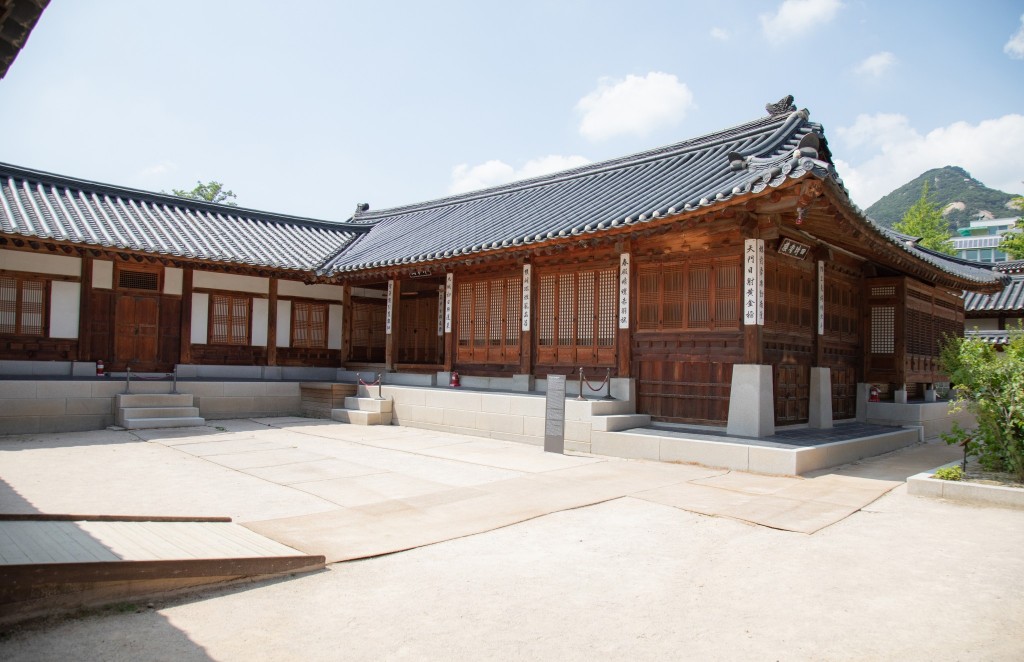
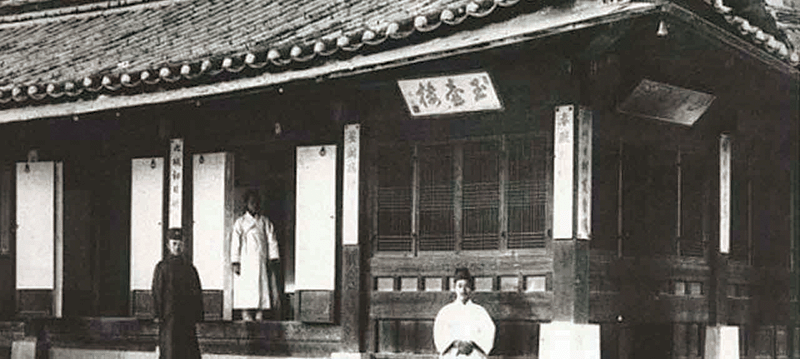
The tragedy did not happen in the grand throne halls but deep within the northernmost, most private quarters of Gyeongbokgung Palace (경복궁). Located just behind the picturesque Hyangwonjeong Pavilion (향원정), you will find Geoncheonggung (건청궁), the residence where King Gojong and the Empress lived at the time.
Geoncheonggung stands in stark contrast to the rest of the palace architecture. While most royal halls were official state buildings, King Gojong commissioned Geoncheonggung in 1873 using his own private funds. It was designed to resemble a noble scholar’s residence rather than a traditional, colorful palace hall. It symbolized Gojong’s political independence from his father, the Daewongun, and served as a quiet sanctuary for the royal couple.
Furthermore, it was the birthplace of Korean modernization. In 1887, through the Edison Electric Light Company, Geoncheonggung became the very first place in Korea to have electrical lighting installed. Yet, the very location that symbolized sovereign independence and modern progress became the site of unthinkable horror. The specific location of the Empress’s murder was Okhoru Pavilion (옥호루), a small, peaceful annex attached to her sleeping quarters.
📌 Local Guide Tip: When you visit Gyeongbokgung Palace today, it takes about 15 to 20 minutes to walk from the main gate to Geoncheonggung at the far back. The modest wooden structure of Okhoru Pavilion belies the profound historical trauma it witnessed.
The Night of the Assassination: October 8, 1895
In the early, pitch-black hours of October 8, 1895 (the 20th day of the 8th lunar month), Minister Miura’s horrifying plan was set into motion.
| Time / Phase | Event Detail |
|---|---|
| The Breach | Japanese legation guards, armed civilian thugs (ronin), and a manipulated faction of Joseon troops forcefully breached Gwanghwamun Gate (광화문), the main entrance to the palace. |
| The Resistance | Joseon’s royal guards, led by regiment commander Hong Gye-hun, fought back fiercely. Tragically, heavily outgunned and outnumbered, Hong and his men died honorable deaths defending their sovereign. |
| The Assassination | The armed mob stormed Geoncheonggung, threatening King Gojong and tearing through the Empress’s quarters. They dragged out Empress Myeongseong, who had been hiding among her court ladies, and brutally murdered her at Okhoru Pavilion. |
| The Desecration | In a desperate attempt to destroy the evidence, the assassins dragged her body to the deer park behind the residence, doused it in kerosene, and set it on fire. |
The Aftermath and the Rise of the Righteous Army
The brazen murder of a nation’s mother in the heart of her own palace sent shockwaves both domestically and internationally. Because Western diplomats—including the Russian architect Afanasy Sabatin, who was working in the palace—witnessed the event, global condemnation rained down on Japan. Attempting a political cover-up, the Japanese government recalled Miura and 47 accomplices to face a tribunal in Hiroshima. In a mockery of justice, all 48 men were acquitted due to “insufficient evidence.”
Immediately following the incident, Japan forced the installation of a pro-Japanese cabinet in Joseon. This puppet government initiated the Eulmi Reforms, which mandated the use of the Gregorian solar calendar, modern vaccination methods, and, most controversially, the Danbalryeong (Short Hair Act), which forced Korean men to cut off their traditional topknots.
The combination of the Queen’s assassination and the attack on traditional Confucian values ignited absolute fury among the Korean populace. This outrage birthed the Eulmi Uibyeong (Righteous Army). Led initially by conservative Confucian scholars holding fast to the ideology of defending orthodox traditions, the army swelled as farmers and disbanded soldiers joined the ranks. They waged fierce guerrilla warfare against pro-Japanese officials and Japanese military outposts.
Meanwhile, fearing for his life, King Gojong orchestrated a daring escape in February 1896, fleeing the palace in disguise to take refuge at the Russian Legation in Jeong-dong (정동)—an event known as Agwan Pacheon. From there, he rolled back the forced reforms and commanded the Righteous Army to disperse, but the embers of resistance were already lit, forming the foundation of Korea’s long independence struggle.
Historical Significance: State-Sponsored Terrorism
When discussing the Eulmi Incident globally, it is crucial not to view it merely as a political assassination. It was an unprecedented act of state-sponsored terrorism against a sovereign nation. By mobilizing military personnel and state diplomats to butcher the symbolic and political heart of Korea, imperial Japan crossed a horrific line. It vividly showcased the ruthless, coercive methods Japan was willing to employ to colonize the Korean peninsula. Understanding this context helps modern visitors fully grasp the deep historical wounds that shaped Korea’s entry into the 20th century.
Movies and Dramas About Empress Myeongseong
Visual media offers a deeply emotional way to connect with this historical period. If you want to explore the life, politics, and tragedy of Empress Myeongseong, here are a few notable productions to look for:
- Empress Myeongseong (KBS Drama, 2001): A monumental historical epic that chronicles her entire life, her political maneuvering against the Daewongun, and the tragic assassination. Highlights from this classic are often available on the KBS World YouTube channel.
- The Sword with No Name (Movie, 2009): A highly fictionalized, action-heavy cinematic romance about a nameless bodyguard deeply devoted to Empress Myeongseong. It captures the tension of the era and is available on streaming platforms like Tubi or Viki (region dependent).
- Mr. Sunshine (tvN/Netflix, 2018): While not directly about the Empress, this globally acclaimed drama is essential viewing. Set slightly after the incident, it brilliantly portrays the rise of the Righteous Army and the desperate struggle of the Korean people as the nation’s sovereignty is stripped away.
Further Reading
The Eulmi Incident was just the beginning of a dark chapter that ultimately led to the annexation of Korea. To understand the deeper consequences of these events and how they led to the complete loss of Korean sovereignty, I highly recommend reading our detailed guide on the Fall of the Korean Empire: Eulsa Treaty to 1910 Annexation.
Korean Culture portal KCulture.com

Founder of Kculture.com and MA in Political Science. He shares deep academic and local insights to provide an authentic perspective on Korean history and society.