Conquering Korea’s Public Transport: The Ultimate Guide
South Korea’s public transportation system is, frankly, a marvel. It’s clean, punctual, extensive, and incredibly affordable. But for a first-time visitor, the network of high-speed trains, color-coded buses, and sprawling subway maps can seem overwhelming.
Fear not. Once you understand a few key concepts and have the right tools, you’ll be navigating the country like a local. This guide breaks down everything you need to know, from the one card you must buy to the essential apps that make travel seamless.
Your Most Essential Tools: Naver Maps & Kakao Maps
Before diving into T-Money cards or train lines, the most critical advice is this: download Naver Maps or Kakao Maps. (Google Maps has limited walking and driving functionality in Korea, making it unreliable for navigation).
These two apps are your lifelines. They are the absolute best way to navigate the public transport system for several reasons:
- Multiple Options: They show you the most efficient routes by combining subways, buses, and walking.
- Clear Guidance: The apps tell you exactly where to wait, which bus number to take, or even which subway car to board for the fastest transfer.
- Real-Time Data: You’ll see precisely when your bus or subway is arriving, down to the minute.
- Full English Support: Both apps are fully translated and easy for any international visitor to use.
For the entirety of your in-city travel, one of these apps will be your primary guide. You can go anywhere, even to an unfamiliar neighborhood, with complete confidence.


Your “Magic Wand”: The T-Money Card
Before you ride anything, you need a transportation card. The most common is the T-Money card (Cashbee is another brand that works identically). Think of this as your all-access pass to nearly all public transport in the country, including buses, subways, and even taxis.(*Lately, there are options available beyond just the T-money card. Please check out ‘WOWPASS vs NAMANE & Climate Card vs T-money, 2025 Guide‘ for more information)
- Where to Buy: Any convenience store (CU, GS25, 7-Eleven) or at ticket vending machines inside subway stations.
- How to Load: At the same locations. Just hand your card and cash (Korean Won) to the cashier and say “chung-jeon” (charge). The subway machines also have an English option.
📌 CRITICAL: Tap On, Tap Off!
This is the most important rule. You MUST tap your card on the reader when you get ON and when you get OFF. This is how the system calculates your fare and, more importantly, gives you a free or discounted transfer (usually within 30 minutes) to another bus or subway line. Forgetting to tap off will result in the maximum fare being charged.
Navigating the City: Subways & Buses
The Subway (Jihacheol)
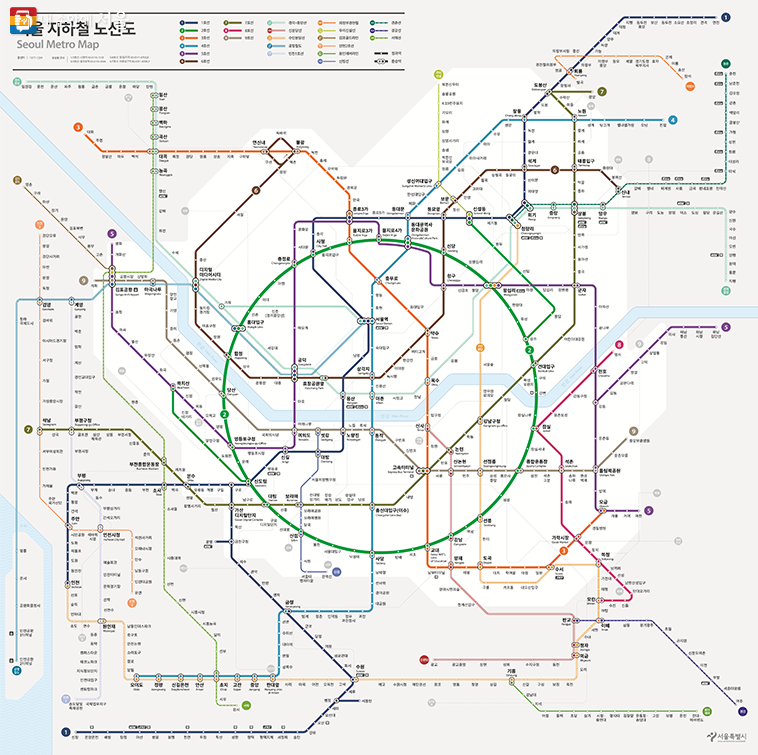
Cities like Seoul, Busan, Daegu, Gwangju, and Daejeon have world-class subway systems. The Seoul Metropolitan Subway, in particular, is one of the world’s largest. While the map looks intimidating, it’s incredibly efficient, clean, safe, and has signs in English, Korean, and Chinese.
Again, your Naver or Kakao Maps app will tell you the exact line to take and even which car and door to board for the quickest transfer.
Local City Buses (Sinae Bus)
Buses fill the gaps where subways don’t go. In Seoul(Instructions on how to use the bus are here.), they are helpfully color-coded:
- Blue Buses (Ganseon): Main arterial routes that travel long distances connecting the outskirts to downtown Seoul.
- Green Buses (Jiseon): Shorter routes that act as feeders, connecting residential areas to subway stations and Blue bus stops.
- Red Buses (Gwangyeok): Express commuter buses connecting Seoul with satellite cities in Gyeonggi-do (like Suwon, Ilsan, or Bundang). They are faster but cost slightly more.
- Yellow Buses (Sunhwan): Circulation buses that loop around specific districts. Tourists use these frequently to access spots like Namsan Seoul Tower.
- Night Buses (Owl Bus / N-Bus): Operate from late night to early morning (approx. 11:30 PM – 3:30 AM) when subways aren’t running. Look for an “N” in the route number.
Don’t try to memorize routes. Just plug your destination into your map app, and it will tell you which bus number to take and its exact arrival time.
Traveling Across Korea: The Train Network
For long-distance travel, trains are the fastest and most comfortable option. The main operator is Korail. Tickets can be booked on their website (Let’s Korail) or via their app “KorailTalk,” both of which support English.
High-Speed Rail (KTX & SRT)
The KTX (Korea Train eXpress) is the flagship high-speed train, connecting Seoul to Busan in about 2 hours and 45 minutes. The SRT is a similar high-speed train operating from Suseo (southern Seoul). These are the fastest and most popular, but also the most expensive, options.
[Image: A KTX high-speed train speeding past a station platform in Korea.]
Slower & Scenic Routes (ITX-Saemaeul & Mugunghwa)
If you’re not in a hurry or want to save money, these are excellent choices. The ITX-Saemaeul is the next step down, still fast and comfortable. The Mugunghwa is the slowest train, stopping at many small towns. It’s a fantastic way to see the countryside and experience “slow travel.”
⚠️ A Warning: The Great Korean Ticket War
During major holidays like Chuseok (Korean Thanksgiving) or Seollal (Lunar New Year), booking train tickets is famously competitive. Pre-booking opens on a specific day announced about a month in advance, and tickets sell out within minutes. If traveling during these periods, check the Korail website for the booking date and be ready, or plan to take a bus.
The Final Frontier: Intercity & Express Buses
Trains are great, but they don’t go everywhere. For many smaller towns, the bus is your best or only option. This is where it can get a bit confusing, as cities often have more than one terminal.
For example, Seoul has several major terminals based on destination:
- Seoul Express Bus Terminal (Gyeongbu Line): For cities in the east/southeast (e.g., Busan, Daegu).
- Central City Terminal (Honam Line): For cities in the west/southwest (e.g., Gwangju, Jeonju).
- Dongseoul (East) Terminal: For cities in the northeast (e.g., Gangneung, Sokcho).
- Nambu (South) Terminal: For shorter-distance routes south of Seoul.
The two main types of buses are Express and Intercity. Here’s a simple breakdown:
| Bus Type | Route | Best For |
|---|---|---|
| Express Bus (Gosok) | Long-distance, direct highway routes (e.g., Seoul to Busan). Very few or zero stops. | Speed and comfort. “Premium” buses offer spacious reclining seats. |
| Intercity Bus (Sioe) | Connects everything else. Makes more stops in smaller towns. | Reaching destinations not served by trains or Express buses. |
Booking apps like T-Money GO (which has English) or websites like KOBUS (for Express buses) are the easiest way to secure tickets.
Taxis: The Convenient Fallback
When you’re tired, have heavy luggage, or are out late after the subways have stopped, taxis are plentiful and affordable compared to many Western countries. You can pay with your T-Money card, a credit card, or cash.
- Standard Taxis: Usually orange, white, or silver.
- Deluxe Taxis (Mobeom): Black with a yellow stripe. They are more expensive but offer nicer cars and service.
💡 The Only Taxi App You Need: Kakao T
Hailing a cab can be difficult in busy areas. Just download the Kakao T app. It’s the “Uber” of Korea. You can connect a foreign credit card, set your destination directly on the map (eliminating language barriers), and call a taxi to your exact location. It’s reliable, safe, and the standard for getting a cab.
Your Essential Korea Travel Toolkit
While it seems like a lot, it boils down to a few key items. With this toolkit, you can confidently navigate the entire country.
- The Card: T-Money card.
- In-City Navigation: Naver Maps or Kakao Maps.
- Train Travel: KorailTalk app.
- Bus Travel: T-Money GO app.
- Taxi Hailing: Kakao T app.
South Korea’s transportation network is a huge part of what makes traveling here so accessible and fun. Don’t be intimidated—embrace the efficiency and enjoy the ride.
Korean Culture portal KCulture.com
Join the mailing service and add to your favorites.

Founder of Kculture.com and MA in Political Science. He shares deep academic and local insights to provide an authentic perspective on Korean history and society.
🇰🇷 Essential Seoul Travel Kit
- ✈️ Flights: Find Cheap Flights to Seoul
- 🏨 Stay: Top Rated Hotels in Seoul
- 🎟️ Tours: Best Activities & K-Pop Tours