
For travelers navigating South Korea in 2026, the optimal cashless setup is pairing a payment hybrid card (like WOWPASS or NAMANE) with a dedicated transit pass (like the Climate Card or T-money). WOWPASS offers the easiest foreign currency exchange for shopping, while the Climate Card provides the most cost-effective unlimited transit within Seoul.
Welcome to Korea, where carrying a thick wallet of cash is officially “old school.” As a local living in Korea, I can tell you that we are moving towards a completely cashless society at breakneck speed. But here is the tricky part for travelers: while credit cards are accepted almost everywhere, you generally cannot use your foreign Visa or Mastercard for public transport or certain local vending machines. You need a local card.
Recently, the landscape has exploded with options. It used to be just “T-money.” Now, we have WOWPASS, NAMANE, and the increasingly popular Climate Card (기후동행카드). Which one do you actually need? Do you need two? (Spoiler: Probably). Let’s cut through the marketing noise and compare these Korea tourist transport cards so you can travel seamlessly like a true local.
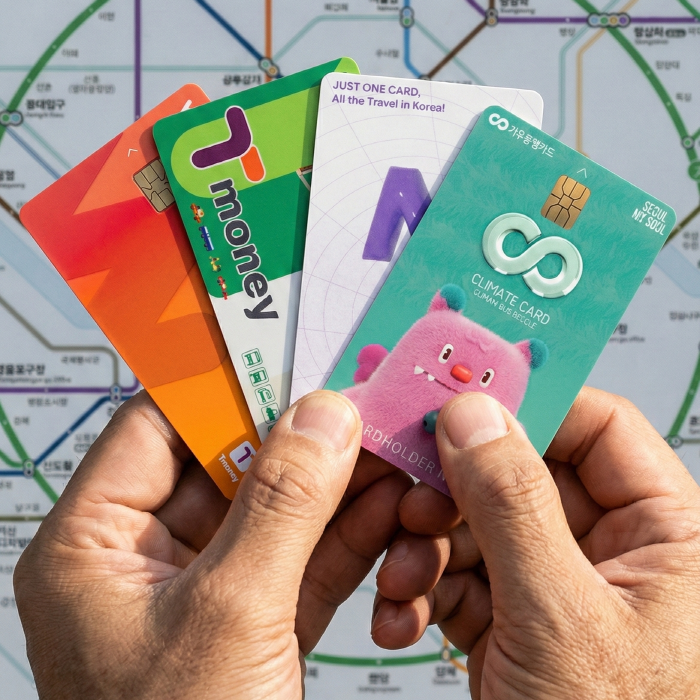
- Round 1: The Payment Hybrids (WOWPASS vs. NAMANE)
- Round 2: The Transit Kings (Climate Card vs. T-money)
- Where to Buy and Top-Up
- The Verdict: Which Combination Do You Need?
Round 1: The Payment Hybrids (WOWPASS vs. NAMANE)
These two cards are revolutionizing Korea travel. They are essentially prepaid debit cards that you can top up with foreign currency or credit cards, allowing you to pay at restaurants, shops, and cafes just like a local. Both cards also include a built-in transit chip for nationwide public transportation.
WOWPASS: The Currency Exchange King
If you hate visiting money changers in Myeongdong (명동), this is your solution. WOWPASS allows you to feed foreign cash (USD, EUR, JPY, etc.) directly into a kiosk, and it loads the equivalent Korean Won onto the card at an exchange rate that often beats banks. (Apply for a WOWPASS card)
- Best For: Travelers who want the best exchange rates and the flexibility of app-based top-ups.
- The “Gotcha” is Gone: Previously, you had to use KRW cash at a subway station to load the T-money transit portion. Now, you can use the WOWPASS app to top up your shopping balance with a foreign credit card, and then transfer that balance directly to the T-money transit chip via NFC on your phone!
- Key Feature: Cash-back rewards at major brands like Starbucks and CU convenience stores.
NAMANE: The K-Pop Fan’s Favorite
NAMANE stands for “My Own” card. Its claim to fame is ultimate customization. You can design the front of the card with a photo of your favorite idol, your pet, or a selfie via their app before printing it at a kiosk.
- Best For: K-Pop fans (for the photo card) and those who want to top up their card balance via a mobile app using Apple Pay, Google Pay, or a foreign credit card.
- The “Gotcha”: It has two separate wallets: “Pay Balance” (Shopping) and “Transit Balance” (Subway/Bus). You often have to manually convert money between these balances in the app. Note: NAMANE uses the Rail+ (레일플러스) transit system, not T-money, but it works exactly the same on subways and buses nationwide.
- Key Feature: Unlike WOWPASS kiosks which are mostly in major hubs, you can top up NAMANE absolutely anywhere using the app and your phone.
| Feature | WOWPASS | NAMANE Card |
|---|---|---|
| Main Function | Currency Exchange + Debit | Custom Design + Debit |
| Transit Chip Brand | T-money | Rail+ |
| Shopping Top-Up | Foreign Cash (Kiosk) or Credit Card (App) | Credit Card / Apple Pay (App) or Cash |
| Transit Top-Up | KRW Cash (Station) or NFC via App | Convert from Pay Balance via App |
| Issuance Fee | 5,000 KRW | 7,000 KRW |
Round 2: The Transit Kings (Climate Card vs. T-money)
While the hybrid cards above can be used for transport, the following are dedicated transit solutions. The battle here is between “Unlimited Rides” (Climate Card) and “Pay-As-You-Go” (T-money).
T-money: The Reliable Classic
T-money is the gold standard. It works on every bus, subway, and taxi in the entire country—from Seoul to Busan and Jeju Island. The balance never expires.
💡 Pro Tip: You can buy “Korea Tour Card” versions of T-money, which offer small discounts at attractions, but a standard 3,000 KRW T-money card from any convenience store works exactly the same for transport.
Climate Card (Tourist Pass): The Seoul Game Changer
Launched with huge success, the Climate Card (기후동행카드) now offers expanded short-term tourist passes for 2026. It provides unlimited rides on Seoul subways and buses. You must purchase the physical card for 3,000 KRW and then load a pass.
- 1-Day Pass: 5,000 KRW
- 2-Day Pass: 8,000 KRW
- 3-Day Pass: 10,000 KRW
- 5-Day Pass: 15,000 KRW
- 7-Day Pass: 20,000 KRW
⚠️ Local Note: The Climate Card is valid ONLY in Seoul. It does not work on the Shinbundang Line (red line), intercity buses, or subways in other cities like Busan. Also, while you can use it to get off at Incheon Airport (if you boarded in Seoul), you cannot use it to board the AREX at the airport to travel into Seoul.
Where to Buy and Top-Up
Finding these Korea tourist transport cards is easier than finding a bad meal in Korea (which is impossible). Here is your updated 2026 top-up guide:
- WOWPASS: Orange Kiosks located at major subway stations (Hongik Univ., Myeongdong, Seoul Station), Incheon Airport, and larger hotels. Top-Up: Feed foreign cash into the kiosk, or simply top up the shopping balance directly in the WOWPASS app using your foreign Visa/Mastercard.
- NAMANE: Kiosks in Incheon Airport, Myeongdong, and Hongdae (홍대). Top-Up: Easily top up via the NAMANE app using a foreign credit card, Apple Pay, or Google Pay.
- T-money: Literally any convenience store (CU, GS25, 7-Eleven, Emart24). Just ask for “T-money.” Top-Up: Standard T-money cards generally require KRW cash at convenience stores or subway machines.
- Climate Card: Tourist Information Centers and convenience stores near subway stations. 2026 Top-Up Update: As of March 2026, you no longer need KRW cash! You can now use overseas-issued Visa and Mastercard credit cards to purchase and top up Climate Cards directly at subway ticket vending machines (Lines 1-8).
The Verdict: Which Combination Do You Need?
You do not need all four Korea tourist transport cards. Here is my breakdown based on your travel style:
Scenario A: The “Seoul Explorer” (Most Travelers)
Recommendation: WOWPASS + Climate Card
Use WOWPASS for all your shopping and dining for easy currency exchange. Use the Climate Card (3, 5, or 7-day pass) for your intense subway hopping around palaces and cafes in Seoul. This saves you from constantly reloading cash for transit.
Scenario B: The “Whole Country” Traveler
Recommendation: WOWPASS (which includes T-money)
If you are traveling beyond Seoul to Busan, Gyeongju, or Jeonju, the Climate Card is not applicable. Just get a WOWPASS. Use the debit side for shopping, and load the integrated T-money side with KRW cash for nationwide transport.
Scenario C: The K-Pop Pilgrim
Recommendation: NAMANE + T-money (Backup)
Get NAMANE to print your idol’s face on the card and use it for merchandise shopping via credit card top-ups. You can use its Rail+ transit balance, but keeping a backup standard T-money card for transport is smart just in case you forget to swap your balance on the NAMANE app.
Korean Culture portal KCulture.com

Founder of Kculture.com and MA in Political Science. He shares deep academic and local insights to provide an authentic perspective on Korean history and society.



Hi. The wowpass tmoney topup information seems to be incorrect. their website says it can be topped up from the app: “Alternatively, you can also use your WOWPASS balance to top up through the mobile app.”