You’re planning your korea travel, you’ve booked your flights, and the perfect itinerary is ready. But then a practical question hits: How do I pay for things in Korea? Should you rely on cash, or is plastic king? As a Local Expert living right here in Seoul, I can tell you that the payment landscape in South Korea is unlike almost anywhere else. Forget personal checks, traveler’s checks, or even carrying heaps of cash—Korea is a hyper-connected, card-centric society. This guide is your Playbook for navigating the ins and outs of money management, ensuring your payment process is as smooth as your K-Pop playlist. Our focus keyword for this essential piece is korea cash and card guide.
Once you’ve read this post, be sure to read ‘WOWPASS vs NAMANE & Climate Card vs T-money, 2025 Guide,’ which compares cards for travelers to Korea. After finishing this article, you won’t be able to resist checking it out.
- Korea’s Payment Landscape: Card is King
- Credit Card Usage: Do’s and Don’ts for Tourists
- How Much Cash Do I Need in Korea? (A Practical Guide)
- When Cash is Still Necessary: Essential Exceptions
- Outdated Payment Methods You Should Avoid in Korea
- Travel Tip: Using Contactless Payment and Transport Cards
Korea’s Payment Landscape: Card is King
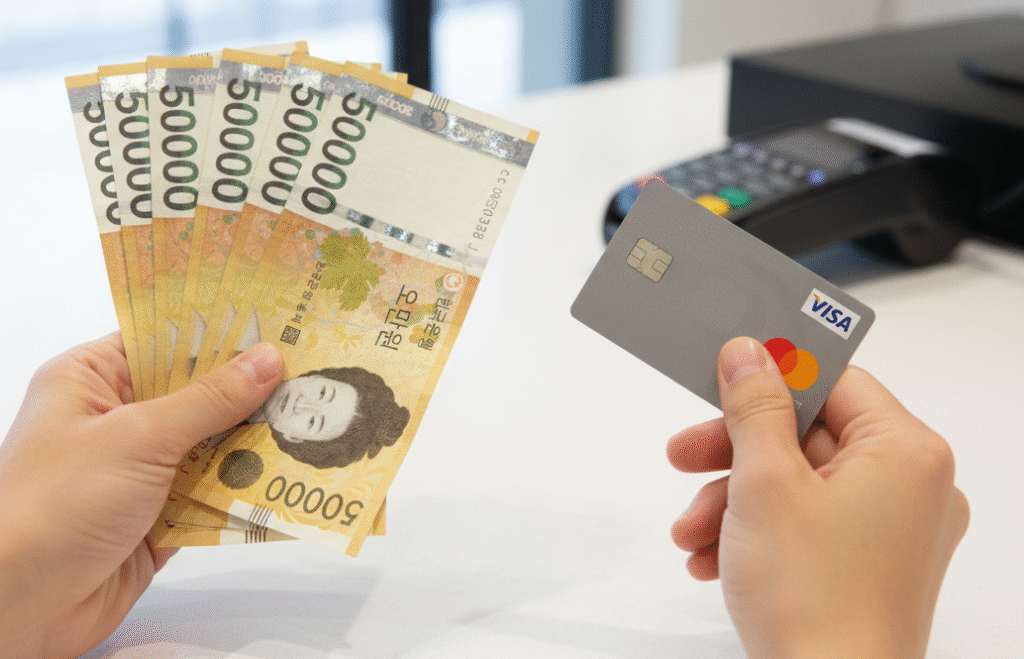
Honestly, the biggest culture shock for many travelers is how rarely cash is used here. South Korea boasts one of the highest credit card usage rates in the world. From the smallest convenience store to the largest department store, nearly every transaction can be completed with a card. We’re talking about transactions as small as $1—even street vendors increasingly accept card payments!
This level of digitization is a core aspect of modern Korean Culture Insight. For you, this means you don’t need to panic about converting huge sums of your home currency. A credit or debit card with an international transaction capability is your best friend.
💡 Pro Tip: Card Processing in Korea
Unlike some countries where merchants prefer cash to avoid fees, Korean law often mandates that even small businesses accept credit cards. This has fundamentally shifted the korea travel experience toward digital payment methods.
Credit Card Usage: Do’s and Don’ts for Tourists
Using your foreign card is straightforward, but there are a few things you should know to avoid issues and fees.
Check Your Card’s Global Network
The vast majority of Korean establishments accept major international networks. Visa and Mastercard are almost universally accepted. Amex (American Express) and JCB are widely accepted in larger cities and at major chains, but less so at small local shops or traditional markets. Check the logos on the card reader before attempting to pay.
Say No to Dynamic Currency Conversion (DCC)
This is a critical warning. When paying, the terminal may ask if you want to be charged in Korean Won (KRW) or your home currency (e.g., USD, EUR). Always choose KRW. If you choose your home currency, you are using Dynamic Currency Conversion (DCC). This service uses an unfavorable exchange rate set by the merchant’s bank, often adding an unnecessary fee of 5% to 15%.
⚠️ Warning: Always Choose KRW!
When presented with the option, selecting KRW ensures your bank uses its (usually better) exchange rate, saving you money on every transaction. This is essential korea cash and card guide knowledge.
Notify Your Bank and Check Fees
Before you depart, inform your bank of your travel dates and destination (South Korea). This prevents your card from being flagged for suspicious activity and frozen. Also, be aware of the fees your bank charges for foreign transactions—these can range from 0% (travel cards) to 3% (standard cards).
How Much Cash Do I Need in Korea? (A Practical Guide)
Given that card acceptance is so high, cash is mostly for emergencies and specific scenarios. You do not need to carry a large amount of Korean Won.
Cash Recommendation by Trip Length
Here is my recommendation for the average tourist based on experience. This assumes you will primarily use a card for meals, shopping, and major transport.
| Trip Length | Recommended Cash Holding (KRW) | Estimated Equivalent (USD) | Usage Scenario |
|---|---|---|---|
| 3-5 Days | ₩100,000 to ₩150,000 | $75 to $115 | Small street snacks, taxi tips (rare), emergency fund. |
| 1-2 Weeks | ₩200,000 to ₩300,000 | $150 to $230 | Occasional cash-only vendors, traditional market purchases. |
| 1 Month | ₩300,000 to ₩500,000 | $230 to $380 | Covering all cash-only situations and small emergencies. |
These amounts are easily withdrawn from a global ATM (identified by the “Global ATM” sign) at the airport upon arrival or at any bank branch (Shinhan, KB Kookmin, Woori) in the city. The rates offered by the international ATMs inside convenience stores are also generally competitive.
When Cash is Still Necessary: Essential Exceptions
While card usage is widespread, there are a few places where cash is preferred or required, especially if you are seeking the ‘real’ Korea experience.
Traditional Markets and Cash Discounts
In bustling spots like Gwangjang Market or Namdaemun Market, many small, independent food stalls (especially for quick street snacks) are still cash-only. Additionally, some small clothing or souvenir vendors in these markets may offer a slight discount (perhaps 5% to 10%) if you pay in cash, as it avoids card processing fees for them.
[Image: A busy vendor at a traditional Korean market accepting a 10,000 KRW bill for street food, with a small sign indicating a cash discount.]
Small Services and Local Picks
Cash is sometimes the only option at extremely tiny, hole-in-the-wall eateries (the kind only a local would know!), certain public restrooms that charge a small fee, or for tipping in specific, non-standard situations (though tipping is very rare in Korea). For deep dive into Local Picks and hidden gems, always keep a ₩10,000 or ₩5,000 note handy.
Outdated Payment Methods You Should Avoid in Korea
Many payment methods common in other parts of the world are virtually non-existent or inconvenient in Korea. Understanding this is key to efficient Local Travel Guide preparedness.
Personal Checks (or Banker’s Drafts)
In the US and some European countries, personal checks are still common for large, non-instantaneous payments. In South Korea, personal checks are almost never used in consumer transactions and will not be accepted by merchants. Attempts to cash them at a bank will involve lengthy procedures and high fees. Do not bring personal checks.
Traveler’s Checks
Traveler’s Checks are largely a relic of the past in Korea. They can only be cashed at a few major bank branches and will offer terrible exchange rates and high fees. They are completely useless for daily transactions. The ubiquity of global ATMs makes them completely unnecessary.
Money Orders and Foreign Currency Payments
While some high-end tourist shops (e.g., duty-free stores) may accept major foreign currencies (USD, JPY, EUR), the exchange rate will always be poor. Pay in KRW via card or cash. Money orders are also not a viable payment method for tourists.
Travel Tip: Using Contactless Payment and Transport Cards
For ultimate convenience, embrace Korea’s advanced digital payment infrastructure.
T-Money Card: Your Seoul and Busan Essential
The T-Money or Cashbee card is a reusable, rechargeable smart card used for all public transportation (subway, buses, and most taxis) nationwide. It is also accepted for small purchases at convenience stores and some vending machines.
- Purchase a T-Money card at any convenience store (GS25, CU, 7-Eleven) or subway station.
- Load it with cash. This is a primary reason to have some Korean Won on hand.
- Tap and go! It makes getting around a breeze, avoiding the need for exact change on buses.
Mobile Contactless Payment
If you have an internationally issued credit card compatible with services like Apple Pay or Google Pay, you can often use them at terminals that support NFC payments, especially at chains like Starbucks or major convenience stores. However, the dominant local services (Samsung Pay, Kakao Pay) may not work seamlessly with foreign bank cards, so it’s always best to have the physical card ready.
In summary, when preparing for your korea travel, prioritize your internationally capable credit/debit card and plan to use cash sparingly—mostly for those irresistible street food moments and local market finds that provide a true Deep Dive into Korean daily life. By following this Playbook, you’ll navigate the Korean economy with confidence and ease.
Korean Culture portal KCulture.com
Join the mailing service and add to your favorites.

Founder of Kculture.com and MA in Political Science. He shares deep academic and local insights to provide an authentic perspective on Korean history and society.