Walking through the dense, wooded path that leads to the heart of Seoul, I often find myself forgetting that a bustling metropolis of ten million people lies just outside the stone walls. There is a specific kind of silence here—a heavy, dignified quiet that feels like it belongs to another century. This is Jongmyo Shrine UNESCO heritage, a site that represents the spiritual pinnacle of the Joseon Dynasty. For those of us living in Korea, Jongmyo is more than just a cluster of ancient buildings; it is a living, breathing connection to a 600-year-old lineage, preserved through a “Triple Crown” of UNESCO recognitions covering architecture, ritual, and music.
- The Triple Crown: A Rare Global Heritage
- The Foundation: Why This Place Exists
- The Stage of Spirits: Understanding Jongmyo’s Architecture
- From Ancient China to Joseon: The Origin of the Rites
- Jongmyo Daeje: The Great Ceremony in the Modern Era
- Jongmyo Jeryeak: The Symphony of Heaven and Earth
- Step-by-Step: The Sacred Flow of the Ceremony
- Pro-Tip: Schedules, Etiquette, and Booking Your Visit
The Triple Crown: A Rare Global Heritage
It is exceptionally rare for a single location to hold three distinct UNESCO designations, but Jongmyo achieves this feat with grace. First, the physical site—the Jongmyo Shrine—was inscribed as a World Heritage site in 1995 for its architectural integrity. Second, the Jongmyo Jerye (the ancestral rite) and third, the Jongmyo Jeryeak (the ritual music and dance), were jointly designated as a Masterpiece of the Oral and Intangible Heritage of Humanity in 2001.
When you stand in the main courtyard, you are witnessing a phenomenon where the “tangible” (the wood and stone) perfectly houses the “intangible” (the sound and movement). This synergy is what makes Jongmyo one of the most complete historical experiences in Asia. It isn’t just a museum; it is a functioning sacred space that has maintained its purpose since the 14th century.
The Foundation: Why This Place Exists
To understand Jongmyo, you must first understand the philosophy that built it. The Joseon Dynasty was founded on Neo-Confucianism, a system that prioritized social order, filial piety, and the veneration of ancestors. In this worldview, death was not an end but a transition. The spirits of the deceased kings and queens were believed to continue watching over the nation, and it was the duty of the living monarch to provide them with a “home” and regular offerings.
This deep-rooted belief system still influences modern Korean life in surprising ways. From the way families gather during holidays to the subtle social hierarchies in everyday interactions, the “Confucian code” remains the hidden operating system of Korea. If you’re curious about how these ancient values still show up in your favorite K-dramas, you might find this deep dive on Confucianism in Korea quite enlightening.
The Stage of Spirits: Understanding Jongmyo’s Architecture
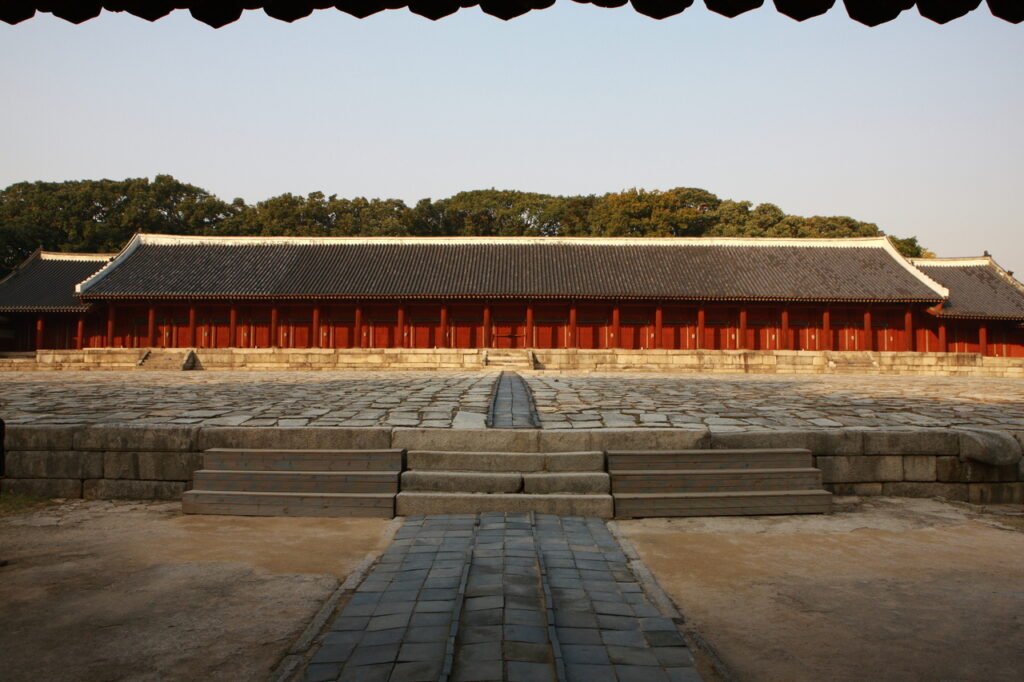
The architecture of Jongmyo is intentionally minimalist. Unlike the colorful, intricate decorations of Gyeongbokgung Palace, Jongmyo uses a restrained palette of deep reds and dark woods. The goal was to create an atmosphere of solemnity and eternity. There are two primary halls you must see:
- Jeongjeon (Main Hall): This is the longest wooden building of its kind in the world. It houses the ancestral tablets of the most prominent Joseon kings. As the dynasty grew, the hall was expanded horizontally, resulting in its current monumental length.
- Yeongnyeongjeon (Hall of Eternal Peace): This smaller hall houses the tablets of kings who were posthumously honored or those whose reigns were shorter. Its design is similar to Jeongjeon but on a more intimate scale.
The stone-paved courtyards are not flat; they are slightly tilted to allow for natural drainage during the rainy season, a testament to the engineering brilliance of the 14th century. The central path, raised slightly higher than the others, is reserved exclusively for the spirits. Even today, visitors are asked to walk on the side paths to show respect to the “unseen” residents.
From Ancient China to Joseon: The Origin of the Rites
The rituals performed at Jongmyo have their roots in the Jurye (Rites of Zhou), an ancient Chinese text that outlined the ideal structure for a state. However, the Joseon Dynasty did not simply copy these rites. According to the Joseon Wangjo Sillok (The Annals of the Joseon Dynasty), early kings like King Sejong the Great felt that the music and procedures should reflect the identity of the Korean people.
While the initial ceremonies were heavily influenced by Chinese ritual music (Aak), King Sejong began composing original pieces that incorporated native Korean melodies. This was a revolutionary act. He believed that the spirits of Korean kings should be entertained with the music they enjoyed while they were alive. Later, King Sejo refined these compositions, completing the “Koreanization” of the ritual. The result is a unique hybrid that adheres to the strict protocols of the Jurye while pulsing with a distinctly Korean soul.
Jongmyo Daeje: The Great Ceremony in the Modern Era
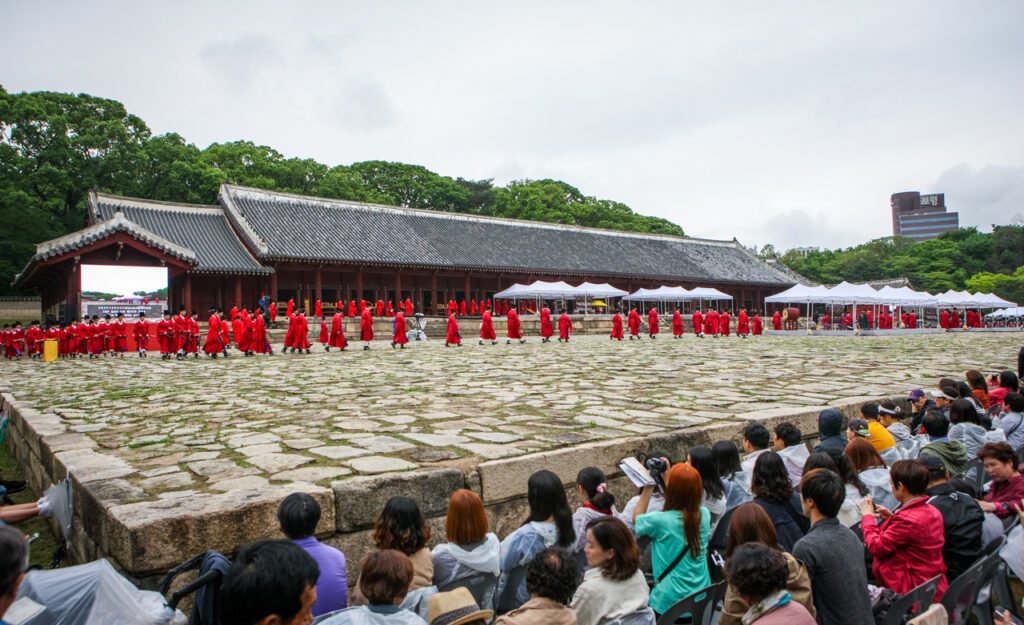
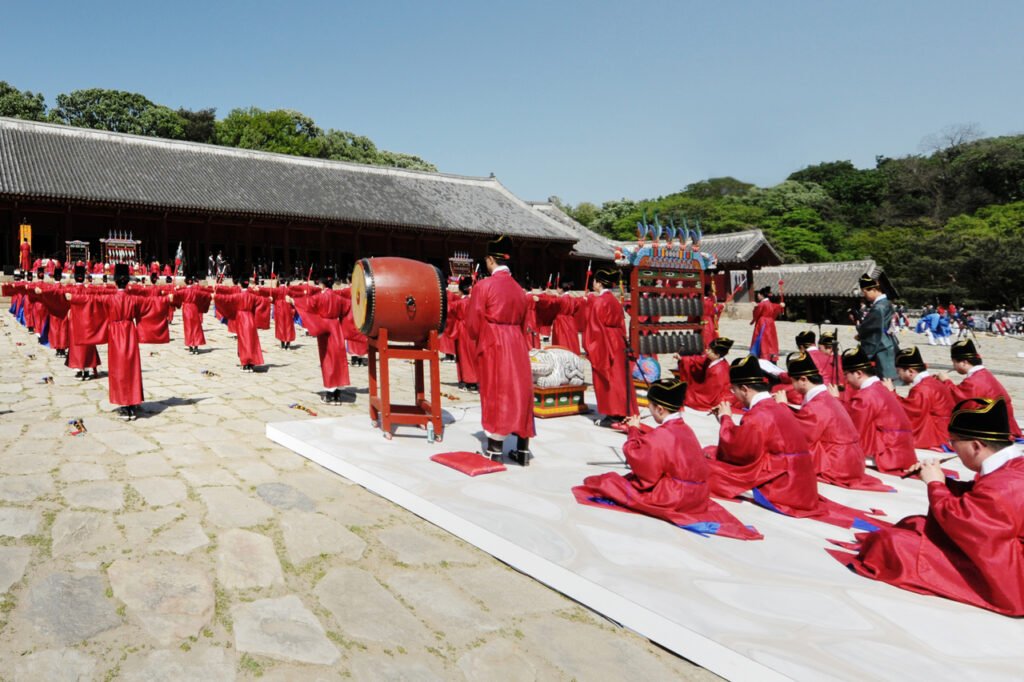
Historically, the Jongmyo Jerye was performed five times a year. While the tradition was interrupted during the Japanese colonial period, it was meticulously restored in 1969. Today, the Jongmyo Daeje (The Great Rite) is held twice a year—on the first Sunday of May and again in the autumn.
The modern ceremony is a massive collaborative effort. It is organized by the National Heritage Administration in partnership with the Jeonju Yi Clan Association (the descendants of the royal family) and the National Gugak Center. Witnessing the descendants, dressed in traditional ceremonial robes, performing the same bows and offerings as their ancestors 600 years ago, is an incredibly moving sight. It proves that tradition in Korea isn’t just about the past; it’s about the continuity of the family line.
💡 Local Note: The May ceremony often includes a spectacular royal procession (Eogachangryeol) that moves from Gyeongbokgung Palace through the streets of downtown Seoul to Jongmyo. It is one of the best photo opportunities in the city.
Jongmyo Jeryeak: The Symphony of Heaven and Earth
The music of Jongmyo, known as Jongmyo Jeryeak, is unlike any other musical tradition. It is designed to be slow, stately, and meditative. The orchestra is divided into two groups: the Deungga (located on the terrace) representing Heaven, and the Heonga (located in the courtyard) representing Earth.
The Instruments and Their Meaning
The instruments used are as much symbolic as they are musical. They represent the harmony of the universe through materials like stone, metal, silk, bamboo, and wood.
- Pyeonjong (Bronze Bells): Sixteen bells that provide the melodic foundation.
- Pyeongyeong (Stone Chimes): L-shaped stones that produce a clear, ethereal sound that does not change even with temperature or humidity.
- Bak: A wooden clapper used to signal the beginning and end of a musical section.
- Chuk and Eo: A wooden box and a tiger-shaped scraper used to start and stop the music, respectively.
The Ritual Dance (Ilmu)
As the music plays, 64 dancers perform the Ilmu (Line Dance) in an 8×8 formation. The dance is divided into two types: 1. Munmu (Civil Dance): Performed to honor the kings’ civil achievements. Dancers hold a flute (yak) and a feathered stick (jeok). 2. Mumu (Military Dance): Performed to honor the kings’ military conquests. Dancers hold wooden swords and spears, moving with more vigor and strength.
Step-by-Step: The Sacred Flow of the Ceremony
The Jongmyo Jerye follows a strict, multi-step procedure that can last several hours. For a first-time observer, it helps to know the three major phases: Welcoming, Entertaining, and Sending Off the spirits.
| Stage | Ritual Name | Description |
|---|---|---|
| Welcoming | Yeongsin | Burning incense and pouring wine to invite the spirits into the hall. |
| Entertaining | Heonrye | The main part of the rite where three rounds of wine are offered (Choheon, Juheon, Jongheon). |
| Offering Food | Jinchan | Dozens of specifically prepared ritual dishes (jegi) are presented to the ancestors. |
| Sending Off | Songsin | A final bow is performed, and the written prayers are burned to send the spirits back to the afterlife. |
Every movement, from the angle of a bow to the way a wine cup is held, is dictated by ancient manuals. The silence between the musical notes is just as important as the sound itself, creating a rhythm that mimics the breathing of the earth. For more details on the specific etiquette of Joseon royal ceremonies, you can explore this guide on Joseon Royal Rites.
Pro-Tip: Schedules, Etiquette, and Booking Your Visit
Because the Jongmyo Daeje is a high-demand state event, planning your visit requires precision. It’s not just about the date—it’s about understanding the specific etiquette and the rigid reservation windows. Whether you’re aiming for the spring or autumn ceremony, you need to know exactly when the booking portal opens and how to navigate the local procedures.
To help you prepare, we’ve put together a comprehensive guide covering the Joseon Royal Ancestral Rites: Schedule, Etiquette, and Insider Tips. This resource explains exactly how to confirm the annual Jongmyo schedule, the best ways to secure a reservation, and what you need to know before stepping into these sacred grounds. Make sure to check it before you book your trip to ensure you don’t miss this once-in-a-lifetime cultural phenomenon.
Korean Culture portal KCulture.com
Join the mailing service and add to your favorites.

Founder of Kculture.com and MA in Political Science. He shares deep academic and local insights to provide an authentic perspective on Korean history and society.