Seeking the ‘real’ Korea? Unpack the culture that underpins K-dramas, K-movies, and modern Korean life. Recently, you might have noticed a recurring, deeply mysterious figure in global hits like the film Exhuma (파묘, Pamyo) and series such as Pachinko and The Glory: the Mudang (무당), or Korean shaman. This powerful, often misunderstood presence is not just a dramatic device; it is a direct window into the soul of Korean spiritual tradition. As a local expert living here, I want to take you on a deep dive into the world of the Mudang, their historical roles, and why this ancient spiritual practice still holds such profound significance in contemporary society.
Here’s the thing: understanding the Mudang is key to unlocking a major part of Korean culture insight. Let’s explore the history, their role in society, and the difference between shamanistic fortune-telling and the more widely known practice of Saju (사주).

- K-Culture’s Spiritual Turn: Mudang in Exhuma, Pachinko, and The Glory
- The Mudang: Who Are the Korean Shamans?
- A History of the Mudang: Korea’s Spiritual Backbone
- The Shifting Social Role of the Mudang: From Pre-modern to Modern Korea
- Mudang vs. Saju: A Cultural Distinction in Foretelling Destiny
- A Look Beyond Korea: The North Asian Shamanic Connection
- Respecting the Spiritual Path in Modern Korea
K-Culture’s Spiritual Turn: Mudang in Exhuma, Pachinko, and The Glory
The recent surge in global popularity of K-content has brought the Mudang into the international spotlight. Honestly, I’m glad this tradition is getting the attention it deserves, even if it’s often sensationalized for dramatic effect. In Exhuma, the Mudang is depicted as a sophisticated spiritual professional, central to resolving an ancient curse. This portrayal, while cinematic, hints at the deep dive into spiritual solutions for life’s biggest problems that many Koreans still seek.
Meanwhile, in Pachinko, the shaman acts as a vital, albeit challenging, source of counsel and comfort for women facing intense hardship and uncertainty. Similarly, in The Glory, a shaman is used by a wealthy family, showcasing how the practice is woven into the lives of people across all social strata. These narratives reflect a historical reality: the Mudang has long been a spiritual confidant and emotional anchor, especially for the marginalized.
The Mudang: Who Are the Korean Shamans?
The term Mudang refers to a person who is believed to be possessed by or able to communicate with gods, spirits, or ancestral figures. They act as a medium between the spiritual and human worlds, performing rituals known as Gut (굿) to appease spirits, heal the sick, bring good fortune, or guide the deceased to the afterlife. It’s an integral part of traditional culture that has survived millennia.
💡 Pro Tip: The Mudang are predominantly women, though male shamans, called Paksu (박수), also exist. The spiritual path is often an inherited or ‘called’ one, usually beginning with a severe illness or spiritual crisis called Sinbyeong (신병).
Their role is highly complex. Unlike priests in organized religion, a Mudang’s power comes from a direct, ecstatic connection with the spirits. They don traditional clothing, sing, dance, and use specific props like bells, swords, and fans to enter a trance state during the Gut.

A History of the Mudang: Korea’s Spiritual Backbone
Korean shamanism, or Muism (무교), is perhaps the oldest continuous religious tradition on the peninsula. Its roots predate the introduction of Buddhism and Confucianism, stretching back into the earliest tribal states of Korea. We’re talking about a heritage that is fundamental to Korean history and spiritual identity.
- Ancient Roots: Evidence of shamanistic practices dates back to the Gojoseon Kingdom (Ancient Joseon). Shamans were often powerful figures, sometimes even ruling as chief priests or priestesses who legitimized the ruler’s authority.
- The Influence of Syncretism: Over the centuries, Muism didn’t disappear; it blended. It seamlessly integrated elements of Buddhism, Taoism, and later, even some Christian ideas, creating a rich, unique spiritual mosaic that is distinctively Korean.
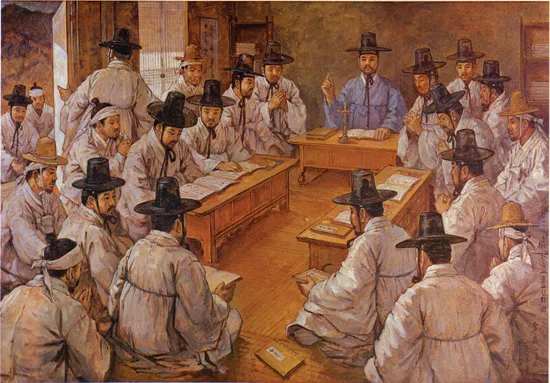
- Persecution and Resilience: During the Joseon Dynasty (1392–1897), the state’s emphasis on Confucianism led to the suppression and marginalization of the Mudang. They were often relegated to the lower classes. Despite this, they survived by remaining the primary spiritual resource for the common people, providing solace and hope when the formal system offered none.
The Shifting Social Role of the Mudang: From Pre-modern to Modern Korea
The role of the Mudang has changed dramatically alongside Korean society’s evolution, yet their core function remains one of mediation and healing.
In Pre-Modern Society: A Source of Last Resort
In the pre-modern era, the Mudang served as a spiritual doctor, a therapist, and an oracle, especially for those with little power. They addressed immediate, tangible problems: sickness, famine, and bad luck. For women in a strictly patriarchal society—like those portrayed in Pachinko—the Mudang was often the only public outlet for grief, fear, and spiritual consultation. They represented a non-Confucian, female-centered spiritual space where the emotional reality of life could be acknowledged and addressed. The traditional culture of Muism served as a crucial social safety valve.
In Modern Society: A Quiet but Persistent Presence
Today, the practice is quieter but still vibrant. While the government officially promotes organized religion, shamanism remains a persistent force. You won’t find the large public *Guts* as often, but private consultations are common. Modern Mudangs (shamans) offer deeply localized, insider advice—akin to a specialized guide—to Koreans facing major life decisions such as launching a business, selecting a wedding date, resolving family conflicts, or navigating a spiritual crisis. They have adapted to modern anxieties, delivering a profound, intuitive form of guidance and spiritual counseling rooted in ancient tradition.
Mudang vs. Saju: A Cultural Distinction in Foretelling Destiny
A common question from visitors is the difference between a Mudang predicting the future and the widely popular practice of Saju (사주), or the “Four Pillars of Destiny.” I see the distinction as one between prophecy and prescription.
| Feature | Mudang (Shamanism) | Saju (Four Pillars) |
|---|---|---|
| Source of Power | Divine/Spirit Possession (*Sinbyeong*) | Cosmological/Yin-Yang Theory (Rational System) |
| Method | Ecstatic trance, spiritual communication, *Gut* | Calculation based on birth date/time (Year, Month, Day, Hour) |
| Focus/Result | Direct intervention, cleansing, spiritual healing, prescribed actions (*Playbook*) | Interpretation of inherent potential, compatibility, and general life flow |
| Tone | Intuitively urgent, often emotional | Calmly analytical, systematic |
The Mudang offers a direct line to the spiritual realm and can perform rituals (a spiritual playbook) to actively change or counteract a bad destiny. Saju is an interpretation of your fate based on a fixed cosmological chart—it tells you what you’re likely to face, but offers limited practical means to alter it beyond careful planning. When Koreans face a crisis, they often seek both: Saju for insight into the pattern, and a Mudang for spiritual action.
A Look Beyond Korea: The North Asian Shamanic Connection
The tradition of the Mudang is not isolated to the Korean peninsula. When we take a deep dive into the history, it’s clear that Muism shares profound similarities with shamanistic traditions found across Siberia and other parts of North Asia. This connection speaks to a vast, shared spiritual heritage.
The focus on an ecstatic trance state, the use of drums, and the central role of mediating with spirits are common features. For instance, the traditional Korean shamanic drum is similar to those used by indigenous groups in Siberia. This suggests that the roots of Korean shamanism are part of a larger, ancient religious wave that swept across the northern Eurasian steppes, connecting the peninsula to a broader cultural sphere.
Respecting the Spiritual Path in Modern Korea
Despite centuries of attempts at suppression and modern skepticism, the Mudang remains a vital, complex figure. It represents the resilient, intuitive, and deeply emotional side of Korean culture. As outsiders, our approach must be one of cultural appreciation and respect. The practice, even if you don’t personally share the belief, is a living piece of Korean history and spiritual autonomy.
It’s important to see the Mudang not as a mere fortune-teller but as a cultural practitioner who continues to perform essential spiritual and psychological labor, especially for those seeking comfort and a path forward in uncertain times. The spiritual drama on screen is merely a reflection of a powerful, enduring spiritual reality on the ground. When you’re in Korea, you’ll see small, subtle signs of this enduring faith—a testament to the power of traditional culture to survive and evolve.
Korean Culture portal KCulture.com
Join the mailing service and add to your favorites.

Founder of Kculture.com and MA in Political Science. He shares deep academic and local insights to provide an authentic perspective on Korean history and society.