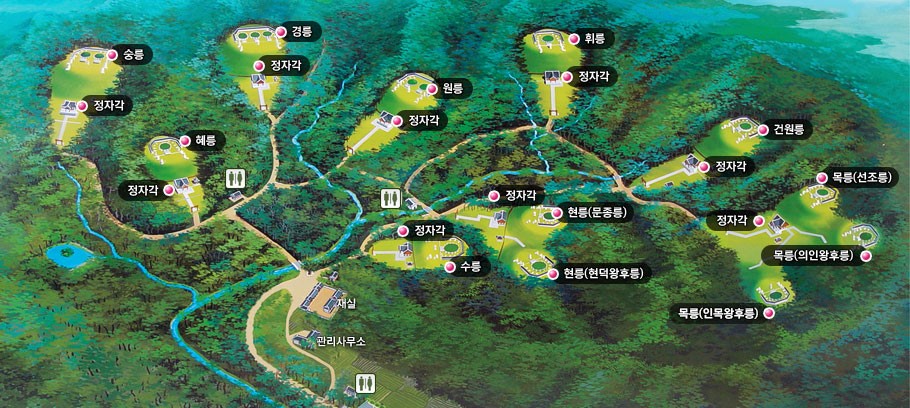
Donggureung (동구릉) in Guri is the largest royal tomb cluster of the Joseon Dynasty, featuring nine distinct tombs and 17 royal figures nestled within a massive, strictly protected forest. For travelers wanting a deeper historical experience beyond the crowded palaces of Seoul, this UNESCO World Heritage site offers a peaceful retreat into Korean royal history, genius ancient architecture, and living cultural traditions. Although it requires a short trip outside the capital, the majestic scenery and fascinating K-drama-worthy stories make it an absolute must-visit for culture lovers.
Living in Korea, I often find that visitors overlook the royal tombs because they assume they are just grassy mounds. But if you have ever watched a historical Korean drama and wondered about the real lives of those kings and queens, this is where their stories physically end—and continue. This guide will walk you through the rich history of the tombs, the famous figures resting here, the anti-robbery secrets of the burial mounds, and essential local tips for your visit.
- The Magnificent History and Scale of Donggureung
- The Nine Royal Tombs and Famous Figures
- How the Tombs Were Built and Protected from Robbers
- Understanding the Architecture of a Royal Tomb
- A Living Tradition: Royal Ancestral Rites
- Exploring the Sacred Forest Across Four Seasons
- Essential Etiquette, Transit, and Nearby Attractions
The Magnificent History and Scale of Donggureung
The name Donggureung literally translates to “nine tombs in the east.” Located on the lush slopes of Mt. Geomam in Guri-si, it forms the largest cluster of royal tombs of the Joseon era. To understand its importance, we have to look at the entire Joseon Dynasty (1392–1910). Out of the 42 tombs built for its 27 kings and their queens, 40 are located in South Korea, all of which were collectively designated as a UNESCO World Heritage site in 2009. It is incredibly rare globally to find an entire dynasty’s burial grounds preserved so flawlessly.
The story of Donggureung began in 1408 when King Taejo, the founder of the Joseon Dynasty, passed away. His tomb, Geonwolleung (건원릉), was the first to be established here. Over the next five centuries, powerful monarchs, tragic crown princes, and influential queens were laid to rest in the surrounding valleys, creating a monumental historical complex.
The Nine Royal Tombs and Famous Figures
Donggureung is home to nine tombs housing 17 royal individuals. Walking through these grounds is like flipping through the pages of a Korean history book.
| Tomb Name | Royal Figures Buried | Historical Significance |
|---|---|---|
| Geonwolleung | King Taejo | The founder of the Joseon Dynasty. |
| Wolleung | King Yeongjo & Queen Jeongsun | The longest-reigning king of Joseon, known for a cultural renaissance. |
| Mokneung | King Seonjo, Queen Uiin, Queen Inmok | The king who ruled during the devastating Imjin War. |
| Sureung | Crown Prince Hyomyeong (King Munjo) & Queen Sinjeong | The brilliant, tragic prince featured in Love in the Moonlight. |
| Gyeongneung | King Heonjong & two queens | The only “triple tomb” layout in the entire Joseon royal tomb system. |
| Mongneung | King Hyeonjong & Queen Myeongseong | Key figures of late 17th-century politics. |
| Hwireung | Queen Jangnyeol | An influential royal widow involved in major court disputes. |
| Hyereung | Queen Danui | The first consort of King Gyeongjong. |
| Suneung | Queen Myeongseong (of King Hyeonjong) | Not to be confused with the later Empress Myeongseong. |
For fans of Korean cinema and historical dramas, a few of these sites hold incredible backstories:
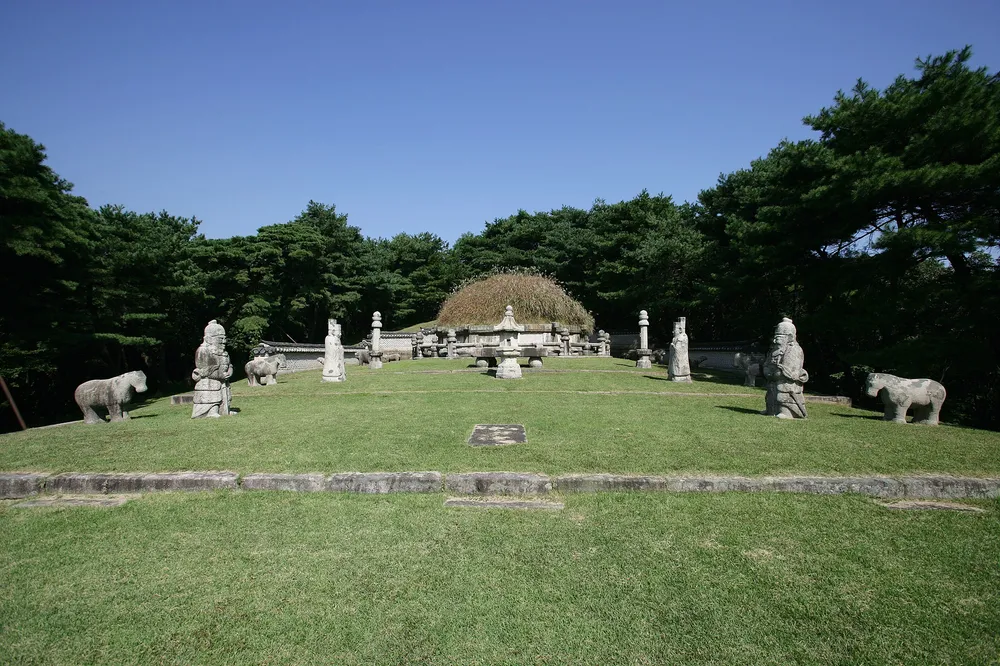
- King Taejo (Geonwolleung): His tomb has a very unique feature—instead of neatly manicured grass, the burial mound is covered in wild silver grass (chungan). Legend says Taejo deeply missed his hometown of Hamheung. To honor his wishes, his son brought soil and silver grass all the way from the north to cover his father’s resting place.
- King Yeongjo (Wolleung): Yeongjo led a major political revival, but he is also famous for the tragic story of locking his son, Crown Prince Sado, in a rice chest. His tomb is a “twin tomb” style, with separate burial mounds for him and his second wife.
- Crown Prince Hyomyeong (Sureung): A gifted reformer who died at just 21 years old before becoming king. He was posthumously elevated to King Munjo, and his brilliant but short life is frequently romanticized in K-dramas.
How the Tombs Were Built and Protected from Robbers
Building a royal tomb was one of the most important state projects in Joseon. Experts in geomancy (feng shui), architecture, and rituals worked together to choose a site that provided ideal harmony between mountains, water, and spiritual energy. The construction process followed a strict order:
- Select the geographically perfect site.
- Build the ceremonial structures at the base of the hill.
- Create the underground burial chamber.
- Install the protective stone sculptures above ground.
- Landscape the sacred forest to protect the spiritual energy.
Unlike the pyramids of Egypt or the ancient tombs of the Silla Kingdom, the Joseon royal tombs were almost never looted. The secret lies in a brilliant engineering technique called the Hoegyeok (회격) structure. Instead of a traditional stone chamber, the wooden coffin was encased in a thick mixture of lime, fine sand, and red clay. As this mixture absorbed carbon dioxide, it chemically hardened into a solid mass tougher than modern concrete. Grave robbers with simple tools could not break through it.
Furthermore, Joseon was a strict Confucian society that valued extreme frugality. They did not bury the dead with real gold crowns. Instead, they used Minggi (명기)—small, inexpensive replicas of everyday objects made from clay or wood. With an impenetrable shell and no shiny treasure inside, robbers had zero motivation to target these tombs.
Understanding the Architecture of a Royal Tomb
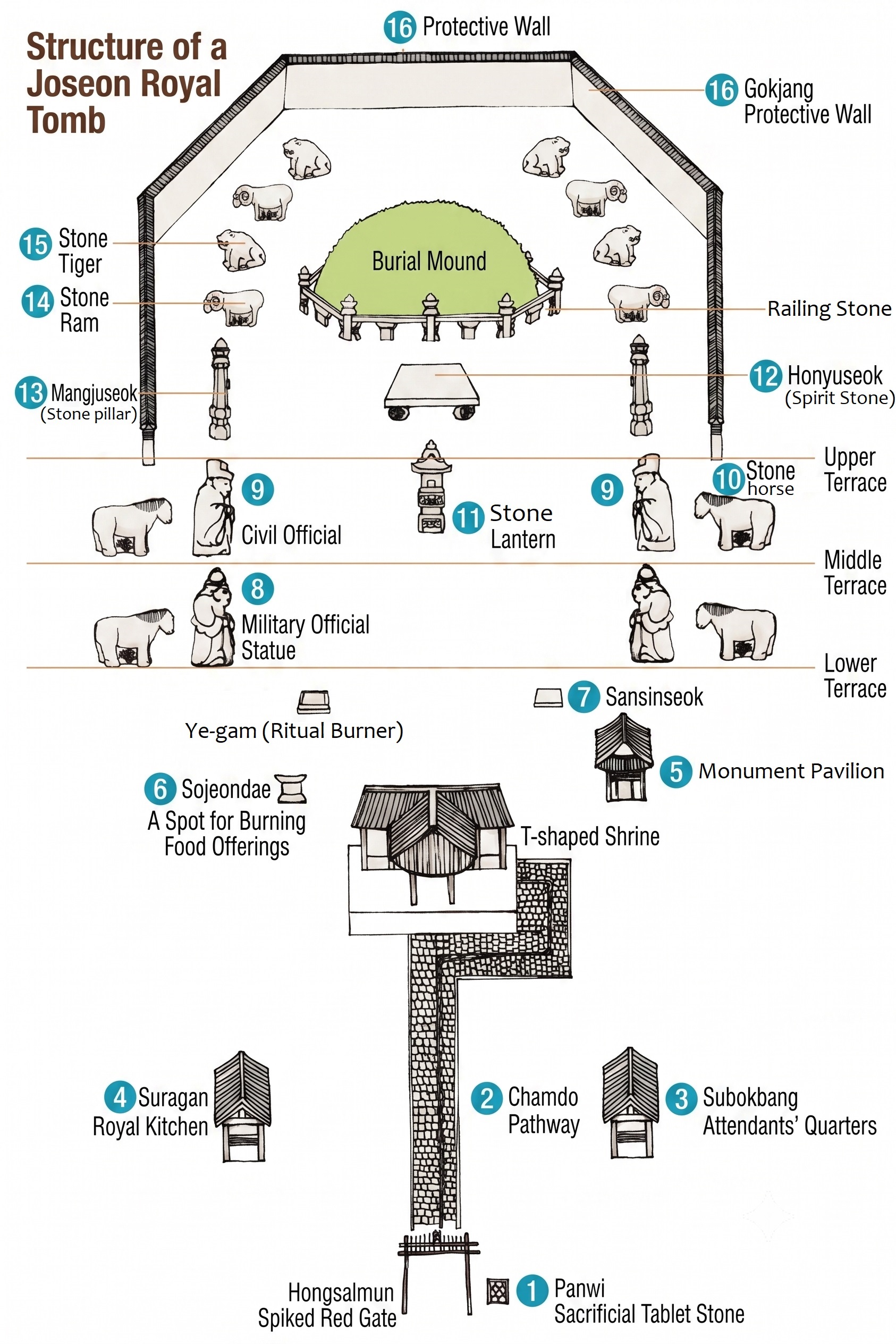
A Joseon royal tomb is an architectural masterpiece designed to bridge the world of the living and the dead. If you refer to the visual guide, royal tomb structure.jpg, you can see the distinct, terraced layout that almost all royal tombs follow.
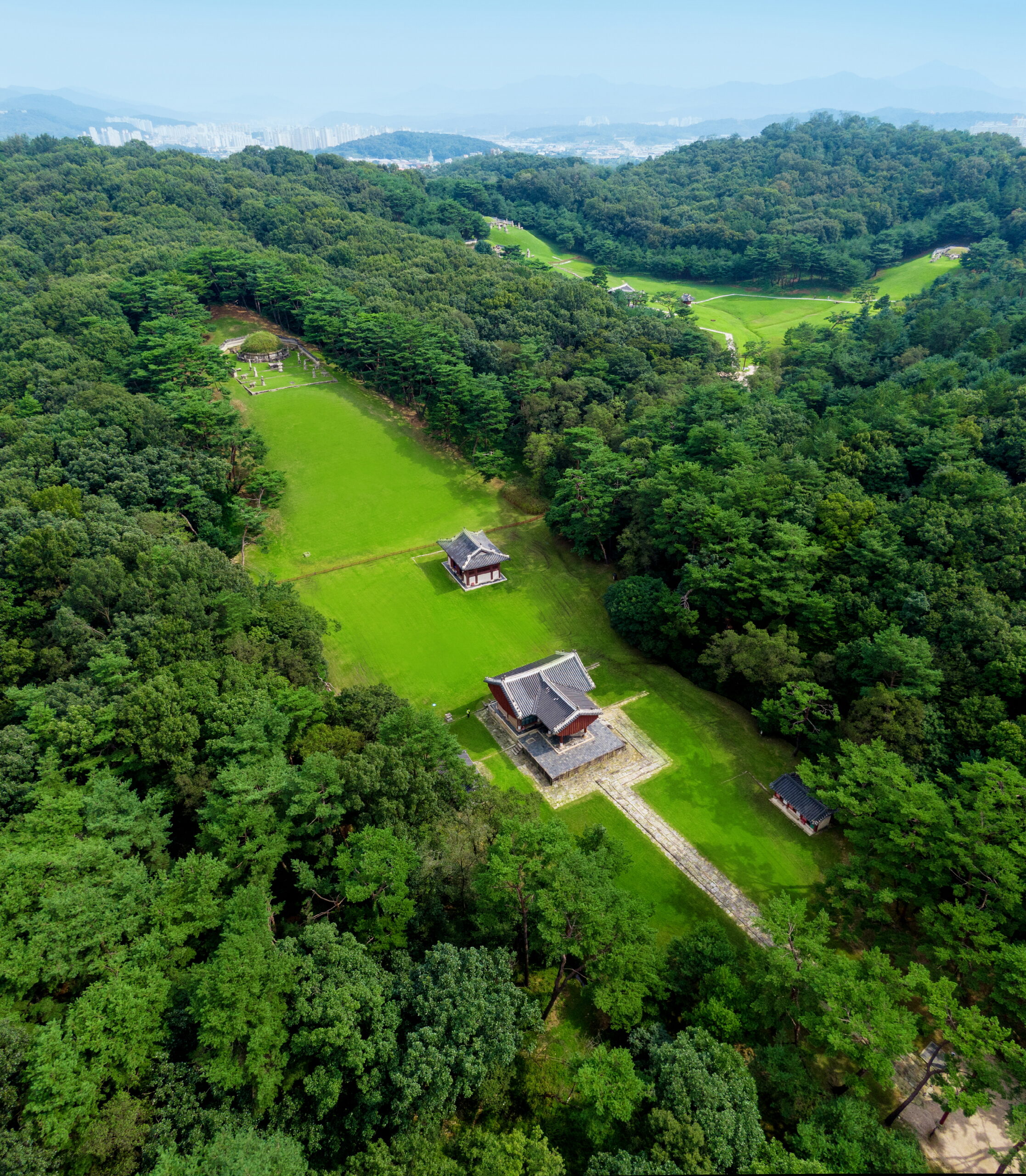
The journey into the tomb begins at the Hongsalmun (홍살문), a spiked red gate marking the sacred boundary. From there, you walk along a stone path called the Chamdo Pathway (참도), flanked by the Suragan (Royal Kitchen) and Subokbang (Attendants’ Quarters). The path leads to the Jeongjagak (정자각), a T-shaped shrine where memorial services are held.
Behind this shrine, the space elevates into three distinct terraces ascending the sacred hill. The Lower Terrace features stone statues of military officials and their horses. The Middle Terrace houses civil official statues and a central stone lantern. Finally, the Upper Terrace is where the burial mound rests. It is surrounded by a protective wall (Gokjang) and strictly guarded by stone tigers, stone rams, and stone pillars (Mangjuseok) to protect the royal spirit.
A Living Tradition: Royal Ancestral Rites
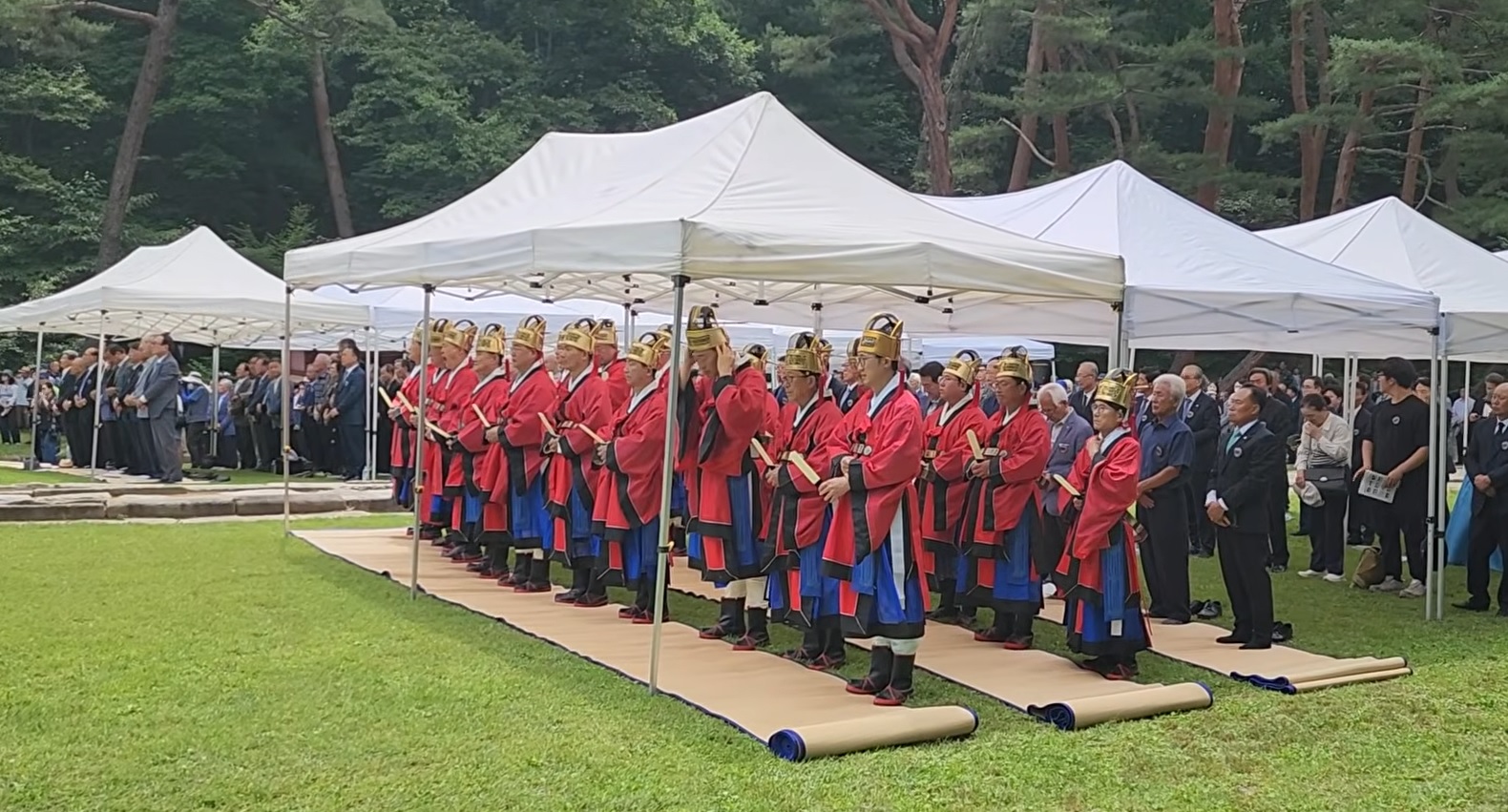
What makes Donggureung truly special is that it is a site of living history. The monarchy may have ended, but the descendants of the royal family (organized under the Jeonju Lee Royal Family Association) still perform traditional ancestral rites, known as Sanneung-jehyang, every single year. To check the specific schedule for the ancestral rites held at Donggureung, please refer to ‘Chosun Royal Ancestral Rites: Schedule, Etiquette, and Insider Tips‘.
💡 Pro Tip: If you time your visit right, you might actually witness one of these ceremonies. Descendants dressed in traditional robes walk the stone paths and perform solemn, 600-year-old Confucian rituals right at the Jeongjagak. For instance, the rite for King Taejo usually falls around June 27th. It is an incredibly rare cultural experience for international visitors.
Exploring the Sacred Forest Across Four Seasons
Because the royal tombs were designated as strictly protected sacred zones for centuries, the grounds of Donggureung are home to a massive, untouched primeval forest. Today, it serves as a “healing forest” for locals.
- Spring: The lush trails burst with vibrant wild azaleas and fresh greenery.
- Summer: The dense canopy of ancient oak and pine trees provides a remarkably cool, shaded retreat full of refreshing phytoncides.
- Autumn: The changing leaves create a spectacular backdrop against the red wooden shrines and dark tiled roofs, making it a favorite spot for photographers.
- Winter: When it snows, the quiet, white blanket covering the stone guardian statues creates a deeply mystical and serene atmosphere.
Essential Etiquette, Transit, and Nearby Attractions
Because Donggureung is a sacred UNESCO site, there are a few important rules to follow.
📌 Local Note: The most critical rule is that no food is allowed inside the grounds. You are welcome to bring bottled water, but picnics and snacks are strictly prohibited. You must also stay off the burial mounds and avoid walking on the raised spirit path.
How to Get There:
Traveling from Seoul is quite easy. You can take the Gyeongui-Jungang subway line to Guri Station (구리역), then hop on a local bus (like number 2 or 6) for a 10–15 minute ride. Even better, with the recent opening of the Byeollae Line (Subway Line 8 extension), you can now get off at Donggureung Station, making the trip much faster.
Make a Day Out of It:
Since you made the trip to Guri, check out some nearby spots! Guri Hangang Citizen Park (구리한강시민공원) is famous for massive riverside flower festivals. If you want more K-drama vibes, visit the Goguryeo Blacksmith Town (고구려대장간마을), a wildly popular outdoor set for historical shows. Finally, grab dinner at the Guri Traditional Market (구리전통시장) to experience authentic street food like tteokbokki and savory pancakes.
For more inspiration on navigating Korea’s historical sites, nature trails, and practical tips, check out some of our other guides below:
- Chosun Royal Ancestral Rites: Schedule, Etiquette, and Insider Tips
- How to Book Changdeokgung Secret Garden & Jongmyo Online (2026)
- Hiking in Korea: The Complete Guide for Foreign Travelers
- 5 Best Beaches in South Korea for Foreigners: 2026 Guide
- Best Korean Souvenirs : Authentic & Practical Gifts
Korean Culture portal KCulture.com

Founder of Kculture.com and MA in Political Science. He shares deep academic and local insights to provide an authentic perspective on Korean history and society.