Introduction and Synopsis
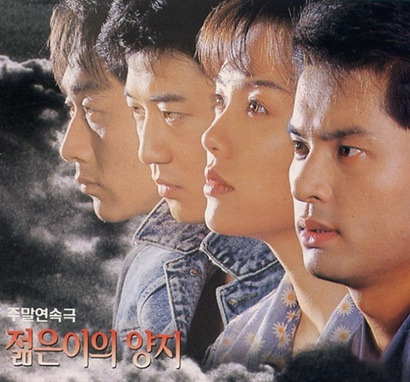
Long before Korean dramas became a global streaming phenomenon, KBS produced one of the defining television hits of the 1990s: A Sunny Place of the Young (젊은이의 양지). The Korean title can also be translated more literally as Youth’s Sunny Place, and English titles may vary among international databases and streaming platforms.
Broadcast on KBS2 from May 6 to November 12, 1995, the drama begins in the late 1980s and moves between Sabuk, a coal-mining town in Jeongseon County, Gangwon Province, and Seoul. Its large ensemble story follows young people attempting to escape poverty, protect their families, pursue creative ambitions, or enter a social world that once seemed beyond their reach.
At the center is Park In-beom, played by Lee Jong-won. In-beom is an exceptionally talented but impoverished young man who earns admission to Seoul National University. His achievement offers a possible route out of Sabuk, but it also intensifies his shame about his family background and his determination to climb the social ladder.
Waiting in his hometown is Im Cha-hee, played by Ha Hee-ra, who has supported and loved him through years of hardship. In Seoul, In-beom meets Ha Seok-joo, played by Bae Yong-joon, the son of the chairman of Jinmi Cosmetics. He also becomes involved with Seok-joo’s twin sister, Ha Seok-ran, played by Park Sang-ah. These relationships push In-beom into a succession of lies and betrayals as he attempts to separate himself from his past.
Another important storyline connects Seok-joo with Cha-hee’s younger sister, Im Jong-hee, played by Jeon Do-yeon. Jong-hee is an intelligent and outspoken literature lover who dreams of becoming a writer, while Seok-joo is more interested in filmmaking than in simply inheriting his father’s business world. Their relationship provides a different vision of youth, ambition, and artistic aspiration.
Sabuk and the End of a Coal-Mining Era
The drama’s mining-town setting is essential to its story. Sabuk was one of South Korea’s best-known coal communities, and coal miners played an important role in supplying the energy used during the country’s rapid industrialization. Mining, however, was dangerous work, and local families lived with industrial accidents, unstable employment, dust, and economic isolation.
The story begins around the end of the 1980s, just as Korea’s coal industry was approaching a historic turning point. The government introduced its Coal Industry Rationalization Policy in 1989. The policy encouraged mine closures and production cuts as demand for domestic coal declined and imported energy sources became more competitive.
The effects were dramatic. According to a government coal-industry plan, South Korea had 347 operating coal mines in 1988 but only 11 by 2000. Over the same period, the number of mine workers fell from more than 62,000 to approximately 8,200. Towns dependent on mining suffered population loss, unemployment, and the collapse of local businesses.
It would therefore be misleading to describe Sabuk at the beginning of the drama as a place where mining had already disappeared. The mines and mining culture remain very much alive in the characters’ daily lives. Instead, the drama captures a community standing near the edge of an enormous economic transition. Viewers watching in 1995 would have understood how quickly that world was disappearing.
In-beom’s move to Seoul reflects a broader migration experienced by many Koreans. Educational and professional opportunities were increasingly concentrated in the capital, while industrial restructuring left communities outside major cities with fewer ways to retain their younger residents. In this context, In-beom’s ambition is understandable even when his behavior becomes morally indefensible.
Ambition, Class, and Betrayal
The Price of Social Mobility
A Sunny Place of the Young examines the distance between educational achievement and genuine social acceptance. In-beom is academically gifted enough to enter one of Korea’s most prestigious universities, but admission alone does not erase differences in family wealth, social connections, manners, or confidence.
His friendship with Seok-joo exposes him to a wealthy family whose lifestyle appears impossibly distant from Sabuk. Instead of treating his background as a source of strength, In-beom begins hiding it. The more he attempts to construct a new identity, the more people he must deceive.
This makes In-beom one of the drama’s most memorable characters. He is neither a simple villain nor an innocent victim of poverty. The audience can recognize the social forces driving him while still condemning the harm caused by his decisions. Lee Jong-won’s performance made In-beom one of Korean television’s best-known examples of an ambitious antihero.
More Than a Story of Han
The suffering of Cha-hee can be understood in relation to han (한), a term sometimes used to describe accumulated sorrow, resentment, loss, and unresolved emotional pain. Her experiences of abandonment, family responsibility, and endurance certainly recall emotions associated with han.
However, han should not be treated as a simple explanation for every Korean tragedy. Cha-hee is more than a passive symbol of suffering. She works, supports her family, raises her younger siblings, and faces the consequences of In-beom’s choices. Her emotional restraint is powerful precisely because it exists alongside persistence and practical responsibility.
A National Television Phenomenon
A Sunny Place of the Young became one of the biggest Korean television successes of its decade. Its commonly reported peak audience rating was 62.7%, placing it among the highest-rated Korean dramas of the era.
This figure is a television audience rating, not proof that nearly two out of every three television sets that happened to be switched on were showing the drama. Audience ratings and audience-share measurements are different statistics, so the 62.7% figure should not be converted into a claim about the proportion of active televisions without additional data.
Even with that qualification, the number demonstrates the drama’s extraordinary reach. In the era before streaming and widespread multichannel television, successful weekend dramas could become shared national events. Viewers discussed the characters at home, at work, in schools, and in neighborhood businesses. In-beom’s betrayal, in particular, made actor Lee Jong-won strongly associated with the image of an unfaithful and socially ambitious man.
An Ensemble Cast of Future Stars
The drama is now especially fascinating because its cast included several actors who would later become major figures in Korean film and television.
- Bae Yong-joon as Ha Seok-joo: Bae Yong-joon had already debuted on television, but A Sunny Place of the Young was an important breakthrough. Seok-joo is the privileged son of a cosmetics-company chairman, yet he is drawn toward filmmaking rather than corporate ambition. Bae’s calm and intellectual screen image anticipated the persona that later helped make him a pan-Asian star through Winter Sonata.
- Jeon Do-yeon as Im Jong-hee: Jeon Do-yeon had been appearing on television since the early 1990s, so this was not her debut. It was, however, one of her most notable early drama roles. Jong-hee’s intelligence, directness, and literary ambition allowed Jeon to stand out within a large ensemble. She later became one of Korea’s most acclaimed film actors and won Best Actress at the 2007 Cannes Film Festival for Secret Sunshine.
- Lee Jong-won as Park In-beom: Lee Jong-won gave the drama its morally complicated center. His portrayal made In-beom convincing as both a product of severe class inequality and a man responsible for his own betrayals.
- Ha Hee-ra as Im Cha-hee: Already an established star, Ha Hee-ra brought emotional weight and public recognition to the production. Her performance prevented Cha-hee from becoming merely an abandoned hometown sweetheart and emphasized the burdens carried by women in working-class families.
- Heo Joon-ho as Hwang Yoon-bae: Hwang Yoon-bae, a miner who pursues boxing, represents another route out of the mining town. His story adds physical danger, labor, and perseverance to the drama’s broader examination of success.
- Park Sang-min as Park In-ho: In-beom’s younger brother follows a far more violent path involving crime and gang conflict. His storyline shows how limited opportunities can lead different members of the same family toward radically different futures.
- Hong Kyung-in as Im Soo-chul: Soo-chul, Cha-hee and Jong-hee’s younger brother, has a developmental disability. His role was notable in a period when Korean television often portrayed disabled characters through crude stereotypes, although modern viewers may still find some aspects of the representation dated.
What the Drama Reveals About 1990s Korea
Although the story begins in the late 1980s, the series resonated strongly with viewers in 1995. South Korea was experiencing economic confidence and rapid social change, while inequality between Seoul and declining industrial regions remained severe. The Asian financial crisis would not strike Korea until 1997, so the drama should not be described as a direct response to that crisis.
Seen in retrospect, however, its distrust of effortless success feels strikingly prescient. The drama asks whether education can truly overcome class, whether wealth provides moral legitimacy, and whether a person can discard family and community without also losing part of himself.
The title is therefore deeply ironic. The characters are all searching for a place in the sun—a secure and respected life—but the path toward that “sunny place” repeatedly passes through exploitation, concealment, and betrayal.
How to Watch A Sunny Place of the Young
International availability remains limited and can change by country. Viewers should be cautious about unofficial uploads, especially when episode numbers or subtitle quality are unclear.
- KBS official program page: The KBS page contains official information about the series and links to available broadcaster services. Visit the official KBS program page.
- KBS VOD: Full episodes are available through KBS’s Korean on-demand service in supported locations. Access may depend on region, account status, and current KBS policies. English subtitles should not be assumed.
- Apple TV: An official series listing with episode information is available in some regions. Whether episodes can actually be streamed or purchased depends on the viewer’s country. Check the Apple TV listing for local availability.
As of September 2026, a reliable official source confirming that the complete drama is available on Kocowa with English subtitles could not be identified. It is therefore safer not to recommend Kocowa unless the title can be found directly in the service’s catalog for the reader’s region.
Final Verdict
A Sunny Place of the Young is an important drama for viewers interested in the history of Korean television. Its production style and melodramatic intensity reflect the period in which it was made, but its questions about class, education, regional decline, and the moral cost of ambition remain recognizable.
It is also an opportunity to see important early performances by Bae Yong-joon and Jeon Do-yeon alongside established and emerging actors such as Ha Hee-ra, Lee Jong-won, Heo Joon-ho, and Park Sang-min. More than a nostalgic hit, the drama preserves the memory of a coal-mining community facing decline and of a generation struggling to find its own place in a rapidly changing Korea.

The KCulture Editorial Team is dedicated to providing deep insights and accurate information about the vibrant world of Korean culture.