If you have spent any time interacting with Koreans lately, you might have noticed a curious phenomenon: people often ask for your MBTI profile before they even ask about your hobbies or hometown. This obsession with categorizing the human psyche is one of the most fascinating Korean personality classification trends of the modern era. From the legacy of blood types to the rise of hormone-based “Teto/Egen” testing in 2025, Korea has turned personality analysis into a sophisticated social language. As a cultural observer watching these shifts unfold, I find that these tests are no longer just “for fun”—they are essential tools for navigating relationships, careers, and self-improvement in a high-pressure society.

- The Legacy Trend: Blood Type Personalities
- The Mainstream Era: MBTI as a Social ID
- MBTI Fatigue and the Rise of Teto/Egen
- Attachment Theory: Mapping Relationship Mechanisms
- The God-saeng Connection: Data-Driven Self-Care
- Why Korea is Obsessed with Classification
The Legacy Trend: Blood Type Personalities
Long before MBTI took over, Korea was dominated by the “Blood Type Personality Theory.” Originating from Japanese influence in the early 20th century and exploding in popularity during the 2000s, this system categorized the entire population into four groups. While scientifically debunked, it remains a deeply rooted cultural shorthand, especially among the older generations.
| Blood Type | Perceived Personality Traits |
|---|---|
| Type A | Diligent, considerate, and perfectionist, but often perceived as timid or easily hurt. |
| Type B | Creative, passionate, and free-spirited, but sometimes seen as selfish or unpredictable. |
| Type O | Sociable, ambitious, and natural leaders, though they can be overly competitive. |
| Type AB | Highly rational and unique; often described as “either a genius or an alien.” |
In 2025, identifying someone by blood type is considered “old-school.” However, it hasn’t disappeared. It survives as a lighthearted icebreaker. You might hear someone say, “You’re so meticulous, you must be a Type A,” using it as a comfortable, familiar way to initiate a conversation without the complexity of modern psychological frameworks.
The Mainstream Era: MBTI as a Social ID
Since the pandemic, the Myers-Briggs Type Indicator (MBTI) has shifted from a corporate tool to a “social ID card” in Korea. It categorizes people into 16 types based on four axes: Extraversion (E) vs. Introversion (I), Sensing (S) vs. Intuition (N), Thinking (T) vs. Feeling (F), and Judging (J) vs. Perceiving (P).
The impact of MBTI on Korean daily life is profound. It has birthed new slang, such as “Are you a T?”—a phrase used (often jokingly) to call someone out for being too logical and lacking empathy during emotional moments. It is common to see MBTI types listed on dating profiles, and some companies have even faced controversy for asking for MBTI types in job applications to ensure “team fit.”
📌 Local Insight: MBTI has become a form of “social cost-effectiveness.” By knowing someone’s four-letter code, Koreans feel they can bypass the long process of trial and error in understanding a new acquaintance’s boundaries and communication style.
MBTI Fatigue and the Rise of Teto/Egen
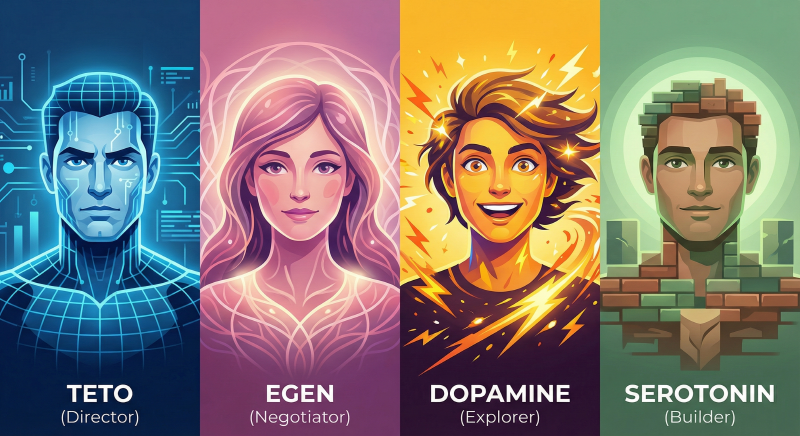
As we move through 2025, a sense of “MBTI fatigue” has emerged. Critics argue that 16 types cannot possibly capture the complexity of a human being. This has led to the rise of more biological and instinct-based assessments, most notably the Teto/Egen test. Based on the theories of anthropologist Helen Fisher, this system looks at how four brain chemicals—Dopamine, Serotonin, Testosterone, and Estrogen—influence our fundamental temperament.
- Teto (Testosterone/Director): Logical, analytical, and decisive. They focus on systems and objective truths.
- Egen (Estrogen/Negotiator): Empathetic, intuitive, and holistic. They focus on context and social harmony.
- Dopamine (Explorer): Risk-taking, creative, and energetic.
- Serotonin (Builder): Calm, traditional, and detail-oriented.
The younger generation is gravitating toward these tests because they feel more “primitive” and “honest.” While MBTI relies on self-reported answers (which can be biased by who we want to be), Teto/Egen is perceived as a map of who we biologically are.
Attachment Theory: Mapping Relationship Mechanisms
Beyond general personality, there is a growing obsession with Attachment Theory. This trend has been fueled by the explosion of “dating reality shows” like Transit Love and I Am Solo, where viewers analyze participants’ romantic struggles through the lens of psychological attachment.
| Attachment Type | Key Characteristics in Relationships |
|---|---|
| Secure | Comfortable with intimacy; trusts self and others; handles conflict through open communication. |
| Anxious | Sensitive to rejection; seeks constant reassurance; often feels “needy” or hyper-vigilant. |
| Avoidant | Values independence over intimacy; retreats or “disappears” when emotions become too intense. |
| Fearful-Avoidant | Desires closeness but fears being hurt; displays hot-and-cold behavior. |
This shift represents a move from “Who am I?” to “How do I interact with you?” People now use these labels to “optimize” their relationships, often saying, “I have an avoidant attachment style, so I need space during arguments,” as a way to set healthy boundaries.
The God-saeng Connection: Data-Driven Self-Care
In Korea, the concept of “God-saeng” (a portmanteau of “God” and “Life,” meaning a productive and exemplary life) is the ultimate goal for many. In 2025, personality testing has become a core component of this culture. It’s no longer just about knowing yourself; it’s about “meta-cognition”—using data to hack your own productivity.
For example, a “God-saeng” practitioner might identify as a “Teto-type” and schedule their most analytical tasks for the morning when their focus is highest. Or, they might use their MBTI “J” (Judging) traits to create minute-by-minute routines, believing that aligning their lifestyle with their innate psychological type is the most efficient way to achieve success and maintain mental health.
Why Korea is Obsessed with Classification
Why is this culture so prevalent in Korea? From a socio-cultural perspective, it boils down to three factors: Uncertainty, Efficiency, and Connection. In a fast-paced, competitive society, these labels provide a sense of stability. They offer a script for how to act and what to expect from others.
Furthermore, it satisfies the need for self-care. In a culture that traditionally emphasized the “collective,” these tests allow individuals to focus on their unique identities. By categorizing themselves, Koreans are paradoxically finding a way to stand out while also finding a group where they belong. Whether it’s through blood types, MBTI, or hormones, the goal remains the same: to find a clear answer to the age-old question, “Who am I?”
Korean Culture portal KCulture.com
Join the mailing service and add to your favorites.

Founder of Kculture.com and MA in Political Science. He shares deep academic and local insights to provide an authentic perspective on Korean history and society.