The 1997 Korean IMF Crisis: How South Korea Survived Bankruptcy Through Unity and Gold
The 1997 Korean IMF Crisis was arguably the most devastating economic disaster in modern South Korean history. Within a matter of weeks, one of Asia’s fastest-growing economies—proudly known as an “Asian Tiger”—stood on the absolute brink of national bankruptcy, forcing the government to seek an unprecedented and humiliating $58 billion bailout from the International Monetary Fund (IMF).
Every Korean who lived through that time, including myself, will never forget the profound despair of seeing lifelong workplaces collapse overnight, nor the overwhelming sense of unity as people lined up in the freezing winter to give up their most precious family heirlooms. For international observers, understanding this crisis is the key to unlocking the modern Korean psyche.
This article explores why the crisis happened, how government failures contributed to the collapse, how the IMF’s neoliberal reforms changed society, and why millions of Koreans willingly sacrificed their personal wealth in the legendary Nationwide Gold-Collecting Campaign.
- The Outbreak: Why the Asian Financial Crisis Reached Korea
- Denial of Reality: Bureaucratic and Political Failures
- The Bitter Medicine: Neoliberal Reforms and Mass Layoffs
- The Miracle of 1998: The Nationwide Gold-Collecting Campaign
- The Triumphant End: Paying Off the Debt Early
- Remembering the Crisis: Dramas, Movies, and Places to Visit
- Frequently Asked Questions (FAQ)
- Further Reading on Korea’s History
The Outbreak: Why the Asian Financial Crisis Reached Korea
To understand Korea’s IMF Crisis, we first need to look at the broader Asian Financial Crisis that began in Thailand in July 1997. When international investors lost confidence in Southeast Asian economies, a wave of capital flight spread quickly. But how did it topple an industrial powerhouse like South Korea?
In the 1990s, Korea was intoxicated by decades of rapid economic growth. However, beneath the impressive surface, massive structural cracks had formed:
- Overexpansion of the Chaebol: Large family-owned conglomerates, known as chaebol, aggressively expanded into dozens of unrelated industries. Rather than focusing on sustainable profits, they borrowed heavily to simply grow their market share.
- Dangerous Short-Term Foreign Debt: Korean banks borrowed U.S. dollars overseas through short-term loans while lending money domestically for long-term investments. Once international banks got nervous and refused to renew these loans, Korea suddenly faced an acute shortage of foreign currency.
| Structural Weakness | Why It Became Dangerous |
|---|---|
| High corporate debt | Companies could not survive the slightest decline in credit. |
| Short-term foreign borrowing | Loans matured faster than the country could repay them in U.S. dollars. |
| Weak banking oversight | Banks continued risky lending to conglomerates despite clear warning signs. |
Denial of Reality: Bureaucratic and Political Failures
By early 1997, the warning signs were flashing red. Major corporations like Hanbo Steel and Kia Motors began to collapse in a domino effect, leaving thousands of suppliers unpaid. Yet, the government officials and economic bureaucrats of the time were shockingly complacent.
They repeatedly assured the public on national television that “the fundamentals of the Korean economy are strong,” aggressively denying reality and downplaying the severity of the situation. Because of this irresponsible delay in acknowledging the crisis, valuable weeks were lost, and the national foreign exchange reserves eventually ran dry.
Adding to the chaos, 1997 was an intensely competitive presidential election year. Political attention was divided, which complicated decision-making at the worst possible moment. Left with no other choice and facing sovereign default, on November 21, 1997, the government formally requested an emergency rescue package from the IMF, which eventually totaled about US$58 billion.
The Bitter Medicine: Neoliberal Reforms and Mass Layoffs
The IMF did not hand over the bailout money without severe conditions. In exchange, they demanded sweeping neoliberal reforms that completely turned South Korean society upside down. The era of the “lifetime workplace”—a deeply rooted social expectation in Korea—was over.
The Human Cost and the Rise of “Non-Regular Workers”
To improve corporate flexibility, labor laws were changed to allow for easy dismissal. Companies that had never laid off employees suddenly announced mass layoffs. Entire departments disappeared, and the streets were flooded with the unemployed.
This marked the rapid expansion of “non-regular workers” (비정규직). Instead of hiring permanent staff, companies increasingly relied on temporary contracts, outsourced workers, and part-time employees. While it helped companies remain globally competitive, it created a stark divide in job security and income inequality that remains one of Korea’s most heavily debated social issues today.
Foreign Capital and the Fire Sale of National Assets
To attract foreign capital and curb inflation, interest rates were hiked to a staggering 20-30%, crushing middle-class families. Furthermore, truly profitable, foundational domestic companies and banks were sold off to foreign investors at incredibly low bargain prices.
A famous example of this controversy is the acquisition of the Korea Exchange Bank (KEB) by the U.S.-based private equity firm Lone Star. Many Koreans felt that strategic, “golden goose” national assets were being stripped away under extraordinary pressure, sparking a long-lasting debate about the infiltration of speculative foreign capital.
The Miracle of 1998: The Nationwide Gold-Collecting Campaign
While the government had failed, the Korean people stepped up in a way that left the world in awe. In January 1998, ordinary citizens started asking a different question: “What can we do ourselves to save the country?”
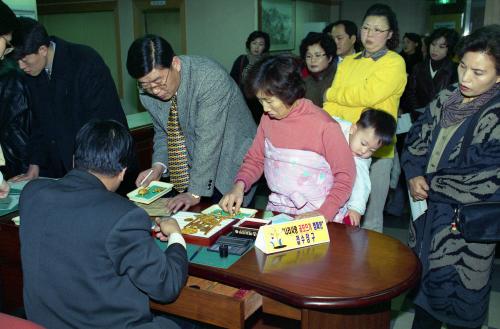
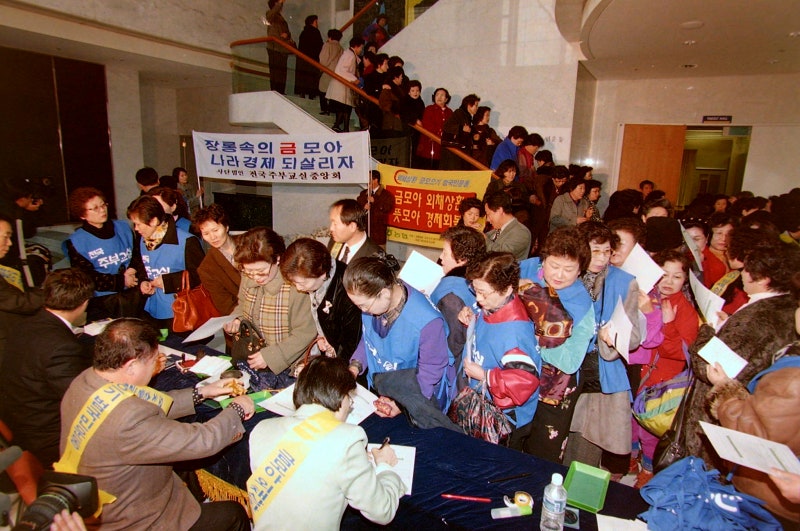
This led to the legendary Nationwide Gold-Collecting Campaign (금모으기 운동), where millions voluntarily donated or sold their personal gold at a discount to help the government raise U.S. dollars.
| Campaign Statistic | Details |
|---|---|
| Total Participants | Approx. 3.51 million people (about 8% of the entire 1998 population) |
| Total Gold Collected | Approx. 227 metric tons |
| Estimated Value | Approx. $2.2 billion USD |
The Heartbreaking Sacrifices: Dolbanji and Heirlooms
In Western cultures, gold represents personal wealth and security. The idea of individuals surrendering their private safety nets to bail out a failed government was unfathomable. Yet, long lines formed outside banks in the freezing cold.
The most emotionally devastating symbol of this era was the sacrifice of the Dolbanji (돌반지). In Korea, it is a tradition to gift a 24-karat pure gold ring to a baby on their first birthday to wish them health and wealth. These rings act as a family’s ultimate emergency fund. During the campaign, countless young parents pushed strollers to collection centers, willingly giving up their children’s gold rings, stating, “If our country does not survive, our children have no future.”
People also donated wedding rings and medals. Social leaders joined the cause; the late Cardinal Stephen Kim Sou-hwan donated his inauguration gold cross, and sports stars like golfer Pak Se-ri and baseball legend Lee Jong-beom donated their championship trophies.
Saving Korea’s Global Credit
While the $2.2 billion raised could not cover the entire $58 billion debt, the true value of the campaign was the miraculous restoration of international trust.
Immediately after the IMF bailout, overseas Korean businesses faced total isolation. Foreign banks refused to issue Letters of Credit (L/C), paralyzing international trade. But when global networks like CNN, BBC, and The New York Times broadcast footage of millions of Koreans lining up to give their personal gold to the state, the global financial sentiment violently shifted.
Foreign bankers and buyers were stunned. The consensus became: “If a nation has citizens who voluntarily sacrifice their own wealth to pay off national debt, that country will not fail.” Frozen credit lines began to thaw, and Korean expats wept as they realized the gold collected back home had literally saved their livelihoods.
The Triumphant End: Paying Off the Debt Early
Driven by the spirit of Hwannan-sanghyul (환난상휼)—a traditional Korean philosophy of helping one another during times of great disaster—and the concept of deep communal affection known as Jeong (정), South Korea endured the grueling years of restructuring.
On August 23, 2001, South Korea fully repaid the IMF bailout loan. They had managed to pay off the massive debt a staggering three years ahead of the scheduled deadline, marking one of the most successful economic recoveries in modern history.
Remembering the Crisis: Dramas, Movies, and Places to Visit
To truly grasp the emotional and historical weight of the 1997 IMF Crisis, viewing it through the lens of Korean media and visiting related sites is highly recommended.
Must-Watch Kdramas and Movies
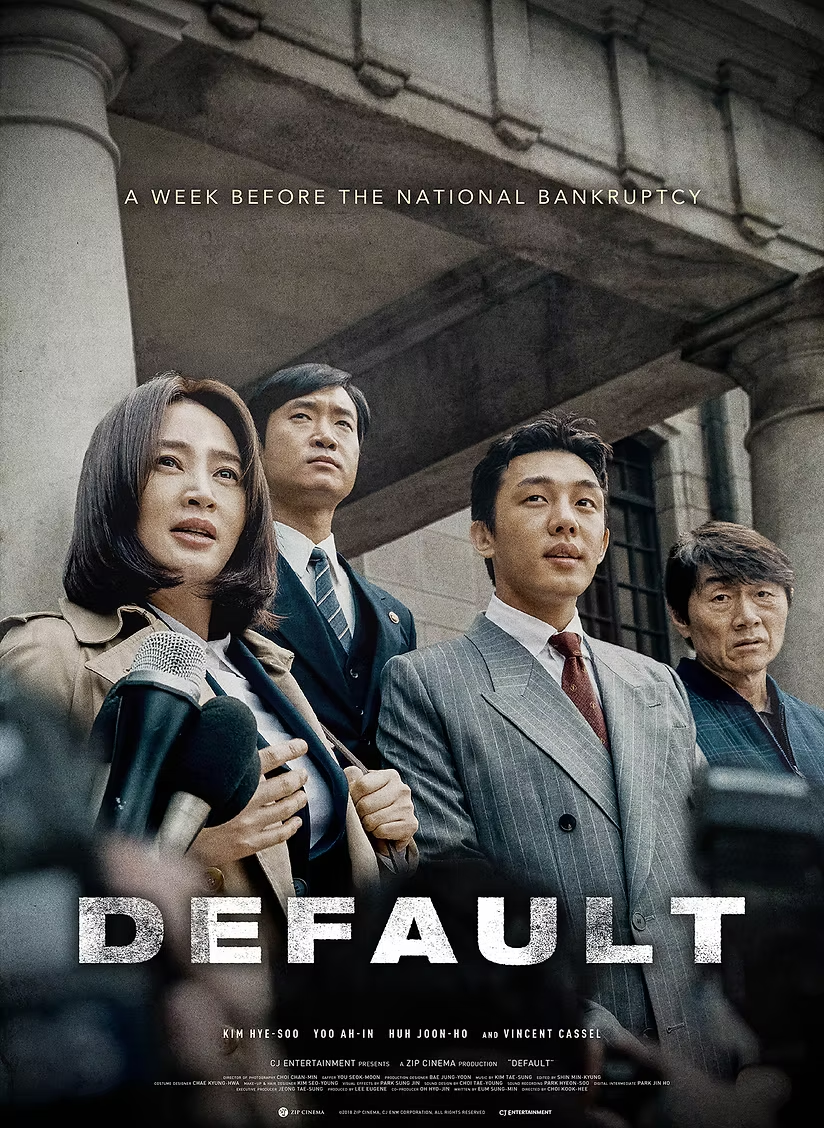
- Default (국가부도의 날, 2018): A gripping film that meticulously tracks the chaotic week before the IMF bailout. It perfectly portrays the conflict between the few trying to warn the country, the bureaucrats hiding the truth, and the ordinary citizens rushing toward disaster. (Available on Netflix and Viki in select regions)
- Twenty-Five Twenty-One (스물다섯 스물하나, 2022): While primarily a romance and coming-of-age drama, the entire premise is deeply rooted in the IMF crisis, illustrating how the economic collapse destroyed the dreams of high schoolers and families. (Available on Netflix)
- Typhoon Family (2025): A recent Kdrama inspired by the atmosphere surrounding the IMF era and the Gold Collection Campaign, focusing on ordinary people facing extraordinary hardship.
Places to Visit in Korea
- Bank of Korea Money Museum (한국은행 화폐박물관, Seoul): Located near Myeong-dong, this beautiful early 20th-century building houses deep historical archives on Korea’s monetary history and the turbulent times of the late 90s.
- National Museum of Korean Contemporary History (대한민국역사박물관, Seoul): Situated in Gwanghwamun, this museum offers a comprehensive timeline of Korea’s rapid modernization, explicitly detailing the pain of the IMF crisis and the triumph of the Gold-Collecting Campaign.
- KBS ON Broadcasting Museum (KBS 견학홀, Seoul): KBS played a central role in broadcasting the Nationwide Gold Collection Campaign. Visiting here offers insight into how television united the country during a national emergency.
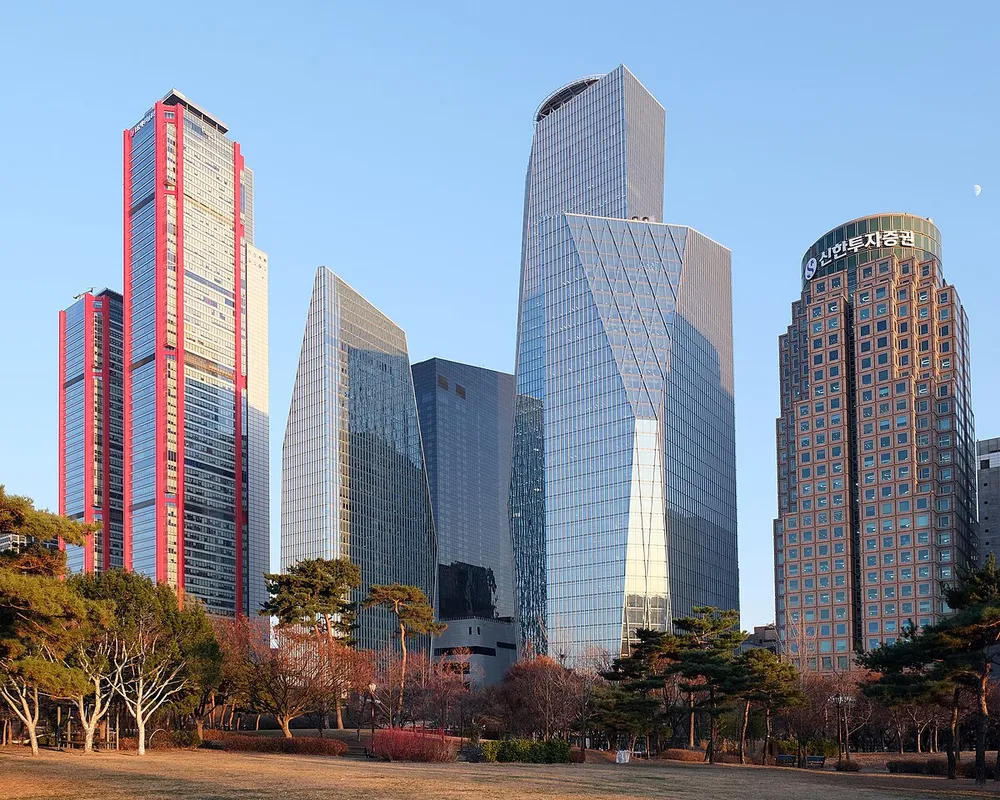
- Seoul Financial District (Yeouido, Seoul): Walking through Yeouido, the heart of Korea’s financial industry, offers a reminder of how dramatically Korea’s financial system has evolved since 1997.
Frequently Asked Questions (FAQ)
Did South Korea really go bankrupt during the IMF Crisis?
No. South Korea came extremely close to running out of foreign currency needed to repay its short-term overseas debt, but it never officially declared bankruptcy. Instead, it secured an emergency rescue package from the IMF.
Why is it called the “IMF Crisis” in Korea?
Outside Korea, it is generally referred to as part of the Asian Financial Crisis. In Korea, however, it is almost universally known as the “IMF Crisis” because the IMF bailout conditions fundamentally changed the country’s economy and everyday life.
Did the Gold Collection Campaign repay Korea’s IMF loan?
Not directly. The 227 metric tons of gold collected—worth about US$2.2 billion at the time—covered only a small portion of the total $58 billion rescue package. Its greatest contribution was restoring international confidence.
Did the IMF Crisis permanently change Korea?
Yes. The crisis transformed labor markets, corporate governance, and Korea’s relationship with globalization. Conversations about job security, temporary workers (비정규직), and economic inequality today all trace their roots back to the “post-IMF” era.
Further Reading on Korea’s History
South Korea’s history is filled with moments where citizens stepped up to overcome impossible odds. Explore more of these incredible stories below:
- Ganghwa Island Battles: The Fall of Joseon’s Isolation
- The Hidden History of Korea’s Reforestation Success
- Foreign Heroes of Korea’s Independence Movement
- The Uigwe: A Window into King Jeongjo’s 8-Day Royal Journey
- History of the 1987 June Democratic Struggle in Korea
- 2007 Taean Oil Spill: South Korea’s Greatest Civic Miracle
- Kdrama ‘Typhoon Family’ Decoded: The Real Story of Korea’s IMF Gold Drive
Korean Culture portal KCulture.com

Founder of Kculture.com and MA in Political Science. He shares deep academic and local insights to provide an authentic perspective on Korean history and society.