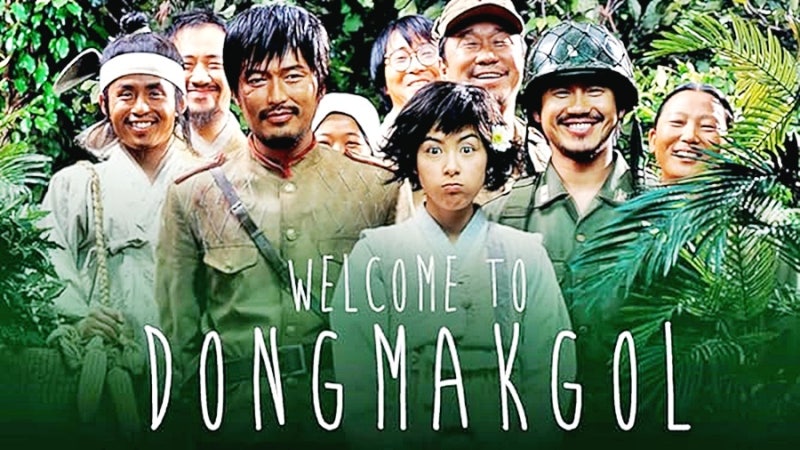
“Welcome to Dongmakgol” is a masterful 2005 South Korean film that seamlessly blends magical realism, comedy, and tragedy to deliver a profound anti-war message by placing sworn enemies in an isolated, innocent village. If you are exploring Korean cinema and seek a unique, emotionally resonant perspective on the Korean War, this cinematic gem is an absolute must-watch that will deeply move you. I am thrilled to guide you through this film’s brilliant premise, iconic symbolism, and why it remains a deeply cherished modern classic.
- The Premise: A War Outside, Peace Inside
- The Masterminds: Cast and Director
- Atmosphere, Themes, and Symbolism
- The Cultural Legacy and Box Office Success
- Where to Watch Welcome to Dongmakgol
- Final Verdict
The Premise: A War Outside, Peace Inside
Set in 1950 during the devastating height of the Korean War, the film centers around a secluded mountain village called Dongmakgol. This village is so fiercely isolated from the modern world that its inhabitants have never seen a gun, let alone comprehended the brutal ideological war tearing their country apart.
By a fascinating twist of fate, three distinct groups of soldiers crash into this idyllic sanctuary: a lost U.S. Navy fighter pilot, two exhausted South Korean soldiers, and three retreating North Korean soldiers. Suddenly, sworn enemies are forced into close quarters within a community of entirely innocent, deeply bewildered villagers. What follows is a beautiful, tense, and often hilarious deconstruction of military hostility.
The Masterminds: Cast and Director
Director Park Kwang-hyun made his sensational feature film debut with this movie, bringing a visionary, almost fairy-tale-like aesthetic to a genre usually dominated by grit and grime. He successfully humanizes each soldier, stripping away their political affiliations to reveal the terrified, exhausted men underneath.
| Actor | Character | Role & Significance |
|---|---|---|
| Jung Jae-young | Comrade Lee Su-hwa | The stoic, weary commander of the North Korean troops who slowly lets his guard down. |
| Shin Ha-kyun | Lieutenant Pyo Hyun-chul | A deeply traumatized and cynical South Korean officer carrying the heavy guilt of war. |
| Kang Hye-jung | Yeo-il | A pure-hearted, eccentric village girl whose performance remains one of the most iconic in Korean cinema history. |
| Steve Tash | Captain Neil Smith | The American pilot whose sudden crash-landing sets the entire chain of events in motion. |
The supporting cast, heavily featuring veterans like Im Ha-ryong and Ryu Deok-hwan, provides incredible depth as soldiers who slowly rediscover their lost humanity through the simple routines of village life.
Atmosphere, Themes, and Symbolism
“Welcome to Dongmakgol” is far from your typical war movie. Instead of focusing on the brutal mechanics of combat, it zooms in on the absurdity of war and the enduring power of shared humanity.
- A Fairy Tale Atmosphere: The film heavily utilizes magical realism. Dongmakgol acts as a literal “Garden of Eden”—a place completely untouched by ideology, hatred, or modern violence. The cinematography here is vibrant, lush, and dreamlike, which sharply contrasts with the desaturated, violent flashbacks of the war raging outside.
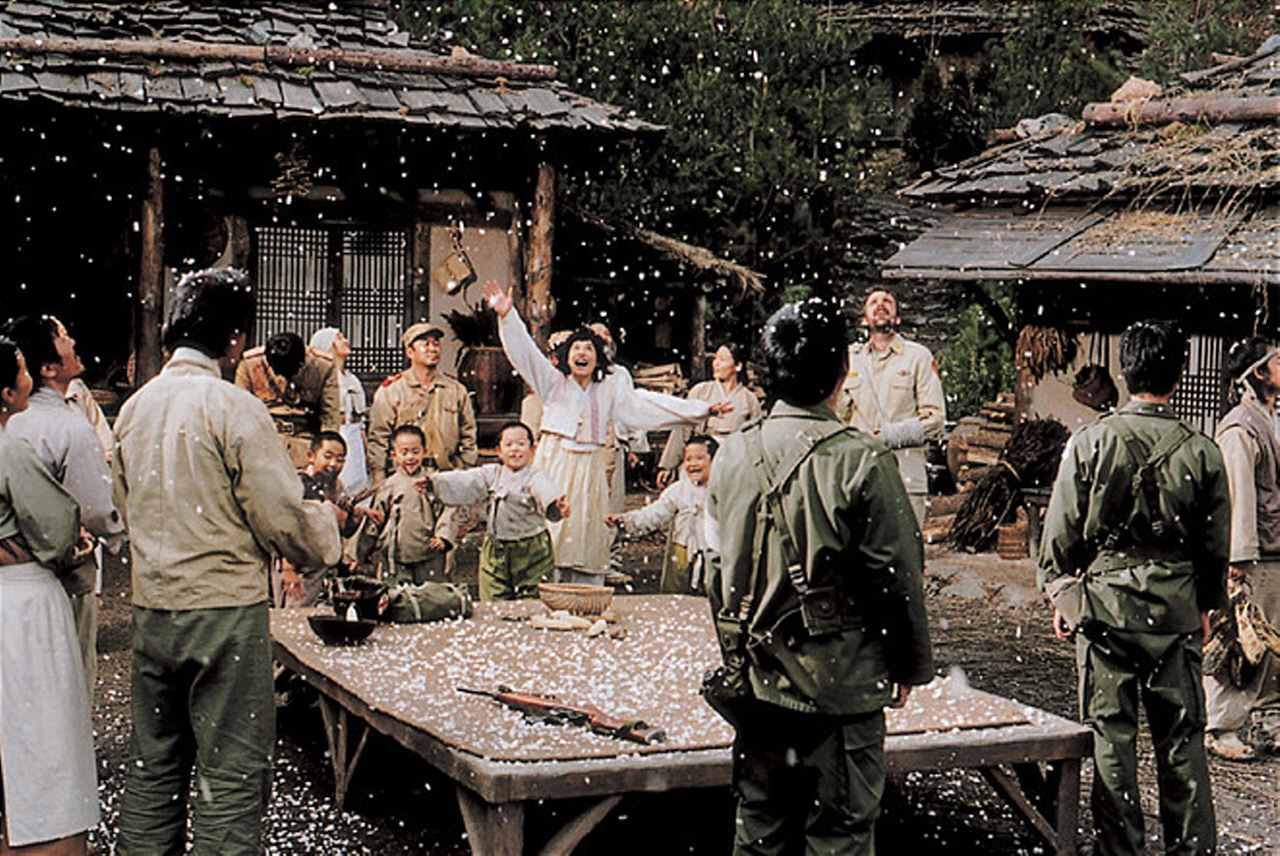
- The Symbolism of “Popcorn”: Without giving too much away, there is an iconic, breathtaking scene early in the film where a terrifying, life-threatening standoff transforms into a magical shower of popcorn raining down like snow. This perfectly visualizes the film’s core message: the destruction of violent tension through innocence and shared joy.
- The Wild Boar Hunt: A pivotal, highly entertaining sequence forces the opposing soldiers to stop pointing guns at each other and work together against a formidable force of nature. It serves as a brilliant, primal metaphor for how artificial human conflicts disappear when faced with a common struggle for survival.
💡 Pro Tip for Cinephiles: The emotional weight of these symbolic scenes is elevated to legendary status by a magnificent, sweeping score composed by world-renowned Japanese composer Joe Hisaishi, famous for his iconic work with Studio Ghibli. Listen closely to how the orchestration shifts between the tension of the soldiers and the whimsical innocence of the villagers.
📌 Local Note: Although Dongmakgol is a fictional village, the breathtakingly beautiful set was actually built in the mountainous region of Pyeongchang (평창) in Gangwon Province. For years after the film’s release, the meticulously crafted village served as a popular tourist destination for film lovers traveling across Korea.
The Cultural Legacy and Box Office Success
Upon its release in 2005, “Welcome to Dongmakgol” was nothing short of a massive cultural phenomenon in South Korea. It resonated deeply with a nation still technically at war, offering a bittersweet glimpse into reconciliation and unity.
The film was a box office smash, drawing over 8 million viewers and becoming the second highest-grossing South Korean film at the time. Beyond commercial success, it received widespread critical acclaim for its bold anti-war message and its rare ability to make audiences laugh uncontrollably before moving them to tears. Its impact was so profound that it was chosen as South Korea’s official submission for the Academy Award for Best Foreign Language Film.
Where to Watch Welcome to Dongmakgol
Availability varies depending on your region, but if you are ready to embark on this cinematic journey, here is where you can typically find it:
- Streaming Services: Asian-cinema focused platforms like Tubi, Kocowa, or Viki frequently feature classic Korean cinema.
- VOD (Video on Demand): It is often available for rent or purchase on major global platforms like Amazon Prime Video, Apple TV, or Google Play Movies.
Search Tip: Always search with the English title or append the exact release year (2005) to easily locate it in your local region’s catalog.
Final Verdict
“Welcome to Dongmakgol” asks a simple but profoundly devastating question: If you strip away the uniforms, the weapons, and the enforced ideologies, what are we ultimately left with? As a critic and a local, I can confidently say that this film is a hilarious, visually stunning, and ultimately heartbreaking cinematic journey. It is a brilliant reminder of our shared humanity that will stay with you long after the credits roll.
Explore More Korean Cinema
- 10 Million Viewer Club Korean Movies: Box Office Legends
- The Sociological Meaning of The King’s Warden
Korean Culture portal KCulture.com

Founder of Kculture.com and MA in Political Science. He shares deep academic and local insights to provide an authentic perspective on Korean history and society.