For those wondering about getting glasses in South Korea, the short answer is: the process is incredibly fast, remarkably affordable, and requires absolutely no prior doctor’s prescription. Customers can walk into a store, receive a free professional eye exam, and walk out with custom-fitted, high-quality glasses in just 15 to 30 minutes for a fraction of what they would pay in North America or Europe.
Expats and travelers often report frustration with the slow, expensive, and heavily regulated optical services in their home countries. While navigating an unfamiliar system can cause hesitation, upgrading eyewear in South Korea is widely considered a must-experience K-service. This guide breaks down the entire process, outlines the stark differences from Western countries, and shares insider tips for securing the best deal on new frames.
- Independent from Medical Services: No Prescription Needed
- The 15-Minute Magic: Step-by-Step Process
- Cost and Time: South Korea vs. The West (April 2026 Pricing)
- Unique Korean Optical Regulations to Know
- Insider Tips for Foreigners
- Exploring Further Medical and Wellness Tourism
Independent from Medical Services: No Prescription Needed
One of the most confusing aspects for visitors is understanding how the system works without a doctor. In South Korea, getting a pair of glasses is a completely independent procedure from visiting an ophthalmology clinic. There is no need to schedule a medical appointment or pay for a separate prescription.
Under Korean medical and technician laws, an optical shop (안경점) employs state-licensed opticians (안경사) who are legally authorized to perform refraction tests and prescribe lenses right on the spot. Unless a customer has an underlying eye disease or is a child under the age of six—which mandates a hospital visit—the entire journey begins and ends at the retail store. This separation of retail optics from clinical ophthalmology is what makes the Korean system so brilliantly efficient.
The 15-Minute Magic: Step-by-Step Process
The Korean eyewear industry prides itself on a flawless “one-stop system.” Here is exactly what to expect when walking through the doors.
- Walk-in Anytime: Appointments are practically unheard of. Whether in a bustling shopping district or a quiet residential neighborhood, customers can simply walk in.
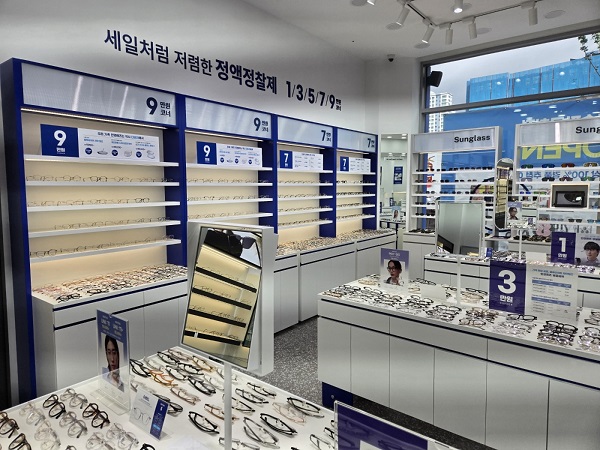
- Frame Selection: Browse thousands of frames on open display. Most stores have transparent, fixed-price zones, making it easy to shop within a specific budget.
- Free Eye Exam: Once a frame is selected, the customer is directed to the in-store testing room. The optician uses state-of-the-art diagnostic machines to measure vision. This test is entirely free when purchasing glasses.
- Lens Selection: Choose lens options, such as blue-light blocking or high-index lenses for thinner profiles.
- Waiting and Fitting: Enjoy a free coffee or ice cream (often provided in the store’s waiting area). In about 15 to 30 minutes, the glasses are cut, assembled, and ready. The optician will then carefully adjust the frames to fit the unique shape of the wearer’s face.
💡 Pro Tip: While standard prescriptions are finished within 30 minutes, if a customer has severe astigmatism, extreme myopia, or needs progressive multifocal lenses, the shop may need to order custom lenses. In these rare cases, it might take 1 to 3 days.
Cost and Time: South Korea vs. The West (April 2026 Pricing)
To truly appreciate the value of getting glasses in Korea, a direct comparison highlights the unmatched affordability and speed. As of April 2026, the cost of prescription eyewear in Western countries continues to rise, while South Korea maintains its highly competitive, budget-friendly pricing model.
| Category | South Korea (As of April 2026) | North America / Europe (As of April 2026) |
|---|---|---|
| Time Required | 15 – 30 minutes (Same-day completion) | 1 to 2 weeks (or more) |
| Eye Exam Fee | Free with glasses purchase | $50 – $250 (Separate medical fee) |
| Starting Price (Frame + Lens) | Around $30 – $50 (Highly affordable) | $200 – $350+ (Average without insurance) |
| High-Index (Thin) Lenses | Cheap and treated as a basic, accessible option | Prices increase drastically with each level of thinning |
| Accessibility | Walk-in friendly, available on every busy street | Advance appointments generally required |
Unique Korean Optical Regulations to Know
While physical stores offer ultimate convenience, South Korea has surprisingly strict laws regarding online eyewear sales to protect public eye health and the optician profession.
Unlike in the US or Europe, where ordering prescription glasses or contact lenses online from direct-to-consumer sites is the norm, selling prescription lenses online is strictly prohibited in South Korea. Even if the exact measurements are known, customers must visit a physical store to pick up any glasses or contacts that have a prescription. Non-prescription fashion frames and cosmetic lenses without grading are the only exceptions.
Insider Tips for Foreigners
To make the shopping experience as smooth as a local’s, keep these practical pointers in mind.
- The Quirky “Compression” Translation: When using a translation app, the optician might offer to “compress” (압축) the lenses. They are not physically squishing the glass in a hydraulic press. This is simply the local slang for upgrading to high-index lenses, which use a higher refractive index to achieve a thinner, lighter lens.
- Bring Old Glasses: If concerned about the language barrier during the eye exam, bringing a current pair of glasses is highly recommended. The optician will pop them into a lensmeter and instantly read the exact prescription.
- Blue-Light Blocking is a Steal: Adding a blue-light filter usually costs an additional $10 to $20. Given the amount of time spent on screens, it is an incredibly cheap and worthwhile upgrade.
- Claim the Tax Refund: Large franchise optical shops in tourist hotspots like Myeong-dong (명동), Hongdae (홍대), and Gangnam (강남) offer immediate Tax-Free services. Bringing a physical passport is necessary to receive an instant discount at the register.
- Embrace Translation Apps: Eye exams rely on reading numbers and symbols, making them universally understood. However, for discussing lens coating options, having a translation app (like Papago) on a smartphone will easily bridge any minor communication gaps.
Exploring Further Medical and Wellness Tourism
While outfitting oneself with stylish new frames is a retail breeze, taking advantage of Korea’s world-class medical infrastructure for deeper eye care or other wellness checkups is also highly recommended. For those who need to see an actual medical doctor for a thorough eye health evaluation, LASIK, or any other clinical treatment, finding the right English-speaking clinic is vital.
For a comprehensive directory of trusted clinics, visitors can search for Korean ophthalmology and specialized clinics here. Additionally, to maximize a health and wellness journey while visiting, explore essential guides on Korean medical tourism trends and essentials.
Korean Culture portal KCulture.com

Founder of Kculture.com and MA in Political Science. He shares deep academic and local insights to provide an authentic perspective on Korean history and society.