Introduction & Synopsis
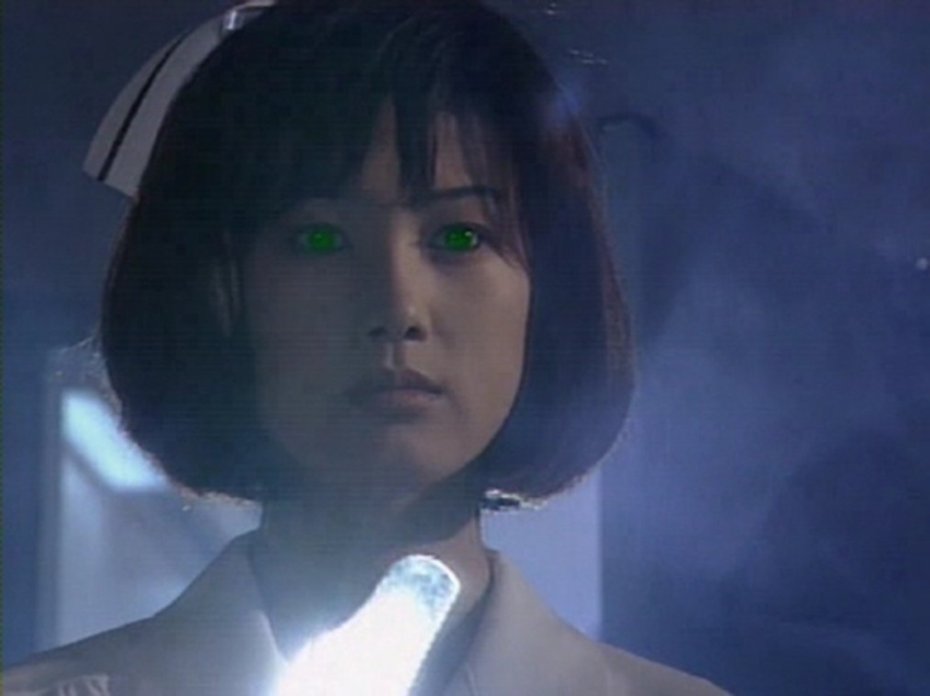
Imagine a gentle, kind-hearted young woman who begins to change. Her eyes flash an unnatural, piercing green. Her voice drops into a chilling, synthesized monotone. This is the terrifying transformation at the heart of M (M), a series that single-handedly defined a generation of Korean horror. The story follows Park Ma-ri (Shim Eun-ha), whose alarming metamorphosis stumps her friends, including her devoted childhood friend Song Ji-seok (Lee Chang-hoon). As they race to find a medical explanation, they uncover a dark secret from the past, unleashing a force that is not just supernatural, but a terrifying product of human transgression.
Aired in the summer of 1994 as a ten-episode special, this landmark production from MBC fused the methodical tension of a medical thriller with the visceral fear of a summer horror story, creating a cultural phenomenon that remains legendary in Korean television history.
The Birth of a Bio-Ethical Nightmare
To understand the seismic impact of M, one must understand the South Korea of the early 1990s. The nation was in the throes of rapid economic growth and technological advancement. With this progress came deep-seated societal anxieties about the speed of change, the ethics of modern science, and the potential consequences of abandoning tradition. M tapped directly into this nerve by building its horror around a subject rarely discussed on mainstream television: abortion.
The drama used the supernatural entity “M”—the vengeful spirit of an aborted fetus that merges with its surviving twin—as a powerful, terrifying metaphor. It wasn’t just a ghost story; it was a primetime bio-ethical debate disguised as a horror series. By tackling the moral complexities of a deeply taboo subject, the show forced a national conversation, questioning the limits of scientific ambition and the human cost of choices made in the name of progress. This was far more than a simple “납량특집” (Nap-ryang-teuk-jip), the traditional Korean summer horror special meant to “chill the blood” during hot months; it was a social critique that left a permanent scar on the cultural psyche.
Narrative Analysis: Science vs. The Supernatural
(No Spoilers)
The brilliance of M’s narrative lies in its masterful genre blend. The story unfolds on two parallel tracks. On one hand, it is a compelling medical mystery. The characters, grounded in the logic of science and medicine, desperately search for a rational diagnosis for Ma-ri’s condition—a tumor, a psychological break, a neurological disorder. This clinical approach makes the eventual intrusion of the supernatural all the more jarring and effective.
On the other hand, it is a relentless psychological horror. The suspense is not built on cheap jump scares but on the slow, creeping dread of Ma-ri’s loss of self. Viewers are forced to watch a beloved character become a vessel for something cold, calculating, and vengeful. The central conflict isn’t merely good versus evil, but reason versus the inexplicable, and the past’s inescapable claim on the present.
The Pulse of the Time: An Unprecedented “M Syndrome”
M was not just a hit; it was a cultural earthquake. During its summer 1994 run, the series captivated the nation, achieving a staggering peak viewership rating that soared over 50%—a figure unheard of for the horror genre, which was typically considered niche. A veritable “M Syndrome” swept the country. Shim Eun-ha’s eerie green eyes, achieved through early computer graphics (CG) because the actress was allergic to contact lenses, became an iconic image of 90s Korean pop culture. Her digitally altered, robotic voice became a national catchphrase, mimicked in schoolyards and on variety shows.
The haunting soundtrack, particularly Choi Yoon-sil’s theme song “I Don’t Know You” (“나는 널 몰라”) and chilling instrumental tracks like “Sad and Scary,” became synonymous with the drama, amplifying its melancholic and terrifying atmosphere. M proved that genre television could be both commercially successful and socially resonant, paving the way for the sophisticated Korean thrillers and horror series we see today.
Cast Spotlight: The Birth of a Superstar
The success of M rests squarely on the shoulders of its lead, Shim Eun-ha. Her portrayal of Park Ma-ri is one of the most iconic performances in K-drama history. She flawlessly captured the character’s terrifying duality: the innocent, vulnerable woman and the cold, omniscient entity inhabiting her. The subtle shifts in her gaze and posture were enough to signal which personality was in control, creating a performance that was both heartbreaking and terrifying.
Supporting her, Lee Chang-hoon delivered a grounded performance as Song Ji-seok, Ma-ri’s devoted fiancé whose life is shattered by Ma-ri’s transformation, representing the audience’s own struggle to comprehend the unfolding horror. Kim Ji-soo, as Ma-ri’s loyal friend, provided the essential emotional anchor, embodying the desperation and fear of watching a loved one disappear before your very eyes.
Global Viewing Guide
For global fans looking to experience this classic thriller, finding officially subtitled versions can be a challenge, but options are available:
- KOCOWA: This platform, specializing in classic and contemporary Korean content, is often the primary source for vintage MBC dramas like M.
- Wavve: This is a major Korean domestic streaming service that houses an extensive library of classic MBC shows, though it is primarily aimed at viewers in Korea.
- MBC Classic YouTube: Broadcasters like MBC sometimes upload episodes of their classic dramas to their official YouTube channels. It is worth searching there for potential availability with subtitles.
Final Verdict
M is more than a nostalgic trip back to 90s television; it is a foundational text in the history of Korean genre storytelling. It is a bold, provocative, and genuinely frightening series that demonstrates how horror can be used to explore a society’s deepest fears. For any fan of modern K-thrillers, this is essential viewing to understand where it all began.

The KCulture Editorial Team is dedicated to providing deep insights and accurate information about the vibrant world of Korean culture.