Korean royal court music was not merely artistic entertainment; during the Joseon Dynasty (1392–1910), it served as an essential instrument of statecraft, cosmic harmony, and ancestral reverence known as Yeak (예악). The ceremonial instruments used in court rituals—ranging from bronze bells and stone chimes to tiger-shaped wooden scrapers—were precisely engineered based on East Asian cosmology and the eight natural materials (Ba-eum) to balance the forces of heaven, earth, and humanity.
When walking through the stone-paved courtyards of historical palaces or standing before the solemn halls of ancestral shrines in Korea today, the echo of this musical heritage remains palpable. Yet, the true meaning behind these majestic instruments is frequently overlooked. Their physical shapes, tuning systems, precise placement in the courtyard, and even the exact moments they sounded were governed by strict Confucian ideals rather than artistic preference alone. This guide explores the philosophy of Korean royal court instruments, their unique materials, the historical roots of sacrificial ritual music, and how they contrast with the vibrant traditions of Korean folk music.
- Music as the Language of Statecraft and Cosmic Order
- The Two Orchestras: Deungga (Terrace) and Heonga (Courtyard)
- Historical Evolution: From Early Joseon Extravagance to Modern Refinement
- Why Did the Joseon Court Adopt Chinese Ritual Music?
- The Eight Sacred Materials (Ba-eum): Nature Becomes Music
- The Anchors of Harmony and Ceremonial Bookends
- The Melodic Leaders, Strings, and Solemn Pulse
- Ritual vs. Banquet: Court Restraint vs. Folk Expression
- How to Experience Royal Court Music in Korea Today
Music as the Language of Statecraft and Cosmic Order
In modern society, music is primarily viewed as a form of personal expression and entertainment. In the Joseon Dynasty, however, music carried profound political and spiritual weight. It was an integral component of Yeak—the foundational Confucian concept dictating that proper ritual propriety (Ye) and harmonious music (Ak) must work together to maintain a stable and moral society.
According to the ancient classic Yue Ji (악기/樂記, Record of Music), true music (Ak) is achieved only when three elements are fully unified: instrumental music, vocal song, and choreographed dance. A ruler who governed with these righteous ceremonies and harmonious melodies would inspire moral order across the entire kingdom. Consequently, music accompanied virtually every significant royal event, from diplomatic receptions and court banquets to solemn sacrificial rituals dedicated to royal ancestors and deities.
To organize this vast musical landscape, the Joseon court maintained three distinct musical traditions within the royal institution:
- Aak (아악): Originally imported as ancient Chinese ritual music, this solemn genre was reserved almost exclusively for Confucian sacrificial ceremonies, emphasizing restraint, symmetry, and absolute emotional balance.
- Dangak (당악): Secular music originating from the Tang and Song dynasties of China, which gradually adapted to Korean aesthetic sensibilities over centuries of palace performance.
- Hyangak (향악): Native Korean court music that evolved organically on the Korean Peninsula. This tradition includes many of the most celebrated instrumental suites and processional melodies heard in palace festivals today.
To understand how these complex orchestral compositions and pitch systems were preserved over centuries without Western sheet music, explore Jeongganbo Explained: How Korean Traditional Music Is Written, which details Korea’s unique grid-based notation system developed by King Sejong the Great.
The Two Orchestras: Deungga (Terrace) and Heonga (Courtyard)
One of the most breathtaking visual and acoustic aspects of Jongmyo Jeryeak (the royal ancestral ritual music) is that it is never performed by a single, stationary band. Instead, the performance relies on two distinct ensembles positioned at different elevations within the shrine grounds, engaging in a musical dialogue between heaven and earth.
- Deungga (등가 – Terrace Orchestra): Situated on the upper stone terrace (Sangwoldaen/상월대) directly in front of the main shrine hall. Historically, this ensemble performed instrumental music without vocal lyrics during specific ritual steps, symbolizing the heavenly realm and the spirits of the ancestors.
- Heonga (헌가 – Courtyard Orchestra): Positioned on the lower stone courtyard (Hawoldae/하월대) below the stairs. This ensemble accompanied songs with lyrics and represented the earthly realm and the living descendants paying tribute.
During the ancestral rites, these two orchestras take turns playing or combine their sounds, creating a layered, antiphonal resonance that fills the expansive courtyard.
Historical Evolution: From Early Joseon Extravagance to Modern Refinement
The instrumentation of the court orchestras was not static; it underwent significant transformation from the early Joseon period (15th century) through the late Joseon era, the 1930s (during colonial rule), and into modern times. In the early Joseon Dynasty, court rites featured a massive, highly varied orchestra utilizing dozens of stringed instruments and ancient Chinese clay and wood instruments.
Over the centuries, especially after historic invasions and the turbulence of the early 20th century, the instrumentation was streamlined. Many plucked string instruments (such as the Gayageum and Geomungo) and obscure ancient winds were gradually removed from the ancestral rituals to focus the acoustic power on resonant metallic and stone chimes, penetrating winds, and authoritative percussion.
| Ensemble | Early Joseon Era (15th Century) | Modern Era (Present Day Heritage) | Key Changes & Acoustic Shift |
|---|---|---|---|
| Deungga (Terrace) | Included strings like Gayageum, Geomungo, Dangbipa, Hyangbipa, Ajaeng, Daejaeng, Wolgeum, alongside ancient clay/reed winds (Hun, Ji, Hwa, Saeng) and standard chimes. | Bak, Hwi, Haegeum, Daegeum, Ajaeng, Eo, Banghyang, Pyeongyeong, Jeolgo, Piri, Janggu, Pyeonjong, Chuk. | Plucked strings and ancient ocarinas were removed; melodic focus shifted entirely to bowed Ajaeng/Haegeum and winds (Daegeum, Piri), led by metal/stone chimes. |
| Heonga (Courtyard) | Included strings (Wolgeum, Gayageum, Geomungo, Bipa), multiple drums (Nogo, Nodo, Gyobanggo, Jingo), and ancient flutes (U, Hwa, Guan). | Jochok, Bak, Eo, Jingo, Pyeonjong, Janggu, Chuk, Pyeongyeong, Banghyang, Daegeum, Haegeum, Taepyeongso, Piri, Jing (Gong). | Massive simplification of drums and removal of plucked strings. Addition of the piercing Taepyeongso (shawm) and Jing (gong) creates a grand, majestic martial volume. |
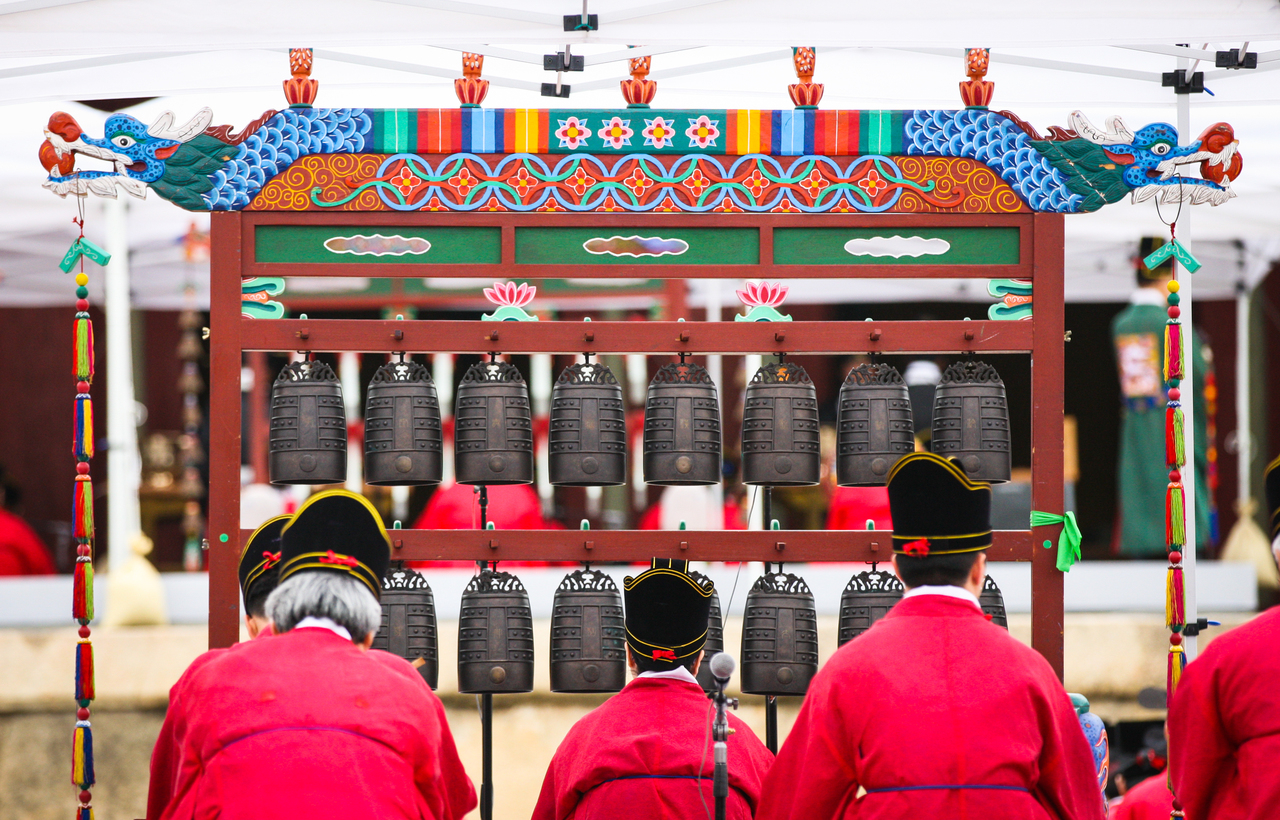
In modern performances of Jongmyo Jeryeak, tuned percussion instruments—specifically the Pyeonjong (bronze bells), Pyeongyeong (stone chimes), and Banghyang (iron slabs)—carry the core skeletal melody. Decorative and ornamental melodic lines are layered on top by wind and bowed string instruments such as the Dangpiri, Daegeum, Haegeum, and Ajaeng. Meanwhile, drums and gongs (Janggu, Jing, Taepyeongso, Jeolgo, Jingo) inject dynamic rhythmic complexity. This unique layering creates a profound, majestic, and heavy texture rarely found in any other musical tradition.
Why Did the Joseon Court Adopt Chinese Ritual Music?
A frequent question among international observers is why a dynasty so deeply protective of its own cultural identity adopted sacred ceremonial music originating in ancient China. The answer lies not in a lack of native artistry, but in the universal philosophical claims of Neo-Confucianism.
When the Joseon Dynasty was established in 1392, its founders sought to build a model Confucian state. They believed that the ideal blueprint for governance had been documented in ancient Chinese classics, most notably the Rites of Zhou (Jurye in Korean). According to these classical texts, a legitimate and moral government required precisely standardized rituals, architecture, garments, and music that mirrored the natural order of the cosmos.
By adopting and strictly standardizing ancient ritual music (Aak), the Joseon court demonstrated that it ruled in accordance with universal moral laws rather than arbitrary personal power. When King Sejong ascended the throne in the 15th century, he collaborated with master musicologist Park Yeon to domestically quarry jadeite stone and recast bronze bells, correcting inaccuracies that had crept into the imported instruments over time.
Remarkably, while many of these ancient ritual instruments and performance practices were altered or entirely lost during successive dynastic upheavals in China, the Korean court meticulously preserved and refined them. Today, Korea maintains the world’s oldest continuously performed Confucian royal ancestral ritual music, recognized globally for its immense historical value.
To dive deeper into the historical preservation of these royal ceremonies and the shrine where they are enacted, read UNESCO Heritage: Jongmyo Shrine, Jongmyo Jerye, Jongmyo Jeryeak.
The Eight Sacred Materials (Ba-eum): Nature Becomes Music
Perhaps the most distinctive aspect of traditional Korean court instruments is their classification system. Unlike Western orchestral instruments, which are categorized by how sound is mechanically produced (strings, woodwinds, brass, percussion), traditional Korean court instruments are categorized by the natural substances used to construct them.
This system, known as Ba-eum (팔음, The Eight Tones), connects orchestral sound directly to the physical earth and the philosophical balance of Yin, Yang, and the Five Elements. An ideal royal orchestra was designed to represent the natural world itself, requiring each material to contribute a specific acoustic and symbolic quality.
| Material (Ba-eum) | Representative Instruments | Symbolic Meaning & Acoustic Role |
|---|---|---|
| Metal (金 – Geum) | Pyeonjong (Bronze Bells), Banghyang | Represents autumn, strength, and unshakeable authority; provides clear, resonant pitch. |
| Stone (石 – Seok) | Pyeongyeong (Stone Chimes) | Symbolizes purity and immutability; unaffected by weather, serving as the absolute tuning standard. |
| Silk (絲 – Sa) | Geomungo, Gayageum, Haegeum, Ajaeng | Used for woven strings; delivers warmth, subtle vibration, and deeply human emotional nuance. |
| Bamboo (竹 – Juk) | Daegeum, Piri, Taepyeongso | Represents moral integrity and flexibility; dominates the melodic wind section with the breath of life. |
| Gourd (匏 – Po) | Saenghwang (Mouth Organ) | Acts as the wind-chamber for multi-pipe instruments, representing the harmonization of multiple voices. |
| Clay (土 – To) | Hun (Vessel Flute), Bu | Offers a grounded, earthy, and hollow resonance connecting the ensemble to the soil and humility. |
| Leather (革 – Hyeok) | Jingo, Jeolgo, Janggu (Royal Drums) | Provides the solemn heartbeat, structural tempo, and ceremonial authority of the ritual. |
| Wood (木 – Mok) | Chuk, Eo, Bak | Associated with spring and structural control; commands the formal beginnings and endings of suites. |
The Anchors of Harmony and Ceremonial Bookends
In the outdoor courtyards of royal shrines, where seasonal temperatures and humidity fluctuate dramatically, maintaining absolute musical pitch was considered a critical state priority. A discordant pitch was interpreted as a sign of cosmic disorder and moral failure in governance. To prevent this, the court relied on immutable materials and dedicated ceremonial markers.
Pyeonjong (편종) and Pyeongyeong (편경): The Immutable Pitchkeepers
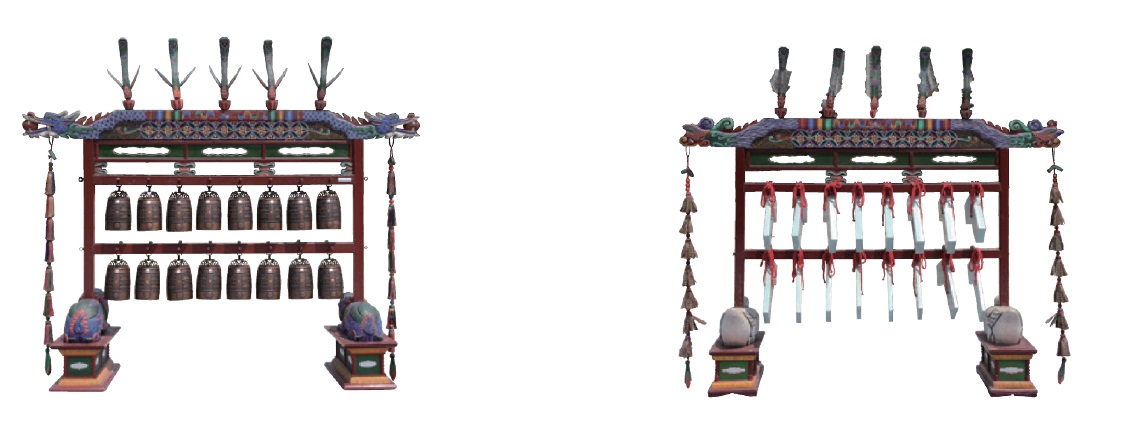
The Pyeonjong consists of sixteen ornate bronze bells suspended in two tiers on an elaborately carved wooden frame. What makes this instrument extraordinary is that every single bell shares the exact same outer dimensions. The pitch is determined entirely by the internal thickness of the bronze walls—thicker walls produce higher pitches, while thinner walls yield lower, deeper tones. Striking them with a horned mallet produces a majestic resonance representing royal dignity.
Paired directly opposite the bronze bells sits the Pyeongyeong, a set of sixteen L-shaped slabs of volcanic pumice or calcite stone (jadeite), similarly hung in two rows. Like the bells, each stone slab is tuned by adjusting its thickness rather than its surface area. Because stone does not expand or contract with changes in humidity and temperature, the Pyeongyeong served as the absolute, unchanging tuning standard for all other instruments in the royal court.
💡 Pro Tip: Historical records reveal just how precious these stone chimes were to the state. During foreign invasions, court musicians were strictly instructed to bury the stone slabs of the Pyeongyeong in secret underground locations before fleeing. While wooden frames could be rebuilt and bronze bells recast, the perfectly tuned volcanic stones were considered irreplaceable national treasures.
Chuk (축) and Eo (어): Summoning and Dismissing the Music
In sacred royal rites, music does not simply start and stop; it is ceremonially summoned from the East and respectfully dismissed toward the West. This directional protocol required two unique wooden instruments that perform no melodies at all.
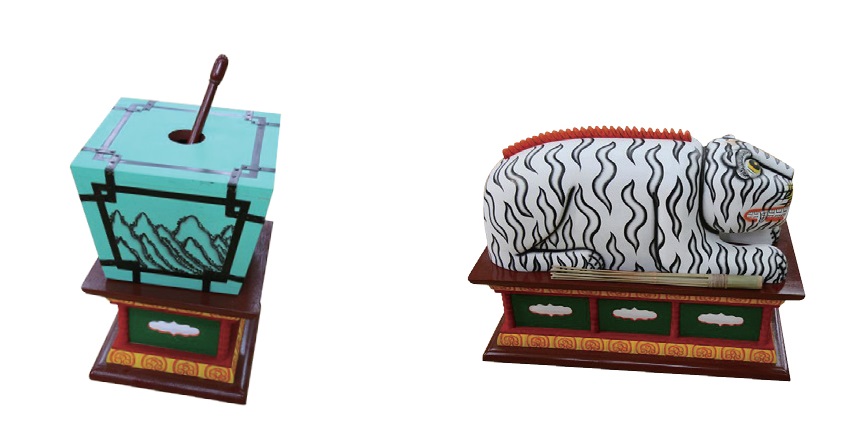
The Chuk is a large, square wooden box painted with vibrant green and blue landscape murals symbolizing the East and the season of spring. To signal the exact initiation of a musical suite, the performer strikes the inner bottom of the box three times with a wooden mallet. This hollow, grounding thud represents the opening of sacred space and the beginning of life.
When the ritual suite concludes, the music is silenced by the Eo, an instrument carved in the shape of a crouching white tiger resting on a rectangular pedestal, featuring twenty-seven sharp, serrated ridges along its spine. The musician strikes the tiger’s head three times with a split-bamboo whisk, then sweeps the whisk down the serrated spine once. This distinctive, raspy clattering sound represents autumn, the West, and the peaceful cessation of worldly activity.
Bak (박): Commanding the Ensemble
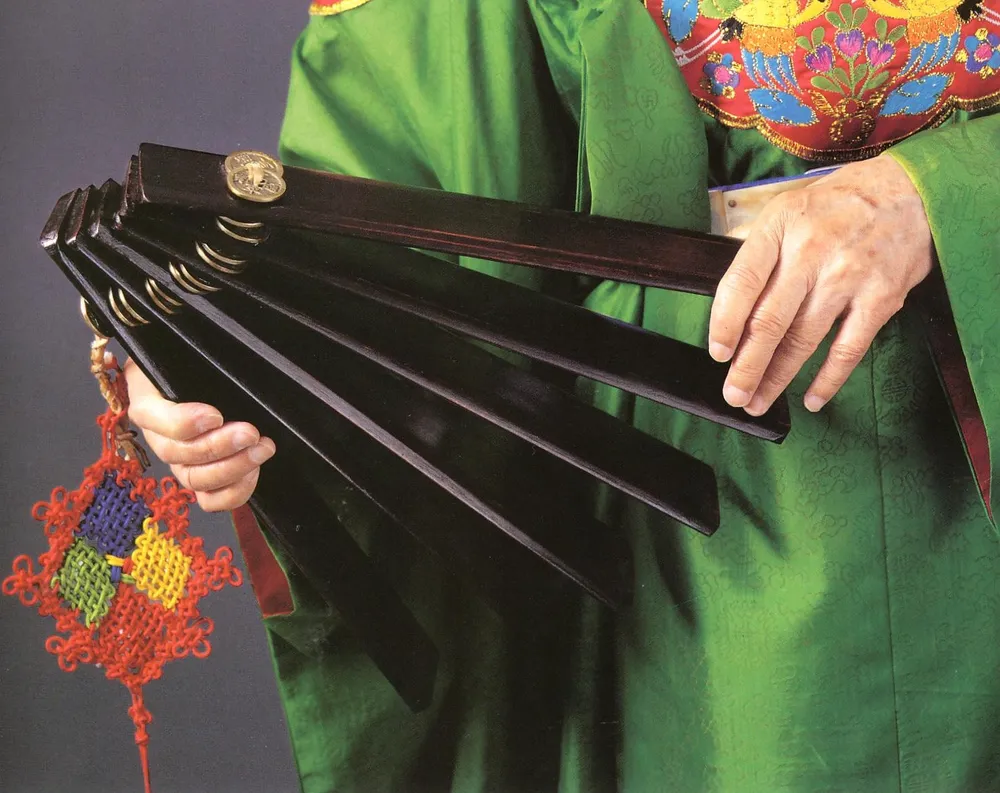
Resembling a folded fan made of six hardwood slats joined at one end by a leather cord, the Bak functions as the visual and acoustic conductor of the court orchestra. Held by the ensemble leader, known as the Jipbak, the wooden slats are snapped shut to produce a sharp, authoritative cracking sound that signals exact tempo changes, structural transitions, and the coordinated entrances of dozens of musicians.
The Melodic Leaders, Strings, and Solemn Pulse
While stone and metal established architectural stability and wooden beasts marked time, the melodic soul of royal court music was carried by bamboo winds and silk-stringed instruments, grounded by the deep pulse of leather drums.
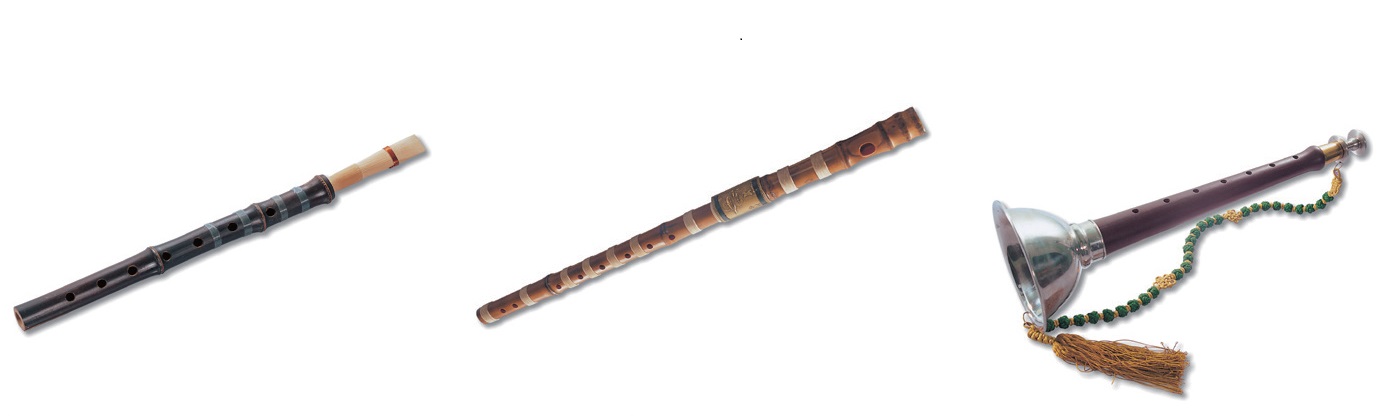
Daegeum (대금), Piri (피리), and Taepyeongso (태평소): The Bamboo Voices
The leading melodic voice of the court ensemble is the Daegeum, a grand transverse bamboo flute. What distinguishes the Daegeum from flutes of other cultures is a specialized blowhole covered by a thin, vibrating membrane harvested from the inner lining of bamboo reeds, known as cheong. When blown with intensity, this membrane generates a signature buzzing resonance that adds a rich, expressive, and slightly raspy timbre capable of piercing through large open-air courtyards.
Working alongside the flute is the Piri, a short, cylindrical bamboo pipe fitted with a large double reed. Despite its modest size, the Piri produces an extraordinarily powerful and textured sound, acting as the principal acoustic leader that drives the wind section forward. In the lower courtyard orchestra (Heonga), the piercing metallic sound of the Taepyeongso (a double-reed shawm with a brass funnel) is added during military dance suites to evoke immense martial energy. For a broader exploration of how these wind instruments fit into the overarching history of Korean music, read Traditional Korean Music: Gugak, Pansori, Daechwita.
Silk Strings: Geomungo, Gayageum, Haegeum, and Ajaeng
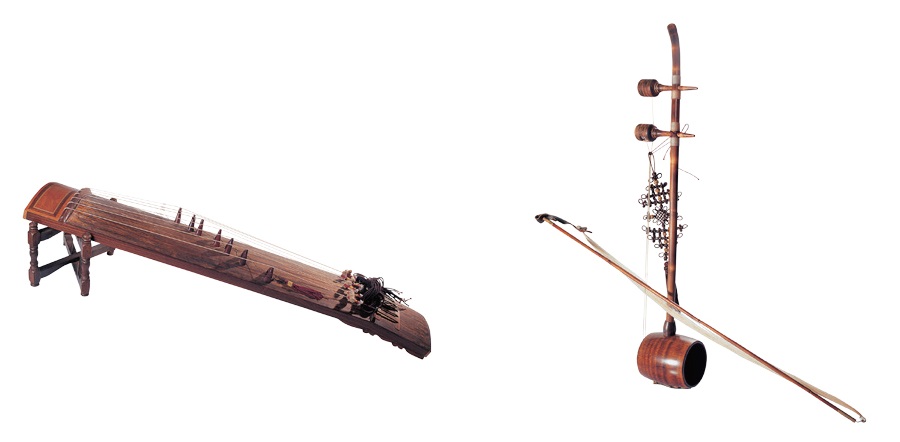
While plucked strings like the Geomungo and Gayageum were heavily featured in early Joseon court rituals, modern ancestral rites rely primarily on sustained, bowed strings to create a continuous, solemn drone:
- Haegeum (해금): A vertical two-stringed fiddle played with a horsehair bow woven between the strings. Unique in its construction, the Haegeum integrates materials from all eight sacred Ba-eum categories, bridging the acoustic gap between sustained wind melodies and chimes with vocal-like slides.
- Ajaeng (아쟁): A bowed zither played with a rosined wooden stick (or horsehair bow in modern adaptations). It produces a deep, raspy, and cello-like sound that anchors the lower registers of both the terrace and courtyard orchestras.
- Geomungo (거문고) & Gayageum (가야금): Though removed from modern Jongmyo Jeryeak rites, these plucked zithers remain central to secular court banquets. The Geomungo, played with a bamboo stick called a suldae, was historically revered as the primary instrument of Confucian scholars who sought moral refinement through music. To understand the deep cultural connection between scholar-officials, artistic pursuits, and spiritual cultivation, explore Understanding Muninhwa and Korea’s Scholar Artists.
The Royal Drums: Jingo, Jeolgo, and Janggu
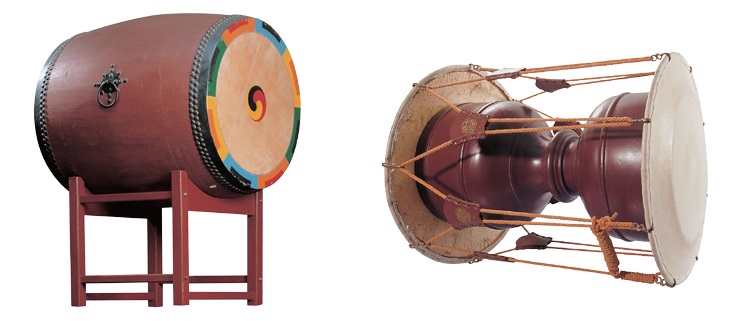
Various drums provided the solemn, unwavering heartbeat of royal ceremonies. The Jingo (진고) is a massive barrel drum positioned in the courtyard that echoes across the palace grounds, marking major structural transitions, while the smaller Jeolgo (절고) rests on the upper terrace. Unlike folk percussion, which emphasizes complex, accelerating syncopation to build excitement, royal court drums maintain a slow, steady, and disciplined pulse that commands reverence and collective unity.
In martial and processional suites, such as those honoring military achievements (Jeongdaeeop), drum rhythms and wind melodies were accompanied by ceremonial weapon dances. To explore the historical martial culture and symbolism of ceremonial swords used during the Joseon Dynasty, check out The Real Sword of K-Pop Demon Hunters: Saingeom History.
Ritual vs. Banquet: Court Restraint vs. Folk Expression
To fully appreciate Korean traditional instruments, one must recognize that court music was strictly segregated by function, and it stood in sharp aesthetic contrast to the music of ordinary people.
Within the palace, sacrificial ritual music (such as Jongmyo Jeryeak) was characterized by slow, mathematically equal note values, sparse textures, and a complete absence of dramatic emotional climax. Its purpose was to project eternal stability. In contrast, banquet and processional music (such as the masterpiece Sujecheon or military marches) allowed for greater rhythmic movement, lyrical ornamentation, and vibrant celebratory energy to entertain royals and foreign envoys.
When court music is compared to Korean folk traditions, the philosophical divide becomes even clearer:
| Attribute | Royal Court Music (Gugak / Aak) | Traditional Folk Music (Minseo / Pansori) |
|---|---|---|
| Primary Purpose | Statecraft, ritual order, cosmic harmony, and moral cultivation. | Communal celebration, emotional release (Han and Heung), and storytelling. |
| Acoustic Character | Restrained, balanced, symmetrical, and dignified; individual virtuosity is subordinated to the ensemble. | Dynamic, emotionally raw, highly rhythmic, and centered on individual virtuosity or vocal power. |
| Performance Style | Strictly notation-based (Jeongganbo), following rigid ceremonial procedures without improvisation. | Highly improvisational, spontaneous, emotionally intense, and dynamically responsive to the audience. |
| Typical Instruments | Pyeonjong (Bronze Bells), Pyeongyeong (Stone Chimes), Chuk, Eo, Banghyang, Ajaeng. | Janggu (Hourglass Drum), Kkwaenggwari (Small Gong), Buk (Barrel Drum), solo vocalists. |
While court instruments were designed to suppress individual ego for the sake of universal order, folk music genres thrived on raw human emotion, dramatic storytelling, and communal participation. To explore the vibrant world of folk music and its iconic vocal traditions, read Guide to Korean Traditional Folk Music & Where to Hear It, What is Pansori? A Deep Dive into Korea’s Musical Soul, and Pansori Five Epics: Guide to Korea’s Masterpiece Storytelling.
Furthermore, royal court banquets were rarely visual or acoustic solitary affairs; they were almost always accompanied by highly choreographed court dances featuring elaborate costumes and traditional props. Discover how movement and visual arts complemented these court melodies in Korean Traditional Dance: Court Dance, Folk Dance & Where to Watch and Traditional Korean Fans: History, Art, and Cultural Meaning.
How to Experience Royal Court Music in Korea Today
Although the Joseon Dynasty ended in 1910, the majestic sounds of its royal court are far from static museum relics. Thanks to centuries of unbroken transmission and institutional preservation, visitors to South Korea can experience these sacred instruments played live in their authentic historical and ceremonial contexts.
The single most immersive event for experiencing traditional court instruments is the Jongmyo Daeje (Royal Ancestral Ritual), held annually on the first Sunday of May at Jongmyo Shrine (종묘) in Seoul. During this massive state ceremony, the complete court orchestra is deployed across the upper terrace (Deungga) and lower courtyard (Heonga). Witnessing musicians strike the bronze bells, play the stone chimes, and scrape the wooden tiger while hundreds of dancers move in unison is an unforgettable encounter with living history.
📌 Local Note: If travel schedules do not align with the annual May ritual at Jongmyo Shrine, visit the National Gugak Center (국립국악원) located in Seocho-gu, Seoul. As the modern institutional successor to the Joseon royal music academy, they host regular Saturday performances that frequently feature authentic royal court music suites, complete with traditional court attire and detailed English subtitles explaining the symbolism of each instrument.
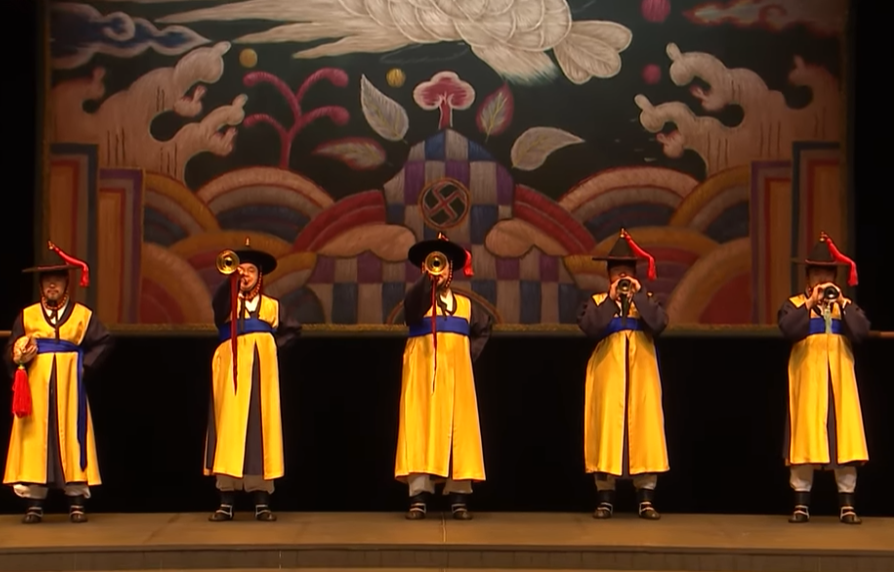
Additionally, travelers exploring the historical center of Seoul can hear martial and processional adaptations of court instruments during the Changing of the Royal Guard ceremonies held daily at Gyeongbokgung Palace (경복궁) and Deoksugung Palace (덕수궁). Understanding the sacred instruments of the Joseon court unlocks a much deeper appreciation for Korean cultural heritage, revealing how wood, stone, silk, and bronze were masterfully united to bridge the human world with the eternal harmony of the cosmos.
Korean Culture portal KCulture.com

Founder of Kculture.com and MA in Political Science. He shares deep academic and local insights to provide an authentic perspective on Korean history and society.