Korean Chaekgeori Paintings: The Scholar’s Shelf
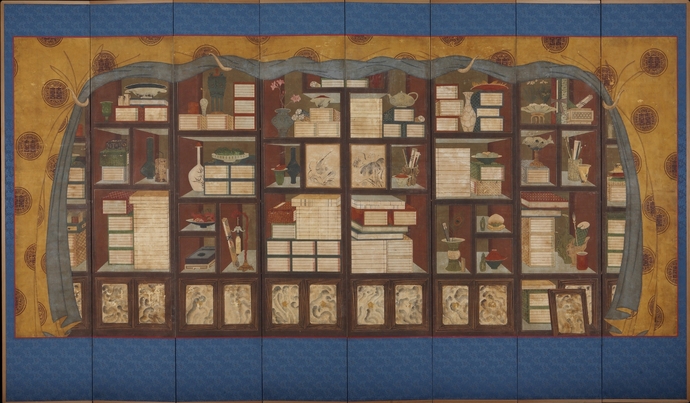
Korean chaekgeori paintings turn books, writing tools, ceramics, and treasured objects into portraits of an ideal life. Popularized under King Jeongjo in the late eighteenth century, they celebrate learning while revealing desires for status, beautiful possessions, and family prosperity. Chaekgado, the bookshelf form of this tradition, gives those ambitions an architectural home.
Look closely at one of these painted shelves. A porcelain vase interrupts a stack of books; a piece of fruit balances beside an inkstone; a compartment seems to open toward you. The arrangement feels surprisingly familiar to anyone who has styled a desk or chosen the books visible behind them on a video call. Yet these inviting interiors also ask a distinctly Joseon question: what should a cultivated person surround themselves with?
- Understanding Korean Chaekgeori Paintings
- Jeongjo and the Politics of Reading
- From the Palace to Family Homes
- Reading the Objects on the Shelves
- Perspective and the Moving Viewpoint
- Three Remarkable Screens to Explore
- Why Chaekgeori Still Feels Contemporary
- Looking Closely and Exploring Further
Understanding Korean Chaekgeori Paintings
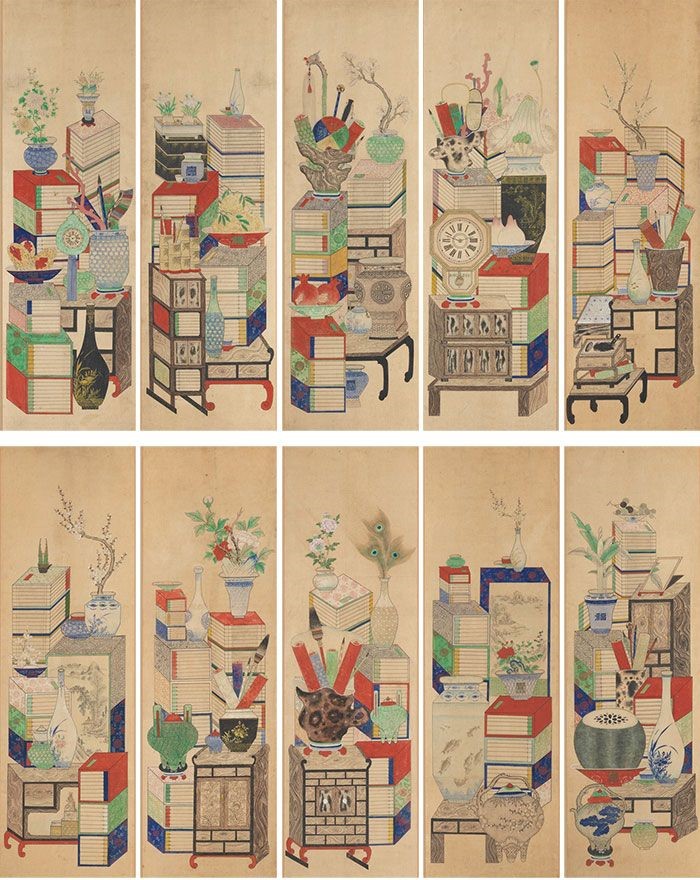
In common contemporary usage, chaekgeori means “books and things”: still-life pictures organized around books and their companions. Chaekgado means “pictures of bookshelves,” identifying compositions in which a cabinet or shelving structure holds everything together. A chaekgeori painting can also dispense with the shelves, arranging its objects on tables or in apparently unsupported stacks.
Terminology varies between museums and scholars. Munbangdo, meaning “scholar’s study painting,” is another important name, and some researchers prefer it for the whole genre. The useful distinction for a first encounter is visual: does a bookcase structure the picture, or do the objects create their own arrangement?
| Term | What to look for |
|---|---|
| Chaekgeori | The widely used umbrella term for paintings of books and associated objects. |
| Chaekgado | A bookshelf or cabinet dividing the composition into compartments. |
| Munbangdo | An overlapping historical term emphasizing the scholar’s study. |
| Munbangsau | The “Four Friends of the Study”: brush, inkstick, paper, and inkstone; a group of tools, rather than the name of the entire painting genre. |
The Four Friends enabled calligraphy, painting, and study. Chaekgeori expanded that working environment into an imaginative world of possessions. Its connection with scholarly culture helps explain its appeal, although elaborate screens were often made by professional painters. For the related tradition of scholar-artists expressing themselves through brushwork, explore Understanding Muninhwa and Korea’s Scholar Artists.
Jeongjo and the Politics of Reading
Books carried unusual political weight in Joseon, the dynasty that ruled Korea from 1392 to 1910. Classical learning underpinned the ideal of the scholar-official. A ruler surrounded by books presented himself as someone whose authority rested on cultivated judgment and moral learning.
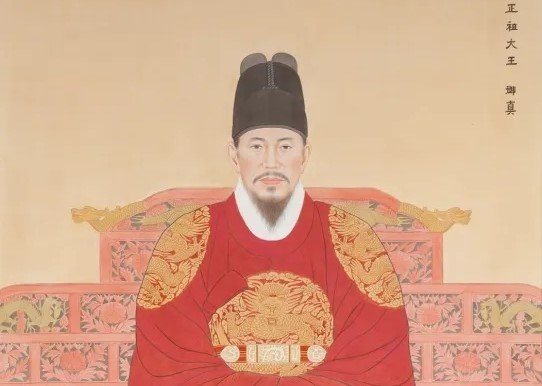
King Jeongjo, who reigned from 1776 to 1800, gave bookshelf painting powerful royal endorsement. The genre became established during his reign, and painting books and scholarly objects entered the competitive assessments of elite court painters. His patronage helped make a seemingly quiet still life a prestigious subject.
A memorable account in Jeongjo’s collected writings describes him drawing his officials’ attention to a painted bookcase behind his seat. He explained that the apparent books were a painting and invoked the pleasure of being near books even when there was little time to read. The image offered both a reminder of study and the consolation of an imagined library.
That affection also had a prescriptive side. Jeongjo promoted classical texts and sought to correct literary styles he considered improper. His enthusiasm for books therefore belonged to a particular vision of good government and approved learning. The painted shelf could communicate an expectation: a properly cultivated court should keep returning to its books.
This reverence for learning also illuminates the cultural world explored in Jeong Seon & Chusa: Joseon Literati Painting Masterpieces. It helps explain why an apparently modest subject could carry such authority.
From the Palace to Family Homes
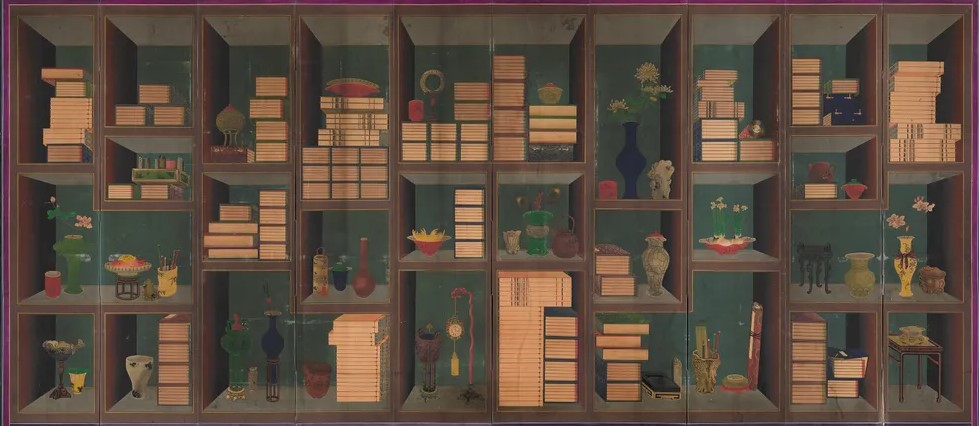
The paintings developed within a world increasingly interested in collecting. Exchanges with Qing China brought Joseon visitors into contact with books, antiques, imported luxuries, and duobaoge, display cabinets whose varied compartments presented treasured objects. European illusionistic techniques, circulating through Qing artistic networks, contributed to this visual encounter.
Korean painters made books central to the resulting compositions. A shelf could unite intellectual seriousness with the pleasures of acquisition: the owner’s imagined library became a place to display both learning and discernment.
During the nineteenth century, the audience widened beyond the palace and established elite. Affluent patrons and households outside court circles adopted the imagery, while popular versions developed freer arrangements and stronger auspicious meanings. Some screens became smaller and more compact; books shared attention with fruit, flowers, and everyday belongings. The tradition continued into the early twentieth century.
These changes connect chaekgeori with minhwa, Korea’s popular decorative painting tradition. Court painting and folk painting met within the same subject, producing considerable variety rather than one uniform style.
For a family, a painted library might express pride in education, hopes for a child, or an ambition to enjoy a more prosperous life. These aspirations existed within an unequal society; the spread of the image did not mean that access to education and office had become equal. Its appeal lay partly in making a desirable world visible inside the home.
Reading the Objects on the Shelves
Why place fruit beside books? Because a chaekgeori painting could hold several conversations at once. Some objects evoked study, others displayed refined taste, and others conveyed blessings. A shelf might be intellectually ambitious, materially luxurious, and warmly domestic.
| Object | Possible meaning |
|---|---|
| Books and writing implements | Learning, cultivated conduct, and hopes for scholarly achievement. |
| Porcelain and archaic-style bronze vessels | Connoisseurship, collecting, and an appreciation of prestigious objects. |
| Pomegranates, grapes, and other many-seeded fruit | Fertility, descendants, and a flourishing family. |
| Peaches | Longevity, drawing on the fruit’s association with Daoist immortals. |
| Peonies | Wealth and prosperity. |
| Clocks and other imported curiosities | Interest in unfamiliar technologies, access to distant goods, and sophisticated taste. |
These associations offer starting points rather than a rigid decoding system. Meaning depends on the combination, the intended setting, and the particular painting. A vase can contribute symbolic associations while also providing a beautiful curve against the rectangles of the books.
The objects also complicate the familiar image of the austere Confucian scholar. A commitment to learning could coexist with an appetite for luxurious ceramics or an intriguing mechanical device. Some painted collections may suggest what a patron owned; others present what someone wished to own. Reading them as exact inventories would miss their imaginative freedom.
A Joseon version of “deskterior”?
Today’s Korean term deskterior, combining “desk” and “interior,” makes an engaging comparison. Choosing a pen, arranging books, or adding a small ornament makes a workspace feel personal. Chaekgeori similarly lets objects communicate a preferred identity.
The historical picture, however, could go much further than decorating an actual desk. It could supply an entire wished-for collection in painted form. A room acquired the atmosphere of an abundant library without physically containing every treasure pictured there. The shelf became a statement about the life its owner valued.
Perspective and the Moving Viewpoint
Chaekgeori’s spatial effects reward slow looking. In some courtly examples, shading and angled shelving create a persuasive impression of recessed compartments. Such works adapt techniques associated with European illusionism, encountered through China. Their depth is part of the attraction: the viewer almost expects to reach inside.
Other paintings organize space more freely. A book may be visible from above while a nearby vase faces forward. Different compartments may seem to follow different viewing positions. The eye moves around the objects, gathering several views into one composition.
Reverse perspective is one particular device within this wider variety. Edges can spread apart as they move into the picture, allowing a farther surface to appear wider. That differs from the familiar construction in which receding lines converge toward a vanishing point. Multiple viewpoints, parallel projection, and reverse perspective can produce related sensations, but they are distinct ways of organizing space.
The result can feel both orderly and unstable. Shelves divide the surface into a reassuring grid, yet books tilt, vessels press forward, and viewpoints shift. Look at a single compartment, then step back to take in the screen: its local spaces may resist the unified room you initially expected.
Looking tip: Follow the top and side edges of one book or shelf. Then compare them with the compartment next door. This simple exercise makes the painting’s spatial choices much easier to see.
Three Remarkable Screens to Explore
Jang Han-jong: a library revealed by curtains
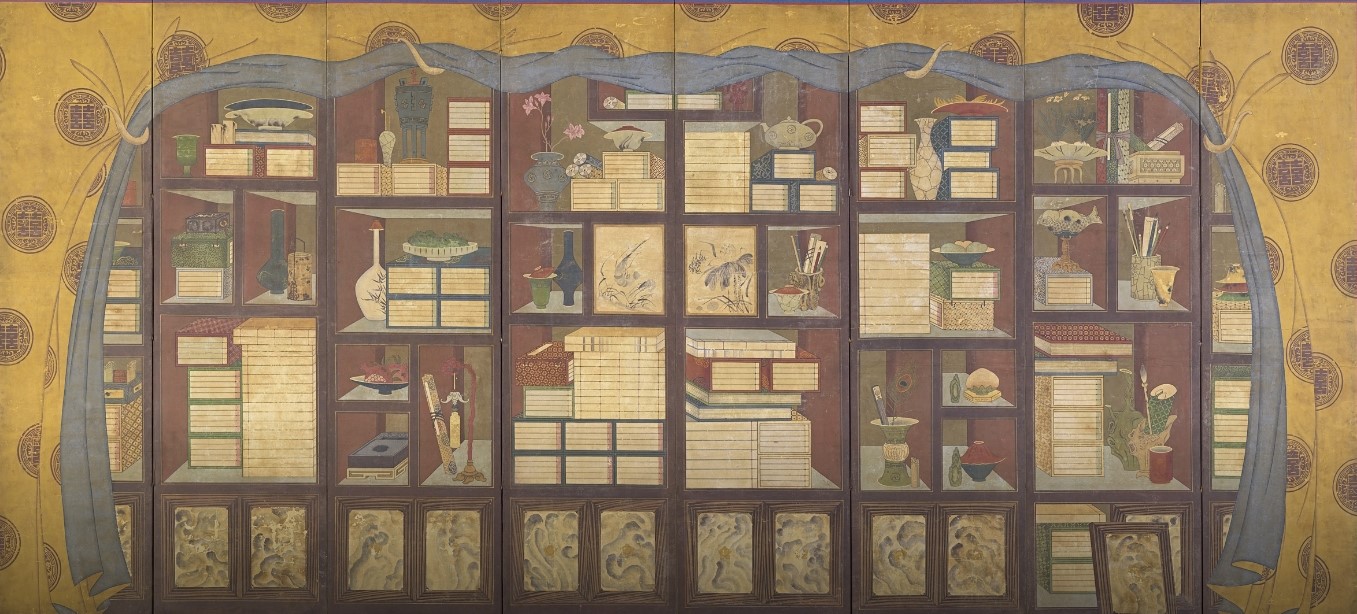
Among the earliest surviving examples is Jang Han-jong’s Books and Scholar’s Utensils, held by Gyeonggi Province Museum (경기도박물관). The museum dates it to the late eighteenth to early nineteenth century. Yellow curtains open onto an eight-section bookcase filled with books, ceramics, writing implements, and other prized objects.
The curtains make looking feel like an event: a private collection is being unveiled. Shading along the cabinet and highlights on small details strengthen the illusion. Then comes a quieter discovery—a painted seal, partly concealed near the bottom of the leftmost panel, identifies Jang. His signature participates in the world of objects he has created.
Yi Taek-gyun: abundance held in order
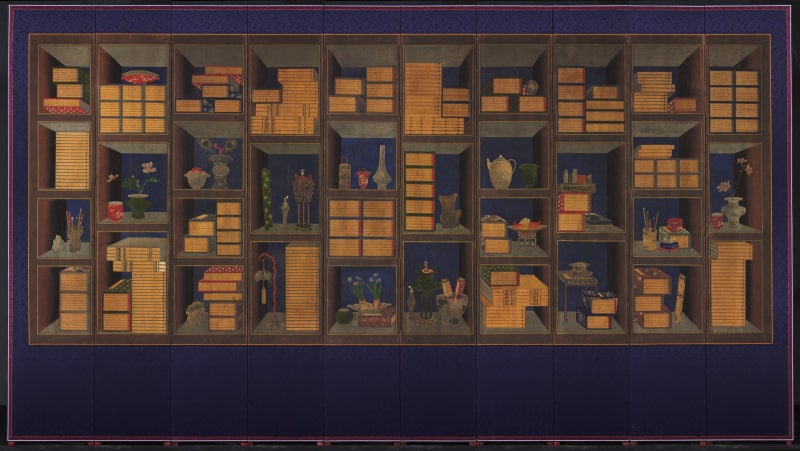
The Cleveland Museum of Art’s Books and Scholars’ Accoutrements, dated to the late nineteenth century, is a ten-panel screen by Yi Taek-gyun. Its deep blue background sets off warm-colored books and carefully distributed treasures. A hidden seal within the composition identifies the artist.
Here the cabinet gives abundance a disciplined rhythm. The books establish repeated rectangular forms; vessels interrupt them with rounded profiles. It is an especially rewarding work for anyone attracted to the genre’s balance between intellectual seriousness and decorative pleasure. Let your eye alternate between the whole shelving structure and a single small object.
An anonymous Met screen: books without a continuous bookcase
The Metropolitan Museum of Art’s Books and Scholars’ Possessions, an early twentieth-century ten-panel screen by an unidentified artist, shows a different approach. Each panel assembles stacked books, vessels, flowers, or small furnishings without the continuous cabinet that defines the bookshelf type.
Look for peacock feathers, small landscape paintings, a game board, and a pendulum clock. Characters wishing for longevity and good fortune recur on the vessels. The screen makes the genre’s range tangible: study, recreation, imported objects, and family blessings occupy a shared imaginative interior.
Comparing these three works reveals how much can change while books remain the connecting motif. One composition stages a revelation, another organizes a sumptuous collection, and a third builds separate worlds from stacks and clusters.
Why Chaekgeori Still Feels Contemporary
Strong outlines, repeated rectangles, rich colors, and familiar objects make chaekgeori easy to enjoy before its symbolism is understood. Its visual rhythm can sit comfortably beside contemporary furniture or graphic design. A bookshelf is already a recognizable structure; the painter makes it surprising through color, scale, and spatial play.
Calling this “Pop Art” can describe a present-day response to its boldness and attention to possessions. Historically, the works belong to their own courtly and domestic traditions, with purposes distinct from the twentieth-century movement. Their modern-looking qualities are an invitation to investigate those traditions more closely.
Contemporary artists have continued the conversation. In his Chaekgado series, photographer Lim Soosik photographs bookcases in sections from different viewpoints, prints the images on Korean paper, and stitches them together. The assembled shelves become portraits of their owners’ interests while renewing the older genre’s experiments with space.
For a wider view of such reinvention, see History of Modern Korean Traditional Painting & Masters. The way a painted shelf enlarges an interior also makes an interesting comparison with Korean gardens and borrowed scenery: each encourages reflection on how a carefully framed view can enrich a living space.
Chaekgeori’s enduring appeal may be easiest to recognize in an ordinary bookshelf. The books kept close, the object given pride of place, and the room imagined around them all say something about a person. These paintings offer the same pleasure of recognition, together with a more ambitious question: what kind of life would you choose to place on your shelves?
Looking Closely and Exploring Further
When viewing a screen, begin with its overall arrangement, then choose one compartment or stack to examine. Notice how much space the books receive, where the viewpoint changes, and which objects draw attention. Look among the painted seals for a possible artist’s signature. A museum’s collection page is useful for examining details and checking whether a particular work is currently displayed.
Chaekgeori becomes even richer alongside other expressions of Korean visual and scholarly culture:
- The Guide to Traditional Korean Painting History places the genre within a broader artistic story.
- Goryeo Buddhist Paintings: Korea’s Rarest Art Treasures explores another world of richly colored painting and deeply valued images.
- Discover Pungsokhwa: Masterpieces of Korean Genre Painting turns from possessions to the people and activities of Joseon society.
- The Art Inside Korean Won Banknotes brings historical art into an everyday modern setting.
- Who Carved the Writing on Korea’s Mountain Rocks? follows literary culture beyond the study and into the landscape.
- Traditional Korean Alcohol Guide: Soju & Makgeolli offers another route into the tastes and social pleasures of Korean cultural life.
Korean Culture portal KCulture.com

Founder of Kculture.com and MA in Political Science. He shares deep academic and local insights to provide an authentic perspective on Korean history and society.