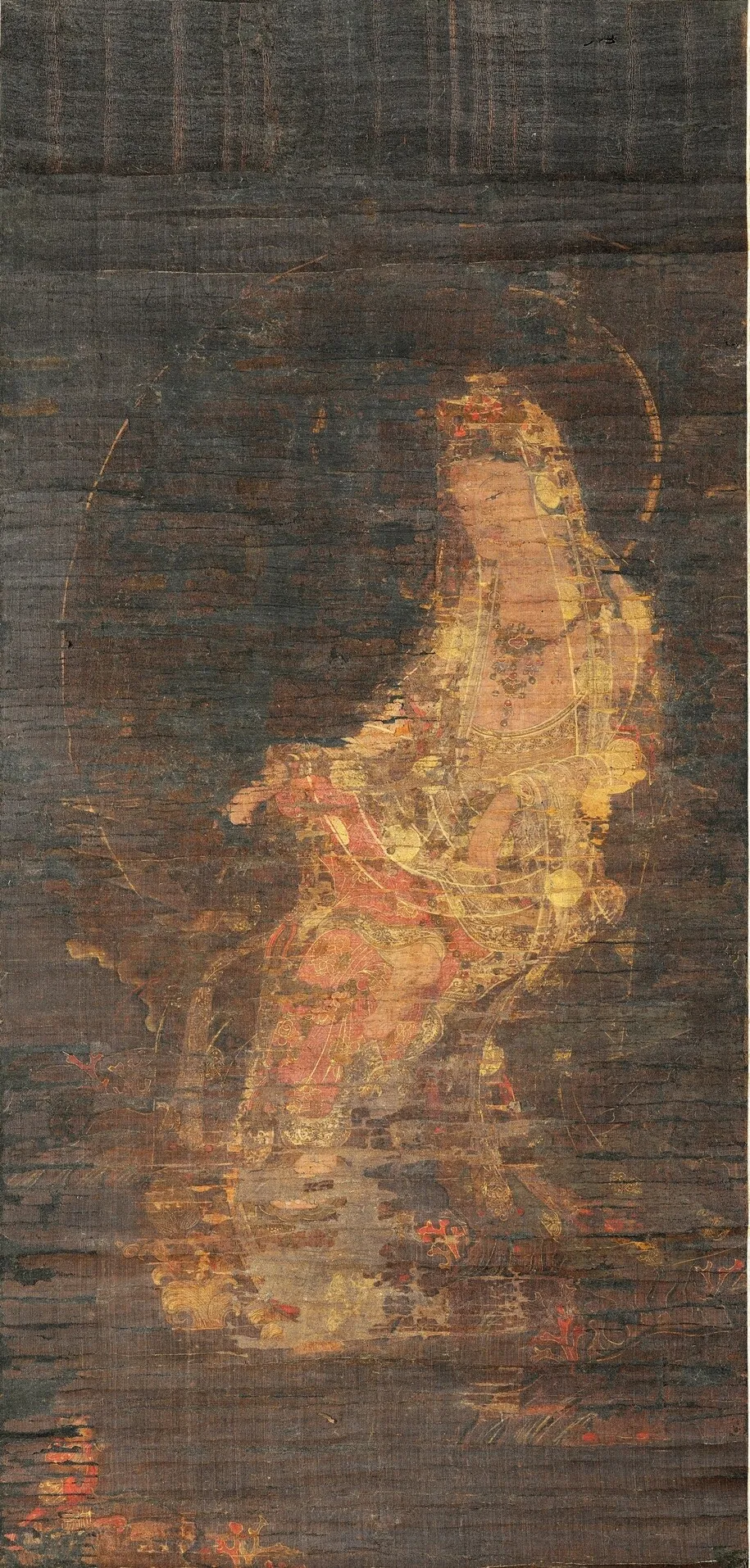
Goryeo Buddhist Paintings (고려불화) are extraordinarily refined, devotional silk scrolls created primarily between the 13th and 14th centuries during Korea’s Goryeo Dynasty. Characterized by their luminous mineral pigments, microscopic gold linework, and the ingenious back-coloring technique, they are universally ranked by art historians among the absolute finest religious masterpieces ever produced in East Asia. Because fewer than 170 authenticated pieces survive globally, encountering an original Goryeo Buddhist painting is considered one of the rarest and most profound experiences in the art world.
For many international culture enthusiasts and art lovers, Korean traditional art is often associated with the minimalist ink landscapes of the Joseon period or the vibrant folk art known as Minhwa. However, centuries before those genres flourished, the royal court of Goryeo cultivated a Renaissance-level artistic tradition centered entirely on Buddhist devotion. These works were not simply decorative; they were magnificent tools for spiritual salvation, designed to visualize the pure land and the boundless compassion of divine beings.
This comprehensive guide explores the breathtaking techniques that make Goryeo Buddhist Paintings technically unmatched, how they distinctly compare to the contemporary religious art of China and Japan, the complex history behind their global dispersion, and where visitors can still witness these rare treasures in South Korea today.
- What Are Goryeo Buddhist Paintings?
- The Three Techniques Behind Their Unmatched Beauty
- Iconic Subjects: Buddhas and Bodhisattvas
- Goryeo vs. Chinese and Japanese Buddhist Art
- Extreme Rarity: Why Are So Many in Japan?
- Where to See Goryeo Buddhist Paintings in Korea
- How to Properly Appreciate a Goryeo Painting
- 2026 Update: Recent Returns and Expanding History
- FAQ
What Are Goryeo Buddhist Paintings?
Goryeo Buddhist Paintings are intricate religious artworks painted on silk, typically taking the form of hanging scrolls measuring about 1 to 1.5 meters in width. Produced during a time when Buddhism was the state religion of the Goryeo Dynasty (918–1392), these works reached their absolute zenith during the late 13th and 14th centuries.
Unlike later Buddhist folk art painted by anonymous temple monks, these masterpieces were commissioned by the royal family and high-ranking aristocrats. They were executed by highly skilled professional court painters attached to state ateliers. Every brushstroke was an act of intense devotion, created to pray for national peace, the health of the royal family, and the patron’s favorable rebirth in the afterlife.
Despite their relatively modest physical size, the canvases are packed with a level of detail and material wealth that continues to astonish modern conservators.
The Three Techniques Behind Their Unmatched Beauty
The visual impact of a Goryeo Buddhist Painting is immediate. The colors are deep and saturated, the figures are infinitely graceful, and the surfaces shimmer with impossible detail. This aesthetic perfection is the result of three specific technical choices.
1. Baechaebeop (Back-Coloring Technique)
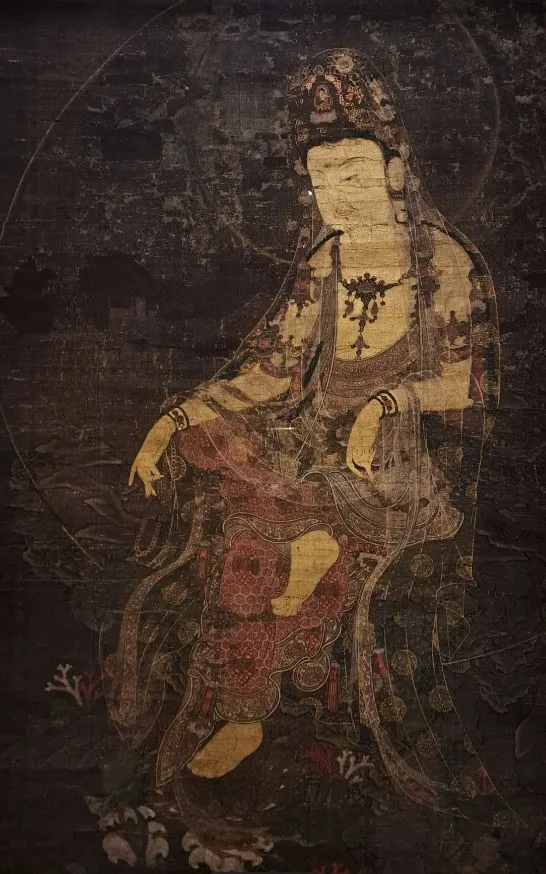
Instead of painting directly onto the front of the silk, Goryeo artists applied thick layers of pigment to the reverse side of the canvas. The colors subtly seeped through the fine weave of the silk to the front. This Baechaebeop (배채법) gave the colors an ethereal, glowing depth that flat front-painting cannot replicate. Crucially, because the pigment sits safely embedded within the silk fibers rather than exposed on the surface, it has resisted fading and flaking for over 700 years.
2. Vivid Natural Mineral Pigments
To achieve their iconic, saturated palette, artists utilized highly expensive, imported natural mineral pigments. Cinnabar was ground for intense reds, malachite for lush greens, and azurite for striking blues. The sourcing and preparation of these costly materials were direct reflections of aristocratic patronage and religious sincerity.
3. Microscopic Gold Linework (Geumni)
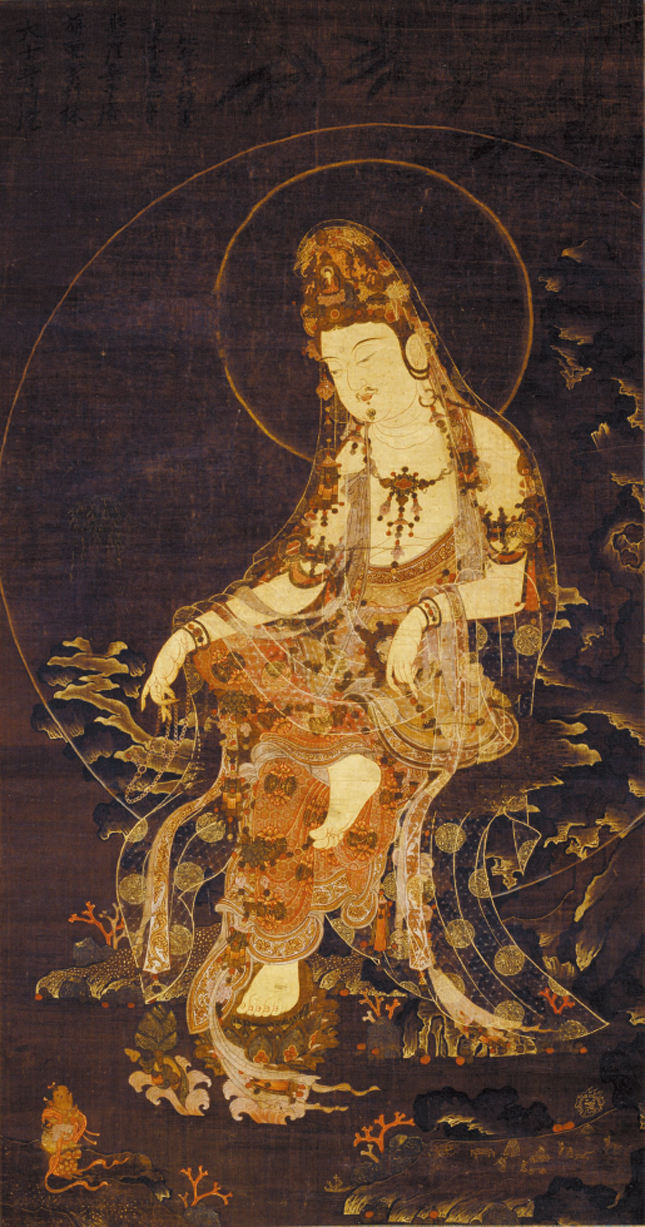
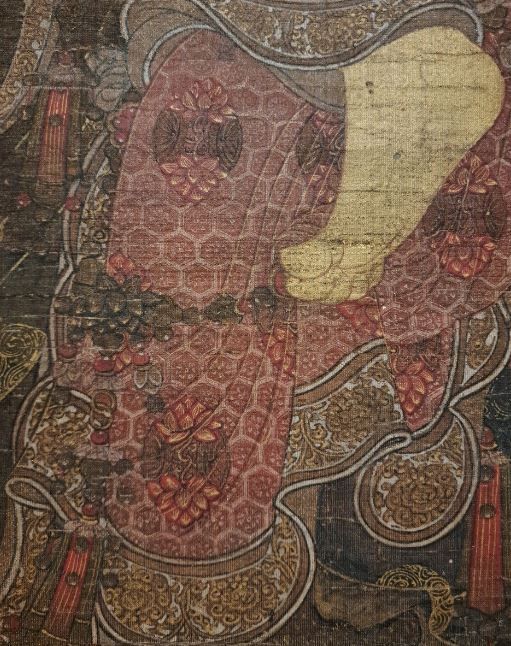
The most mind-boggling feature of these paintings is the Geumni (금니), or gold pigment linework. Artists used lines thinner than a human hair to paint elaborate mandala patterns, lotus motifs, and geometric tortoiseshell designs onto the red robes of the Buddhas. Furthermore, they used pure gold to depict the sheer, transparent veils draping the bodies of Bodhisattvas. These microscopic details are often so fine that they can only be fully appreciated with a magnifying glass.
Iconic Subjects: Buddhas and Bodhisattvas
While various deities were depicted, the surviving Goryeo corpus is dominated by three main figures, each answering the specific spiritual needs of the era’s people.
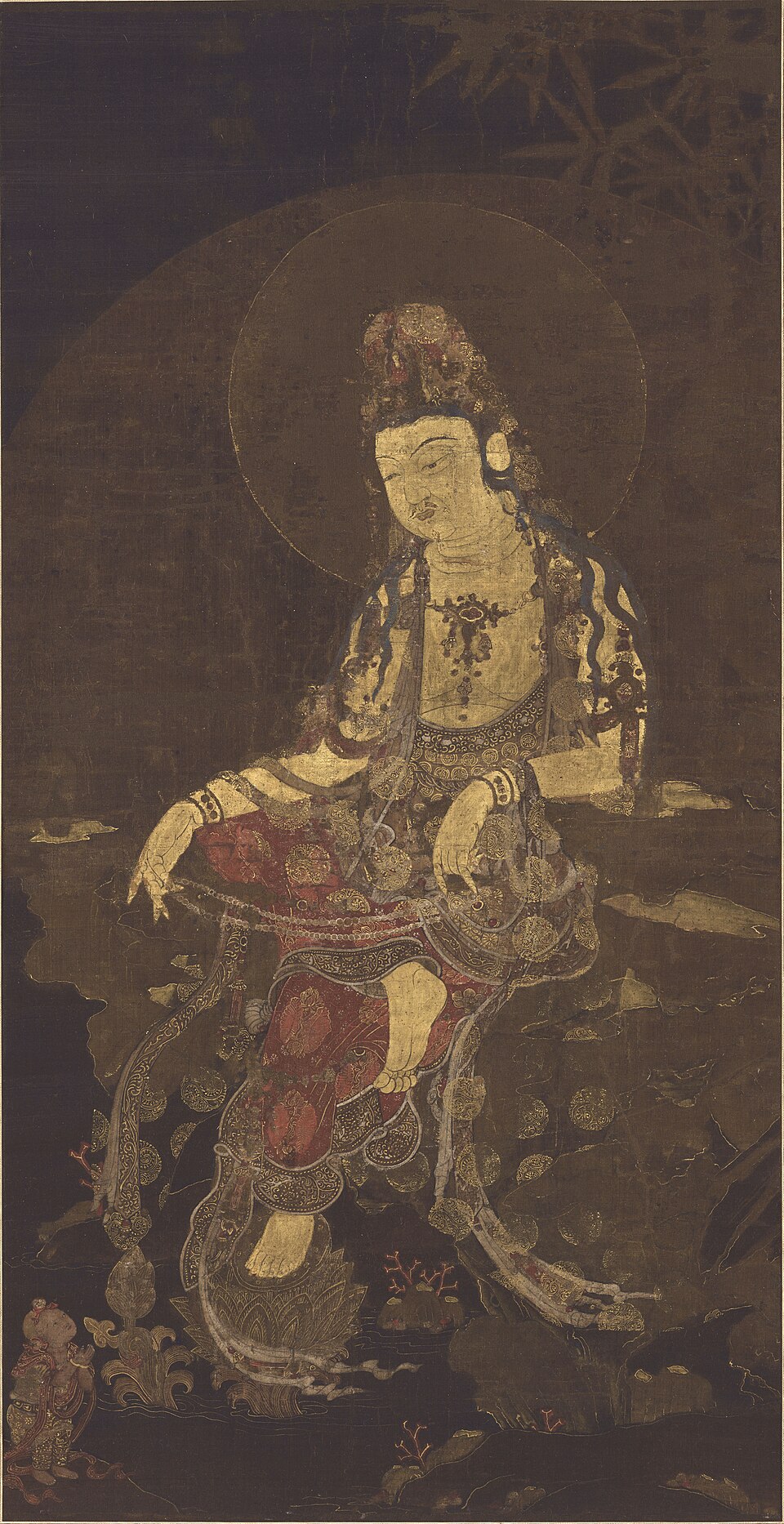
- Water-Moon Avalokitesvara (Suwolgwaneumdo, 수월관음도): This is the undisputed icon of Goryeo art. It depicts the Bodhisattva of Compassion seated in a relaxed, royal ease pose on a rocky outcropping above the water. A transparent veil cascades over the deity’s body, and a crystal vase holding a willow branch—a symbol of healing—sits nearby. At the bottom corner, the tiny boy pilgrim Sudhana looks up in search of enlightenment. Over 40 of the surviving paintings feature this exact, mesmerizing composition.
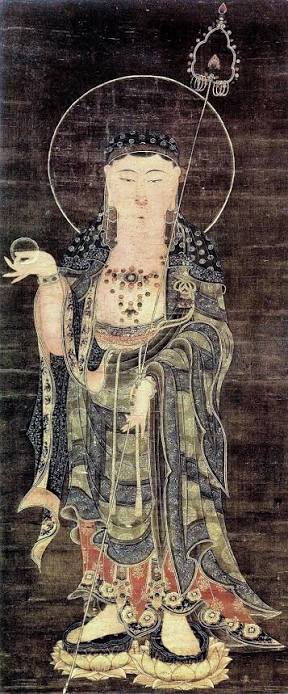
- Amitabha Buddha (아미타불): As the ruler of the Western Paradise, Amitabha was immensely popular among those praying for a peaceful afterlife. He is often depicted either standing alone or descending from the heavens to welcome the soul of a dying believer.
- Kshitigarbha Bodhisattva (Jijang Bosal, 지장보살): The savior of the underworld. Kshitigarbha vowed not to achieve Buddhahood until all the hells were emptied. Paintings of this deity were essential for mourning rituals and praying for deceased ancestors to be saved from suffering.
Goryeo vs. Chinese and Japanese Buddhist Art
During the 13th and 14th centuries, Buddhist painting flourished across East Asia. While ideas and iconography were shared among Korea, China, and Japan, Goryeo artists transformed the international visual language into a distinctive national style.
| Tradition (13th-14th C.) | Visual Characteristics | Contrast with Goryeo Art |
|---|---|---|
| Goryeo Korea | Back-coloring, rich mineral pigments, microscopic gold linework. Focuses on single deities. | Pursues an aesthetic of extreme elegance and Static, Meditative Serenity. |
| Song & Yuan China | Naturalistic figures, wider color palettes, complex backgrounds. | Highly narrative and spatial. Uses significantly less gold pigment compared to Goryeo’s lavishness. |
| Kamakura Japan | Dynamic scenes of Amitabha Buddha rapidly descending on clouds to greet the dying. | Highly Dynamic & Story-Driven, standing in stark contrast to the quiet stillness of Goryeo works. |
Extreme Rarity: Why Are So Many in Japan?
The tragedy of Goryeo Buddhist Paintings lies in their extreme rarity. Of the tens of thousands that were likely produced, only about 160 to 170 remain today. Their global distribution is a stark reflection of Korea’s turbulent history.
Currently, around 130 pieces are located in Japan. Another 15 to 20 are held in Western institutions, including the Metropolitan Museum of Art in New York, the Smithsonian’s National Museum of Asian Art, and the Musée Guimet in Paris. Remarkably, fewer than 20 pieces remain in South Korea.
The concentration of these paintings in Japan is the result of centuries of layered history, not a single event. Some works left Korea legitimately during the Goryeo period as diplomatic gifts or were purchased by visiting Japanese monks who revered their beauty. However, a massive portion was lost through violence and exploitation. Raids by Japanese pirates (Wakō) in the late Goryeo period, the devastating Japanese invasions of Korea (Imjin War) in the 1590s, and the systematic exportation of cultural heritage during the Japanese colonial rule (1910–1945) all contributed to the scattering of these masterpieces.
Where to See Goryeo Buddhist Paintings in Korea
Viewing an original Goryeo Buddhist Painting in Korea requires careful timing. The primary custodians of these remaining national treasures include:
- National Museum of Korea (국립중앙박물관) in Seoul: Holds several masterpieces, including a designated Treasure-level Water-Moon Avalokitesvara and pieces from the rare Five Hundred Arhats series.
- Horim Museum (호림박물관) in Seoul: Known for housing a stunning 14th-century Water-Moon Avalokitesvara that was successfully repatriated from Japan.
- Leeum Museum of Art (리움미술관) in Seoul: Houses exceptional Buddhist art, including works from the famous Lee Kun-hee bequest.
📌 Local Exhibition Note: Do not expect these paintings to be on permanent display. 700-year-old silk is hypersensitive to light and humidity. Museums rotate them from climate-controlled vaults into public galleries for only a few weeks at a time, usually during major special exhibitions. Always check current museum exhibition schedules before planning a visit.
How to Properly Appreciate a Goryeo Painting
If you are fortunate enough to encounter an original Goryeo Buddhist Painting in a museum, approach it in three steps to fully grasp its brilliance:
- From a Distance (The Composition): First, stand back. Observe the perfect balance of the composition, the bold contrast of the deep red and green pigments, and the serene, tranquil posture of the deity. The painting projects a sense of absolute stillness.
- Up Close (The Microscopic Details): Move as close to the glass as permitted. Look for the transparent veil cascading down the Bodhisattva’s arm. Look for the tortoiseshell and lotus patterns drawn in gold lines thinner than a thread. Find the tiny, emotional face of the boy pilgrim Sudhana. This is where the physical devotion of the artist is revealed.
- Step Back Again (The Luminous Effect): Notice how the gold linework catches the light differently as you move. The painting is designed to be both a monumental icon from afar and an intricate universe up close.
2026 Update: Recent Returns and Expanding History
The effort to repatriate dispersed Korean heritage remains a vital ongoing mission. In April 2025, the art world witnessed a historic moment when a previously unseen 14th-century Water-Moon Avalokitesvara was unveiled at the Gana Art Center in Pyeongchang-dong (평창동), Seoul, after being acquired and returned from a Japanese collector.
What made this newly discovered piece revolutionary was its technique. Unlike the standard works bursting with red, green, and gold, this painting was rendered almost entirely in black ink outlines. Korean art historians concluded that this rare monochrome approach proves the stylistic spectrum of Goryeo artists was far wider and more experimental than previously documented.
Concurrently, modern scientific research utilizing infrared imaging and X-ray fluorescence continues to uncover the hidden underdrawings beneath the silk, proving that these paintings are not merely art, but the physical crystallization of supreme patience and religious faith.
FAQ
How many Goryeo Buddhist Paintings survive today?
Only about 160 to 170 authenticated pieces are known to exist worldwide. Their extreme rarity is due to the fragility of 700-year-old silk and centuries of wars and historical turbulence.
Why are there more Goryeo paintings in Japan than in Korea?
It is a mix of legitimate religious/diplomatic exchange over centuries, and significant looting during historical conflicts, including pirate raids, the Imjin War (1590s), and the Japanese colonial period (1910-1945).
What is the most famous type of Goryeo Buddhist Painting?
The Water-Moon Avalokitesvara (Suwolgwaneumdo). It depicts the Bodhisattva of Compassion elegantly seated on a rock above water, wearing a transparent veil decorated with microscopic gold lines, looking down at a young pilgrim.
Can I see an original painting at the National Museum of Korea anytime?
Usually not. Due to strict conservation rules, these fragile works are rarely put on permanent display. They are only brought out for limited-time special exhibitions. It is highly recommended to check the museum’s website in advance.
To further explore the evolution of Korean art—from the religious devotion of the Goryeo court to the scholarly pursuits and vibrant folk art of the subsequent Joseon Dynasty—delve into these detailed guides:
- The Guide to Traditional Korean Painting History
- Jeong Seon & Chusa: Joseon Literati Painting Masterpieces
- Discover Pungsokhwa: Masterpieces of Korean Genre Painting
- Minhwa: The Guide to Korea’s “Pop Art” Tradition
- Understanding Muninhwa and Korea’s Scholar Artists
- History of Modern Korean Traditional Painting & Masters
- The Art Inside Korean Won Banknotes
Korean Culture portal KCulture.com

Founder of Kculture.com and MA in Political Science. He shares deep academic and local insights to provide an authentic perspective on Korean history and society.