
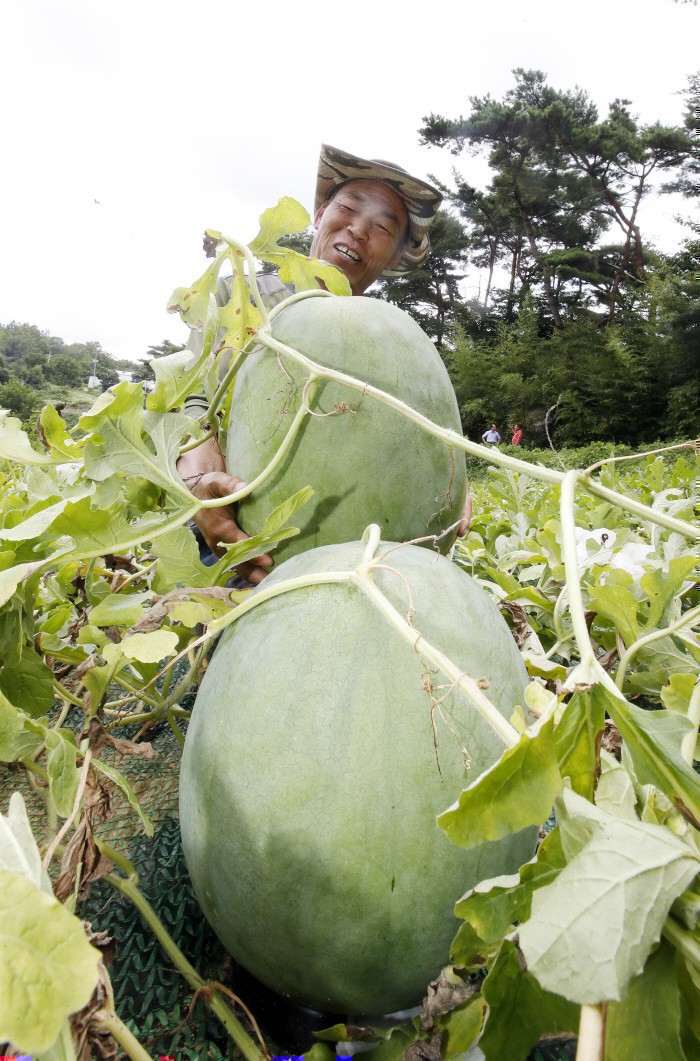
Mudeungsan Watermelon, locally known as “Puraengi” (푸랭이), is an ultra-premium, dark-green heirloom Korean watermelon grown exclusively on the slopes of Mount Mudeungsan (무등산) in Gwangju (광주). Weighing up to 30 kilograms and selling for hundreds of dollars, this rare fruit is prized for its distinct umami flavor and royal history, though it now faces a severe survival crisis with only seven cultivating farms remaining.
For most international travelers—and even a majority of Koreans—this giant, unstriped watermelon remains a complete mystery. It is not mass-produced for standard grocery store shelves, nor is it a simple novelty item marketed for tourists. Instead, it is a fascinating piece of living agricultural heritage. Its survival tells a complex story about Korean gift culture, climate change, the deep connection between a mountain ecosystem and its local crops, and the struggle to preserve traditional farming in a modern, efficiency-driven world.
This article explores the 400-year history of this former royal tribute, what makes its flavor and appearance so extraordinary, the devastating impact of modern climate change on its traditional cultivation, and how food enthusiasts can experience it during the current 2026 season.
- What Is Mudeungsan Watermelon (Puraengi)?
- A 400-Year Legacy: Mongolian Seeds to Royal Tribute
- Beyond Sweetness: How Puraengi Looks and Tastes Different
- The Secret Terroir of Mudeungsan
- Size and Price: Why Does It Cost Over $200?
- The Paradox of Puraengi: Why Growing It Is So Difficult
- Who Actually Buys Such an Expensive Watermelon?
- GEOfood Status and Preservation Efforts
- FAQ: Tasting and Buying Puraengi
What Is Mudeungsan Watermelon (Puraengi)?
Mudeungsan Watermelon is a traditional heirloom variety of watermelon cultivated specifically in the foothills of Mount Mudeungsan in southwestern Korea. While its formal name ties it to the mountain, the local people of Gwangju have long called it Puraengi.
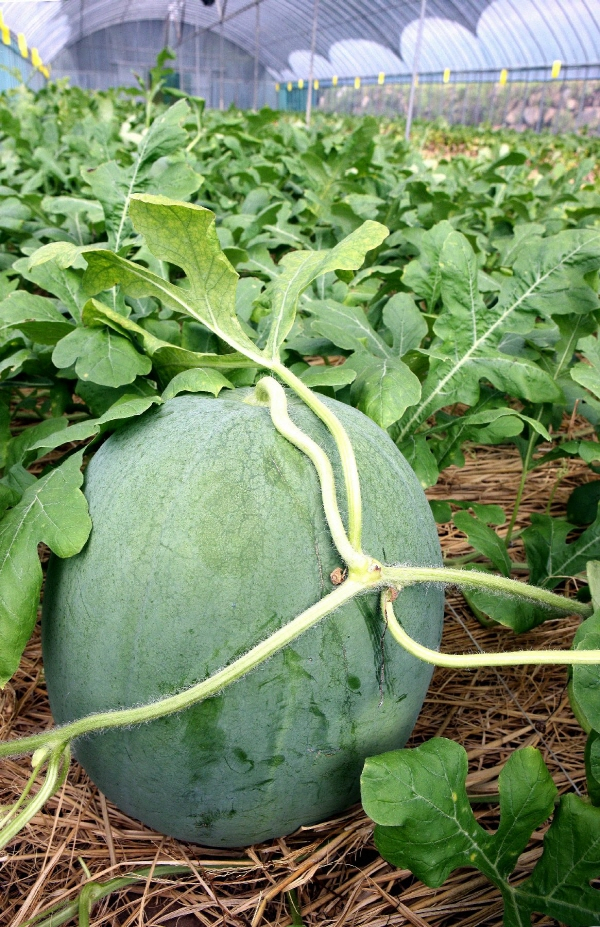
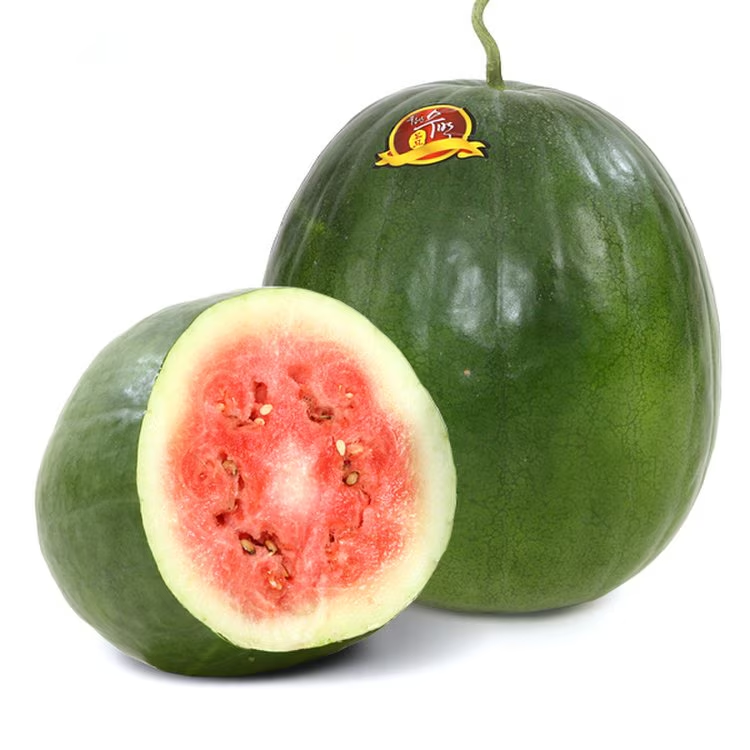
The nickname is derived from the Korean word pureuda (푸르다), which means “to be blue-green.” Unlike the familiar watermelon that announces itself with contrasting green and black stripes, Puraengi has a striking, uniform dark bluish-green rind with no stripes at all. The city of Gwangju proudly markets the fruit under this local nickname, treating it as an inseparable part of the watermelon’s historical and regional identity.
A 400-Year Legacy: Mongolian Seeds to Royal Tribute
The story of Mudeungsan Watermelon bridges local oral tradition and documented regional history. According to the long-held accounts of local growers, the fruit’s lineage traces back roughly 350 to 400 years. Tradition states that the original seeds arrived from Mongolia during the Goryeo Dynasty, were initially cultivated further north in the Gaeseong region, and eventually found their perfect ecological niche around the Mudeungsan area.
What is firmly documented is the fruit’s prestigious status during the Joseon Dynasty. Gwangju’s official historical records note that Mudeungsan Watermelon was cultivated as a royal tribute—a delicacy deemed so exceptional that it was presented directly to the king. This royal association elevated the fruit from a humble agricultural product to a symbol of regional pride, laying the cultural foundation for its modern status as a luxury gift.
Beyond Sweetness: How Puraengi Looks and Tastes Different
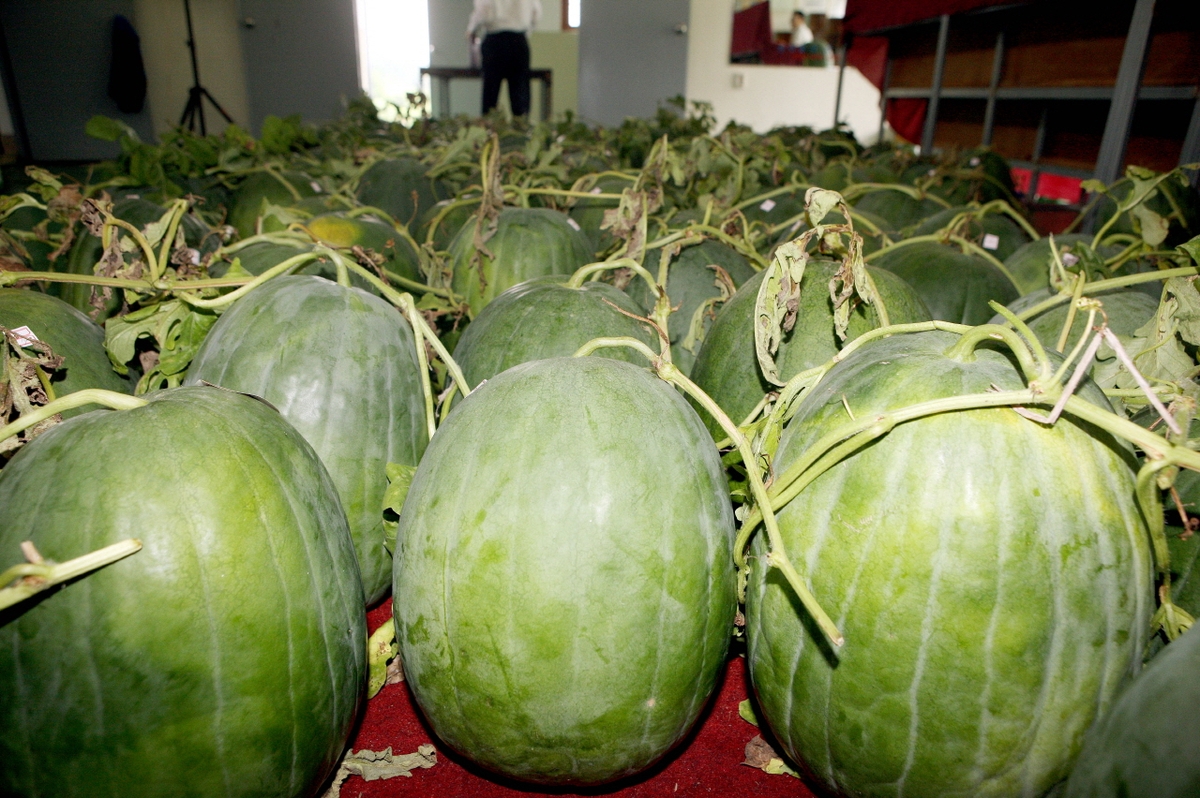
To understand why this fruit is so revered, one must look past its massive size. While a typical supermarket watermelon weighs between 7 and 9 kilograms, Puraengi starts at 7 kilograms and routinely exceeds 20 kilograms, with exceptional harvests pushing 30 kilograms.
| Feature | Regular Commercial Watermelon | Mudeungsan Watermelon (Puraengi) |
|---|---|---|
| Rind Appearance | Light green with prominent black stripes | Solid, deep blue-green (no stripes) |
| Seeds | Solid black | Mostly white, or pale with a dark tip |
| Flesh & Texture | Crisp, crunchy, and standard sweetness | Notably softer, melting texture |
| Flavor Profile | Simple sugar-sweetness | Deep sweetness combined with a rich, aromatic umami |
Cut one open, and the contrast becomes even more apparent. The thick rind protects a bright red, unusually soft flesh. Local consumers and longtime fans rarely use the word “sweet” alone to describe it. Instead, they highlight its intense aroma and a lingering, savory depth—often referred to in Korean as gamchilmat (감칠맛), or umami. It is not a savory taste like fermented food, but rather a complex depth of flavor that ordinary watermelons lack.
The Secret Terroir of Mudeungsan
You cannot simply take a Puraengi seed, plant it in a modern greenhouse on the other side of the country, and expect to grow a Mudeungsan Watermelon. Its identity is inextricably tied to the concept of terroir.
A Royal Legacy: From Goryeo Seeds to Joseon Tribute
The story of Mudeungsan Watermelon bridges local oral tradition and documented regional history. While the very first watermelon seeds are said to have arrived on the Korean Peninsula from Mongolia during the Goryeo Dynasty (over 700 years ago) and were initially planted in the Gaeseong region, the specific history of Puraengi is much more localized.
According to the long-held accounts of Gwangju growers, this unique variety found its perfect ecological niche on the slopes of Mount Mudeungsan roughly 350 to 400 years ago, during the mid-Joseon Dynasty.
What is firmly documented is the fruit’s prestigious status during this era. Gwangju’s official historical records note that Mudeungsan Watermelon was cultivated as a royal tribute—a delicacy deemed so exceptional that it was presented directly to the Joseon kings. This royal association elevated the fruit from a humble agricultural product to a symbol of regional pride, laying the cultural foundation for its modern status as a luxury gift.
Size and Price: Why Does It Cost Over $200?
The price of Puraengi is legendary in Korea, but it can also be highly confusing for first-time buyers depending on where they look. If you visit the local direct-sales center in Gwangju, you will see one price. If you visit a luxury department store in Seoul, you will see a dramatically different number.
To understand the actual cost of this fruit, we must look at the finalized market data from the 2025 season, which clearly illustrates the gap between buying direct from the source versus premium retail channels:
| Weight | 2025 Local Direct-Sale (Gwangju) | 2025 Premium Retail (Dept. Stores) |
|---|---|---|
| 8 kg | – | ~75,000 KRW |
| 10 kg | ~60,000 KRW | 100,000 KRW and up |
| 17 kg | ~130,000 KRW | – |
| 24 kg | ~270,000 KRW | Up to 400,000 KRW |
One of the most fascinating aspects of Puraengi pricing is that it does not scale linearly. A 24-kilogram melon is not simply 2.4 times the price of a 10-kilogram one. The price jumps exponentially because massive, perfectly shaped fruits are incredibly rare and highly sought after in Korea’s luxury gifting market. For fruits exceeding 30 kilograms, there is no set price tag—it essentially becomes whatever the grower calls.
As of late August 2026, the new harvest is already underway. While definitive season-wide averages are still forming, extreme summer heatwaves and severe monsoon rains have kept production numbers critically low this year. Consequently, buyers should expect 2026 prices to remain firmly in the premium tier, with a standard 10-kilogram specimen likely starting around the 100,000 KRW mark in retail channels.
💡 Local Note: Do not confuse authentic Puraengi with standard watermelons occasionally labeled “Mudeungsan” at general wholesale markets, which trade for much lower per-kilogram prices. Authentic, premium Puraengi is sold strictly through designated direct-sales channels.
The Paradox of Puraengi: Why Growing It Is So Difficult
The most compelling story behind Puraengi is a harsh paradox: the traditional inefficiencies that preserved its unique identity are the exact same factors threatening its survival.
Growing Puraengi is an extreme labor of love. Farmers shun commercial seeds, instead carefully extracting and replanting their own heirloom seeds year after year. Modern mechanization is virtually impossible. According to recent field reports, planting a single Puraengi vine requires digging a hole roughly one meter in diameter and 1.2 meters deep, filling it with rich organic compost. The vines themselves can stretch up to 10 meters long.
Furthermore, Puraengi absolutely refuses continuous cropping. A plot of land used for the watermelon cannot immediately be used for it again without severely degrading the soil and the fruit’s flavor, meaning farmers must constantly rotate their fields.
Add the devastating impacts of modern climate change to this equation. The fruit requires a precarious balance of mountain sunlight and controlled moisture. Today’s brutal summer heatwaves scorch the vines and destroy the fruit’s umami flavor, while unpredictable, torrential monsoon rains prevent the rind from hardening, causing the massive watermelons to burst in the fields before they can be harvested.
The numbers reflect this crisis starkly. In the late 1990s, there were over 34 farms cultivating Puraengi. By 2023, production had plummeted to just 1,844 melons. In 2025 and heading into 2026, only about seven farming households remain, producing roughly 2,300 watermelons per year. The aging farmers are retiring, and younger generations are unwilling to take on such a high-risk, labor-intensive crop.
Who Actually Buys Such an Expensive Watermelon?
With its high price point, Puraengi does not compete with the standard watermelon sitting in a family’s grocery cart. Its consumer base is highly specific:
- Premium Gift Buyers: Korea possesses a strong culture of presenting luxury fruit as a sign of deep respect or gratitude. A massive, rare, 20-kilogram Puraengi is the ultimate “statement gift” during the late summer and autumn holidays.
- Regional Loyalists: Many residents of Gwangju and the surrounding Honam region view eating the fruit as an annual seasonal ritual, returning year after year for the taste of their local heritage.
- Culinary Enthusiasts: Serious food lovers who seek out regional specialties and want to experience the specific umami and aroma that cannot be replicated by commercial agriculture.
GEOfood Status and Preservation Efforts
To prevent this agricultural heritage from vanishing, local governments and international networks are taking action. In 2024, Mudeungsan Watermelon was officially registered as a GEOfood. This is an international branding network specifically for food products inextricably tied to the geological and cultural landscapes of UNESCO Global Geoparks.
(Note: It is important to clarify that Mudeungsan Watermelon is a GEOfood associated with the Mudeungsan UNESCO Global Geopark. It is not an FAO Globally Important Agricultural Heritage System (GIAHS), nor is the fruit itself a UNESCO World Heritage item.)
Locally, the Gwangju city government and Buk-gu district provide essential production subsidies. In 2025, they completely remodeled the Mudeungsan Watermelon Joint Direct Sales Center for the first time in two decades to improve the consumer experience. Authorities are also actively exploring the creation of premium juicing facilities to utilize bruised or misshapen fruits, adding a new layer of economic sustainability for the remaining farmers.
FAQ: Tasting and Buying Puraengi
Where is the best place to buy authentic Puraengi?
You will not find it in Seoul department stores or standard supermarkets. Almost the entire harvest moves through the Mudeungsan Watermelon Joint Direct Sales Center (무등산수박 공동직판장) located in Geumgok-dong, Gwangju.
When is the actual season?
Unlike standard summer watermelons, Puraengi is a late-season harvest. The prime window opens in late August, peaks in September, and occasionally stretches into early or mid-October depending on the year’s weather.
Can international tourists buy one to try?
While visitors are more than welcome at the direct sales center, traveling with a 15-to-25-kilogram watermelon is highly impractical. Your best option is to visit the center during the peak season in Gwangju to witness the massive scale of the fruit, ask if they have any tasting samples available, or inquire about domestic shipping if you are staying in Korea for an extended period.
For more deep dives into Korea’s seasonal and regional food culture, explore our guides to Must-Try Korean Summer Fruits, Korea’s Ancient Fermented Seafood (Jeotgal), and the Ultimate Guide to Korean Gukbap Varieties.
Korean Culture portal KCulture.com

Founder of Kculture.com and MA in Political Science. He shares deep academic and local insights to provide an authentic perspective on Korean history and society.