Korean genre painting, widely known as Pungsokhwa (풍속화), is a revolutionary art form from the late Joseon Dynasty that authentically captures the everyday lives, sweaty labor, joys, and hidden romances of both commoners and aristocrats. If you have ever wondered how ordinary people actually lived during Korea’s historical eras, looking at these vivid paintings is like opening a visual time capsule. Living in Korea, I often find that understanding these masterpieces offers the most profound glimpse into the true spirit of the Korean people. In this guide, we will explore the lives and artistic worlds of the two greatest genre painters, Kim Hong-do and Shin Yun-bok, uncover the deep cultural significance of their work, and share insider tips on where you can view these national treasures today.
- What is Pungsokhwa: The Awakening of Joseon Identity
- Kim Hong-do: The Warm-hearted Observer of the People
- Shin Yun-bok: The Daring Painter of Romance and Satire
- Other Masters: The Legacy of Kim Deuk-sin
- The Enduring Significance of Korean Genre Painting
- Where to See Masterpieces in Seoul
💡 Essential Reading Before We Begin: To fully grasp the context of genre painting within the broader spectrum of Korean art, I highly recommend checking out these foundational guides:
What is Pungsokhwa: The Awakening of Joseon Identity
When discussing traditional Korean painting, two main categories usually dominate the conversation: Muninhwa, the idealized, philosophical ink-wash landscapes painted by elite scholars, and Minhwa, the vibrant, anonymous folk paintings meant to bring good fortune. However, during the cultural renaissance of the late 18th century, a third, radically different category emerged.
Pungsokhwa, or genre painting, shifted the artistic focus away from idealized nature and mythical beasts, pointing the brush directly at the noisy, vibrant reality of the Joseon people. This artistic shift perfectly mirrored the rise of the Silhak (Practical Learning) movement, which encouraged intellectuals to focus on the reality of Korean society rather than abstract Chinese philosophies. Suddenly, blacksmiths, farmers, gisaeng (female entertainers), and wrestling matches were deemed subjects worthy of high art.
Kim Hong-do: The Warm-hearted Observer of the People
Kim Hong-do, also known by his pen name Danwon, is arguably the greatest genius in the history of Korean painting. Born in 1745, he was a prodigy who mastered every genre, from royal portraits to landscapes and Buddhist paintings. He served as an official court painter at the Dohwaseo (도화서), the royal bureau of painting, and became the absolute favorite of King Jeongjo.
Life and Downfall
Kim Hong-do enjoyed immense privilege during his peak, even being appointed to a provincial government post—a rare honor for a painter of middle-class origins. He traveled to Mount Geumgang under the king’s orders to paint its breathtaking landscapes. Tragically, after the sudden death of his great patron, King Jeongjo, in 1800, Kim Hong-do’s life spiraled into poverty and sickness. He passed away in obscurity, leaving behind a legacy that would define Korean art forever.
Artistic World and Characteristics
While his elite landscape paintings are masterpieces, his genre paintings are what captured the hearts of the public. Kim Hong-do had a unique ability to capture the dynamic energy of human movement using thick, vigorous, and rhythmic brushstrokes.
- Focus on Figures: He frequently omitted backgrounds entirely, drawing the viewer’s eye straight to the actions and facial expressions of the people.
- Dynamic Composition: He utilized circular or X-shaped compositions to create a sense of thrilling action, as seen in his famous wrestling scenes.
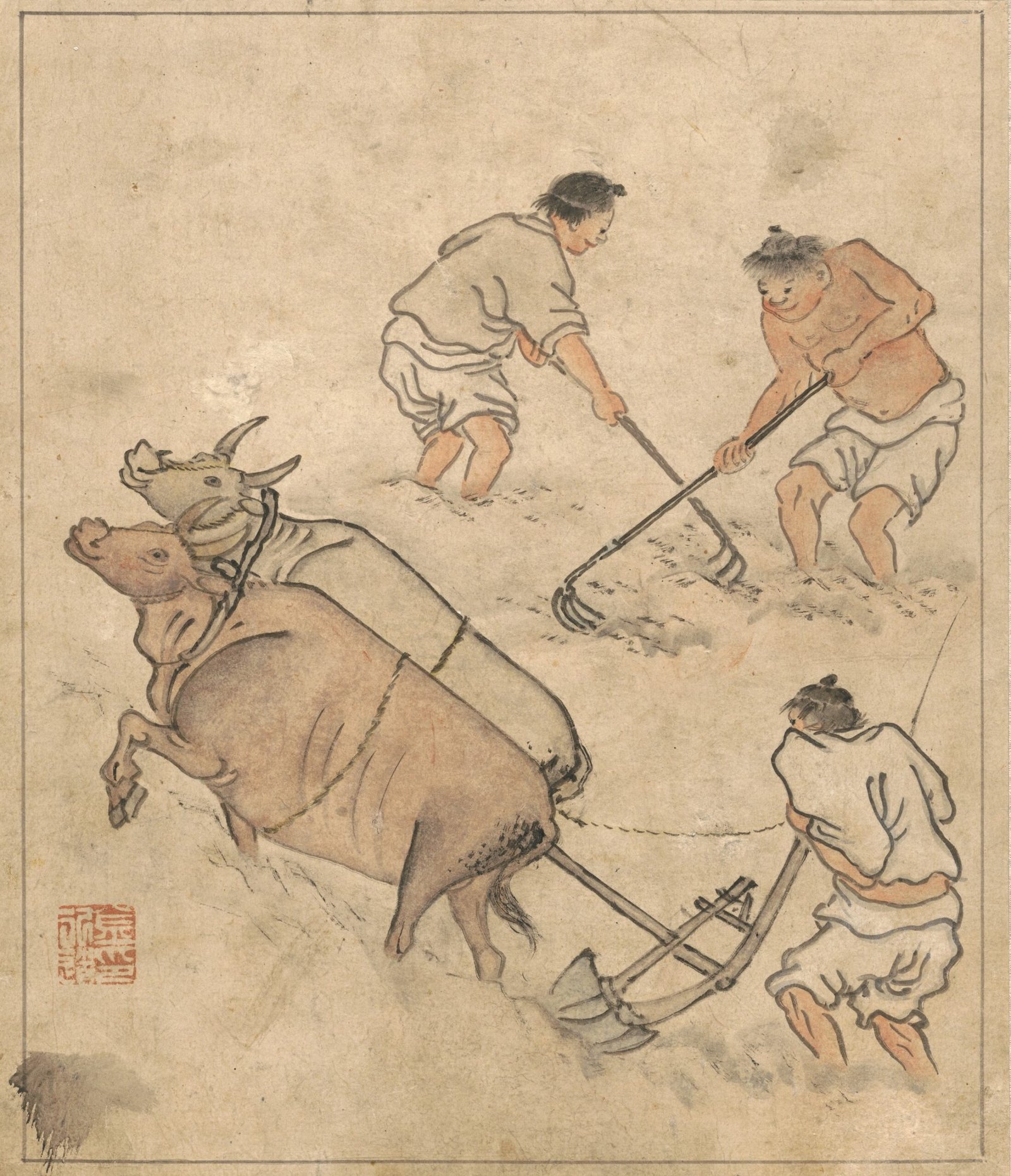
- Humor and Humanity: Rather than mocking the lower classes, he painted their labor and leisure with deep affection and a uniquely Korean sense of humor (haehak).
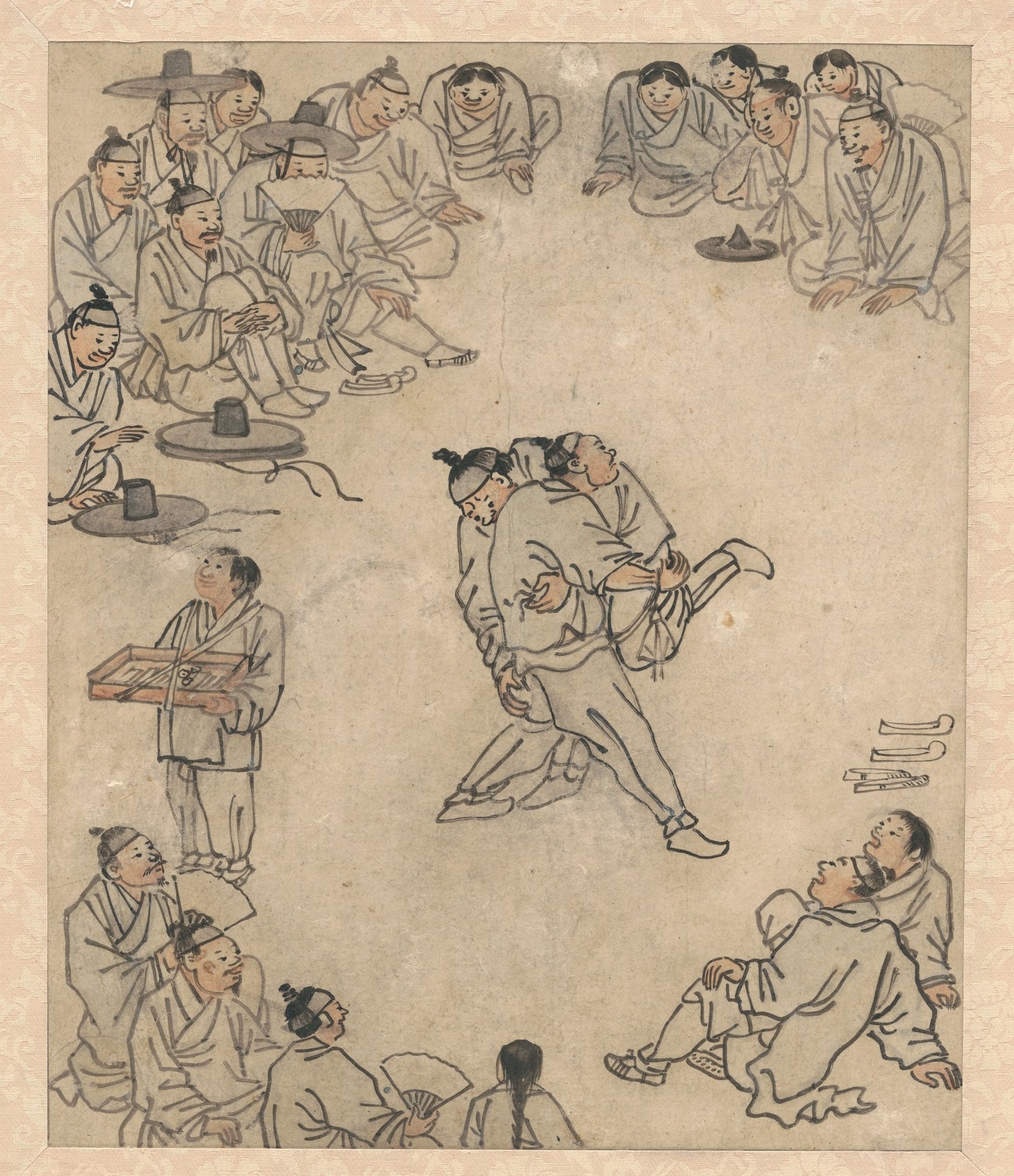
His most famous work, Ssireum (Korean Wrestling), is a testament to this. It depicts a village festival where a diverse crowd forms a circle around two wrestlers. Every spectator’s face shows a different emotion, and a taffy seller on the periphery is so engrossed in the match that he forgets to sell his wares. It is a brilliant, modern snapshot of humanity.
Shin Yun-bok: The Daring Painter of Romance and Satire
If Kim Hong-do painted the sweaty, joyful daytime labor of the commoners, Shin Yun-bok (pen name: Hyewon) painted the secretive, moonlit romances and hedonistic leisure of the urban aristocracy. Born in 1758 into a family of esteemed court painters, his life remains largely shrouded in mystery.
The Provocateur of the Joseon Dynasty
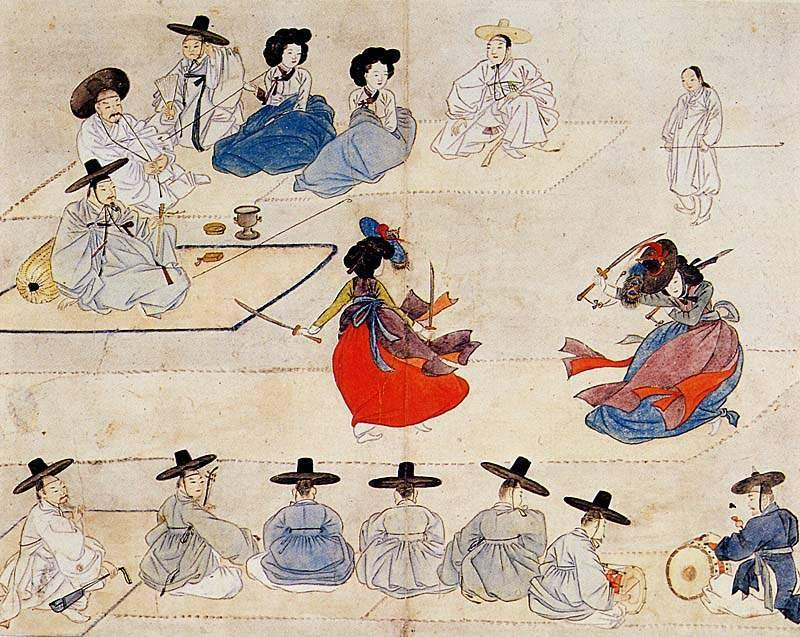
Legend has it that Shin Yun-bok was expelled from the royal painting bureau for his provocative subjects. In a strictly Confucian society that suppressed public displays of affection and female expression, Shin Yun-bok audaciously painted intense romantic trysts, the lives of gisaeng, and the hypocritical nobility who outwardly preached morality but secretly engaged in indulgent partying.
Artistic World and Characteristics
Shin Yun-bok elevated genre painting to a new level of sophistication, introducing an aesthetic that was shockingly modern for its time.
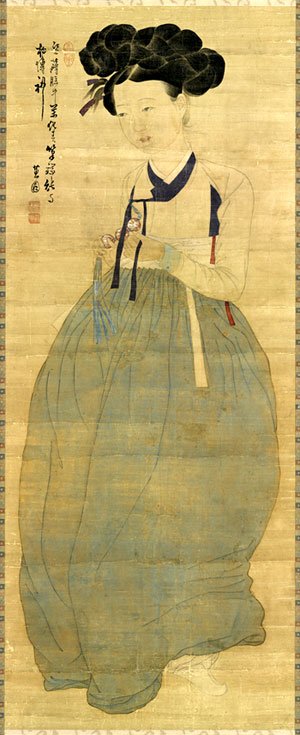
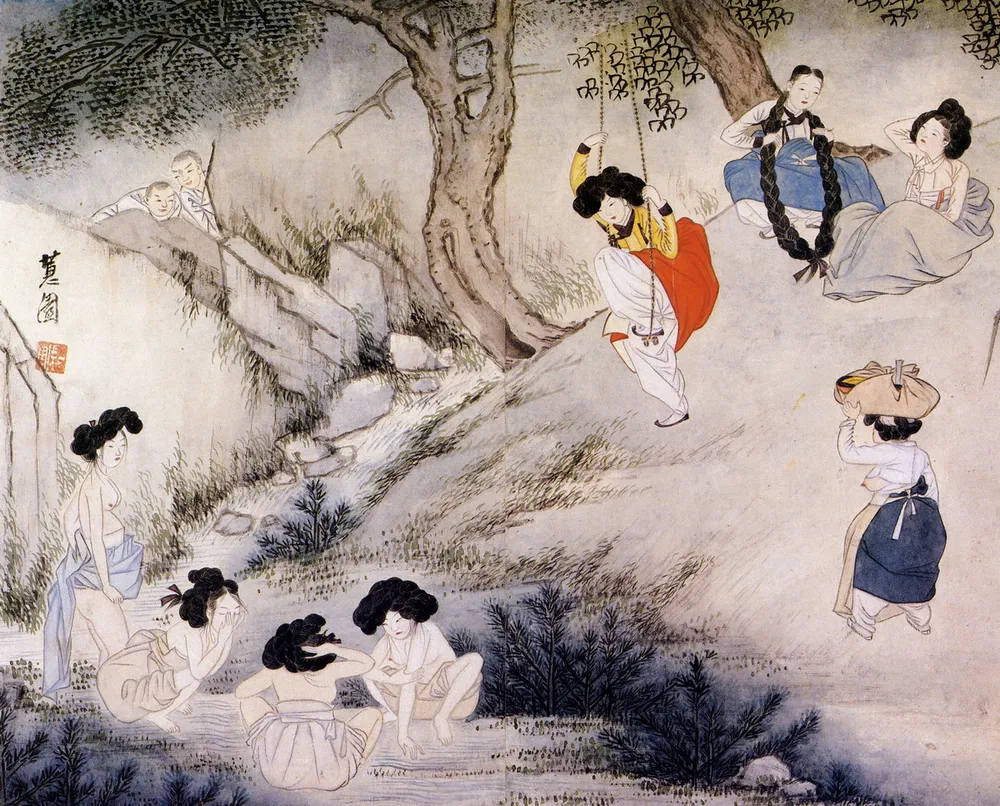
- Delicate and Fluid Lines: Unlike Kim Hong-do’s bold strokes, Shin used incredibly thin, graceful lines, capturing even the finest strands of a woman’s hair.
- Vibrant Colors: He broke away from monochromatic ink, utilizing striking reds, yellows, and blues to give his works a sensual, luxurious atmosphere.
- Detailed Backgrounds: Shin meticulously painted architecture, landscapes, and room interiors to set the mood and provide psychological context for his characters.
His undisputed masterpiece, Portrait of a Beauty (Miindo), perfectly captures the subtle eroticism and refined elegance of a Joseon woman. Another famous collection, the Hyewon Jeonsincheop, includes iconic scenes like the Danoje Festival—where women bathe half-naked in a stream while young monks peek from behind rocks—and Lovers Under the Moon, a deeply romantic portrayal of a midnight rendezvous.
Comparing the Two Masters
| Characteristic | Kim Hong-do (Danwon) | Shin Yun-bok (Hyewon) |
|---|---|---|
| Primary Subjects | Commoners, farmers, artisans, daily labor | Aristocrats, gisaeng, urban leisure, romance |
| Tone | Humorous, warm-hearted, energetic | Sensual, romantic, satirical, elegant |
| Background | Often omitted to focus on figures | Highly detailed to set the psychological mood |
| Brushwork & Color | Bold, thick lines; minimal color (ink-focused) | Delicate, thin lines; vibrant, striking primary colors |
Other Masters: The Legacy of Kim Deuk-sin
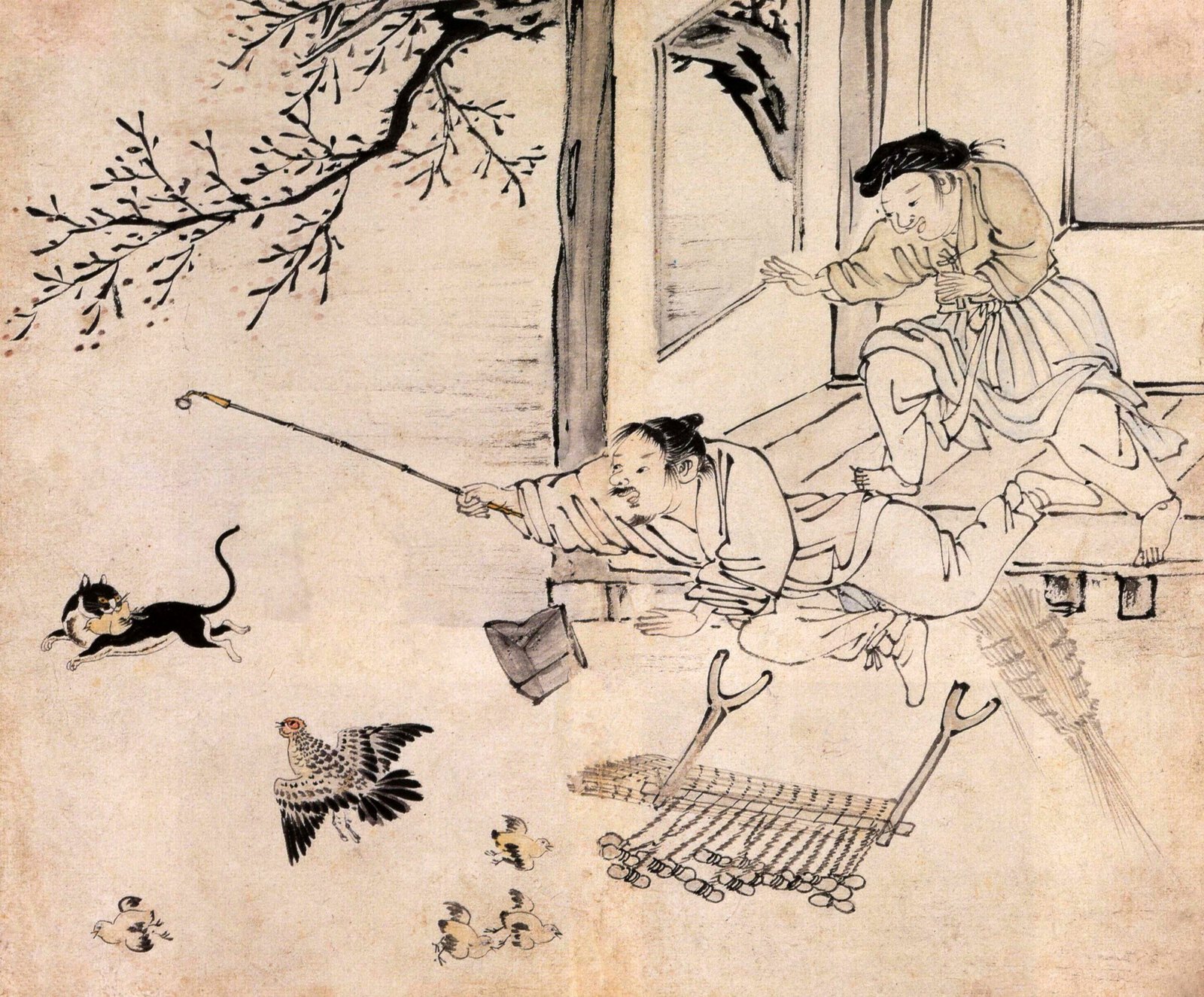
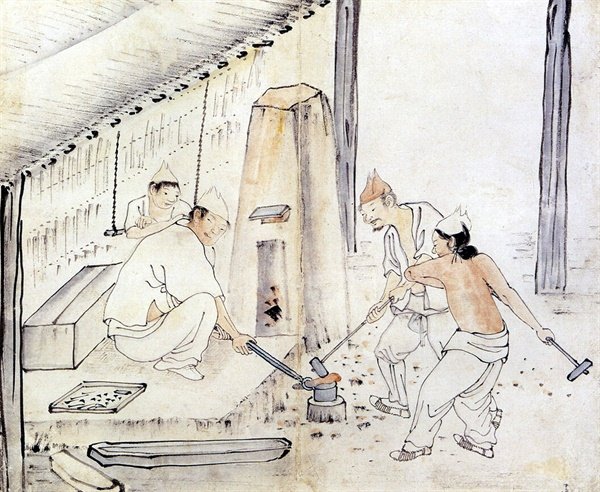
While Kim Hong-do and Shin Yun-bok are the towering giants, the golden age of Korean genre painting also produced other brilliant artists. Most notable is Kim Deuk-sin (pen name: Geungjae). Strongly influenced by Kim Hong-do, he carried on the tradition of painting the lives of commoners but added his own distinct flair.
His paintings often feature a heightened sense of theatrical comedy and exaggerated expressions. His famous work showing a man chasing a wild cat that has stolen a chick, while his wife tumbles over a weaving loom in panic, perfectly captures the chaotic, humorous split-second moments of rural life.
The Enduring Significance of Korean Genre Painting
The transition to genre painting was more than just a change in subject matter; it was a profound cultural awakening. Renowned Korean art historian Ahn Hwi-joon has emphasized that traditional genre painting represents the moment Joseon artists finally stopped imitating Chinese ideals and began looking at their own land and people. It was the birth of an independent, truly Korean visual identity.
Today, modern experts evaluate these paintings as an irreplaceable visual encyclopedia. Because detailed written records of the lower classes and private lives of women were scarce in the male-dominated, aristocratic Joseon society, the artworks of Kim Hong-do and Shin Yun-bok provide the most accurate historical evidence of traditional clothing, architecture, commerce, and social dynamics. They elevated the ordinary to the eternal.
Where to See Masterpieces in Seoul
If you are traveling to Korea, seeing these masterpieces in person is a breathtaking experience. However, there is a crucial detail you must know: traditional paintings on silk and paper are extremely sensitive to light and humidity. Therefore, museums do not keep them on permanent display.
📌 Local Note: The Rotation Rule
Major museums rotate their traditional painting collections every three to six months to let the artworks “rest” in dark storage. Always check the museum’s current exhibition schedule on their official website before visiting to avoid disappointment.
- National Museum of Korea (국립중앙박물관): Located in Yongsan, this massive institution holds the Danwon Pungsokdocheop, the famous album containing Kim Hong-do’s Ssireum and Seodang (Village School). They frequently rotate pages from this album in their Calligraphy and Painting gallery on the second floor.
- Kansong Art Museum (간송미술관): This private museum is the holy grail for Shin Yun-bok fans. It houses his Portrait of a Beauty and the spectacular 30-page album Hyewon Jeonsincheop. Pro Tip: The original Seoul location typically only opens for brief special exhibitions a year. However, with the recent opening of the Daegu Kansong Art Museum, you can now enjoy many of these masterpieces much more freely through their permanent and special rotating exhibitions!
- Leeum Museum of Art (리움미술관): Occasionally features spectacular genre paintings, including works by Kim Deuk-sin, in their traditional art wing.
While you are exploring traditional Korean arts, the meticulous craftsmanship didn’t stop at painting. To truly understand the aesthetic evolution of Korea, I highly suggest exploring the peninsula’s world-renowned pottery traditions as well. Check out our deep dive: The Guide to Korean Ceramics: Goryeo Celadon to the Moon Jar.
Korean Culture portal KCulture.com

Founder of Kculture.com and MA in Political Science. He shares deep academic and local insights to provide an authentic perspective on Korean history and society.