Korea’s liberation in 1945 ended Japanese colonial rule, but it did not immediately give Koreans control of an independent, unified state. Japan’s defeat was followed by Soviet occupation in the north and American occupation in the south. In both zones, foreign military authorities held decisive power over the conditions under which Koreans could build a new country.
August 15 therefore carries two connected histories: the genuine liberation of a colonized people and the beginning of a struggle over who would govern them. Understanding this period through Korean independence brings the provisional government, local self-government initiatives, political repression, and the destruction of alternatives to partition into the same account.
- Japan’s Defeat and Korea’s Liberation in 1945
- The 38th Parallel: A Decision Without Korean Consent
- The Provisional Government Returns Without Authority
- Southern Korea: Military Rule and Colonial Continuities
- Korean Self-Government Efforts Are Displaced
- Northern Korea: Soviet Authority and Kim Il Sung’s Rise
- Political Violence and the Loss of Independent Alternatives
- From Occupation Zones to Two States
- Liberation, Sovereignty, and the Meaning of Freedom
Japan’s Defeat and Korea’s Liberation in 1945
On August 15, 1945, Emperor Hirohito broadcast Japan’s acceptance of the Allied surrender terms. For Koreans, this announced the collapse of the empire that had formally annexed their country in 1910. The Allied war against Japan had reached its conclusion after years of fighting, the atomic bombings of Hiroshima and Nagasaki, and the Soviet entry into the war.
The immediate cause of the colonial regime’s collapse was Japan’s military defeat. Korea’s independence movement had nevertheless sustained the demand for national sovereignty through protests, diplomacy, education, underground organization, and armed resistance. The end of Japanese rule fulfilled that movement’s central demand while leaving the exercise of sovereignty unresolved.
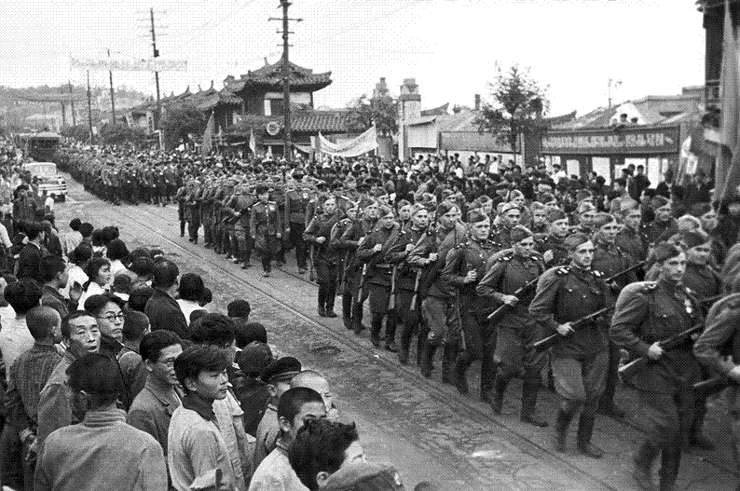
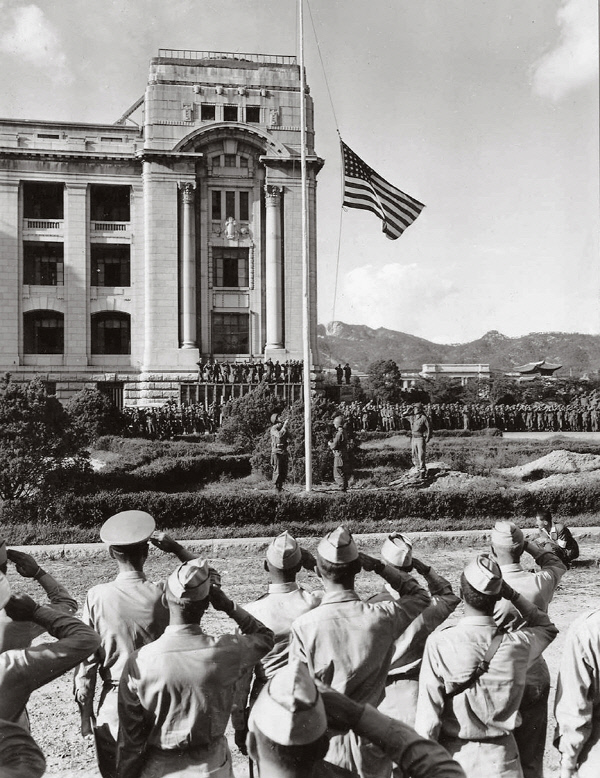
The arrival of the two occupying armies occurred several weeks apart. Soviet forces entered northern Korea during August, following their offensive against Japan. American troops landed at Incheon (인천) on September 8 and accepted the Japanese surrender in Seoul (서울) the following day.
| Date | Event | Significance for Korean independence |
|---|---|---|
| August 9, 1945 | Soviet military operations against Japan begin. | Soviet forces subsequently enter northern Korea. |
| August 10–11, 1945 | American officers formulate the proposal for a division at the 38th parallel. | Korea’s occupation boundary is selected without Korean participation. |
| August 15, 1945 | Japan broadcasts its acceptance of surrender terms. | Japanese colonial rule loses its imperial foundation. |
| September 2, 1945 | Japan signs the formal surrender instrument. | The division of Korea is incorporated into Allied military orders, without Korean consent. |
| September 8–9, 1945 | American troops land and receive the surrender in southern Korea. | Authority passes to an American occupation command. |
| November 23, 1945 | Kim Gu and a first group of provisional government leaders return. | They enter as private individuals, without governmental authority. |
| August–September 1948 | Separate governments are established in the south and north. | The occupation zones become rival states. |
The 38th Parallel: A Decision Without Korean Consent
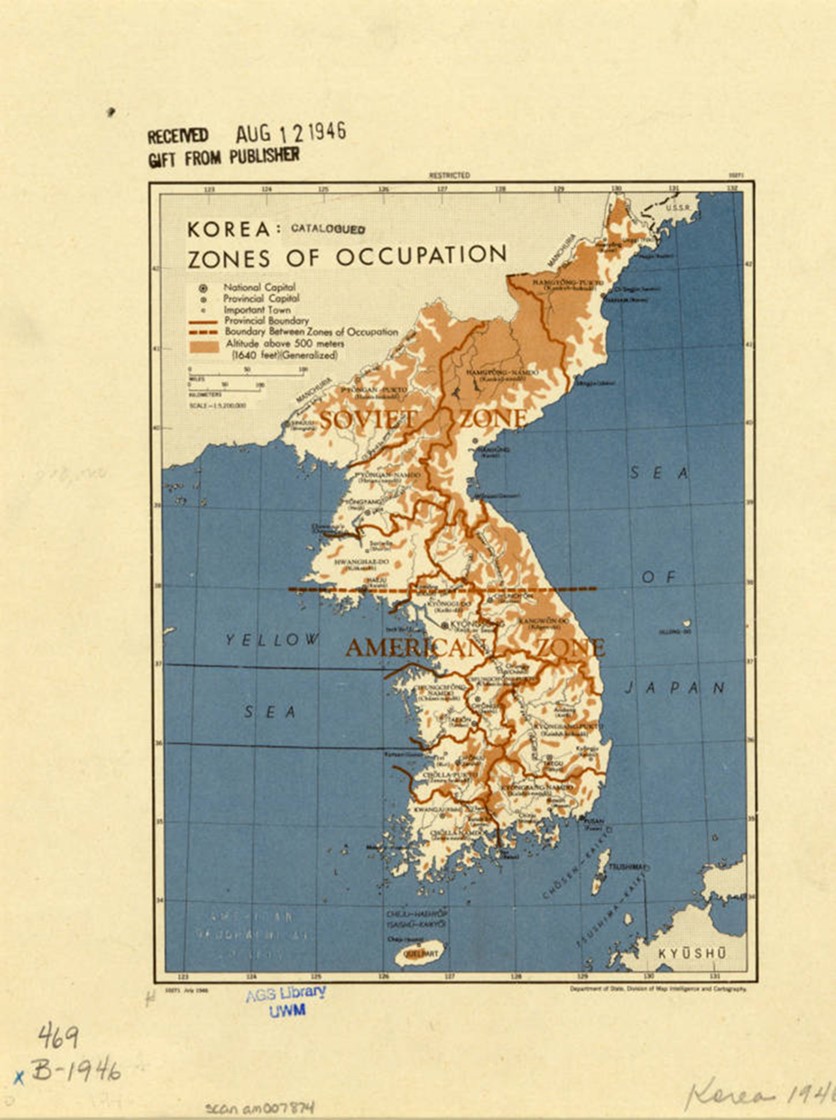
The 38th parallel was proposed by the United States and accepted by the Soviet Union in August 1945, without Korean participation. As Soviet forces advanced and American troops remained some distance away, Washington sought to prevent the entire peninsula from falling under Soviet military control and to secure a zone in which the United States could exercise authority and influence.
This strategic calculation appears in American planning and in the recollections of Dean Rusk, who helped formulate the boundary with Charles Bonesteel. Rusk described reconciling American political objectives with the forces available and emphasized the importance of including Seoul in the American zone. Earlier military planning had likewise considered territorial division as a means of securing American influence against Soviet military advantage.
Allied orders expressed the boundary through arrangements for accepting the Japanese surrender. That formal mechanism should not be treated as a complete explanation of the division or as evidence that its purpose was limited to disarming Japanese troops. The allocation of occupation zones also determined which foreign army could establish governing authority over each part of Korea.
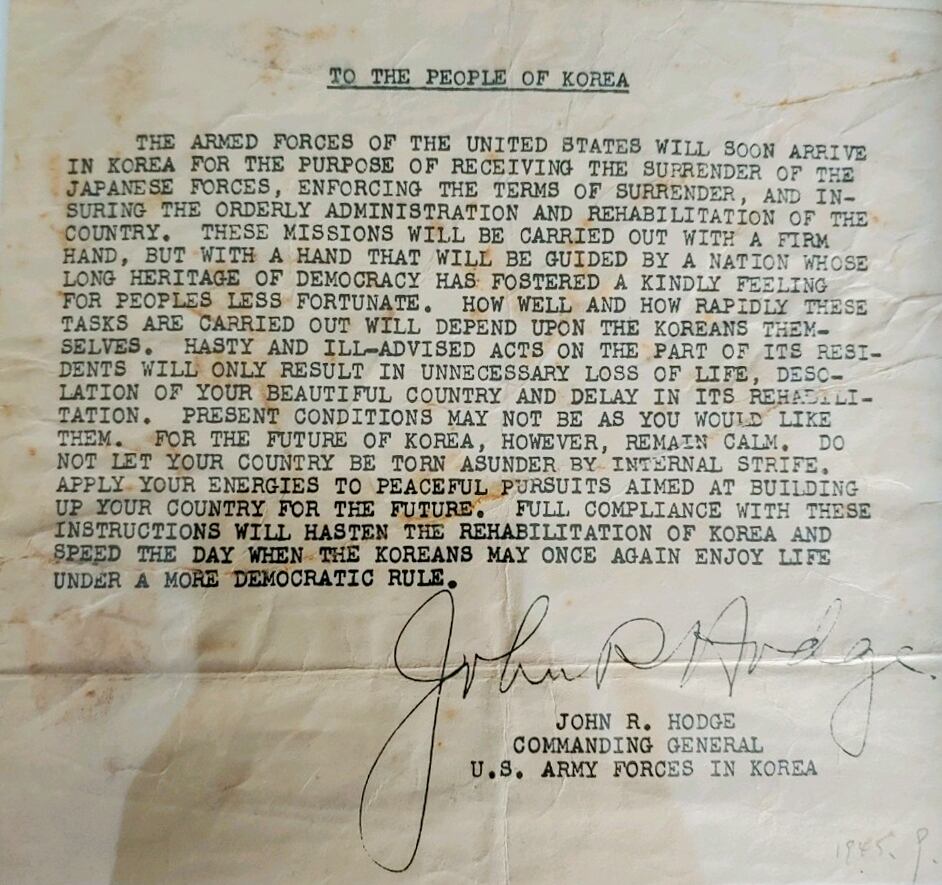
American preparations explicitly included military government before troops landed. Hodge’s Field Order No. 55 of August 28 provided for taking control of government offices, police, communications, banks, and other institutions. MacArthur’s September 7 proclamation then vested governing powers in the occupation command. In the north, Soviet authorities supervised the reorganization of Korean governing bodies and the selection and promotion of political leaders.
Political control was therefore built into the occupation framework; it was not simply an unforeseen expansion of a narrow surrender procedure. Both powers acquired the means to shape the governments that would succeed Japanese rule. Although the precise form of those governments remained unsettled, Korean state-building was already subject to separate foreign military authorities.
From the standpoint of Korean independence, the decisive issue was consent. A country emerging from colonial rule had its administration divided by foreign governments before its people could establish a national authority of their own.
The Provisional Government Returns Without Authority
The Provisional Government of the Republic of Korea, established in 1919, had spent decades asserting Korea’s right to independence. During the Second World War, it declared war on Japan and pursued military cooperation with the Allies through the Korean Liberation Army.
That cooperation included a small detachment assisting British forces in the India–Burma theater with intelligence, propaganda, translation, and prisoner interrogation. In 1945, liberation army personnel also trained with the American Office of Strategic Services for infiltration into Korea. Japan surrendered before that planned wartime operation could be carried out.
For a related perspective on international support for Korea’s struggle, see Foreign Heroes of Korea’s Independence Movement.
Military cooperation, however, did not secure Allied recognition of the provisional government as Korea’s sovereign government or a seat in the decisions governing the occupation. The United States had withheld recognition before Japan’s defeat and maintained that position afterward.
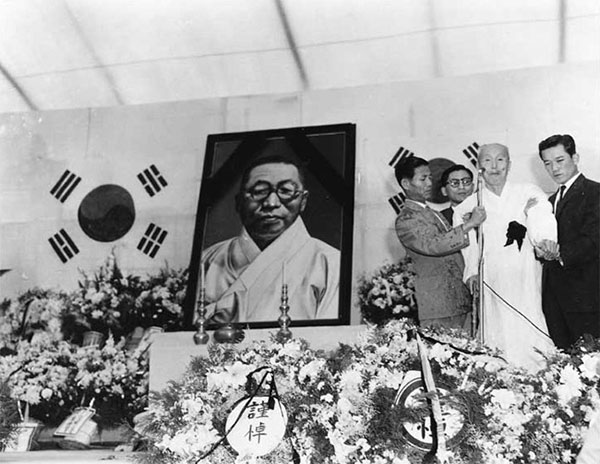
Kim Gu and his colleagues consequently faced a stark condition for returning home: they could enter as individuals, but could not exercise governmental authority. Kim signed an undertaking to that effect on November 19; the first group returned on November 23, 1945.
For a movement that had hoped to return as the government of a liberated country, this was a major political defeat. Its historical legitimacy and public standing did not translate into control of the territory, administration, or armed forces.
Southern Korea: Military Rule and Colonial Continuities
General Douglas MacArthur’s proclamation of September 7, 1945, explicitly established military control over Korea south of the 38th parallel. Governing powers were placed under his authority. Existing officials and essential-service employees were instructed to continue their duties until further orders, resistance to the occupation was subject to punishment, and English was designated the official language for military government purposes.
The United States Army Military Government in Korea therefore assumed authority over a population whose own state had not been an enemy belligerent: Korea had been a colony of the defeated empire. The proclamation promised eventual independence, while reserving present governing power to the occupation command.
The surrender arrangements also preserved Japanese command and administrative structures during the handover, rather than transferring authority immediately to Korean organizations. On September 9, Lieutenant General John R. Hodge announced the temporary retention of Governor-General Abe Nobuyuki and other Japanese officials to facilitate administration.
Korean opposition helped force a rapid reversal. Abe was removed on September 12, and other senior Japanese officials followed. Japanese rule did not continue intact throughout the occupation.
More enduring continuities lay in administrative institutions and the employment of Koreans who had served the colonial system, particularly in the police. American concern about communist influence also favored conservative political partners. To independence activists who expected liberation to bring accountability for collaboration, the continued authority of former colonial personnel made the transition deeply contentious.
The colonial administration also reshaped the physical symbols of Korean sovereignty. For that background, see How Japan Systematically Destroyed Joseon Royal Palaces.
Korean Self-Government Efforts Are Displaced
Koreans were already organizing a new political order before American troops arrived. In the immediate aftermath of Japan’s surrender, Yeo Un-hyeong helped establish the Committee for the Preparation of Korean Independence. Its activities included maintaining public order, securing food supplies, and encouraging local organization.
The committee initially brought together figures from different political backgrounds, including the nationalist An Jae-hong. Local committees spread widely, although their composition and authority varied. These were substantial Korean initiatives in state-building, without constituting a universally accepted or nationally elected government.
Right-wing withdrawals and growing left-wing influence weakened the original coalition. On September 6, a national assembly of representatives proclaimed the Korean People’s Republic. This short-lived organization must be distinguished from the Democratic People’s Republic of Korea established in the north in 1948.
The American military government rejected the People’s Republic’s claim to govern. Military Governor Archibald Arnold publicly denied its authority in October, and Hodge reiterated the position in December. Local people’s committees were displaced or suppressed as military government and police authority expanded.
The precise sequence matters: the preparatory committee, the People’s Republic, and the local committees were related but distinct organizations. Their exclusion cannot be reduced to a single order banning one universally representative body. What was foreclosed was their development into an autonomous governing structure outside American military authority.
Northern Korea: Soviet Authority and Kim Il Sung’s Rise
In northern Korea, Soviet occupation also placed the final balance of power in foreign military hands. Its administrative method differed from the American system: Soviet authorities worked extensively through Korean people’s committees, recognizing and reorganizing local institutions while supervising political development.
Early northern politics included communists, Christian nationalists, and other anti-Japanese figures. Soviet policy initially allowed broader coalitions while prioritizing a government friendly to Moscow. This limited cooperation should not be confused with unrestricted Korean political choice.
Kim Il Sung, an anti-Japanese guerrilla who had subsequently served in the Soviet military, returned through Wonsan (원산) on September 19, 1945. Soviet sponsorship helped him rise rapidly within the emerging political order. He became chairman of the Provisional People’s Committee of North Korea in February 1946.
Cho Man-sik, a prominent nationalist with an established public following, illustrates the limits of permissible independence. After opposing the trusteeship arrangement, he was placed under Soviet detention in January 1946 and removed from effective political leadership.
Land redistribution and other reforms gave the emerging northern authorities support among sections of the population. Political exclusion developed alongside these changes. The recognition of Korean committees did not give those committees freedom to determine the country’s direction independently of the occupying power.
Kim’s eventual personal monopoly took longer to establish. Rival communist groups remained influential after 1945, and major purges continued into the 1950s. Some later moves even met resistance from Moscow and Beijing. His consolidation therefore extended beyond the occupation years.
Political Violence and the Loss of Independent Alternatives
Occupation shaped political possibilities through appointments, recognition, policing, and the capacity to use force. Korean parties and armed groups also pursued their own objectives, sometimes through intimidation and murder. The resulting violence progressively narrowed the space for political compromise.
Coercion beyond the political leadership
In northern Korea, the student protests at Sinuiju (신의주) in November 1945 met armed suppression by Soviet forces and local communist authorities. Survivor testimony records shootings and subsequent arrests. Opposition to the emerging order could therefore carry immediate physical consequences.
In the south, labor disputes and popular protests also encountered armed repression. Police shootings in Daegu (대구) in October 1946 helped precipitate a wider confrontation involving attacks on police and officials, military intervention, and further civilian deaths. South Korea’s Truth and Reconciliation Commission later established cases of unlawful police killings during the suppression.
These events involved different local circumstances. They nevertheless show that the political settlement after liberation was enforced through violence affecting ordinary Koreans as well as prominent leaders.
The violence that began on Jeju during the occupation and continued after the southern government’s establishment is explored separately in Jeju 4.3 Incident History: Rebellion, Massacre, and Truth.
Yeo Un-hyeong: a coalition movement loses its leader
Yeo Un-hyeong, a nationalist of the moderate left, sought cooperation across ideological divisions. Together with Kim Kyu-sik, he pursued a coalition capable of supporting a unified government.
American policy toward this effort complicates a simple account of uninterrupted support for Syngman Rhee. In 1946, Hodge’s administration supported the coalition initiative and opposed Rhee’s immediate push for a separate southern government. That support later waned as international negotiations and domestic cooperation deteriorated.
After repeated attacks, Yeo was assassinated in Seoul on July 19, 1947, by Han Ji-geun, a right-wing assailant. His death severely weakened a movement whose influence depended heavily on his ability to bring different groups together.
Kim Gu: opposition to partition ends in assassination
Kim Gu came from the nationalist right and had been strongly anti-communist. His later cooperation with leaders across the political divide grew from his opposition to partition; describing him simply as a centrist obscures that trajectory.
In 1948, Kim Gu and Kim Kyu-sik traveled north for talks intended to prevent separate governments. Kim Gu refused to participate in the southern election. On June 26, 1949, after the Republic of Korea had already been established, he was assassinated by serving army officer Ahn Doo-hee.
Later parliamentary investigation implicated military and right-wing networks and documented the protection afforded to the assassin. It did not establish that the United States directly ordered the killing. The distinction preserves accountability without turning disputed command responsibility into fact.
The two assassinations occurred at different stages of division. Together, they removed influential leaders who challenged the emerging settlement and weakened the organizations around them. They did not alone cause partition, but they damaged the capacity to oppose it.
From Occupation Zones to Two States
Partition was consolidated through several decisions after 1945. The December 1945 Moscow agreement envisaged a provisional Korean government and a possible four-power trusteeship lasting up to five years. Subsequent American–Soviet negotiations failed over which Korean organizations could participate and how the political transition would proceed.
Trusteeship was itself contentious because it again placed Korean independence within a timetable supervised by outside powers. Korean responses divided sharply, further intensifying domestic political conflict.
After the negotiations failed, the United States took the Korean question to the United Nations. Soviet authorities denied the UN commission access to the north. Elections observed by the commission consequently proceeded in the south on May 10, 1948, amid boycotts, political intimidation, and violence. The resulting assembly elected Syngman Rhee president.
The Republic of Korea was established on August 15, 1948. The Democratic People’s Republic of Korea followed on September 9, with Kim Il Sung as premier. Separate institutions developed under the occupations had become competing national governments.
Both leaders benefited decisively from foreign backing and had Korean political constituencies and agendas of their own. Their routes to office and the institutions they headed also differed.
Rhee’s pre-liberation career centered on diplomacy and lobbying, conducted primarily from the United States and Hawaii. He placed particular emphasis on foreign recognition and American support. This reliance on outside powers brought him into sharp conflict with other independence activists, including advocates of armed struggle, and his authority within the movement was repeatedly challenged.
In 1919, Rhee petitioned President Woodrow Wilson for Korea to be placed under a League of Nations mandate as a transition to independence. This provoked sharp criticism from independence activists who rejected substituting another form of external supervision for Japanese rule.
In June 1919, he used the title “President of the Republic of Korea” in correspondence with foreign leaders, rendering his appointment by the Hanseong provisional government in presidential terms. This claim provoked opposition, including from An Chang-ho, before the unified provisional government formally elected Rhee president that September.
In March 1925, the provisional legislature impeached and removed him. The proceedings cited his prolonged absence from the government’s seat, obstruction of administrative and financial work, and rejection of the legislature’s authority. He later resumed an official role as head of the provisional government’s U.S. diplomatic commission in 1941. His long diplomatic career was thus accompanied by serious conflicts over strategy, accountability, and representative authority.
The central parallel concerns sovereignty: neither government emerged from a political process in which the whole Korean population could freely decide a common national future. Soviet occupation troops withdrew by the end of 1948, and most American occupation troops by June 1949, leaving the division in place.
Liberation, Sovereignty, and the Meaning of Freedom
The expression violent liberation is an interpretation of this transition: colonial rule ended, while military occupation, political repression, assassination, and enforced exclusion constrained the construction of an independent country. These developments unfolded over several years rather than in a single moment on August 15.
The end of Japanese colonial rule was a profound liberation. For the immediate question of who held supreme governing authority, however, the transition initially replaced Japanese imperial power with two foreign military commands. Korean self-government remained conditional on decisions made by those commands.
The unresolved question after Japan’s defeat was who had the authority to turn liberation into sovereignty. Koreans organized governments, committees, parties, and coalitions, but the decisive power to recognize or overrule them rested with occupying armies.
Seen through Korean independence, 1945 marks both a historic achievement and the opening of an unfinished national settlement. The colonial ruler fell; the people who had lived under that ruler were still struggling to determine their country’s future.
Continue Exploring Korean History
- The March 1st Movement: The Day Modern Korea Was Born
- The 1894 Donghak Peasant Revolution: Joseon’s Great Awakening
- Eulmi Incident 1895: Empress Myeongseong’s Assassination

Founder of Kculture.com and MA in Political Science. He shares deep academic and local insights to provide an authentic perspective on Korean history and society.