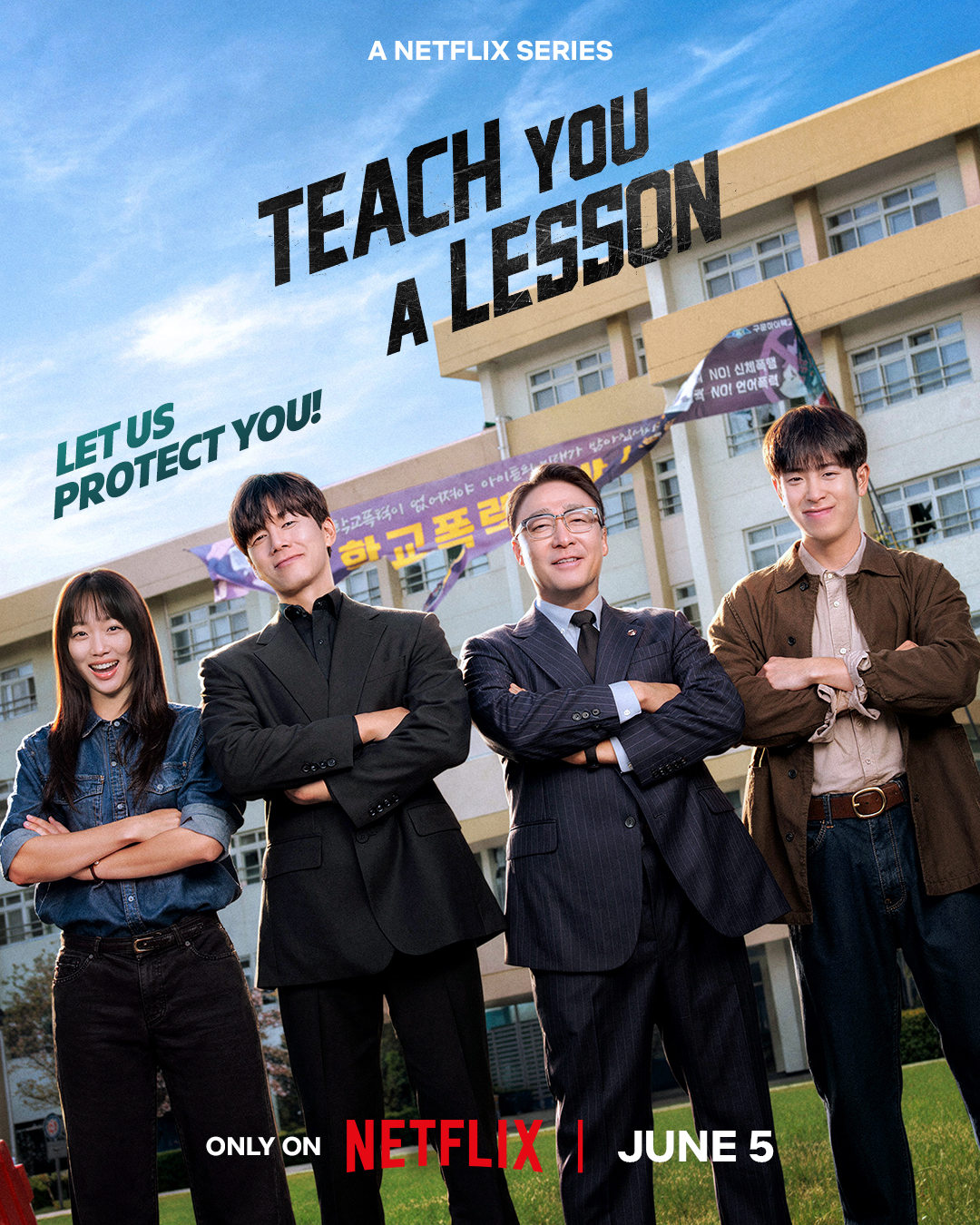
The 2026 Netflix series Teach You a Lesson (참교육), is a highly cathartic, action-packed K-drama that tackles school violence through the lens of a fictional, vigilante-style government agency. While the show delivers thrilling entertainment by hunting down untouchable bullies and corrupt parents, it has also sparked massive discussions across South Korea. For international viewers, the true depth of the series lies in its reflection of a very real and ongoing cultural debate: the delicate balance between protecting student human rights and restoring the severely weakened authority of teachers in modern classrooms. If you are wondering whether this controversial thriller is worth watching, this review explores the drama’s gripping plot, its stellar cast, and the fascinating social backdrop that makes it a must-watch.
- What Is Teach You a Lesson?
- Plot (Without Major Spoilers)
- Main Cast and Creative Team
- Why the Series Is So Controversial
- Understanding Korea’s Education Debate
- Teacher Authority vs. Student Rights
- How the Drama Changed Public Discussion
- Review: Is It Worth Watching?
- FAQ
What Is Teach You a Lesson?
Released globally on Netflix on June 5, 2026, Teach You a Lesson is a ten-episode K-drama adaptation of the highly popular Naver Webtoon written by Chae Yong-taek and illustrated by Han Garam. Directed by Hong Jong-chan, who gained international recognition for tackling complex societal questions in Juvenile Justice, the series brings a dark, vigilante-style fantasy straight into the classroom.
Like his previous works, the director explores uncomfortable social issues through heightened, fast-paced fictional scenarios. Rather than portraying everyday school life, it imagines an alternative reality where a specialized government agency steps in whenever traditional disciplinary and educational systems completely break down.
| Category | Information |
|---|---|
| Platform | Netflix (Global Subscription) |
| Episodes | 10 |
| Genre | Action, Social Drama, Thriller |
| Director | Hong Jong-chan |
| Screenwriters | Lee Nam-gyu, Kim Da-hee, Moon Jong-ho |
Plot (Without Major Spoilers)
The story takes place in a fictionalized version of modern South Korea where public education is nearing a total administrative collapse. Classrooms are overwhelmed by unpunished juvenile crime, severe school violence, and highly confrontational parents who manipulate institutional legal loopholes.
To restore order, the government establishes a specialized federal agency called the Educational Rights Protection Bureau (교권보호국), granting it extraordinary, unchecked administrative and investigative authority. Top field inspectors Na Hwa-jin and Lim Han-rim are dispatched directly to the country’s most troubled schools. Their core philosophical mission is simple yet fierce: to ensure that perpetrators face the exact consequences of their actions, standing firmly by the victims while rebuilding a functional environment for education.
Main Cast and Creative Team
The success of the adaptation heavily relies on a cast capable of balancing intense physical action sequences with complex moral gray areas.
- Kim Mu-yeol as Na Hwa-jin: A former Special Forces captain turned ERPB field supervisor. Combining military combat expertise with uncompromising determination, Kim Mu-yeol delivers a standout performance as a dark hero who punishes perpetrators legally and physically while confronting the heavy burdens of his role.
- Lee Sung-min as Choi Kang-seok: The Minister of Education and the political mastermind who founded the ERPB. He serves as a powerful mentor and institutional anchor for Hwa-jin.
- Jin Ki-joo as Im Han-rim: A former Special Forces sergeant turned ERPB supervisor. Her undeniable charisma and powerful action choreography provide a perfect counterweight to Hwa-jin’s investigative methods.
- Pyo Ji-hoon (P.O) as Bong Geun-dae: A brilliant young analyst who graduated early from KAIST. He manages the intelligence, technological support, and digital investigations for the bureau.
Why the Series Is So Controversial
Filtering the Original Webtoon
Long before Netflix adapted the story, the original webtoon faced heavy criticism during its international serialization on North American platforms due to racially insensitive imagery and offensive language. This led to a suspension of its overseas distribution. Recognizing these major past missteps, the Netflix adaptation strictly filtered the source material. Director Hong Jong-chan and the production crew completely rewrote and discarded the problematic chapters, keeping only the fictional premise of the ERPB and its core focus on victim protection.
The Debate Over Physical Punishment as Entertainment
In the series, the inspectors frequently use physical force to overpower defiant bullies and corrupt administrators. While these high-octane action scenes provide massive dramatic catharsis for a public tired of seeing legal loopholes abused, critics express concern that it risks glorifying vigilante justice or advocating for corporal punishment in real life. The director addressed this directly in press interviews, clarifying that real-world violence is never justifiable and emphasizing that the show’s physical confrontations are strictly genre-specific fantasy intended for entertainment.
Understanding Korea’s Education Debate
To global viewers, some of the extreme scenarios in Teach You a Lesson may look like standard thriller exaggeration. However, in South Korea, the show is highly relevant because it reflects long-running, real-world public debates about how schools, teachers, and student rights should function in modern society.
The Classroom Crisis and “Monster Parents”
In recent years, the relationship between Korean schools and families has become increasingly tense. A growing number of teachers have reported intense stress due to severe verbal abuse, online harassment, and malicious, groundless complaints from a highly disruptive minority of “monster parents.” While the vast majority of parents actively support schools and prioritize cooperation, a confrontational minority often uses aggressive tactics to shield their children from the consequences of bullying. Following several highly publicized real-world tragedies involving teachers, the discussion around preserving basic classroom discipline has become an incredibly emotional national topic.
📌 Local Note: For many Korean families, university admissions and academic standing are seen as uncompromisable priorities. When children face a school violence committee, certain wealthy or highly influential families file extensive, prolonged administrative lawsuits. This intentional legal strategy delays final disciplinary rulings so they do not show up on a student’s record during college applications, frequently leaving teachers trapped in exhausting legal litigation while trying to protect victims.
Teacher Authority vs. Student Rights
Grasping the social background of the show requires looking at a significant historical shift in South Korea’s education system. Prior to the 1990s, widespread corporal punishment was common in local schools—disciplinary methods that would be classified as unacceptable violence under modern legal and human rights standards.
To correct these historical abuses, progressive movements successfully introduced major reforms, such as the Student Human Rights Ordinance (학생인권조례), to protect children from institutional harm. While these changes were absolutely essential, a major debate has emerged over whether the pendulum has now swung too far toward the opposite extreme. Many educators argue that excessive emphasis on student rights has unintentionally stripped teachers of the basic authority needed to manage classrooms and protect the learning rights of other students. Teach You a Lesson centers itself right inside this unresolved national conversation, highlighting the difficulty of finding a healthy equilibrium.
How the Drama Changed Public Discussion
The high viewership of Teach You a Lesson has directly coincided with a massive public push to build better legal and systemic protections for educators. Across the country, regional governments and educational boards have ramped up discussions regarding dedicated legal task forces and support networks to defend teachers against malicious complaints.
The drama did not start these massive public discussions, but it certainly amplified them by turning complex social problems into an accessible, gripping narrative. Crucially, the show serves as a reminder that correcting classroom issues should never mean abandoning student rights. The overarching lesson is that a healthy, functioning educational system must focus on finding a constructive balance between both values rather than prioritizing one extreme.
Review: Is It Worth Watching?
Teach You a Lesson succeeds beautifully because it executes on two distinct fronts. As a piece of high-budget action entertainment, it delivers exceptional fight choreography, memorable antagonists, and satisfying moments of swift justice. As a piece of societal commentary, it brings uncomfortable structural questions to light without offering oversimplified real-world answers.
Its ultimate strength lies in forcing audiences to think deeply about accountability, systemic fairness, and the true purpose of education. It is highly recommended for K-drama fans who enjoy dark hero stories that push back against institutional failures.
- Rating: 4.5/5
- Highlights: Outstanding performances from Kim Mu-yeol and Jin Ki-joo, great pacing, and thought-provoking cultural themes.
- Keep in Mind: Best appreciated as a dark social fantasy and satire rather than a literal guide for educational policy.
FAQ
Is the Educational Rights Protection Bureau a real agency in South Korea?
No, the Educational Rights Protection Bureau (ERPB) is a completely fictional government organization created purely for the webtoon and drama. However, the individual cases of school bullying and parental lawsuits depicted on screen are heavily inspired by real social issues.
Does the series promote corporal punishment in real life?
The show’s production team has explicitly stated that the intense action sequences are strictly stylized entertainment and fictional genre elements, rather than an endorsement or promotion of physical punishment in classrooms.
Related Articles for K-Drama Enthusiasts
- The WONDERfools Netflix Review: Korea’s Most Unusual Heroes
- Why My Royal Nemesis is Netflix’s Best Time-Slip K-Drama
- We Are All Trying Here Netflix Review: Deep Cultural Meaning
- Perfect Crown K-Drama Review: IU & Byeon Woo-seok Shine
- 10 Million Viewer Club Korean Movies: Box Office Legends
Korean Culture portal KCulture.com

Founder of Kculture.com and MA in Political Science. He shares deep academic and local insights to provide an authentic perspective on Korean history and society.