Introduction & Synopsis
Imagine the ambition of a rapidly changing nation poured into the chassis of a car. That is the engine driving Asphalt Man (아스팔트 사나이), a 16-episode SBS drama that aired in 1995. Based on Huh Young-man’s popular manhwa of the same name, the series blends family melodrama, corporate rivalry, romance, and motor racing into one of the most ambitious Korean television productions of its era.
At the center of the story is Kang Dong-joon, a gifted automobile designer who dreams of developing a Korean car capable of competing on the global market. His younger brother, Kang Dong-seok, carries deep resentment toward both Dong-joon and their father. He eventually heads to the United States, where his difficult journey leads him toward professional motor racing.
The brothers’ strained relationship is only one part of a larger family story. Their sister, Kang Dong-hee, faces a painful life in the United States, while Dong-joon’s relationship with fellow car designer Oh Hwa-ryun becomes increasingly complicated by professional competition, personal ambition, and corporate pressure. As rival companies fight over technology and market opportunities, the family’s private conflicts become inseparable from the struggle to build a successful Korean automobile.
Korea’s Roaring ’90s: A Nation on the Move
Watching Asphalt Man today is like opening a time capsule from mid-1990s South Korea. The country was enjoying rapid economic growth and becoming increasingly confident about its place in the global market. Cars represented much more than transportation. They symbolized personal success, technological progress, industrial independence, and national pride.
By 1995, Korean automakers were already expanding overseas, but the drama looks back at the difficult process of developing original models rather than remaining dependent on foreign designs and technology. Dong-joon’s determination to create a competitive Korean car therefore works as both a personal dream and a metaphor for the country’s industrial ambitions.
The timing gives the drama an additional layer of historical meaning. It appeared only two years before the 1997 Asian financial crisis transformed the national mood. Its intense confidence, large-scale dreams, and belief in relentless growth belong unmistakably to the years immediately before that crisis.
Narrative Analysis: A Blockbuster Blueprint
Asphalt Man was designed to look and feel larger than an ordinary television drama. Contemporary reports emphasized its 16mm film photography, lengthy advance production, extensive location work, and budget of more than 4 billion won—an unusually large investment for Korean television at the time. The American sequences and motor-racing scenes gave the series a cinematic texture that distinguished it from many studio-centered dramas of the period.
The family conflict provides the emotional foundation. Dong-joon is the responsible eldest son carrying his father’s expectations, while Dong-seok feels neglected and remains angry about old family wounds. Their relationship is shaped by affection, jealousy, misunderstanding, and sacrifice rather than simple competition.
A second narrative thread follows the struggle to develop an original Korean automobile. Designs are stolen, alliances change, vehicles are sabotaged, and business rivals attempt to exploit the brothers’ resentment. Some developments are highly melodramatic, but that combination of industrial ambition and emotional excess is also a major part of the drama’s appeal.
The relationship between Dong-joon and Hwa-ryun is similarly complicated. Hwa-ryun is not merely a supportive love interest. She is a talented automobile designer with ambitions of her own, and her choices repeatedly place professional success and personal loyalty in conflict. Their romance consequently becomes part of the corporate drama rather than a separate subplot.
Instead of fitting neatly into the romantic “trendy drama” category associated with the 1990s, Asphalt Man combines several genres: family melodrama, corporate thriller, racing drama, and industrial epic. Its scale and visual ambition anticipated the blockbuster-style Korean dramas that would become more common in later decades.
The Pulse of the Time
Asphalt Man attracted considerable attention when it premiered. According to contemporary ratings reported by Media Service Korea, its first episode recorded a 24 percent rating and its second rose to 29 percent. These numbers were lower than the extraordinary ratings achieved by SBS’s earlier hit Sandglass, but they placed Asphalt Man ahead of competing dramas in the same time slot.
The drama was also widely discussed for its film-like appearance, large production budget, American location footage, and unusually glamorous cast. Its presentation captured the bold, outward-looking mood of the period, while Jung Woo-sung’s performance as the wounded and rebellious Dong-seok became an important early breakthrough in his acting career.
Cast Spotlight: Established Favorite and Rising Stars
A Remarkable 1990s Ensemble
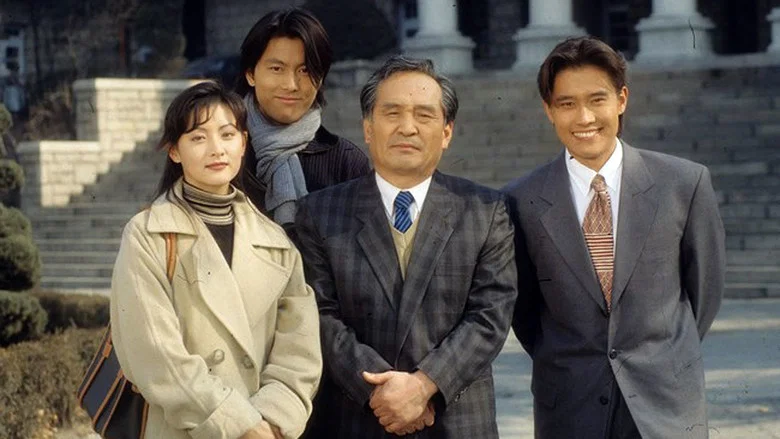
Seen from the present, the cast of Asphalt Man is extraordinary. It brought together one of Korea’s most popular actresses with several young performers who would later become internationally recognized stars.
- Lee Byung-hun as Kang Dong-joon: Lee Byung-hun plays the talented and determined automobile designer at the center of the story. Dong-joon is driven by an almost obsessive desire to build a world-class Korean car, but he is also burdened by financial hardship, family responsibility, and the expectations placed on him as the eldest son. Lee gives the ambitious hero both confidence and emotional vulnerability.
- Jung Woo-sung as Kang Dong-seok: Dong-seok is Dong-joon’s younger brother, a wounded and impulsive young man whose anger sends him to the United States. His journey from a troubled outsider toward professional racing gave Jung Woo-sung an opportunity to display the physical presence and rebellious charisma that would later become central to films such as Beat.
- Choi Jin-sil as Oh Hwa-ryun: Already one of Korea’s biggest stars, Choi Jin-sil plays a skilled automobile designer who begins as Dong-joon’s professional rival and becomes his romantic partner. Hwa-ryun is intelligent and ambitious, but her desire for advancement leads her to make morally difficult choices. Choi brings warmth to the character without erasing her contradictions.
- Lee Young-ae as Kang Dong-hee: Lee Young-ae plays Dong-joon and Dong-seok’s sister—not a second romantic interest, as some English summaries incorrectly suggest. Dong-hee’s painful experiences in the United States form one of the drama’s darkest storylines and help explain Dong-seok’s anger and emotional instability. It was an early dramatic role that revealed a very different side of the actress who would later become internationally famous through Jewel in the Palace.
- Huh Joon-ho as Han Ki-soo: Huh Joon-ho adds considerable tension as Han Ki-soo, a powerful figure within the rival automobile company. His character connects the romantic conflict to the corporate struggle and becomes one of the principal forces working against Dong-joon’s ambitions.
What Has Aged—and What Still Works
Some parts of Asphalt Man unmistakably belong to 1990s television. The plot moves through dramatic coincidences, sudden betrayals, family tragedies, and sharply defined heroes and villains. Certain depictions of life in the United States and some of the drama’s attitudes toward gender and family may also feel dated to modern viewers.
What still works is the energy behind the story. The drama genuinely believes in the excitement of designing, building, and racing cars. Its industrial setting is unusual even by contemporary K-drama standards, and the conflict between personal loyalty and professional ambition remains engaging. The cast also gives emotional weight to material that could easily have become little more than corporate spectacle.
Global Viewing Guide
Finding a 1995 Korean drama with English subtitles can be difficult, but there are legal ways to look for the series:
- Official SBS Website: The official SBS program page contains episode listings, clips, cast information, and replay links. Account requirements and regional playback restrictions may apply.
- Official SBS YouTube Uploads: SBS has uploaded full episodes and selected scenes through its official classic-drama channels. The first full episode is available on YouTube, although English subtitles may not be included.
- Search by Alternative Titles: The drama may also appear under English titles such as The Man on the Asphalt, The Man from the Asphalt Street, or Dream Racers. Availability can vary by country and platform.
International viewers should check subtitle availability before starting. Official Korean uploads are easier to locate than fully subtitled international releases.
Final Verdict
Asphalt Man is more than a nostalgic collection of fast cars and famous young actors. It is a revealing portrait of South Korea at a moment of industrial confidence, when developing a world-class national automobile could serve as the central dream of a prime-time television hero.
Its storytelling can be exaggerated and its worldview sometimes feels dated, but the drama’s speed, ambition, family conflict, and remarkable cast still make it worth exploring. For viewers interested in the evolution of Korean television—or in the early careers of Lee Byung-hun, Jung Woo-sung, and Lee Young-ae—Asphalt Man offers a fascinating ride through the hopes and anxieties of 1990s Korea.

The KCulture Editorial Team is dedicated to providing deep insights and accurate information about the vibrant world of Korean culture.