
South Korea has become a leading global destination for treating severe acne and scars by utilizing personalized, multi-step combination therapies rather than single laser treatments. For international patients dealing with stubborn cystic breakouts or deep indented scars, Korean dermatology clinics offer advanced packages that integrate medical extractions, Subcision (진피절제술), Secret RF microneedling, and prescription medications. This comprehensive guide explains how the Korean dermatological process works, what procedures to expect, expected recovery timelines, typical costs, and essential preparations for a safe medical journey.
Unlike standard facial spas, Korean medical skincare treats acne as an ongoing medical condition. By combining precise treatments tailored to specific scar types—such as rolling or boxcar scars—clinics ensure maximum collagen stimulation with minimal downtime. Understanding this system before booking your flight is crucial to maximizing the results of your medical trip.
⚠️ Medical Disclaimer: The medical and treatment information provided in this article is for general educational purposes only. Every patient’s skin condition, scar depth, and treatment response are different. Professional medical advice, medication adjustments, and exact treatment plans must always be determined through a personalized consultation with a qualified, board-certified dermatologist.
- The Korean Acne Treatment System: Combination Therapy
- Major Procedures for Acne and Scars
- Getting Isotretinoin Prescriptions in Korea
- Preparing Before You Travel
- Choosing the Right Clinic & Typical Costs
- Treatment Process and Recovery Timeline
- Who Is a Good Candidate?
- FAQ
- Safety Considerations
- Continue Planning Your Korea Medical Journey
The Korean Acne Treatment System: Combination Therapy
The core strength of treating severe acne and scars in Korea is the concept of “combination therapy.” Rather than recommending the same single procedure for every patient, dermatologists systematically address active inflammation, break down fibrotic scar tissue, and rebuild the dermal layer simultaneously.
Instead of relying on one laser, doctors evaluate the severity of the scars, the patient’s Fitzpatrick skin type, previous treatment history, and the available travel schedule to create a customized package.
| Typical Concern | Common Korean Clinical Approach |
|---|---|
| Active inflammatory acne | Medical extraction + prescription medication + calming therapy |
| Rolling scars (Deep, wide indentations) | Subcision + collagen-stimulating skin boosters (e.g., Rejuran, Juvelook) |
| Boxcar scars / Large pores | Secret RF microneedling + Pico Fractional laser |
| Post-inflammatory redness/hyperpigmentation | LED therapy + vascular lasers + medical skincare |
Major Procedures for Acne and Scars
Korean-style Medical Acne Extraction
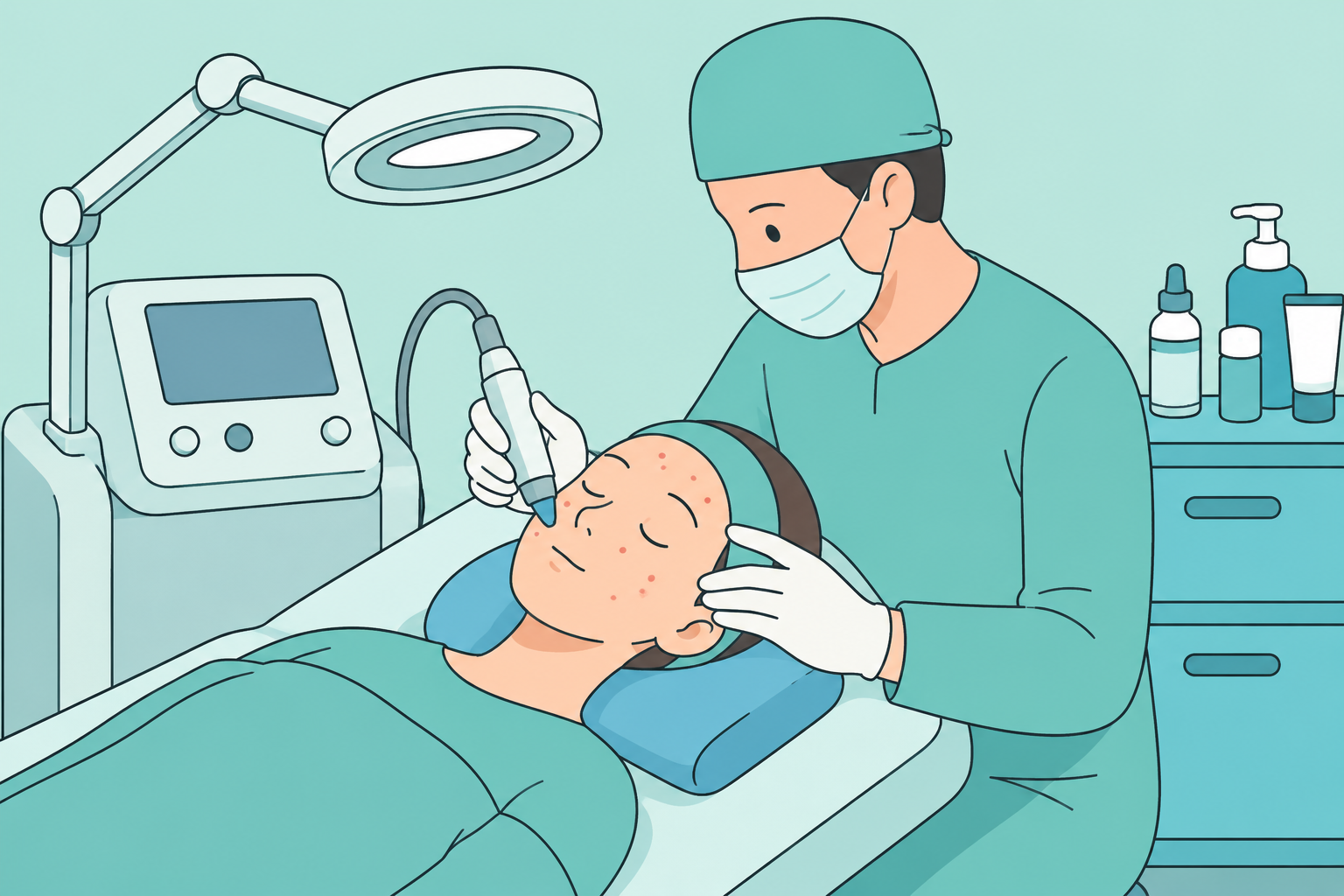
In Korea, extraction is not merely a spa service; it is an intensive medical process. It involves AHA/BHA scaling, followed by the precise extraction of inflammatory acne using sterilized needles to prevent secondary pore expansion. The session usually concludes with LDM ultrasound or LED therapy and a cooling modeling mask to rapidly reduce redness.
Subcision
Subcision is a vital treatment for rolling and deep boxcar scars. A specialized Nokor needle or cannula is inserted beneath the skin to physically cut the fibrotic bands pulling the scar downward. By releasing this tension, the skin surface naturally rises. Clinics frequently inject skin boosters directly into the newly created space to accelerate tissue regeneration.
Secret RF (Microneedling RF)
Secret RF combines ultra-fine microneedles with high-frequency radio energy delivered directly into the dermal layer. Because the thermal damage to the surface epidermis is minimal, it stimulates massive collagen production while significantly lowering the risk of post-inflammatory hyperpigmentation (PIH). This makes it highly effective and safe for diverse skin tones, especially for patients with darker complexions.
Fractional Lasers (Pico and CO2)
Fractional lasers create microscopic thermal zones to force skin remodeling. While traditional CO2 fractional lasers are highly effective for severe scars, they require longer downtime. Therefore, Pico Fractional lasers are often recommended for short-term medical travelers, as they provide powerful collagen stimulation with far less redness and crusting.
Getting Isotretinoin Prescriptions in Korea
For patients suffering from treatment-resistant cystic acne, regulating sebum production is crucial. Isotretinoin (commonly known internationally under brands like Accutane) is frequently prescribed to prevent future breakouts.
In Korea, this medication is strictly prescription-only and cannot be purchased over the counter at a pharmacy. International patients can receive an isotretinoin prescription, but it requires a direct, in-person consultation where the dermatologist will review your medical history and current condition.
📌 Clinical Note: Isotretinoin carries strict contraindications. It is absolutely prohibited for women who are pregnant or planning pregnancy due to severe risks of birth defects. Furthermore, because the medication slows down the skin’s natural healing process, your doctor may need to adjust your dosage if you are planning to undergo aggressive laser treatments or Subcision.
Preparing Before You Travel
Successful treatment begins well before you arrive in Seoul. Because many international patients stay for only a limited time, preparing your medical background ensures your clinic can formulate an accurate plan immediately.
- Share your treatment history: Provide the clinic with a list of previous laser procedures, microneedling sessions, chemical peels, current skincare routines, and any known allergies.
- Prepare recent photos: Send clear photographs taken under natural lighting from multiple angles so the clinic can estimate your scar types before arrival.
- Discuss medications honestly: Inform your doctor if you are taking blood-thinning medications, aspirin, or supplements that may increase bruising during Subcision. Never stop prescriptions without medical advice.
- Avoid sun exposure: Refrain from intense sun exposure, tanning beds, or aggressive at-home chemical peels for at least two weeks before your treatment to reduce pigmentation risks.
Choosing the Right Clinic & Typical Costs
Not every dermatology clinic is equipped to handle international visitors. Before booking, verify whether the facility is officially registered to accept foreign patients under Korea’s medical tourism system.
| Feature | Registered Medical Institution (외국인환자유치 등록 의료기관) | Standard Local Clinic (일반 의료기관) |
|---|---|---|
| Target Audience | International medical travelers | Local residents |
| Language Support | In-house professional interpreters (English, Chinese, etc.) | English communication may be limited |
| Remote Post-Care | Robust follow-up via email/messaging after returning home | Remote follow-up support is highly limited |
Treatment costs vary based on the clinic’s equipment, the doctor’s expertise, and the complexity of the combination therapy. A personalized quotation is usually provided after a physical examination.
- Complex Scar Program (Subcision + Secret RF + Skin Boosters + Aftercare): Approximately ₩400,000 to ₩1,200,000+ (USD $300 to $900+) per session.
- Single Procedure (e.g., Basic Fractional Laser or Standalone Subcision): Approximately ₩150,000 to ₩500,000 per session.
Treatment Process and Recovery Timeline
Most patients are surprised by the efficiency of the Korean medical system. A comprehensive initial visit includes consultation, diagnosis, treatment, and calming care, often taking 1.5 to 2.5 hours in total.
Recovery and Downtime Expectations
Recovery varies depending on the specific procedures performed in your combination package:
- Medical Extraction: 1 to 2 days of mild redness.
- Secret RF: 3 to 5 days of redness and slight swelling.
- Fractional Laser: 3 to 7 days of redness, dry skin, and micro-crusting (tiny scabs).
- Subcision: 3 to 7 days of localized swelling and potential bruising.
💡 Pro Tip: Post-treatment care is vital. Use a broad-spectrum sunscreen (SPF 50+, PA++++) daily, avoid heavy sweating, saunas, and alcohol for at least 48 hours, and frequently apply a barrier-repair moisturizer containing Panthenol or Cica (Centella Asiatica) to soothe the skin.
Who Is a Good Candidate?
Medical travel for scar revision requires realistic expectations. You are likely a strong candidate for Korean combination therapy if you:
- Have persistent active acne, rolling scars, boxcar scars, or enlarged pores.
- Understand that significant scar improvement requires a gradual remodeling process, often necessitating multiple sessions rather than a one-time “cure.”
- Can remain in Korea long enough for an initial follow-up (ideally 3 to 7 days) or are willing to return for subsequent sessions over several months.
- Are committed to strict post-care instructions, including rigorous sun protection.
FAQ
Q: Can Subcision and Secret RF be performed on the exact same day?
A: Yes. Combining Subcision to release the fibrotic bands with Secret RF to stimulate dermal collagen is a hallmark of Korea’s “downtime reduction packages.” Doing them together safely maximizes the regenerative effect.
Q: Is the acne scar treatment painful?
A: Most laser and RF procedures are performed after applying a strong topical anesthetic cream. You may feel warmth, pressure, or minor prickling, but severe pain is uncommon. Subcision may cause temporary soreness afterward.
Q: Will my acne scars return after treatment?
A: Once structural scar tissue is successfully remodeled and improved, those specific scars do not “return.” However, if active acne is not controlled, new breakouts can cause new scars. This is why managing current inflammation is just as critical as treating old damage.
Q: Can I wear makeup after the procedures?
A: It depends on the intensity of the laser used. For mild treatments, light makeup is sometimes possible the next day, but for fractional lasers or intensive Secret RF, your doctor will likely advise waiting 3 to 5 days until the micro-channels in your skin have fully closed.
Safety Considerations
While South Korea boasts world-class dermatological standards, patients must prioritize safety over speed. Do not request overly aggressive treatments simply because you have a short travel window. Rushing intensive lasers without adequate healing time can lead to hyperpigmentation or compromised skin barriers. Always follow the exact medication and aftercare instructions provided by your clinic, and reach out to your clinic’s coordinator if you experience unexpected swelling or severe discomfort.
Continue Planning Your Korea Medical Journey
- Find Clinics in Korea: Medical Tourism Guide
- Top 5 Advanced Medical Treatments in South Korea for Travelers
- Returning Home After Medical Treatment in Korea: What You Need
- Seoul Medical Stay: How to Choose the Best Recovery Housing
- [Hospital Translation] Translating for Surgery Korea: Costs, Risks, and Tips
- [Safety Guide] Guide to Korea Medical Tourism Insurance
- AI Skin Analysis & Personal Color in Korea: The K-Beauty Guide
- Korean Pharmacy Guide: Prescriptions & OTC Meds
- Korea Health Checkup Guide: VIP Packages and Costs
Korean Culture portal KCulture.com

The KCulture Editorial Team is dedicated to providing deep insights and accurate information about the vibrant world of Korean culture.