Jeongganbo (정간보) is one of the most remarkable musical inventions in world history. Created during the reign of King Sejong in the 15th century, it records not only pitch but also time, allowing Korean traditional music to be preserved with extraordinary precision. While Western staff notation focuses on notes moving across a horizontal timeline, Jeongganbo visualizes rhythm and breathing through a grid-based structure that reflects the unique character of Korean music.
If you’ve ever listened to traditional Korean instruments and wondered how such fluid and deeply expressive music is recorded and passed down, you’re not alone. For many international listeners, Korean traditional music can feel mysterious at first. This guide explores Jeongganbo, Korean rhythmic cycles known as jangdan, and the musical philosophy that has shaped Korean sound for centuries.
- What Is Jeongganbo?
- How Music Was Preserved Before Jeongganbo
- King Sejong and the Invention of Jeongganbo
- Jeongganbo vs Western Staff Notation
- Understanding Jangdan: The Heartbeat of Korean Music
- Melody, Nong-eum, and Musical Expression
- What Music Has Been Preserved Through Jeongganbo?
- Why Jeongganbo Still Matters Today
- Related Reading
What Is Jeongganbo?
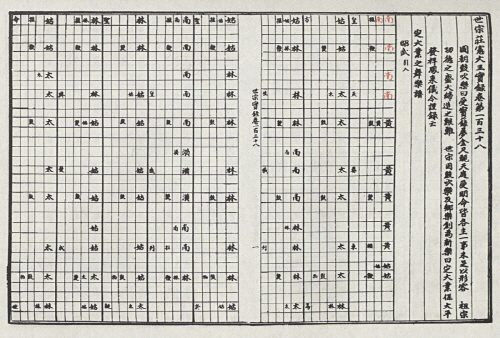
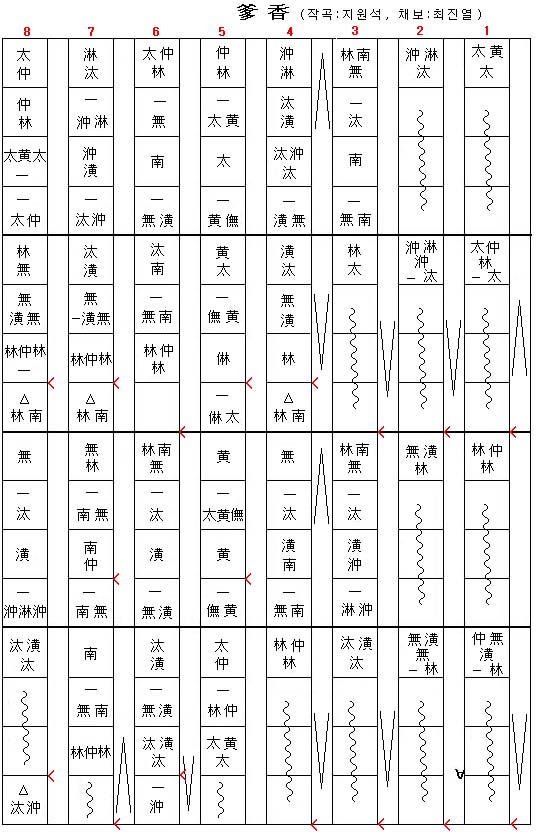
Jeongganbo (정간보) is the traditional notation system used in Korean court and classical music. The name comes from the Chinese character 井, meaning “well,” whose shape resembles a grid. This grid became the foundation of one of the world’s most distinctive systems for visualizing musical time. The name literally means “grid notation,” referring to the square cells that organize musical time.
Unlike Western sheet music, which is read from left to right, Jeongganbo is traditionally read from top to bottom and from the right column to the left. Each square box, called a jeonggan, represents a unit of time.
Inside these boxes, musicians write pitch names using traditional Chinese characters such as Hwang (黃), Tae (太), and Jung (仲), known collectively as yulmyeong.
The brilliance of the system is its visual simplicity:
- One note in one square = one beat.
- An empty square extends the previous sound.
- Divided squares indicate shorter rhythmic values.
- The grid itself visually represents the flow of time.
Even for modern readers unfamiliar with Korean music, the notation makes rhythm surprisingly easy to see.
How Music Was Preserved Before Jeongganbo
Before Jeongganbo was invented, Korean music was transmitted primarily through oral tradition. This approach is often described by the traditional phrase Gujeonsimsu (구전심수), meaning “transmitted by word and received by heart.” The expression captures the deeply personal relationship between master and student that remains central to many Korean performing arts. Teachers demonstrated melodies, rhythms, and performance techniques directly to students.
This method, often described as “teaching by mouth and receiving through the heart,” remains important in Korean traditional arts today. Many folk traditions, including regional folk songs, shamanic music, and later forms such as pansori, survived largely because performers passed them from generation to generation.
Written systems existed, but they typically recorded pitch rather than precise duration. Musicians still relied heavily on memory, performance practice, and rhythmic cues from percussion instruments.
📌 Cultural Note: For centuries, preserving music meant preserving living performance traditions rather than preserving fixed written scores. This philosophy still influences Korean traditional music today.
King Sejong and the Invention of Jeongganbo
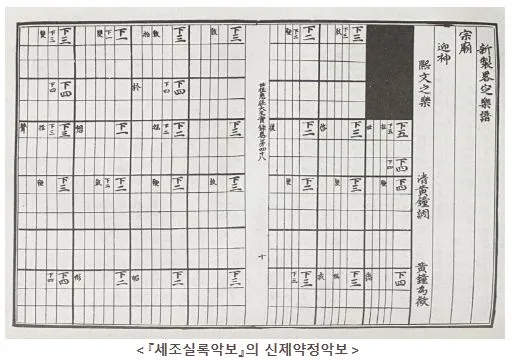
Jeongganbo was created during the reign of King Sejong the Great (세종대왕), the same ruler famous for creating Hangul, the Korean alphabet.
What many international visitors do not realize is that King Sejong was also deeply interested in music, acoustics, and musical theory. His goal was to establish a system that could accurately preserve ceremonial and court music for future generations.
The challenge was clear: existing notation systems could indicate pitch but struggled to record duration precisely. As a result, musicians often depended on memory, oral instruction, or percussion cues to determine how long notes should be sustained. Over generations, this made it difficult to preserve music exactly as it had originally been performed. Without accurate rhythmic information, melodies gradually changed over time.
To solve this problem, King Sejong and court scholars developed Jeongganbo during the 1430s and 1440s. Historians often regard it as one of the world’s earliest notation systems capable of recording both pitch and duration in a highly organized way.
Its creation represented a major cultural achievement. Just as Hangul democratized written language, Jeongganbo helped preserve Korea’s musical heritage with unprecedented accuracy.
Jeongganbo vs Western Staff Notation
Although both systems record music, they reflect different ways of understanding sound, rhythm, and musical space.
| Category | Western Staff Notation | Jeongganbo |
|---|---|---|
| Reading Direction | Left to right | Top to bottom, right to left |
| Time Representation | Symbol-based note values | Grid-based visual time units |
| Pitch System | Fixed pitch relationships | Traditional yulmyeong system |
| Strength | Harmony and multi-part writing | Melody, breathing, and rhythmic flow |
| Visual Focus | Notes on lines and spaces | Time organized through boxes |
Western notation developed alongside harmonic music, where multiple notes often sound simultaneously. Jeongganbo evolved in a musical culture that emphasized melodic movement, rhythmic cycles, and expressive ornamentation.
Neither system is inherently superior; they simply serve different musical traditions.
Understanding Jangdan: The Heartbeat of Korean Music
To understand Korean traditional music, it is impossible to ignore jangdan (장단), the rhythmic cycles that form its foundation.
Many first-time listeners assume jangdan is simply a Korean version of meter or time signatures. Rather than functioning like a rigid metronome, a jangdan cycle can feel elastic and alive. Musicians often describe it as something that breathes, creating waves of anticipation and release throughout a performance. In reality, it is much more than that.
Western rhythm is often imagined as a steady mechanical pulse. Korean jangdan functions more like breathing. It expands and contracts, creating tension and release while guiding the emotional flow of a performance.
Musicians often describe jangdan using concepts such as:
- Beginning and resolution
- Tension and relaxation
- Pushing and pulling
- Breathing and flow
This is one reason Korean traditional music can feel simultaneously structured and flexible. The rhythm is organized, but it remains deeply human.
💡 Pro Tip: When listening to gugak, try following the drum rather than the melody. The rhythmic cycle often reveals the structure of the entire piece.
Melody, Nong-eum, and Musical Expression
Another major difference between Korean and Western music is the treatment of individual notes.
In many Western classical traditions, performers aim to reproduce pitches as accurately as possible. Korean traditional music often treats a note as something alive and constantly changing.
This expressive technique is called nong-eum (농음), often translated as “ornamentation” or “vibrating tone.”
Instead of simply playing a pitch, performers may:
- Shake the note gently.
- Slide into the pitch.
- Bend the tone upward.
- Let it fall naturally.
- Add subtle fluctuations in volume and color.
Traditional notation includes additional symbols that guide performers in shaping these expressive movements.
As a result, Korean music often feels less concerned with perfect geometric precision and more concerned with emotional nuance and natural movement.
Harmony with Nature
Korean traditional music developed alongside instruments made from bamboo, silk strings, paulownia wood, and animal leather. Rather than pursuing perfect uniformity, musicians often embrace the subtle variations that naturally occur in these materials.
This connection to nature is reflected not only in the instruments themselves but also in the flowing rhythms of jangdan and the expressive pitch movements of nong-eum. Together, they create a musical language that feels organic rather than mechanical.
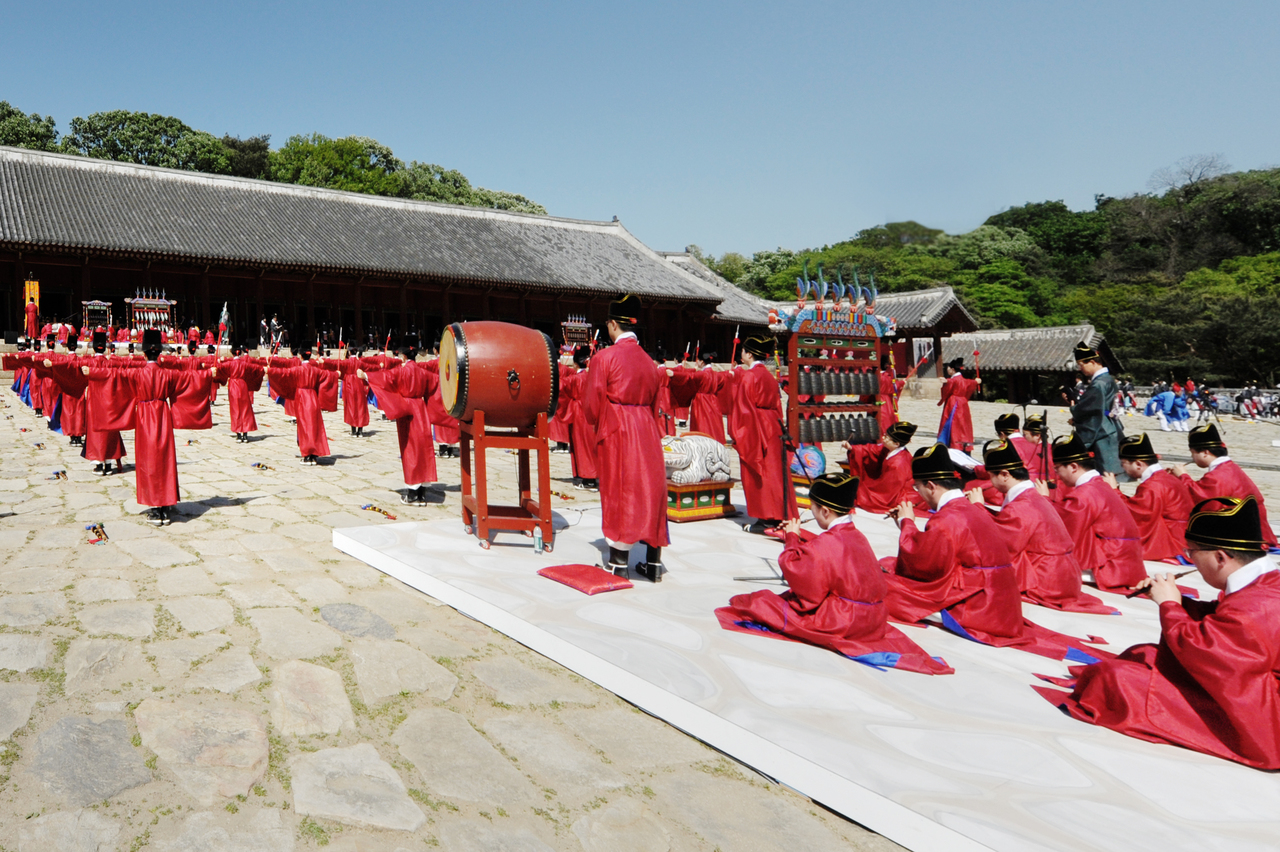
What Music Has Been Preserved Through Jeongganbo?
Jeongganbo played a particularly important role in preserving Korea’s court and elite musical traditions.
Jongmyo Jeryeak (종묘제례악)
This UNESCO-recognized ritual music is performed at Jongmyo Shrine (종묘). Several compositions associated with King Sejong were preserved through Jeongganbo and continue to be performed today. For more information on Jongmyo Shrine and Jongmyo Jeryeak, refer to ‘UNESCO Heritage: Jongmyo Shrine, Jongmyo Jerye, Jongmyo Jeryeak‘.
Yeominrak (여민락)
Meaning “Enjoyment Shared with the People,” Yeominrak reflects King Sejong’s vision of harmony between ruler and people. It remains one of the most celebrated works in Korean court music.
Jeongga and Pungryu Music
Refined musical traditions enjoyed by scholar-officials, including Yeongsan Hoesang and other chamber repertoire, were carefully documented through notation.
Meanwhile, many famous folk traditions followed a different path.
| Mainly Preserved Through Jeongganbo | Mainly Preserved Through Oral Tradition |
|---|---|
| Court Music | Folk Songs |
| Jongmyo Jeryeak | Pansori |
| Yeominrak | Regional Folk Music |
| Jeongga | Shamanic Music |
| Pungryu Repertoire | Many Percussion Traditions |
Why Jeongganbo Still Matters Today
More than 500 years after its invention, Jeongganbo remains one of Korea’s most fascinating cultural achievements.
It demonstrates that musical notation is not merely a technical tool. It reflects how a society understands time, sound, memory, and artistic expression.
Western notation excels at organizing harmony and complex ensembles. Jeongganbo excels at visualizing rhythmic flow, melodic breathing, and the organic movement that defines Korean traditional music.
For many visitors discovering gugak for the first time, understanding Jeongganbo offers a new way to listen. The music stops sounding unfamiliar and begins revealing its internal logic—one built around rhythm, breath, and the natural flow of life.
Related Reading
If you would like to explore Korean traditional performing arts further, these guides provide useful context:
- Korean Traditional Dance: Court Dance, Folk Dance & Where to Watch
- Guide to Korean Traditional Folk Music & Where to Hear It
- What is Pansori? A Deep Dive into Korea’s Musical Soul
- What is Arirang? The Deep Meaning Behind the BTS New Album
- Traditional Korean Music: Gugak, Pansori, Daechwita
Korean Culture portal KCulture.com

Founder of Kculture.com and MA in Political Science. He shares deep academic and local insights to provide an authentic perspective on Korean history and society.