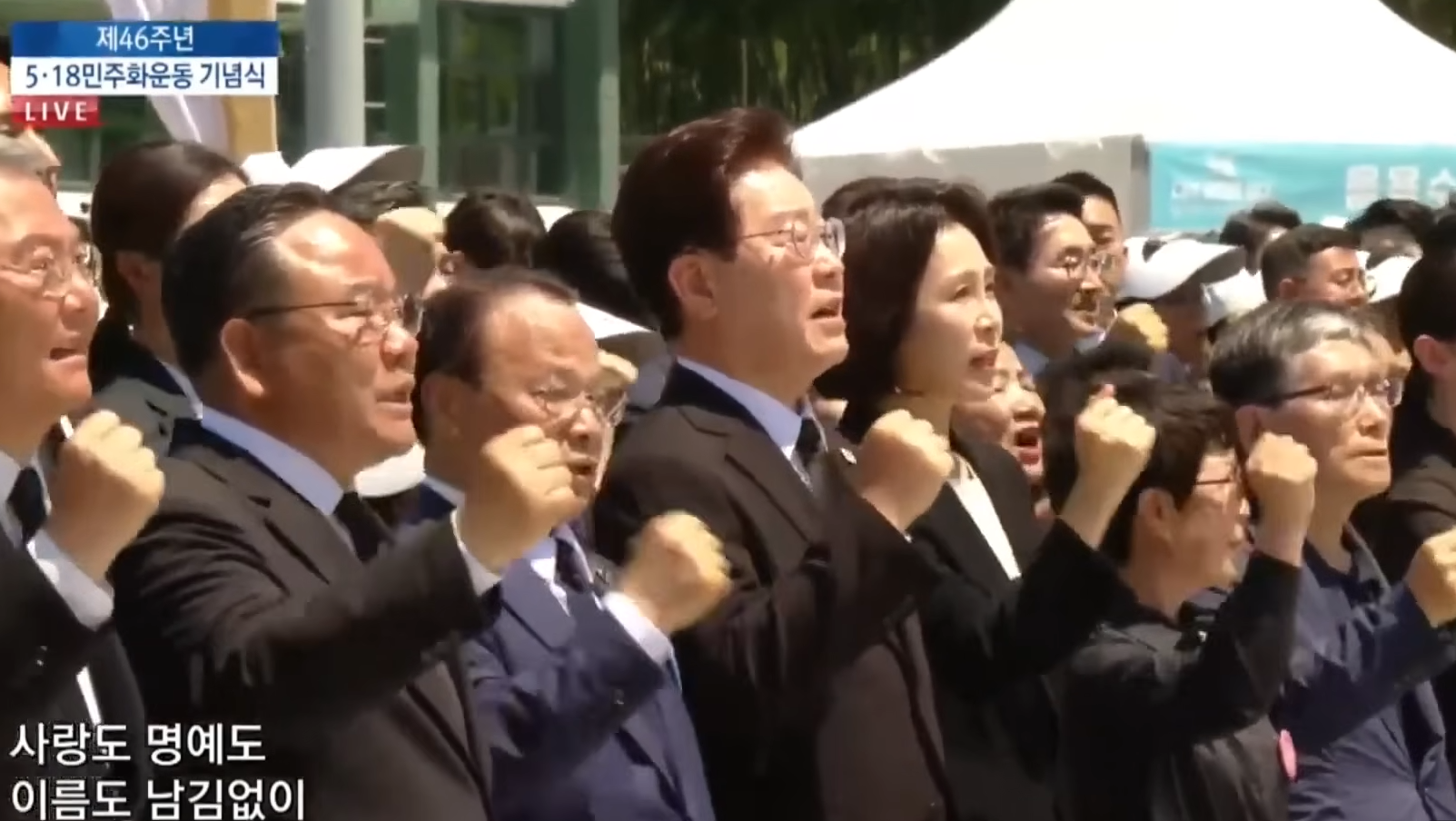
The “March for the Beloved” (임을 위한 행진곡) is a historic South Korean protest song created in 1982 to honor the victims of the May 18 Gwangju Democratization Movement. Originally written for a spiritual wedding of two fallen activists, it has transcended its origins to become the definitive anthem of South Korea’s democratic struggle and a powerful symbol of solidarity for pro-democracy movements across Asia. As someone living in Korea, I am deeply moved every time this song echoes through the streets. Today, I want to share the profound story of how a melody born in the dark shadows of a military dictatorship became a beacon of hope for the living.
- A Requiem for a Spiritual Wedding in the Spring of 1982
- Emerging from Darkness to Ignite the Streets
- An Anthem of Solidarity for Asian Democracy
- The Legacy of the Survivors: Follow Me, You the Living
A Requiem for a Spiritual Wedding in the Spring of 1982
Let us travel back to the spring of 1982. South Korea was under the strict surveillance of Chun Doo-hwan’s military regime. In Gwangju (광주), a group of cultural artists gathered in hushed secrecy at the home of novelist Hwang Sok-yong. They were creating a musical play titled Neokpuri (Soul-cleansing) to honor the posthumous marriage—a spiritual wedding—of two martyrs: Yoon Sang-won, the spokesperson for the citizen militia who fought to the end and was killed by martial law forces at the Jeollanam-do Provincial Office in 1980, and Park Gi-soon, a labor activist who had tragically passed away earlier in 1978.
The final act of this musical play featured a newly composed song: the “March for the Beloved.” The lyrics were adapted by Hwang Sok-yong from a poem written in prison by civil rights activist Baek Ki-wan. The heavy, resolute melody was composed by Kim Jong-ryul, who was a student at Chonnam National University (전남대학교) at the time. The YouTube video below is the original recording of ‘March for the Beloved’.
📌 Local Note: To evade the eyes and ears of the martial law authorities, the creators draped thick blankets around the room to soundproof it. They recorded the song in hushed tones onto a small cassette tape. If you listen closely to the original recording, you can actually hear a dog barking and a train passing by outside—elements that perfectly capture the desperate and raw reality of that era.
Emerging from Darkness to Ignite the Streets
That crudely recorded cassette tape was secretly copied and distributed across university campuses and labor sites nationwide. During the dark days of the 1980s dictatorship, when the truth about the May 18 massacre was heavily censored, this song spread from mouth to mouth. It served as the central spiritual pillar that sustained the Korean democratization movement.
The 1987 June Democratic Struggle
The most pivotal moment for this anthem came during the 1987 June Democratic Struggle. Millions of citizens poured into the streets, singing this song in unison, which ultimately led to the military regime’s surrender and the June 29 Declaration. It evolved from a simple memorial song into a powerful cultural force that united people fighting against injustice.
However, the song’s journey was not without hardship. After the May 18 Gwangju Democratization Movement was officially designated as a national commemorative day in 1997, the song was sung at official ceremonies. During subsequent conservative administrations, it faced political controversy regarding its ideological undertones, and the singing format was downgraded from a “mass sing-along” to a “choir-only” performance. Fortunately, since 2017, it has been fully restored as an official sing-along piece, firmly cementing its place as the definitive symbol of South Korea’s democratic history.
An Anthem of Solidarity for Asian Democracy
Perhaps the most remarkable aspect of the “March for the Beloved” is its enduring vitality. From the 1980s and 1990s onward, as Korean civil society and human rights activists began collaborating with organizations across Asia, the song naturally crossed borders. Its power to resonate with the oppressed transcends language, leading to it being translated and adapted into various local languages.
| Country / Region | Local Adaptation & Significance |
|---|---|
| Hong Kong | Introduced by Christian student groups in the early 1980s. During the 2014 Umbrella Revolution and the 2019 Anti-Extradition Bill Protests, countless citizens sang a Cantonese version of the song on the streets as a powerful symbol of resistance against state suppression. |
| Taiwan | Adopted by Taiwanese labor activists in 1988 under the title “Laborers’ Battle Song” (勞動者戰歌). It has since become a staple protest song echoing through local labor rights rallies and social movements. |
| Myanmar | During the 2021 anti-coup protests, citizens in Myanmar sang this song, identifying their own struggles against the military junta with the pain of Gwangju in 1980. It served as a deeply moving testament to solidarity for Asian democracy. |
Beyond these regions, the song is frequently sung in localized versions at human rights rallies in countries like Indonesia, Thailand, and Malaysia—nations that have experienced authoritarian or military rule. It has truly earned the title of “Asia’s Internationale.”
The Legacy of the Survivors: Follow Me, You the Living
“Leaving no love, no honor, no name behind… Follow me, you the living.”
Whenever I hear the core refrain of this song, I am overcome with profound emotion. The agonizing sorrow for those who fell before us, combined with the immense guilt and resolve of the survivors, strikes a deeply powerful chord.
Even today, somewhere in the world, people fighting against injustice and marching for freedom are stepping to this very melody. The quiet voices recorded under a blanket in a small room in 1982 have transformed into a majestic echo that represents the struggles and hopes of citizens worldwide. If you want to delve deeper into the turbulent modern history of South Korea and its journey toward democracy, I highly recommend exploring the resources below.
- History of the 1987 June Democratic Struggle in Korea
- The History of Gwangju 5.18: Coup, Massacre, Legacy and Best 5.18 Movies
Korean Culture portal KCulture.com

Founder of Kculture.com and MA in Political Science. He shares deep academic and local insights to provide an authentic perspective on Korean history and society.