Long before modern artillery dominated the battlefield, the Joseon Dynasty developed an extraordinary gunpowder weapon system known as the Singijeon (신기전)—a self-propelled rocket arrow that represented one of the most sophisticated military innovations of the 15th century. While empires in Europe focused heavily on massive bronze and wrought-iron siege cannons, and China guarded its ancient secrets of gunpowder, Korean engineers forged a unique tactical path by perfecting rapid-fire multi-launch rocket systems and delayed-action explosive shrapnel. For military historians and strategy gamers who recognize the Hwacha (화차) from series like Civilization, the real-world engineering behind these medieval Korean secret weapons is even more fascinating than fiction.
The story of Joseon’s gunpowder arsenal is a testament to state-sponsored scientific R&D, standardized manufacturing, and tactical adaptability. From the early chemical breakthroughs of pioneer Choi Mu-seon (최무선) during the Goryeo Dynasty to King Sejong the Great’s rigorous royal workshops, Korea transformed primitive fire arrows into standardized, multi-stage weapon matrices. These rocket systems not only defended the peninsula’s rugged northern borders from nomadic cavalry and coastal villages from pirate raids, but also played a decisive role in some of the most miraculous defensive victories in East Asian history.
This comprehensive guide explores the chemical origins of Korean gunpowder, the engineering mechanics of the four Singijeon rocket variants, the modular genius of King Munjong’s Hwacha launcher, and the legendary defensive stand at Haengju Fortress. We will also examine the paradoxical historical decline of Joseon’s military technology during its two centuries of peace, and provide an insider’s travel guide on where you can see these centuries-old weapons in South Korea today.
- Why Joseon Developed Rocket Weapons
- Choi Mu-seon and the Birth of Korean Gunpowder
- King Sejong and the Development of the Singijeon
- The Four Types of Singijeon Lineup
- The World’s Oldest Rocket Blueprints
- The Hwacha: King Munjong the Engineer King
- The Battle of Haengju: Where the Hwacha Became a Legend
- More Than the Hwacha: Other Gunpowder Weapons of Joseon
- The Paradox of Peace: Why Did Joseon’s Rocket Technology Stagnate?
- Where to See Joseon’s Gunpowder Weapons Today
- FAQ
Why Joseon Developed Rocket Weapons
When most people imagine medieval siege warfare, massive stone castles and enormous cannons battering down walls usually come to mind. However, the early Joseon military faced a completely different tactical reality that required a radically different type of firepower.
Throughout the late Goryeo and early Joseon periods, the Korean peninsula was under constant threat from two distinct enemies. Along the rugged northern frontier, the military had to defend against Jurchen nomadic cavalry—fast-moving horsemen who struck swiftly and melted back into the wilderness. Meanwhile, along the southern and western coastlines, highly organized Japanese pirates, known as Wokou, repeatedly raided coastal settlements and disrupted maritime trade networks. Standard, heavy siege cannons were cumbersome, slow to reload, and ineffective against agile, fast-moving raiding parties.
This strategic dilemma forced Korean engineers to innovate. They needed weapons that could be deployed rapidly, produce high-density area suppression, and cause massive psychological confusion among advancing horses and infantry. Rocket-propelled projectiles offered the perfect solution, leading to a military tradition that diverged significantly from both Chinese siege warfare and European field artillery.
💡 Historical Perspective: While China originally invented gunpowder and Europe refined the metallurgy of heavy bronze and wrought-iron siege artillery, Joseon specialized in rapid-fire volley systems and rocket propulsion, turning gunpowder into coordinated area-denial tactical weapons.
Choi Mu-seon and the Birth of Korean Gunpowder
The technological lineage of the Singijeon begins with one visionary inventor: Choi Mu-seon, universally celebrated as the father of Korean gunpowder.
During the late 14th century, the ruling Yuan Dynasty in China treated the chemical formula for gunpowder as a top-secret state monopoly, strictly refusing to export the technology or vital ingredients like saltpeter to foreign states. Deeply frustrated by the helplessness of Korean naval forces against pirate raids, Choi dedicated years of his life to reverse-engineering gunpowder chemistry through relentless trial and error, eventually mastering the extraction of potassium nitrate from local soil.
His breakthrough fundamentally altered Korean history. In 1377, the government established a specialized military office for gunpowder weapons under his leadership. By 1380, Choi’s naval cannons and incendiary weapons famously annihilated an armada of 500 pirate ships at the Battle of Jinpo (진포). Among his many inventions was the Juhwa (주화), meaning “Running Fire”—a primitive self-propelled rocket arrow that served as the direct technological prototype for later Joseon innovations.
| Innovation | Historical Significance |
|---|---|
| Domestic Gunpowder Production | Eliminated reliance on foreign imports and established self-sufficient national defenses. |
| Juhwa (Running Fire) | The earliest documented ancestor of the self-propelled rocket arrow in Korea. |
| Office of Gunpowder Weapons | Laid the systematic institutional foundation for state-sponsored military R&D. |
King Sejong and the Development of the Singijeon
The Singijeon did not emerge overnight as an accidental discovery; it was the product of decades of institutional research that reached its golden age during the reign of King Sejong the Great in the 15th century.
King Sejong is globally renowned for creating Hangul (한글), the indigenous Korean alphabet, but his administration was equally dedicated to scientific advancement, astronomy, agriculture, and military engineering. Recognizing the limitations of older Goryeo weapons, Sejong ordered royal workshops to improve gunpowder purity, standardize weapon dimensions, and establish systematic quality control across state arsenals. Around 1448, these intensive efforts produced the perfected weapon system officially named Singijeon, which poetically translates to “Divine Machine Arrows” or “Ghostly Machine Arrows.”
Rather than leaving craftsmanship to individual blacksmiths, Joseon established strict manufacturing standards. This allowed different arsenals across the peninsula to produce interchangeable parts and uniform ammunition—a remarkable manufacturing achievement for the medieval era.
The Four Types of Singijeon Lineup
The Singijeon was not a single weapon, but an adaptable family of four distinct rocket projectiles, each specifically engineered for a different tactical range and payload requirement.
| Type (Name) | Approximate Length | Flight Range | Key Tactical Feature & Payload Mechanism |
|---|---|---|---|
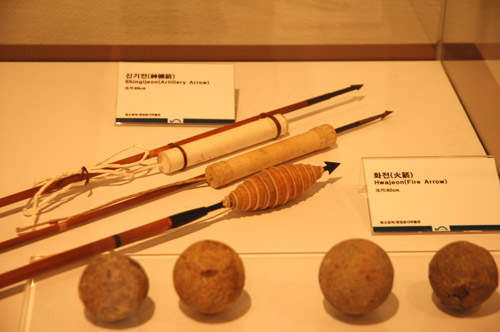
| So-singijeon (Small) | 1.1 m | 100–150 m | Launched in massive rapid-fire volleys of up to 100 from modular Hwacha launch carts. Lacking an explosive warhead, these lightweight, high-speed rocket arrows relied on kinetic force and sheer volume of fire to break enemy infantry formations. |
| Jung-singijeon (Medium) | 1.45 m | Approx. 250 m | Equipped with a small paper gunpowder bomb called Sobalhwa attached to the shaft, engineered to detonate automatically upon landing in enemy ranks. |
| Dae-singijeon (Large) | 5.2 m | 1–2 km | A massive, heavy rocket carrying a powerful incendiary and explosive payload (Daebalhwa). Designed to create deafening shockwaves and shatter enemy morale from long distance. |
| Sanwha-singijeon (Scatter-fire) | 5.2 m | 1–2 km | The world’s earliest documented two-stage rocket. The primary engine propelled the shaft, while a secondary fuse ignited sub-munitions that scattered mid-air. |
The ingenuity of the Sanwha-singijeon is particularly striking. By utilizing a primary propellant cartridge to achieve altitude and distance, and then triggering a secondary explosive charge to scatter smaller rocket projectiles over the target area, 15th-century Korean engineers successfully demonstrated the fundamental mechanical principles of modern multi-stage rockets and cluster munitions.
The World’s Oldest Rocket Blueprints
One reason modern aerospace historians understand the Singijeon with such precision is Joseon’s deep cultural commitment to meticulous record-keeping and systematic documentation.
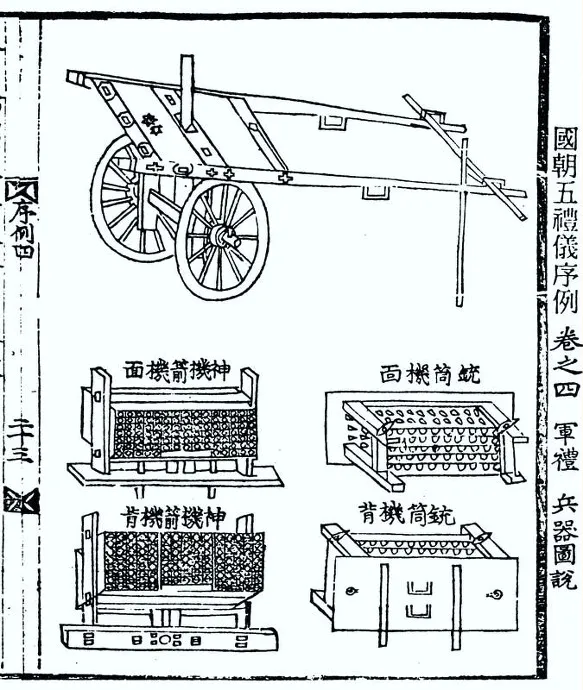
In 1474, the royal military treatise Byeonggi Doseol (병기도설)—compiled within the comprehensive national ritual and statecraft text Gukjo Orye Seorye (국조오례서례)—recorded the exact technical specifications of Joseon’s arsenal. The text details the precise measurements, wood types, paper thickness, gunpowder mixtures, and fuse assembly methods for every variant of the Singijeon.
These records are widely recognized by military historians as the world’s oldest surviving rocket blueprints preserved with enough technical detail to allow for a 100% functional modern reconstruction. This rigorous archival tradition is a hallmark of traditional Korean governance, visible in civil works as well, such as The Uigwe: A Window into King Jeongjo’s 8-Day Royal Journey, which documents royal ceremonies with photographic precision.
The Hwacha: King Munjong the Engineer King
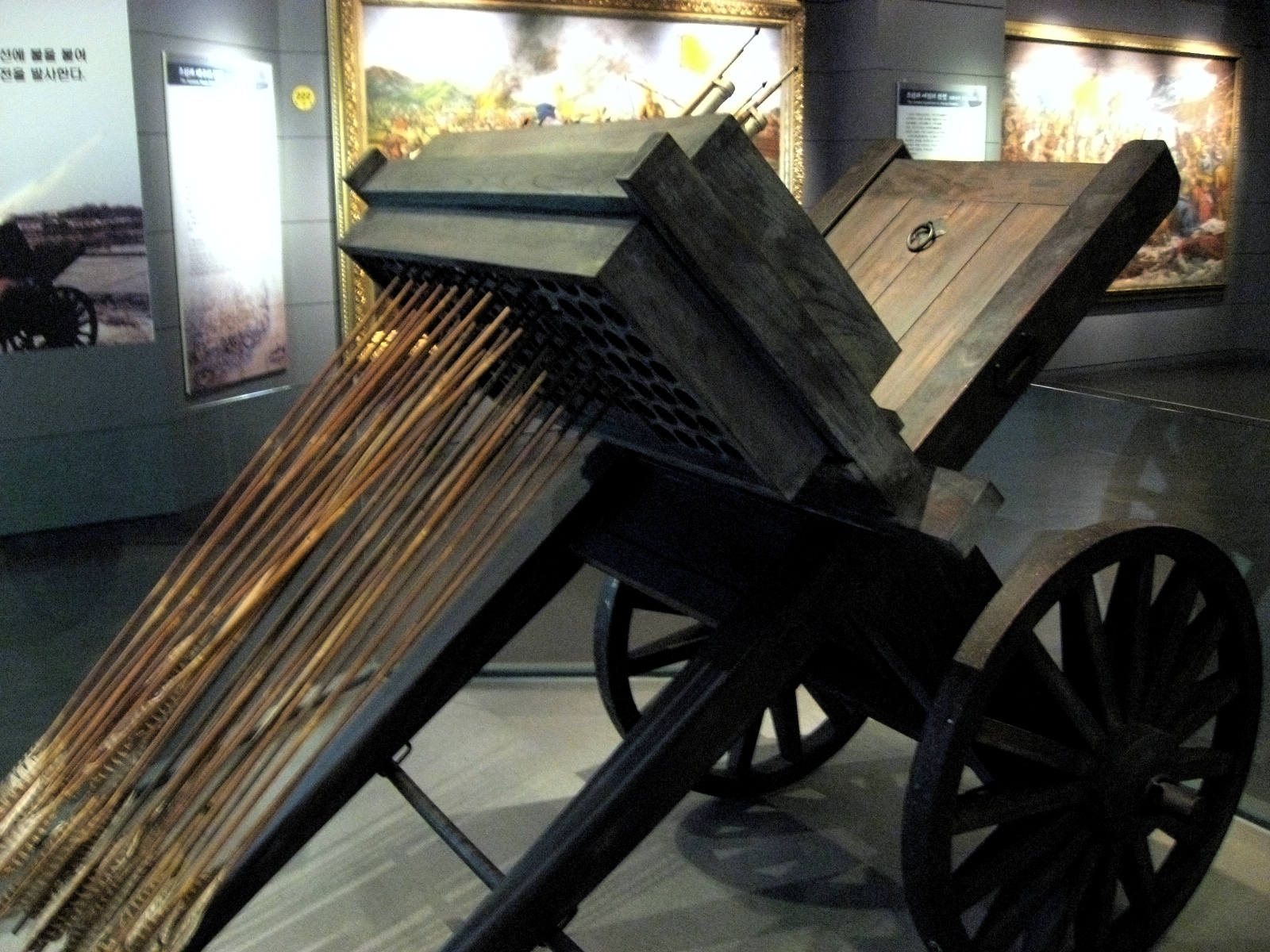
While a self-propelled rocket arrow is an impressive technological feat, firing them individually from bows or simple stands could not generate enough volume to break a disciplined enemy charge. The solution was the Hwacha, literally meaning “Fire Cart”—a mobile two-wheeled launch platform that transformed the Singijeon into a devastating Multiple Launch Rocket System (MLRS).
Although early prototype fire carts were tested around 1409 under King Taejong, they lacked battlefield mobility and reliability. The weapon was perfected in 1451 by King Munjong (문종), the eldest son of King Sejong. Often remembered by historians as an “Engineer King,” Munjong was a dedicated military technologist who personally reviewed technical drawings, adjusted trajectory elevation mechanisms, and redesigned the cart for maximum field efficiency.
King Munjong introduced a brilliantly forward-thinking modular design. Rather than building fixed carts for single weapons, he designed interchangeable wooden top plates that could be swapped on the same wheeled chassis depending on the battlefield situation:
- Singijeon-gi (신기전기): A wooden launch matrix drilled with 100 holes, capable of firing 100 Medium or Small Singijeon rockets in a terrifying, continuous chain reaction.
- Chongtong-gi (총통기): A gun barrel module mounting 50 small hand cannons called Sajeon-chongtong (사전총통), capable of blasting 200 iron bullets or heavy bolts in a single synchronized volley.
The Battle of Haengju: Where the Hwacha Became a Legend
While the Hwacha proved its worth defending northern border fortresses throughout the 15th century, its most legendary battlefield performance occurred during the Imjin War (임진왜란) from 1592 to 1598, when massive Japanese invasion armies equipped with Portuguese-style muskets swept across the Korean peninsula.
Facing a national crisis, Joseon engineers rapidly revived and upgraded their gunpowder arsenals. A brilliant scholar and official named Byeon I-jung (변이중) modified the traditional Munjong cart by mounting 40 advanced hand cannons called Seungja-chongtong (승자총통) onto the chassis. He linked the ignition fuses for automatic rapid-fire sequencing and enclosed the cart in thick wooden shields to protect gunners from enemy sniper fire.
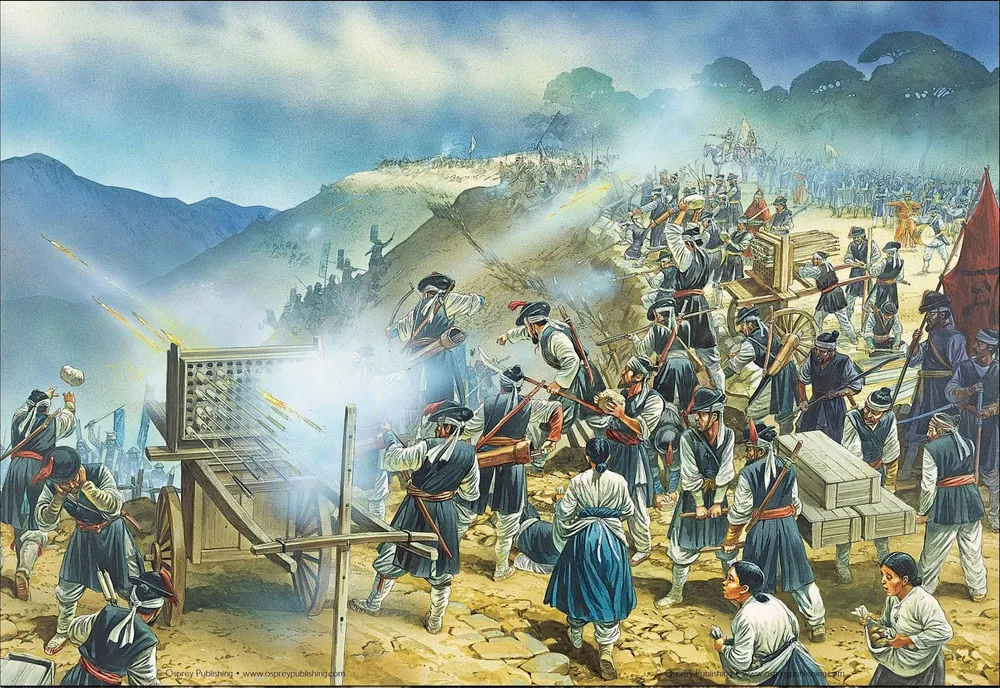
This rapid-fire mobile artillery took center stage at the Battle of Haengju (행주대첩) in 1593, one of the three most celebrated defensive victories of the war. General Gwon Yul (권율) commanded an unlikely garrison of roughly 2,300 defenders—comprising regular soldiers, civilian volunteers, Buddhist warrior monks, and local women—holding Haengjusanseong Fortress (행주산성), an earthen hilltop fortification overlooking the Han River. Surrounding them was a battle-hardened Japanese force of roughly 30,000 elite samurai and infantry.
As the massive enemy force surged up the steep slopes, General Gwon Yul held his fire until the attackers reached close range. He then ordered his approximately 40 Hwachas to open fire simultaneously. A deafening storm of fire arrows, iron shrapnel, and explosive bolts ripped through the advancing ranks. While historians still debate whether the fortress primarily deployed Munjong’s traditional rocket-launching matrix or Byeon I-jung’s newly modified rapid-fire hand cannon carts—or a lethal combination of both—the sheer volume of fire, combined with the terrifying psychological shock of screeching projectiles, shattered wave after wave of Japanese assaults. After suffering over 10,000 casualties and losing several top commanders, the invading army was forced into a total retreat.
The victory at Haengju was a triumph of tactical positioning, collective courage, and technological superiority. This spirit of resilience in the face of overwhelming odds echoes throughout Korean history, from the fierce resistance seen in the Ganghwa Island Battles: The Fall of Joseon’s Isolation to modern civic triumphs like The 1997 Asian Financial Crisis: South Korea’s Civic Miracle and the History of the 1987 June Democratic Struggle in Korea.
More Than the Hwacha: Other Gunpowder Weapons of Joseon
While the Hwacha and Singijeon capture the imagination with their rapid-fire rocket volleys, they operated alongside a diverse array of advanced gunpowder weapons that defended the kingdom on land and at sea.
| Weapon Name | Type | Key Mechanism & Battlefield Role |
|---|---|---|
| Cheonja-chongtong (천자총통) | Heavy Cannon | The largest royal cannon of the early Joseon period, capable of firing massive wooden darts winged with iron or heavy stone balls against fortress walls and naval vessels. |
| Jija-chongtong (지자총통) | Medium Cannon | A highly versatile medium artillery piece used extensively on Admiral Yi Sun-sin’s famous Turtle Ships and Panokseon warships to shatter enemy hulls. |
| Seungja-chongtong (승자총통) | Hand Cannon | A lightweight personal firearm developed in the late 16th century that fired clusters of iron pellets or small arrows, acting as an early shotgun for infantry. |
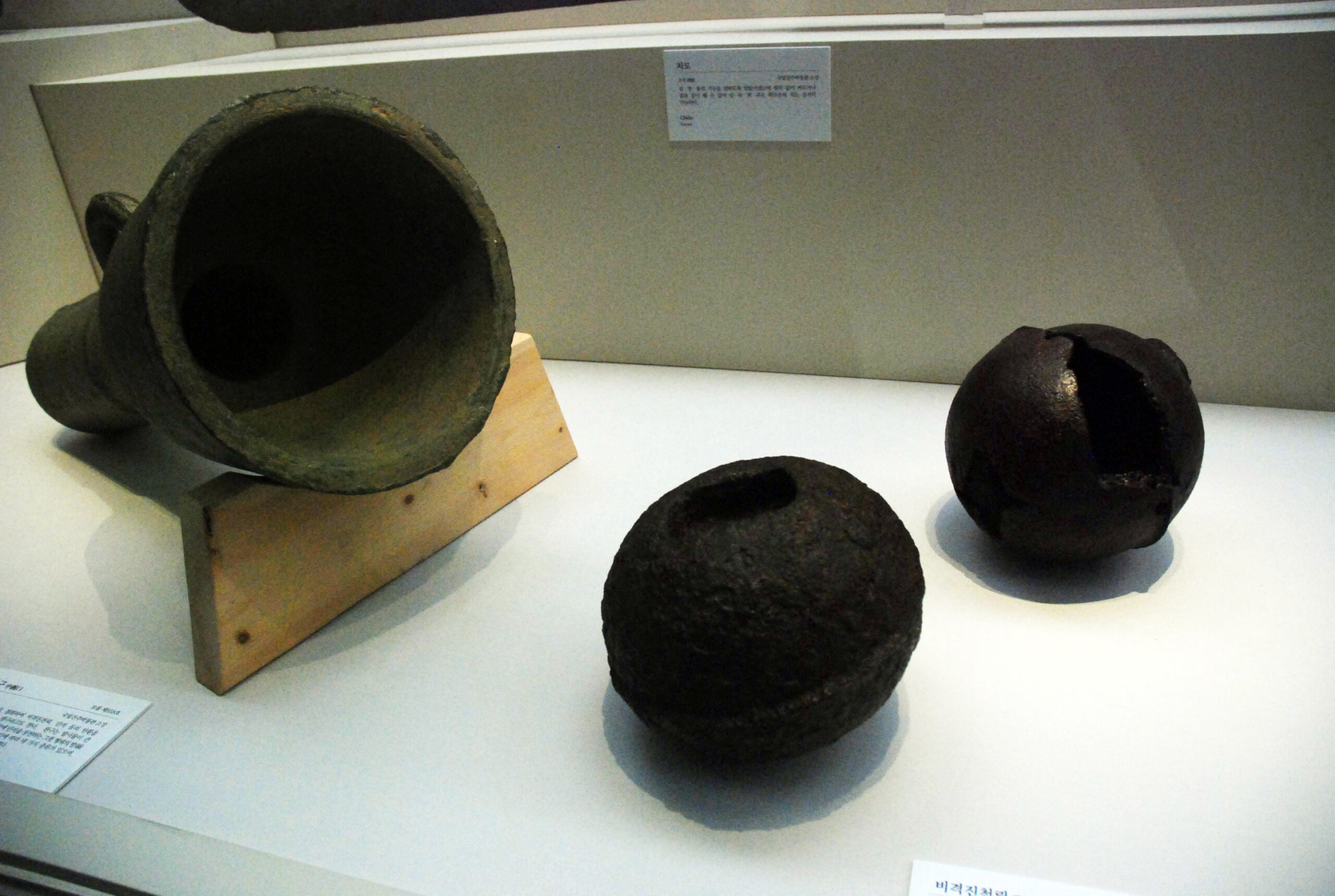
| Bigyeok-jincheonroe (비격진천뢰) | Time-Bomb Shrapnel Shell | A cast-iron spherical bomb launched from a heavy mortar called a Wan-gu (완구), featuring an adjustable internal wooden timer that detonated after landing among enemy troops. |
The Bigyeok-jincheonroe, invented by military engineer Yi Jang-son, deserves special recognition as one of East Asia’s earliest delayed-action shrapnel shells. By threading a gunpowder fuse through a spiral groove carved into an internal wooden core (known as a mogok), gunners could precisely control the detonation delay based on how many loops of fuse they wound around the wood. When the iron sphere landed inside enemy camps, curious soldiers often gathered around what they assumed was a dud cannonball, only for the shell to shatter moments later, spraying lethal iron shrapnel in a 360-degree radius.
The Paradox of Peace: Why Did Joseon’s Rocket Technology Stagnate?
Given the extraordinary sophistication of the Singijeon and Hwacha during the 15th and 16th centuries, an important historical question arises: why did Joseon artillery fail to keep pace with global military technology in the later centuries?
The answer lies in the prolonged peace that followed the devastating Imjin War and the Manchu invasions of the early 17th century. For over two hundred years, the Joseon Dynasty experienced an era of relative external stability. Without the constant pressure of foreign invasions, the royal court shifted its primary focus toward Neo-Confucian scholarship, internal factional politics, and civil administration. Military research budgets shrank, and the rigorous testing established by kings like Sejong and Munjong was largely neglected.
While European powers spent the 17th and 18th centuries industrializing their metallurgy, developing advanced chemistry, and perfecting long-range rifled artillery and explosive shells, Joseon’s military technology remained frozen in time. Weapons that were revolutionary in 1450 or 1592 were still being preserved without significant modification in the 1800s. The consequences of this stagnation became tragically apparent in the late 19th century during incidents like the Eulmi Incident 1895: Empress Myeongseong’s Assassination and clashes with Western imperial powers, where Joseon’s traditional matchlocks and short-range cannons were overwhelmingly outmatched by modern breach-loading rifles and naval artillery.
Recognizing this decline does not diminish the brilliance of early Korean inventors. Rather, it provides a balanced historical perspective: early Joseon demonstrated how state-sponsored science can lead the world in innovation, while late Joseon serves as a sobering reminder of what happens when technological adaptation is abandoned. Today, that appreciation for scientific restoration and long-term planning has returned to modern Korea, visible in impressive nationwide efforts like The Hidden History of Korea’s Reforestation Success.
Where to See Joseon’s Gunpowder Weapons Today
For history buffs, martial arts enthusiasts, and curious travelers exploring Korea, the story of the Singijeon and Hwacha does not have to remain in history books. You can inspect authentic artifacts, full-scale replicas, and detailed engineering exhibits at several specialized institutions across South Korea.
1. Jinju National Museum (국립진주박물관)
If you only have time to visit one destination to explore traditional Korean firepower, it must be the Jinju National Museum (국립진주박물관), located inside the historic grounds of Jinjuseong Fortress (진주성) in South Gyeongsang Province. Widely celebrated as the premier specialized museum for the Imjin War and traditional weapons, this institution features an entire gallery dedicated to Joseon gunpowder technology.
Here, you can examine authentic Chongtong hand cannons, inspect the complex internal timer mechanism of a preserved Bigyeok-jincheonroe shell, and marvel at full-scale, combat-ready reconstructions of the Hwacha and Large Singijeon rockets. The museum utilizes modern 3D animations and interactive displays to demonstrate exactly how these weapons were cast, loaded, and aimed on the battlefield.
📌 Local Note: If you visit Jinju in early October, you can combine your historical tour with the famous Jinju Namgang Yudeung Festival (진주남강유등축제). During the festival, the river surrounding the fortress is illuminated by thousands of colorful lantern sculptures, recreating the nighttime defense strategies used by Joseon soldiers during the historic Siege of Jinju!
2. The War Memorial of Korea (전쟁기념관)
Conveniently located in the Yongsan district of central Seoul, The War Memorial of Korea (전쟁기념관) offers an expansive look at the nation’s military history from ancient kingdoms to the modern era. The museum’s traditional warfare halls feature impressive full-scale replicas of the Munjong Hwacha and various sizes of Singijeon arrows. Because it is located in the heart of the capital, it is an easy and rewarding addition to any Seoul travel itinerary.
3. Haengjusanseong Fortress (행주산성)
To truly understand the tactical brilliance of the Hwacha, walk the actual grounds where General Gwon Yul’s outnumbered garrison made their legendary stand. Located in Goyang, just on the northwestern outskirts of Seoul, Haengjusanseong Fortress (행주산성) offers scenic walking trails along the fortified ridge overlooking the Han River. The site includes a dedicated shrine to General Gwon Yul, a victory monument, and a small boutique museum displaying replica Hwachas and tactical paintings of the 1593 siege.
As you explore Korean history—from ancient rocket engineers to the Foreign Heroes of Korea’s Independence Movement—you gain a deeper appreciation for the ingenuity and resilience that define Korea’s cultural heritage.
FAQ
Was the Hwacha really the world’s first multiple rocket launcher?
Yes, historical consensus widely regards the Munjong Hwacha, developed in 1451, as the world’s earliest practical, standardized Multiple Launch Rocket System (MLRS). While primitive rocket arrows were fired in China and Goryeo earlier, Joseon was the first to successfully integrate standardized solid-propellant rockets with a mobile, adjustable, multi-tube launch cart designed for coordinated battlefield deployments.
Did So-singijeon arrows use poison or explosive warheads?
No. According to official royal blueprints in the Byeonggi Doseol, the Small Singijeon (So-singijeon) did not carry explosive gunpowder pouches or verified poison treatments. Instead, they relied on high-speed kinetic impact and were launched in overwhelming volleys of 100 from Hwacha carts to break advancing infantry lines through sheer volume of fire.
Why is the Hwacha featured in video games like Civilization?
Game developers frequently select the Hwacha as Korea’s unique historical unit because it represents a distinct technological divergence from global medieval warfare. While other civilizations in strategy games rely on catapults, crossbows, or early bronze cannons, the Hwacha highlights Korea’s unique historical mastery of rapid-fire rocket artillery.
Is it difficult to visit the Jinju National Museum from Seoul?
Not at all. You can easily reach Jinju from Seoul by taking the KTX high-speed train from Seoul Station to Jinju Station, which takes approximately 3 hours and 30 minutes. From Jinju Station, a short 15-minute taxi or local bus ride will bring you directly to the gates of Jinjuseong Fortress, where the museum is located.

Founder of Kculture.com and MA in Political Science. He shares deep academic and local insights to provide an authentic perspective on Korean history and society.