Korea’s Fast Public Services: More Than Ppalli-Ppalli
Korea’s fast public services make many everyday administrative tasks surprisingly manageable: residents can obtain common certificates online, and the official domestic passport guidance is usually eight working days from application to collection. Digital systems help explain that speed, but so do expectations about what public institutions should do for the people who use them.
Imagine a bank asking for one more document during an already busy week. You start thinking about office hours, a queue, and time away from work. Then you discover that the certificate can be issued online, sometimes without a fee, and sent electronically to an institution that accepts it. The errand becomes a small interruption instead of something to organize your day around.
That quieter convenience deserves a place beside Korea’s famous fast internet and delivery culture. It also opens a larger question: how do people understand the relationship between their own lives, their community, and the government? The answer involves technology, the familiar demand for things to move quickly, and a public-service ideal that includes both cooperation and accountability.
- How Korea’s Fast Public Services Fit Into Daily Life
- How Everyday Paperwork Compares Abroad
- A Passport in Eight Working Days?
- Ppalli-Ppalli Meets Digital Government
- Public Servants and Public Expectations
- Cooperation, Community, and the Right to Disagree
- Why Korean Visas Follow a Different Timeline
- Using Korean Public Services as a Foreign Resident
- Explore More of Korea’s Everyday Culture
How Korea’s Fast Public Services Fit Into Daily Life
A great deal of administration concerns facts that are already on record: where someone lives, their registered family relationships, their reported income, or their foreign-resident registration. Korea’s convenience is especially visible when those facts need to become an official document.
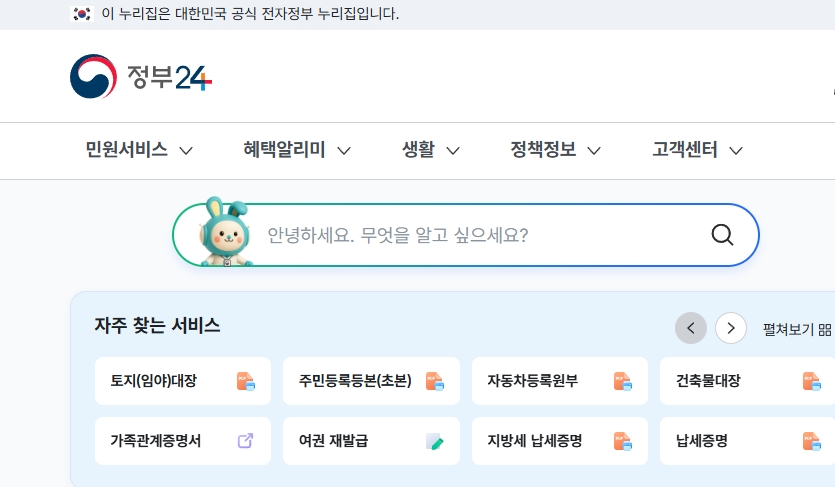
Government24 provides information and access to many such services. Family-record certificates are issued through the courts’ electronic family-registration system, while tax services also have specialist channels. There are several connected routes rather than one website that completes every government task.
| Everyday document | Official processing guidance | Online cost |
|---|---|---|
| Resident-registration certificate: registered address and household information | Immediate, defined as within three working hours | Free |
| Family-registration certificates, including family and marriage records | Immediate | Free |
| Certificate of foreign-resident registration | Immediate, within three working hours | Free |
| Income certificate for income already recorded for taxation | Immediate, within three working hours | Free |
“Immediate” is an administrative category, not a claim that every applicant waits three hours. Automated certificates can be issued promptly after authentication; services needing a staff member’s confirmation follow their own working arrangements. An income certificate also proves existing tax information. It does not mean a tax refund or a disputed assessment will be resolved immediately.
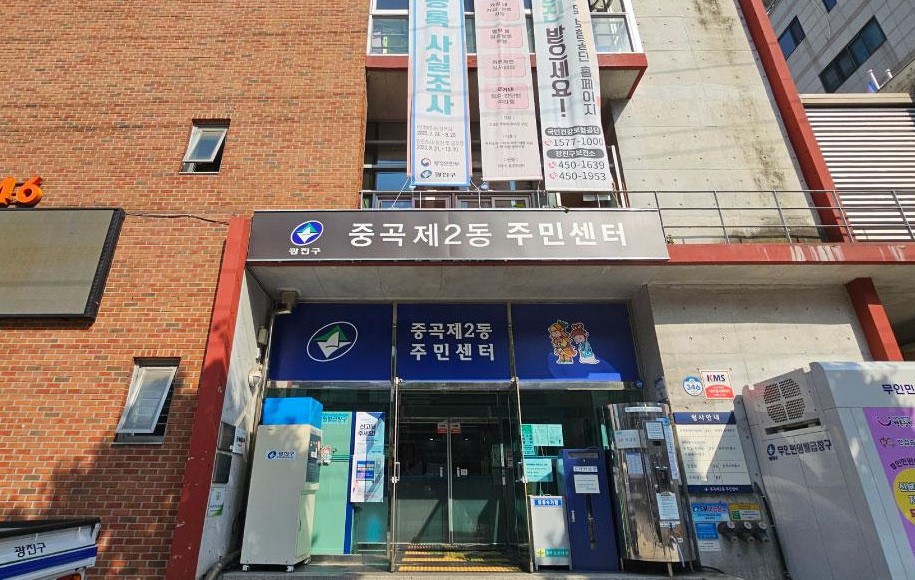
For someone who prefers a counter, neighborhood administrative welfare centers (행정복지센터), also commonly called community service centers (주민센터), provide another route for many routine documents. Some certificates are also available from self-service kiosks, subject to the machine’s supported documents, identification requirements, and opening hours.
Practical tip: Ask the receiving institution for the exact document name before applying. A family-relationship certificate and a marriage-relationship certificate answer different questions. Getting the wrong certificate quickly still means doing the errand twice.
How Everyday Paperwork Compares Abroad
The useful comparison is what happens after you click “apply.” An online service may let you order a paper document that arrives later, or it may issue a usable electronic record directly. Both are digital services, but they occupy very different amounts of your week.
| Place and example | Published service arrangement |
|---|---|
| South Korea: common resident- and family-registration certificates | Immediate-issuance services with free online issuance for eligible applicants. |
| England and Wales: General Register Office certificate copies | Standard certificates are sent four days after application; without the index reference number, dispatch is after 15 working days. Delivery comes afterward. |
| New York City: online birth- and death-certificate orders | The Health Department’s guidance allows two to three weeks for processing, with additional time for regular-mail delivery. |
| Berlin: residence-registration certificate | Immediate when requested online or in person; one to two weeks when requested by post. |
| Japan: supported municipal certificates | My Number Card holders can obtain supported documents from convenience-store machines. Hiroshima’s residence-certificate service operates from 6:30 a.m. to 11 p.m., subject to service availability. |
| Taiwan: electronic household-registration transcripts | Eligible users can authenticate, download or print records, and have their authenticity verified online. |
These documents have different legal functions, and the figures describe particular services and channels, not national averages. New York’s times also vary by record type and application route. Still, the lifestyle difference is easy to recognize: having a certificate available directly can remove the need to keep checking the mailbox.
Berlin, Japan, and Taiwan also show that convenient administration is widespread beyond Korea. The strongest case for Korea lies in how its familiar online certificates, local counters, and electronic submission options fit into ordinary life.
A Passport in Eight Working Days?
A passport provides a closer comparison because each country must check an application and produce a secure travel document. Korea’s application form, revised in June 2026, gives a usual domestic period of eight working days from application to collection, while allowing for delays when demand rises.
| Country or locality | Ordinary domestic passport guidance | What the period covers |
|---|---|---|
| South Korea | Usually eight working days | Application to collection; demand can cause delays. |
| United States | Four to six weeks | Processing only. Mailing the application and receiving the passport take additional time. |
| United Kingdom | Usually within three weeks | Domestic receipt; further information or an interview can extend the period. |
| Berlin, Germany | Up to eight weeks | Local ordinary-service guidance. Express service is generally four working days under its stated conditions. |
| Japan | Usually around two weeks, excluding weekends and holidays | Domestic receipt guidance; applicants should check their individual collection date. |
| China | Within seven working days when applying in the household-registration locality | Approval, issuance, and production. Cross-province applications have a 20-day guidance period; delivery is separate. |
| Taiwan | Ten working days | Standard processing for a new passport; paid expedited options are available. |
The comparison reflects official guidance checked for October 2026, rather than a timed experiment. Each row concerns that country’s own citizens applying domestically. The agencies also count different stages, so the table should guide expectations rather than produce a precise speed ranking.
Even with those qualifications, the difference between Korea’s eight working days and the United States’ four to six weeks of processing is substantial for someone planning travel. China’s and Taiwan’s guidance also places Korea within a broader group of relatively quick Asian services.
Ppalli-Ppalli Meets Digital Government
Ppalli-ppalli, meaning “quickly, quickly,” is one of the expressions foreigners soon encounter when learning about Korea. In public services, it offers a useful way to understand the expectation of a prompt response and an errand brought to completion.
Korea’s rapid economic and social transformation provides part of the background. Sociologist Kyung-Sup Chang’s concept of “compressed modernity” describes changes concentrated into a short period. In everyday terms, people had to adapt quickly as workplaces, cities, family life, and technology changed around them.
A reasonable interpretation is that this experience helped strengthen the value placed on getting things done, while convenient digital services raised expectations further. Culture alone cannot explain an issuance time, however. A clerk’s willingness to work quickly has limits if records sit in separate files or every application requires a new manual check.
The system behind the speed
Korea’s practical advantages include standardized records, digital identification, cooperation between agencies, and sustained investment in online government. Where legal conditions and consent requirements permit, an institution can check existing information instead of making an applicant carry another certificate between offices.
The electronic document wallet extends that convenience beyond issuance. Supported certificates can be stored, viewed, and transmitted to participating recipients. As of October 2026, its official guidance lists 487 electronic certificate types, with 98 available for application through participating private apps. Availability differs by app and document.
This infrastructure has international recognition. The OECD’s 2026 Digital Government Outlook reports Korea’s score of 0.95 in the 2025 Digital Government Index, against an OECD average of 0.70. The index evaluates digital-government foundations and practices; it does not measure how many minutes everyone spends at a counter.
The everyday benefit is more concrete than any index: fewer journeys, fewer repeated explanations, and fewer documents to print, scan, and deliver.
Public Servants and Public Expectations
The Korean term gongbok means a public servant, with the underlying idea of service to the public. It describes a responsibility attached to public employment. An official earns a salary, but exercises authority and handles information on behalf of the community.
That principle appears explicitly in Article 7 of Korea’s Constitution:
“All public officials shall be servants of the entire people and shall be responsible to the people.”
Read alongside Article 1, which places sovereignty with the people, it supports a democratic understanding of public institutions: their authority comes with an obligation to serve and explain. Obtaining a document is a routine exercise of an entitlement under the applicable rules. The applicant should be able to understand the requirements, fees, and expected period.
There are formal response expectations, too. Under Korea’s civil-petition rules, questions about systems and procedures generally have a seven-day deadline, while questions requesting legal explanation or interpretation have a 14-day deadline, unless special reasons apply. The statutory calculation excludes Saturdays and public holidays. A reply within that period does not necessarily complete a permit, refund, or dispute.
Public-service ideals also exist elsewhere. Japan’s Constitution describes officials as serving the whole community, and Britain’s Civil Service Code emphasizes public-service obligations. Korea’s speed therefore needs both the ideal and the practical arrangements that make it possible.
For daily life, the implication is simple: people’s time matters. Clear instructions and a usable answer can be as valuable as a fast certificate. Serving the whole public also requires fairness, so an individual demand cannot automatically override everyone else’s rights or the rules.
Cooperation, Community, and the Right to Disagree
The pandemic made this relationship unusually visible abroad. Some commentary explained Korean cooperation with public-health measures through Confucian hierarchy or a supposedly unquestioning attitude toward authority. That explanation leaves out much of modern Korean society.
Research on Korea’s pandemic response has challenged the assumption that deference or uniformly high trust supplied an easy foundation for cooperation. Political disagreement and distrust were part of the setting. A 2021 study also found that political trust reflected both people’s evaluations of the response and their existing democratic values.
A useful interpretation is that people can cooperate because they see a shared problem requiring collective action. Public-health coordination can protect parents, coworkers, neighbors, and strangers. Participation may express confidence in a particular response, concern for others, a sense of obligation, or several motives at once.
From this perspective, national and local institutions represent ways for a community to organize tasks that individuals cannot manage alone. Their purpose is tied to shared welfare. Helping a public institution carry out a useful task can therefore be understood as helping the community of which the individual is part.
That is a way of interpreting civic behavior, rather than a belief shared identically by every Korean. Pandemic policy also involved enforceable rules, pressure, privacy concerns, unequal burdens, and opposition. Cooperation should never be treated as proof that everyone freely agreed with every measure.
Korea’s history of democratization and public protest belongs in the picture. A person can support a practical public-health measure and criticize the government’s other decisions. The same concern for the public interest can motivate participation, a complaint, or a demand that officials change course.
For a foreign reader, this helps explain how demanding public expectations and willingness to cooperate can coexist. A reciprocal relationship is possible: institutions are expected to act competently and fairly, while people may contribute when collective action appears useful and justified. Trust has to be maintained through performance and accountability.
Why Korean Visas Follow a Different Timeline
Visa applications are where expectations about fast Korean paperwork most need adjusting. Issuing evidence of an existing registration is different from deciding whether someone qualifies to enter, work, study, or remain in the country.
Korean visa periods depend on the responsible consulate, visa category, nationality, documents, and any further checks. Appointment availability and postal delivery can add time outside the stated processing period. Always use the instructions of the office handling the application.
There are relatively quick examples. The Korean Embassy’s notice for the visa application center that opened in Singapore in September 2026 gives a general period of eight working days for accepted applications other than marriage-immigration visas, which take at least 11 working days. Additional verification can extend either period, and submission requires an appointment. That is guidance for one application location, not a deadline applying to every Korean visa worldwide.
Other countries illustrate how much the task matters. Japan’s published guidance allows five working days from the day after receipt for an application without problems. Britain’s overseas Standard Visitor guidance is three weeks, counted from the specified identity-verification stage. A Schengen short-stay visa normally takes 15 calendar days, extendable to 45 for further examination. These are different processes, not a universal league table.
For Korea, online access to a visa result or an issuance notice can make the final step convenient. It says little about how long the preceding decision took. A foreign-resident registration certificate similarly proves an existing record; it does not create a new residence status or make a physical residence card appear immediately.
Using Korean Public Services as a Foreign Resident
The system can feel different before you have established your digital identity. A resident with accepted authentication ready to use may complete a task easily, while a newcomer spends much longer identifying the correct service or passing the login stage. Language, eligibility, and authentication are part of the real service experience.
Can foreigners use Government24?
Some services are available to foreign residents, including online self-application for a certificate of foreign-resident registration. Eligibility and accepted authentication differ by service. A nonmember application option can still require identity verification, and a tourist should not assume access to documents intended for registered residents.
Which document should you request?
Get the exact name from the organization requesting it. A Korean resident-registration certificate and a foreign-resident registration certificate are different documents. Some foreign nationals appear in particular resident-registration records, but the certificate is not interchangeable for everyone.
- Check the document’s contents: Ask whether a general or detailed version is needed and which personal information must appear.
- Check the submission method: A verified electronic certificate sent through an accepted channel is different from a screenshot.
- Check overseas requirements early: An English version, translation, authentication, or apostille may be required by the receiving organization.
- Check the clock: Online submission outside office hours does not mean a staff-reviewed application will be completed then.
- Check before visiting: Immigration and visa procedures can require an appointment, even when routine certificate services use simpler access arrangements.
Where can you get language help?
The Immigration Contact Center at 1345 provides multilingual guidance on immigration and foreign-resident matters. It operates on weekdays from 9 a.m. to 10 p.m., excluding public holidays; after 6 p.m., consultation is limited to Korean, English, and Chinese. Its services also include three-way interpretation for relevant administrative matters.
For anyone trying to reduce an errand to a manageable interruption, a little preparation matters. Confirm the document, arrange authentication, and find the accepted delivery route. Then the convenience Korea has built into routine paperwork has a much better chance of reaching you.
Explore More of Korea’s Everyday Culture
Public services offer one window into Korean life. Language, literature, landscapes, food, and wellness reveal other ways that history and everyday habits meet.
- Hangeul Day and the Voices Hidden in Old Books
- Bamseom Island in Seoul: From Explosion to Ramsar Wetland
- Mudeungsan Watermelon (Puraengi): Korea’s $200 Giant Fruit
- 5 Famous Korean Poets & Must-Read Translated Books
- Korean Functional Cosmetics: Ingredients, Science & Side Effects
- What Is Korean Boknal? Korea’s Hottest Summer Days Explained
- Yi-Yeol-Chi-Yeol: Inside Korea’s Traditional Hanjeungmak Kilns
- Best Korean Literature in English: A Guide Beyond Han Kang
Korean Culture portal KCulture.com

Founder of Kculture.com and MA in Political Science. He shares deep academic and local insights to provide an authentic perspective on Korean history and society.