Onggi (옹기) is South Korea’s traditional “breathing” earthenware, a unique ceramic vessel fired at 1,100–1,200°C with a natural ash glaze that creates microscopic pores, allowing the pot to regulate airflow and humidity for perfect fermentation. For centuries, these jars have served as the essential foundation of Korean cuisine, providing the ideal environment for fermenting kimchi, doenjang (soybean paste), and ganjang (soy sauce). Many who encounter traditional Korean food wonder how its deep, complex flavors are created; the secret lies not just in the ingredients, but in the living, breathing clay of these traditional pots. This article explores the extensive historical records of Onggi, the measurable science behind its porous structure, the meticulous traditional crafting process, and why premium food artisans still rely on this ancient technology rather than modern refrigeration.
- What Is Korean Onggi?
- The History of Onggi: Written in Royal Records
- The Science of Breathing Clay: Onggi vs. Porcelain
- How Traditional Onggi Is Made: From Clay to Kiln
- The Jangdokdae: Korea’s Outdoor Fermentation System
- Modern Survival: Onggi vs. The Kimchi Refrigerator
- Where to Experience Onggi in Korea Today
- FAQ
- Explore More of Korea’s Traditional Heritage
What Is Korean Onggi?
While often translated simply as “Korean pottery,” Onggi is a broad category of traditional earthenware designed specifically for practical household use, storage, and fermentation. The Korean word ong (옹) refers to a large earthenware vessel, and the full term encompasses a wide family of clay vessels.
Depending on their size and purpose, these vessels are categorized into danji (small jars), hangari (medium-sized jars), and dok (large jars). Unlike decorative ceramics made exclusively for display, Onggi was engineered as practical infrastructure for survival. It functioned as a food-preservation system that combined earth, fire, microorganisms, and seasonal weather to sustain households between harvests. Today, the traditional craft of making these vessels, known as Onggijang, is recognized as a National Intangible Cultural Heritage.
The History of Onggi: Written in Royal Records
The story of Onggi in Korea goes back much further than most assume, and unusually for an everyday craft, its production is thoroughly documented in official state records.
Prehistoric Origins and the Three Kingdoms
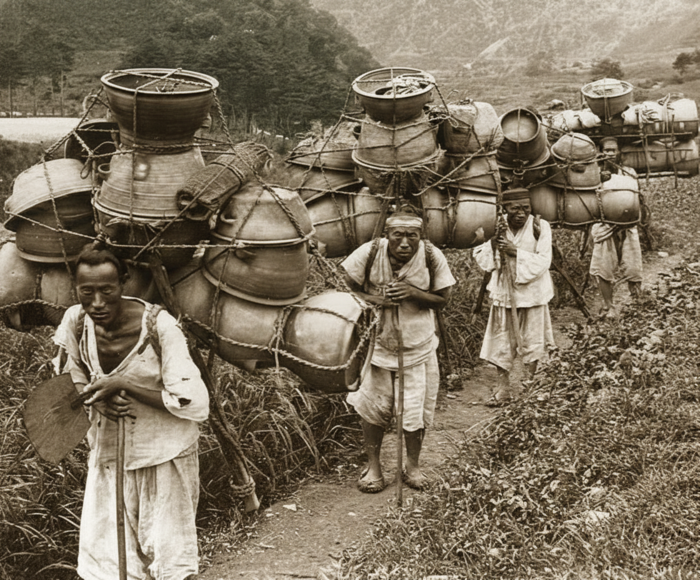
Large unglazed storage jars were essential on the Korean Peninsula dating back to prehistoric times. Wall paintings in the Goguryeo dynasty’s Anak Tomb No. 3 clearly depict rows of large and small storage jars used in daily life. Historical records and archaeological evidence from the Baekje and Silla kingdoms also describe large pottery vessels used for storing commodities like rice, liquor, oil, and salted seafood.
The Goryeo Dynasty: Observations of a Foreign Envoy
One of the most revealing descriptions comes from the early 12th century. The Song Chinese envoy Xu Jing recorded his observations in the Gaoli Tujing (Illustrated Account of Goryeo), noting that large vessels were used across the kingdom for storing rice, fermented sauces, vinegar, and water. This historical account was recently corroborated by the discovery of a Goryeo-era shipwreck off the coast of Mado, Taean, which contained large ceramic jars that had been carrying salted seafood and water.
Joseon Dynasty: A State-Managed Industry
During the Joseon Dynasty, Onggi production became a highly organized, state-managed industry. The Sejong Sillok Jiriji (세종실록 지리지), a geographical treatise compiled in 1454, records kilns dedicated specifically to firing hwangong (yellow earthenware) in the Chogye and Jinju regions of Gyeongsang Province.
Even more remarkable is the Gyeongguk Daejeon (경국대전), the supreme code of law completed in 1485. This document records that exactly 104 master Onggi potters were formally attached to 14 central government offices. This level of institutional support highlights that Onggi was not merely a rustic craft, but an absolute necessity for royal culinary practices and state rituals—managed with the same meticulous care as the royal musical instruments detailed in The Acoustic Philosophy of Joseon.
The Science of Breathing Clay: Onggi vs. Porcelain
For visitors encountering Korean ceramics for the first time, it is easy to lump Onggi together with celadon (Cheongja) and white porcelain (Baekja). However, from a scientific standpoint, they serve completely different functions. Porcelain is fired to near-total vitrification, sealing the clay body tightly to block both water and air. Onggi, on the other hand, is defined by its microporosity (미세 기공).
| Material / Vessel | Physical Characteristics | Primary Function in Korea |
|---|---|---|
| Traditional Onggi | Microscopic pores (1 to 100 micrometers) allow gas exchange without liquid leakage. Low thermal conductivity. | Long-term fermentation (Kimchi, Doenjang) and outdoor food storage. |
| Celadon / Porcelain | Highly vitrified, dense, and essentially non-porous. Blocks both air and water completely. | Fine tableware, royal dining, ritual vessels, and decorative art. |
| Modern Plastic / Glass | Non-porous, chemically stable, lightweight. Traps fermentation gases inside. | Convenient, short-term indoor food storage. |
Modern materials science has proven that the “breathing vessel” concept is a measurable physical phenomenon. Electron microscopes reveal that the walls of Onggi contain pores ranging from 1 to 100 micrometers. These pores are large enough to let carbon dioxide (a byproduct of fermentation) escape, but too small for liquid water to seep through.
This selective permeability is crucial. If fermenting foods are sealed in airtight plastic or glass containers, gases build up, potentially causing off-flavors, souring, or even bursting. Onggi acts as a passive pressure-release system, maintaining a steady, moderate environment where beneficial lactic acid bacteria can thrive while spoilage is suppressed.
How Traditional Onggi Is Made: From Clay to Kiln
Creating a vessel that successfully balances waterproofing with gas permeability requires an incredibly controlled traditional crafting sequence.
1. Clay Preparation and Taerimjil
The process begins with soft clay containing about 29% moisture. Instead of throwing a lump on a wheel, artisans roll the clay into thick, long coils and stack them spirally to build the vessel wall. This is followed by a technique called Taerimjil (타림질). The potter rhythmicly strikes the inner wall with a wooden anvil (도개) and the outer wall with a wooden paddle (수레) to compress the clay, eliminate air pockets, and thin the walls evenly. This paddling gives the large vessels their immense structural strength.
2. The Essential Natural Ash Glaze
Traditional Onggi must be coated in Jaemul yuyak (재물유약), a 100% natural ash glaze. This glaze is created by mixing the fine ash of burned pine needles, bean pods, and silvergrass with leaf mold or loess-like soil in equal parts with water.
📌 Local Note: In modern times, some mass-produced pots use chemical glazes containing red lead (Gwangmyeongdan) to achieve a quick, glossy finish. However, these chemical glazes completely seal the clay’s pores, destroying its ability to breathe. True artisanal Onggi relies solely on natural ash glaze, resulting in a duller, more organic, matte-to-satin finish.
3. Staged Firing in the Kiln
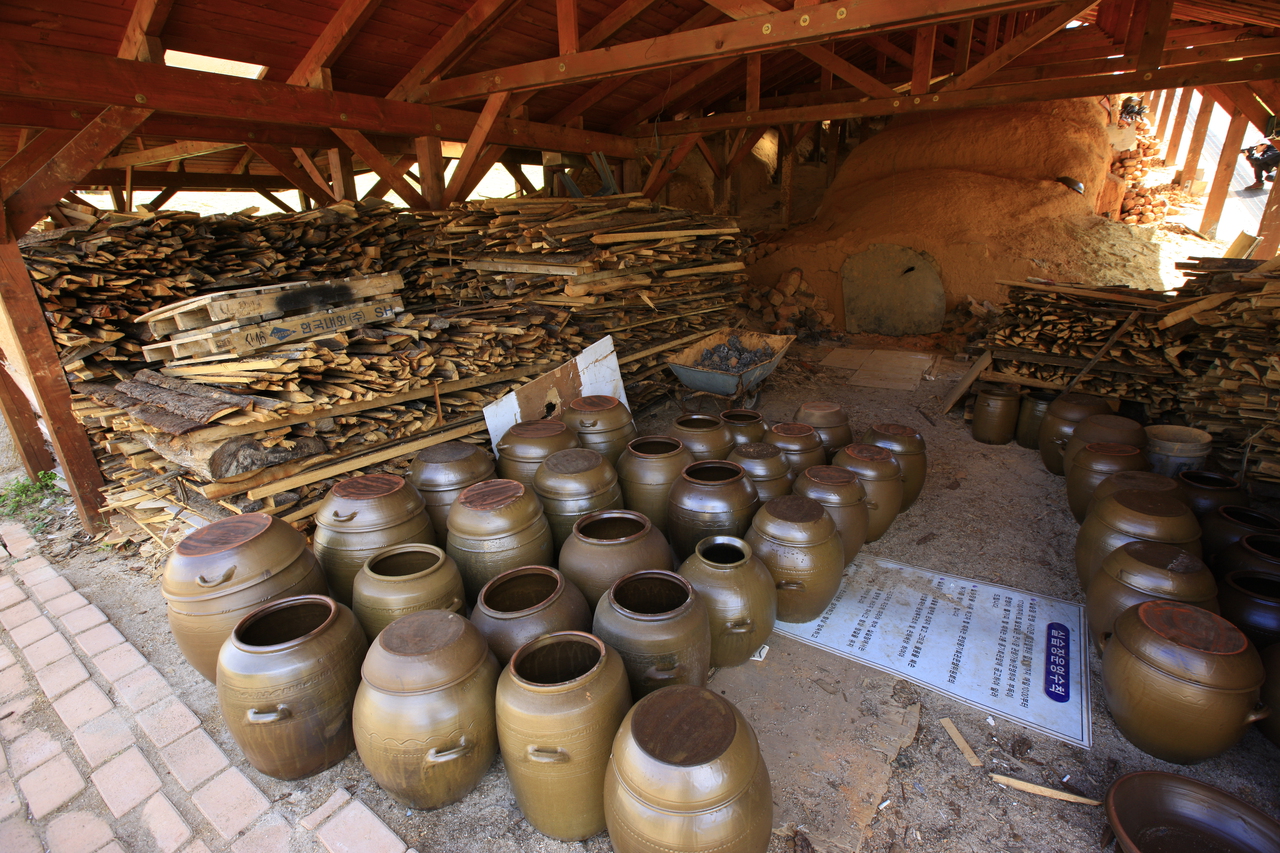
Firing happens in stages inside a traditional climbing kiln. The artisan begins with a low heat under 200°C, known as Piumbul (피움불), to slowly draw out remaining moisture. Over several days, the temperature is steadily increased to a blazing 1,100–1,200°C, a stage known as Dareumbul (달음불). This precise heat curve burns away organic matter inside the clay, leaving behind the crucial network of microscopic pores.
The Jangdokdae: Korea’s Outdoor Fermentation System
Traditional Korean cuisine relies heavily on fermentation to transform seasonal agricultural resources into long-lasting foods. The vessel itself is not merely an inert container; it is an active participant in the recipe.
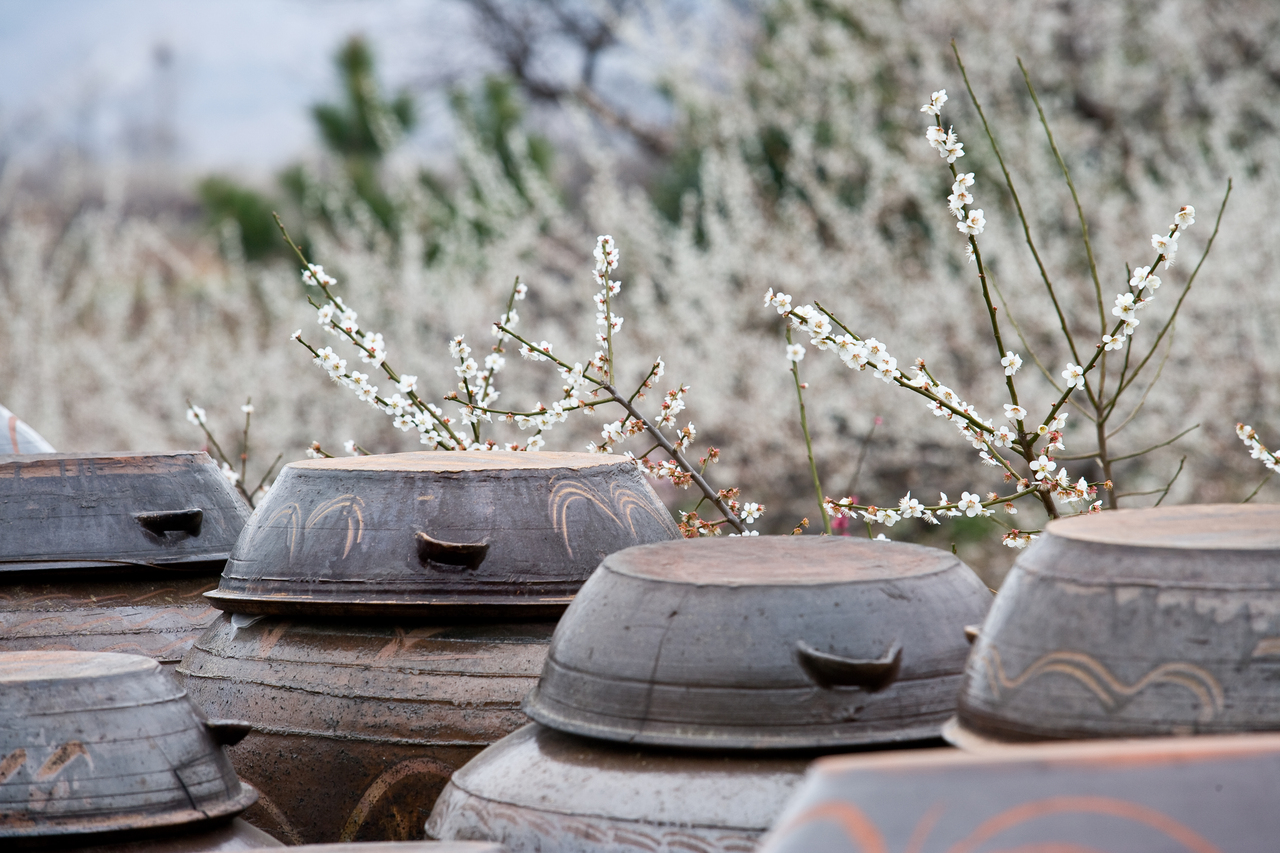
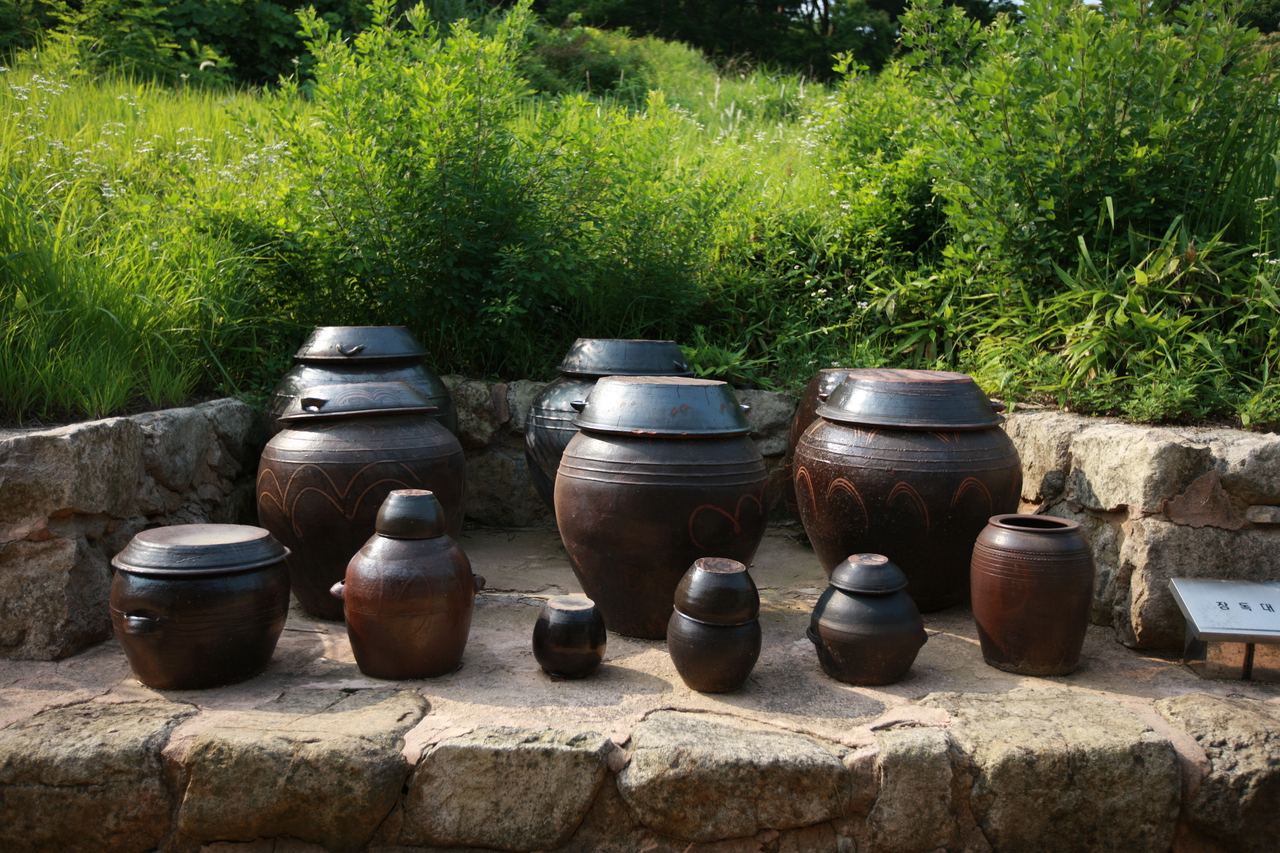
Behind traditional Korean homes, temples, and countryside restaurants, you will find the Jangdokdae (장독대)—an elevated outdoor terrace dedicated entirely to arranging dozens of Onggi jars. To a modern observer, this might look like simple outdoor storage, but it functioned as an advanced outdoor food-processing facility.
The jars were meticulously positioned to catch the sun and the wind. The low thermal conductivity of the thick clay walls protected the fermenting soybean paste (Doenjang) and soy sauce (Ganjang) from freezing in the winter and overheating in the summer. Generations of accumulated experience dictated exactly where to place the jars, when to open the lids to sunlight, and how to manage the seasonal fermentation cycles.
Modern Survival: Onggi vs. The Kimchi Refrigerator
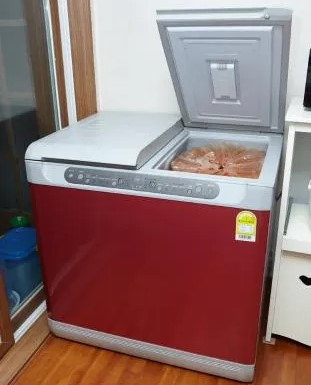
In modern South Korea, the everyday use of large clay pots in urban homes has drastically declined. The shift to high-rise apartment living eliminated the outdoor space required for a Jangdokdae. In response, Korean technology companies engineered the “Kimchi Refrigerator”—a highly advanced appliance designed specifically to replicate the stable, cold temperature environment that buried Onggi jars once provided.
However, while kimchi refrigerators have largely replaced Onggi for everyday household storage, they have not replaced it for artisanal fermentation.
A refrigerator is designed to halt or vastly slow down maturation, preserving food at a static temperature. But premium traditional food masters and Buddhist temples require natural maturation. Deep, complex flavor profiles—such as a soy sauce aged for three years—demand the passage of time, the fluctuating warmth of the sun, and the continuous oxygen exchange provided by breathing clay. For these producers, the natural Onggi vessel remains entirely irreplaceable.
Where to Experience Onggi in Korea Today
For those interested in witnessing this traditional craft firsthand, there are dedicated cultural hubs in Korea where the art of Onggi remains highly active.
- Oegosan Onggi Village (외고산 옹기마을): Located in Ulsan, this is Korea’s largest surviving Onggi-producing community. Visitors can explore working traditional kilns, visit the dedicated Onggi museum, and participate in hands-on pottery making experiences.
- Icheon Ceramics Village: While globally famous for its exquisite celadon and porcelain, Icheon also hosts master craftsmen who continue to demonstrate traditional Onggi techniques, making it an excellent destination for understanding the full spectrum of Korean ceramic history.
FAQ
Is Onggi the same as regular Korean pottery?
No. “Onggi” refers specifically to high-fired earthenware coated in a natural ash glaze that preserves microscopic pores in the clay. It is fundamentally different from fully vitrified, non-porous ceramics like celadon and white porcelain used for tableware.
Why is Onggi called a “breathing” pot?
During the high-temperature firing process, organic particles in the clay burn away, leaving microscopic pores (1 to 100 micrometers in size). These pores are small enough to block liquid water from leaking out, but large enough to allow gases (like carbon dioxide from fermentation) to escape and oxygen to slowly diffuse in.
Can I use Onggi for making Kimchi at home?
Yes. Many people still use smaller Onggi crocks for the initial, active fermentation stage of Kimchi at room temperature. Once the Kimchi reaches the desired sourness, it is typically transferred to modern containers and placed in a Kimchi refrigerator to slow down further fermentation.
Explore More of Korea’s Traditional Heritage
The philosophy of integrating natural materials into daily life extends far beyond pottery in Korean culture. To dive deeper into the history, arts, and spiritual heritage of Korea, explore these fascinating topics:
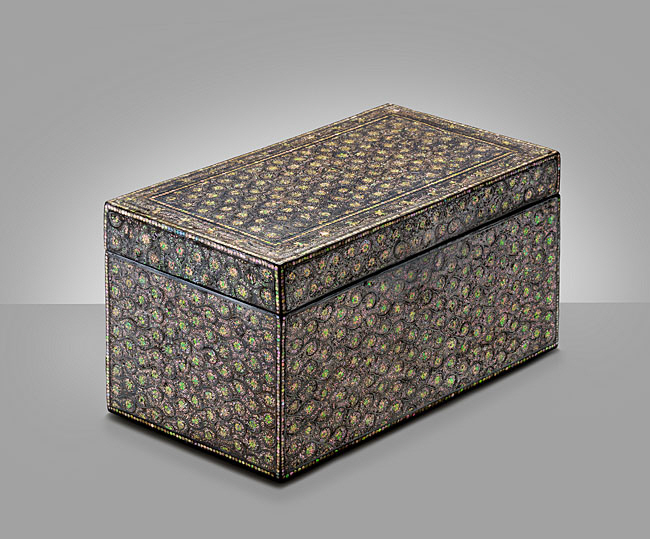
- Najeonchilgi: The Art of Korean Mother of Pearl Lacquerware
- History of Modern Korean Traditional Painting & Masters
- Goryeo Buddhist Paintings: Korea’s Rarest Art Treasures
- Pansori Five Epics: Guide to Korea’s Masterpiece Storytelling
- Traditional Korean Fans: History, Art, and Cultural Meaning
- Understanding Muninhwa and Korea’s Scholar Artists
- The Real Sword of K-Pop Demon Hunters: Saingeom History
Korean Culture portal KCulture.com

Founder of Kculture.com and MA in Political Science. He shares deep academic and local insights to provide an authentic perspective on Korean history and society.